


Restoration company lead generation works best when a local contractor targets property managers who control vendor approval, rather than every building owner in reach. A strong prospect has sites inside your service area, a clear route for approving emergency vendors, and a practical reason to review coverage before damage occurs.
A loss may need stabilization, drying, contents work or repairs. Decide what your crew performs, where a partner is needed and who authorizes each stage. The B2B lead generation basics cover the general process; here the focus is a credible restoration partner pipeline.
Key takeaways
- Target property managers who can explain vendor approval, site access and who authorizes work across the buildings they oversee.
- Separate urgent mitigation from contents work and later repairs so a prospect understands the scope your crew can actually accept.
- Qualify service boundaries, staffed response windows, credentials and documentation before asking for a place on a vendor list.
- Write outreach around a verified coverage area and one useful question, without implying the property has suffered a loss.
Which property management buyers should you approach?
Section titled: Which property management buyers should you approach?Start with property managers who oversee several buildings or a defined portfolio and can describe how outside restoration vendors are reviewed. A property record alone does not show who can authorize access, appoint a contractor or approve a repair plan.
- Portfolio or regional manager: This role can explain which buildings share a vendor process, who approves emergency attendance and whether owners must sign off before mitigation or reinstatement begins.
- Building or facilities manager: A site lead often knows access rules, plant-room restrictions, tenant communication steps and the records needed after a loss. They may shape the scope even when another person approves the supplier.
- Vendor or procurement coordinator: Ask this contact about onboarding, insurance documents, training records, call-out coverage and how a provider is added to the approved list. Do not assume the coordinator can authorize work at a damaged site.
Treat insurers and loss adjusters as part of the approval chain when the property manager describes that route, not as a substitute for finding the building-side decision maker.
Qualify a property account before enriching contacts
Section titled: Qualify a property account before enriching contactsA restoration lead is worth researching when the operating fit is clear and a real person can explain how the site would be referred or approved. Confirm the following before adding contacts.
- Service boundary: Map the places your crew can reach under normal and urgent conditions. State whether your coverage includes nights or weekends only when the team is actually staffed for those calls.
- Loss types and work stages: List the events and tasks your business handles, such as water extraction, structural drying, smoke or soot cleaning, contents packing, temporary protection, or repairs. Mark any stage that requires a partner or separate authorization.
- Site readiness: Find out whether access, keys, isolation of services, tenant notices and safe work areas are controlled by the property team. Occupied buildings may need containment, noise planning and clear updates before work starts.
- Proof and records: Keep current insurance, relevant training and credentials ready for the services you offer. Explain how your team records photographs, moisture readings, affected materials, contents movement and changes to the agreed scope.
- Approval route: Separate permission to inspect from permission to begin mitigation, remove contents or carry out repairs. Ask who can approve each stage and whether an owner or insurer must review the estimate.
If your company handles only water extraction and drying, present that narrower service clearly. The water damage lead generation guide covers that focused buyer angle; restoration providers with mixed-loss and repair capabilities should describe their broader scope without claiming every trade.
About the demo data
The operator label shown in this demo is London Building restoration service Services. The property management companies, contacts, messages and replies are fictional records for illustrating the workflow. They are not Anomalead customers, real restoration requests, confirmed vendor approvals or campaign results.
Build a prospect list around the buildings you can serve
Section titled: Build a prospect list around the buildings you can serveSet the search area from dispatch limits, equipment transport and disposal access. Keep the first list to property managers with buildings your team can reach and serve without stretching its capacity.
Treat company descriptions as clues, then verify the portfolio and building types. A “property management” label does not prove site fit or an active loss. The small-business lead finding process can organize discovery; your service criteria should decide which records merit attention.
Set the search to match your coverage
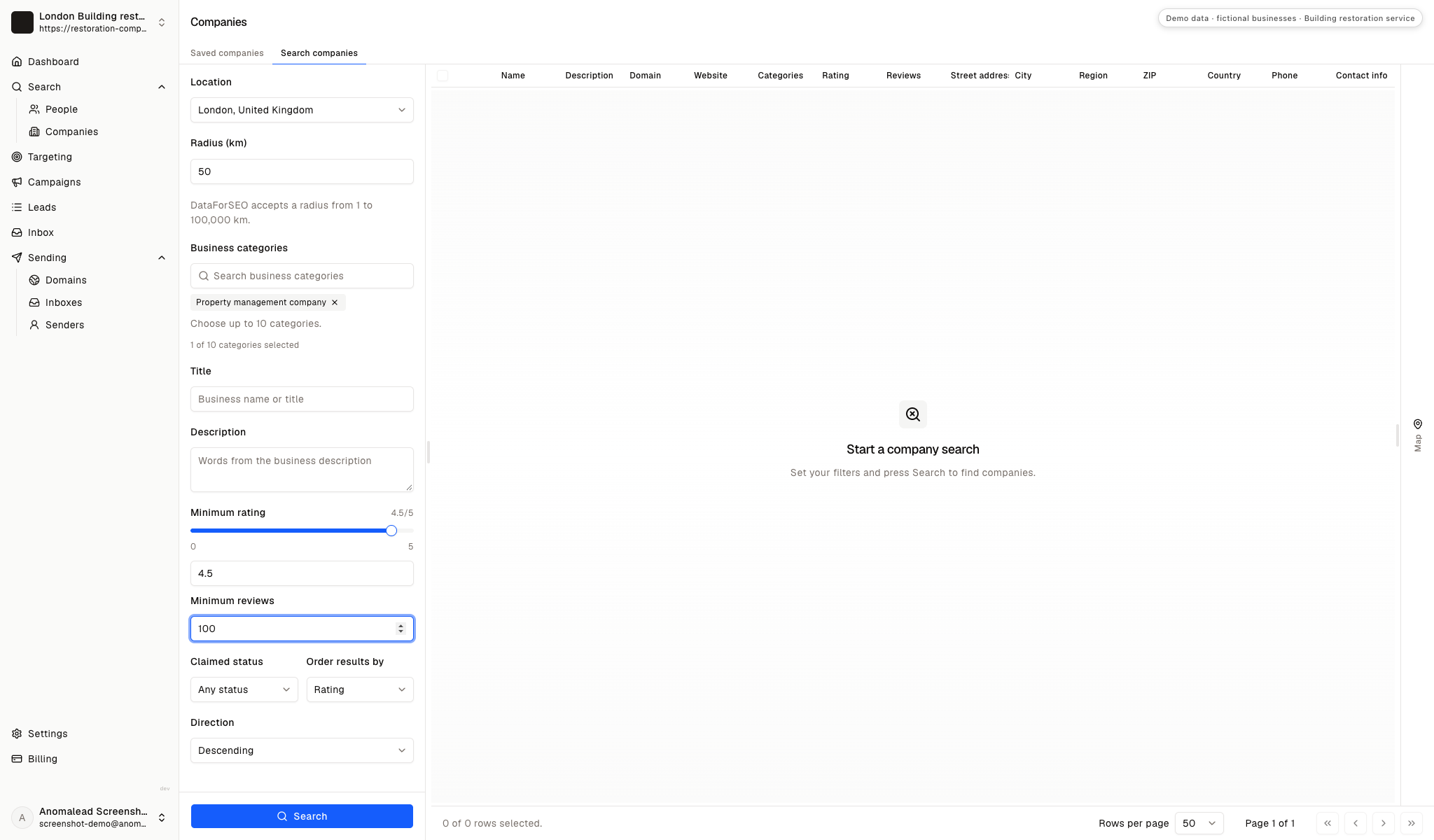
Section titled: Set the search to match your coverageThe search form uses a location, radius, company category and rating filter. Set these controls to your own practical service area and property-manager audience; a search filter cannot tell you whether a building has suffered damage or whether a vendor is approved.
Review the returned companies as candidates
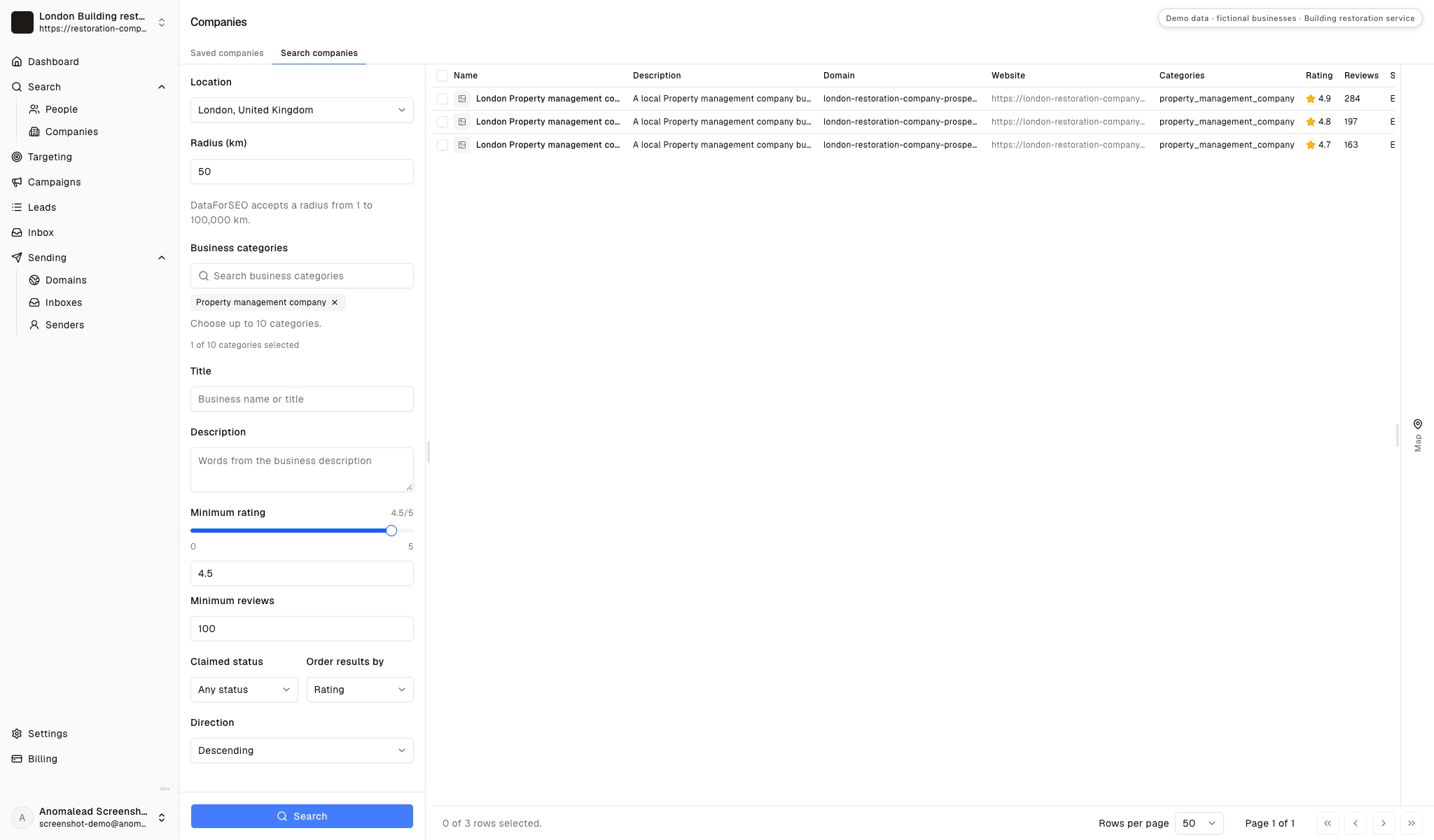
Section titled: Review the returned companies as candidatesCompare the listed organization and visible company details with the buildings your crew can reach. Confirm portfolio fit from information you can verify, then remove organizations whose work, location or decision route falls outside your offer.
Save only accounts with a credible fit
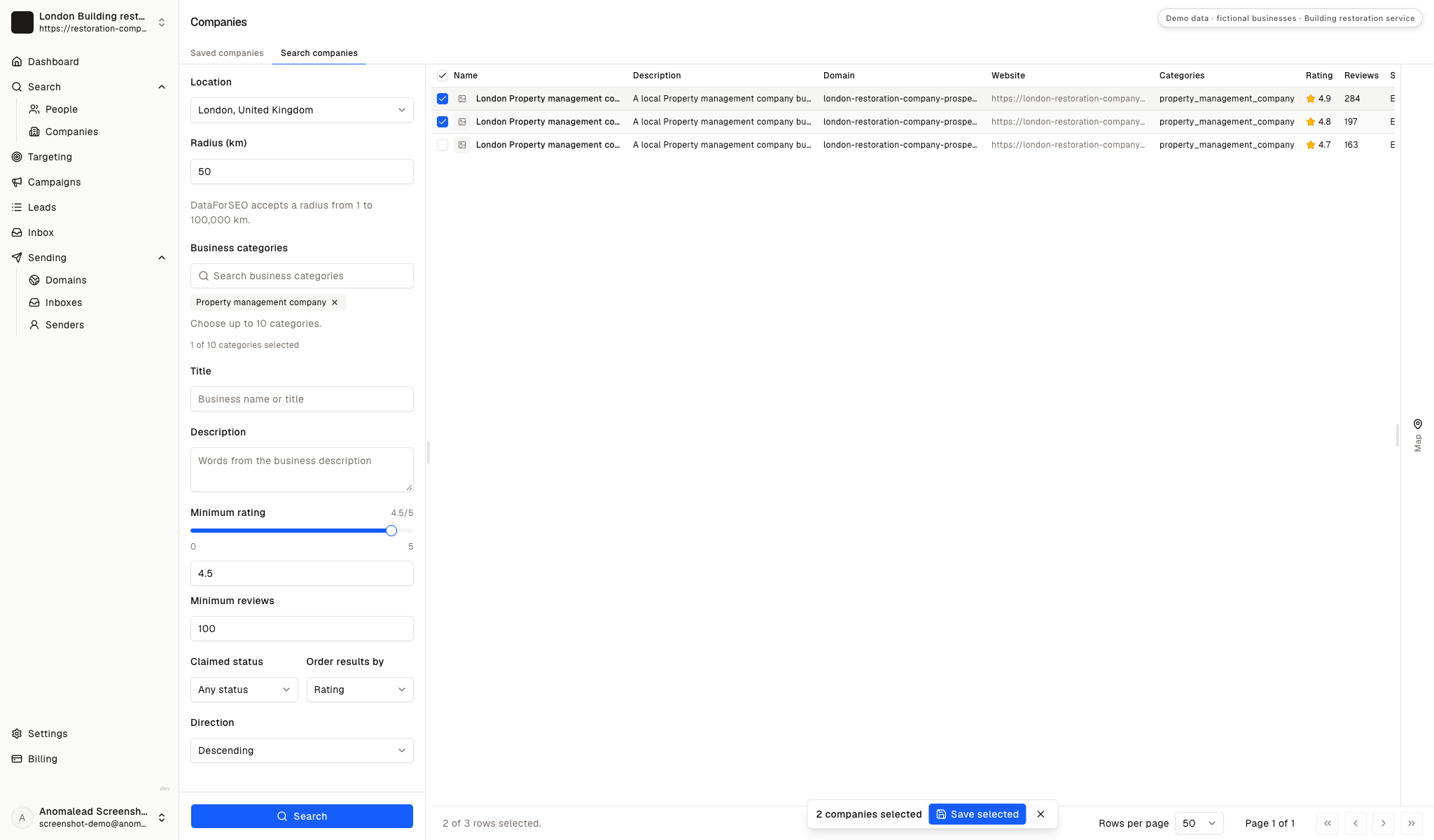
Section titled: Save only accounts with a credible fitThe demo selects two of the three listed companies for saving. Apply the same restraint to your own search: keep an account only when its property portfolio, service territory and likely vendor process justify further research.
Find the person who controls vendor readiness
Section titled: Find the person who controls vendor readinessChoose contacts by responsibility. A property manager may know approvals, a facilities lead controls access, and a vendor coordinator gathers credentials. An enriched title is a clue to verify, not proof that someone selects restoration providers.
Match the contact to your question. Learn which documents a formal vendor process needs, or start with the local manager who can nominate providers. A guessed job title is not consent to dispatch.
Recheck the account before finding contacts
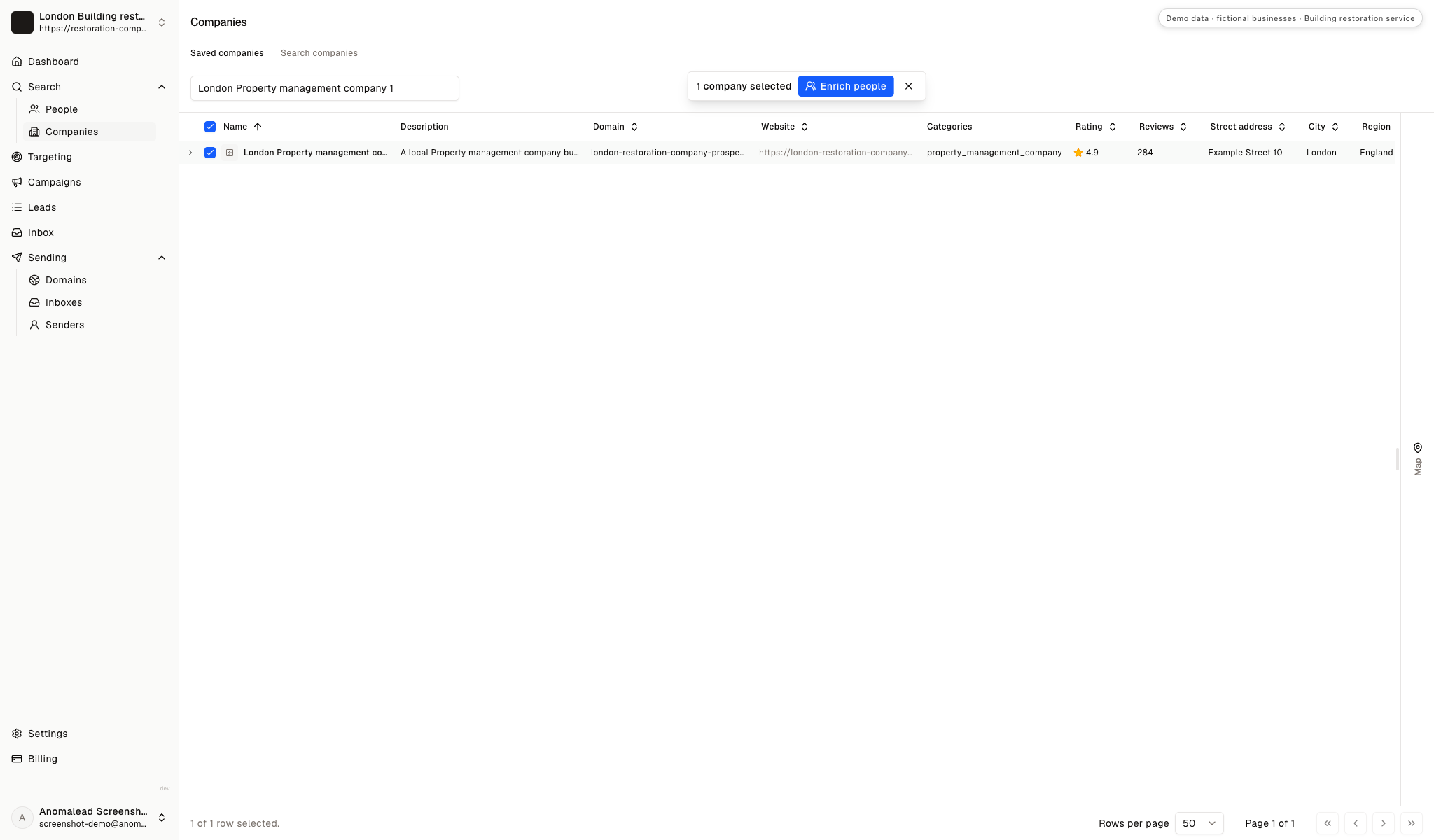
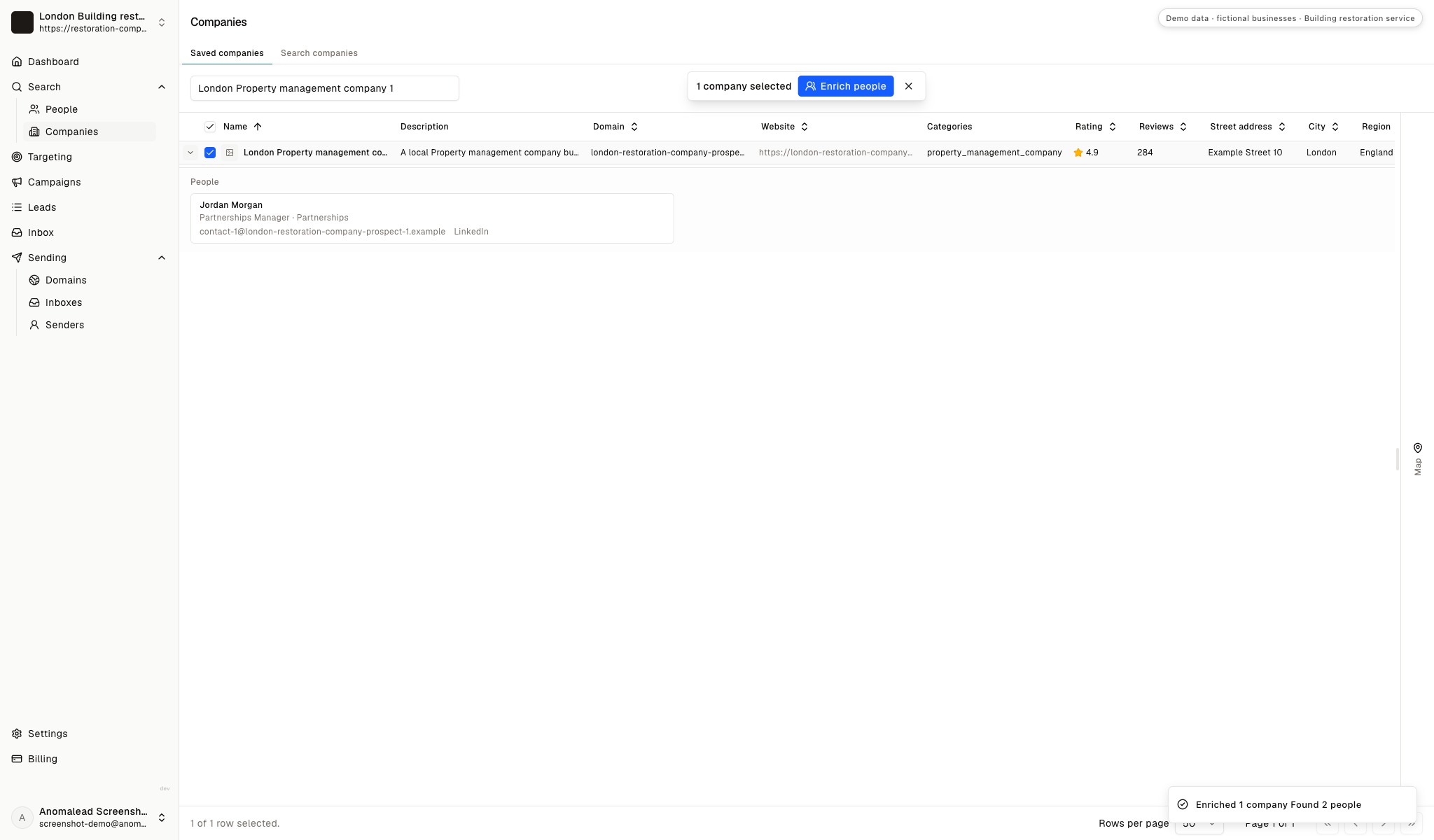
Section titled: Recheck the account before finding contactsThe saved-company screen lets you select an account before using Enrich people. Revisit the property fit and the likely vendor route first; contact discovery should deepen a relevant account, not rescue a weak one.
Compare contacts with the approval task
Section titled: Compare contacts with the approval taskThe enriched view includes two fictional contacts. Match each person’s role to the next decision: portfolio coverage, site access, vendor onboarding or estimate review. Do not assume a partnerships title means the contact can authorize emergency attendance.
Keep the working list tied to a next step
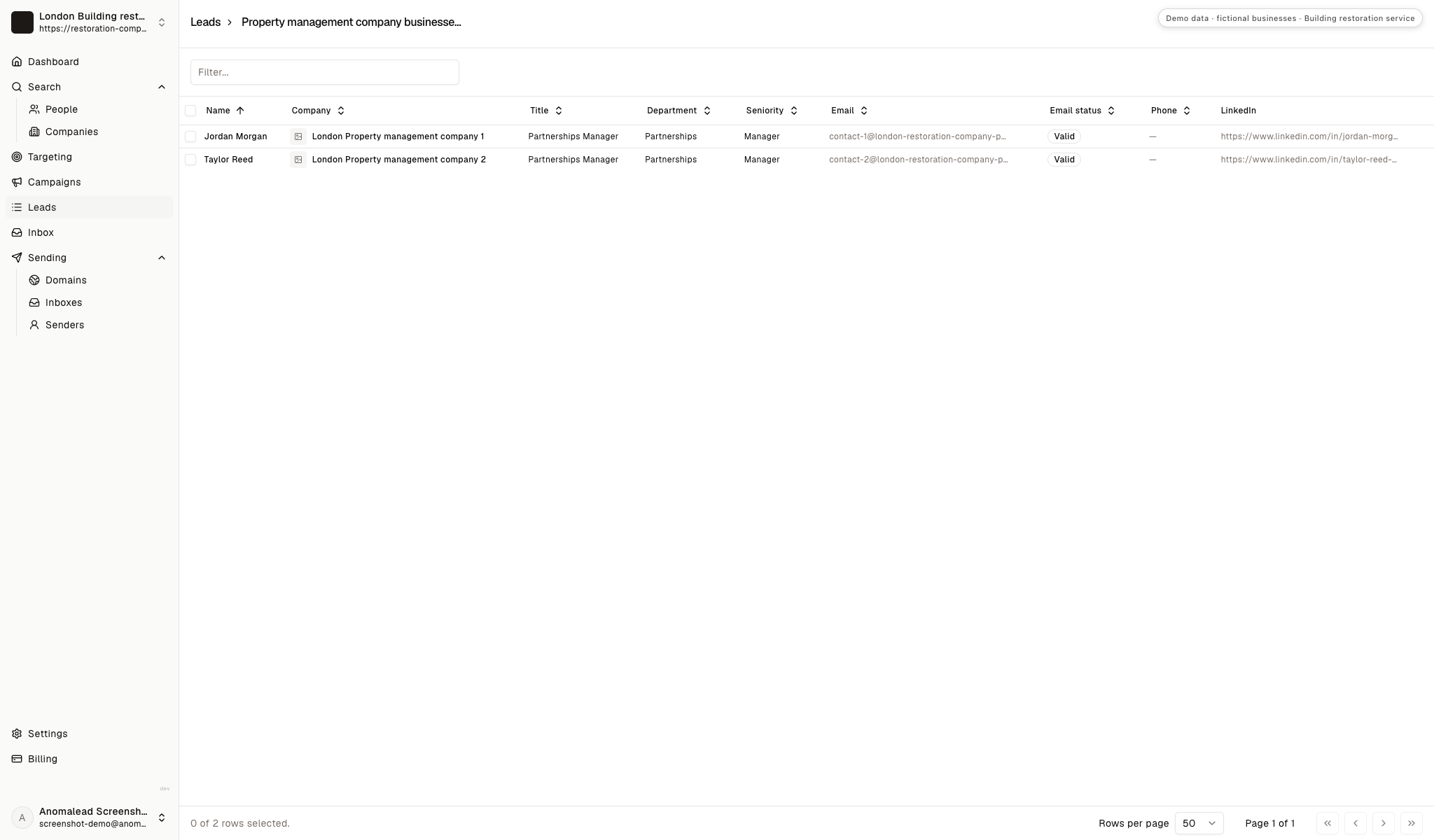
Section titled: Keep the working list tied to a next stepThe curated list contains two contacts for follow-up. Keep each entry only when the account belongs in your service area and the person can direct a specific question about coverage or vendor review.
Estimate the case for restoration company lead generation
Section titled: Estimate the case for restoration company lead generationA property-management relationship can span several buildings, but a vendor conversation is no promise of work. Weigh the account against your own capacity and job economics.
Enter your assumptions for a scoped job’s contribution, outreach and onboarding time, and the work your crew can accept. The calculator is a planning aid, not a prediction of incident frequency, insurer approval, awarded work or return.
Do the math on one good deal
If one new customer is worth thousands, you don’t need magic. You need a few more meetings a month.
Projected monthly results
- Deals closed
- 2.0
- Projected revenue
- £10,000
- Growth plan (1 business)
- £79/mo
- ROI
- 12,558%
Conservative math on meetings you already believe you can book. One closed deal often pays for a year of Anomalead.
Separate emergency attendance, mitigation and repairs when they use different crews or approvals. Update assumptions when your service mix changes; do not borrow a benchmark from another contractor.
Start a conversation before a loss is reported
Section titled: Start a conversation before a loss is reportedDescribe your actual coverage and ask how the property manager reviews restoration vendors. Do not suggest you know of a loss, promise an unavailable response window or imply that a sample property requested a quote.
Name the work you perform, one boundary such as service area or mitigation scope, then ask one question about vendor review. Use these B2B cold email examples for structure, but base every claim on your operation.
Choose recipients who can route the question
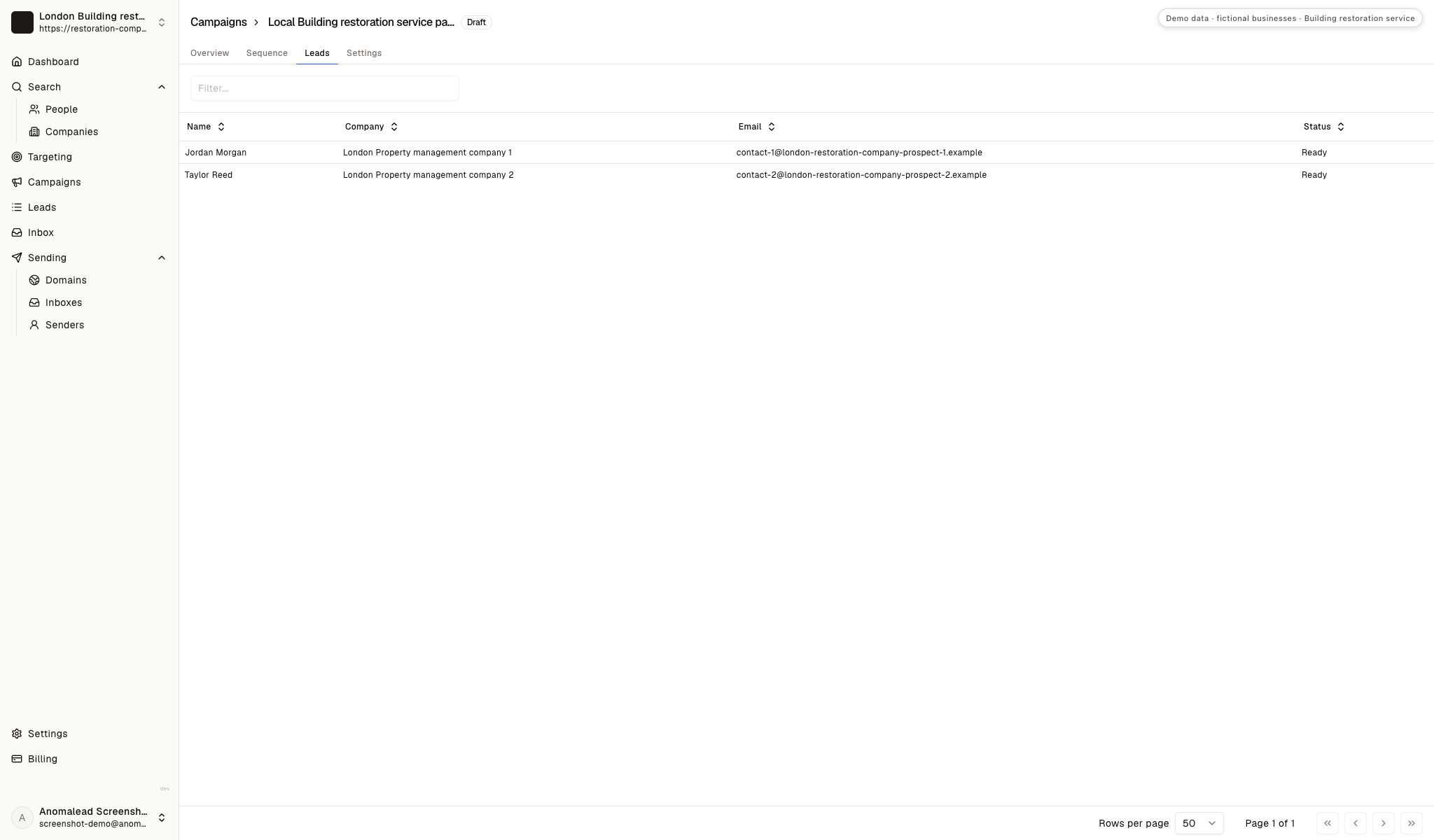
Section titled: Choose recipients who can route the questionThe campaign draft contains two recipients. Confirm that each person has a reason to receive a vendor-readiness message, and remove anyone whose role or organization has not been checked.
Check the sequence for accurate promises
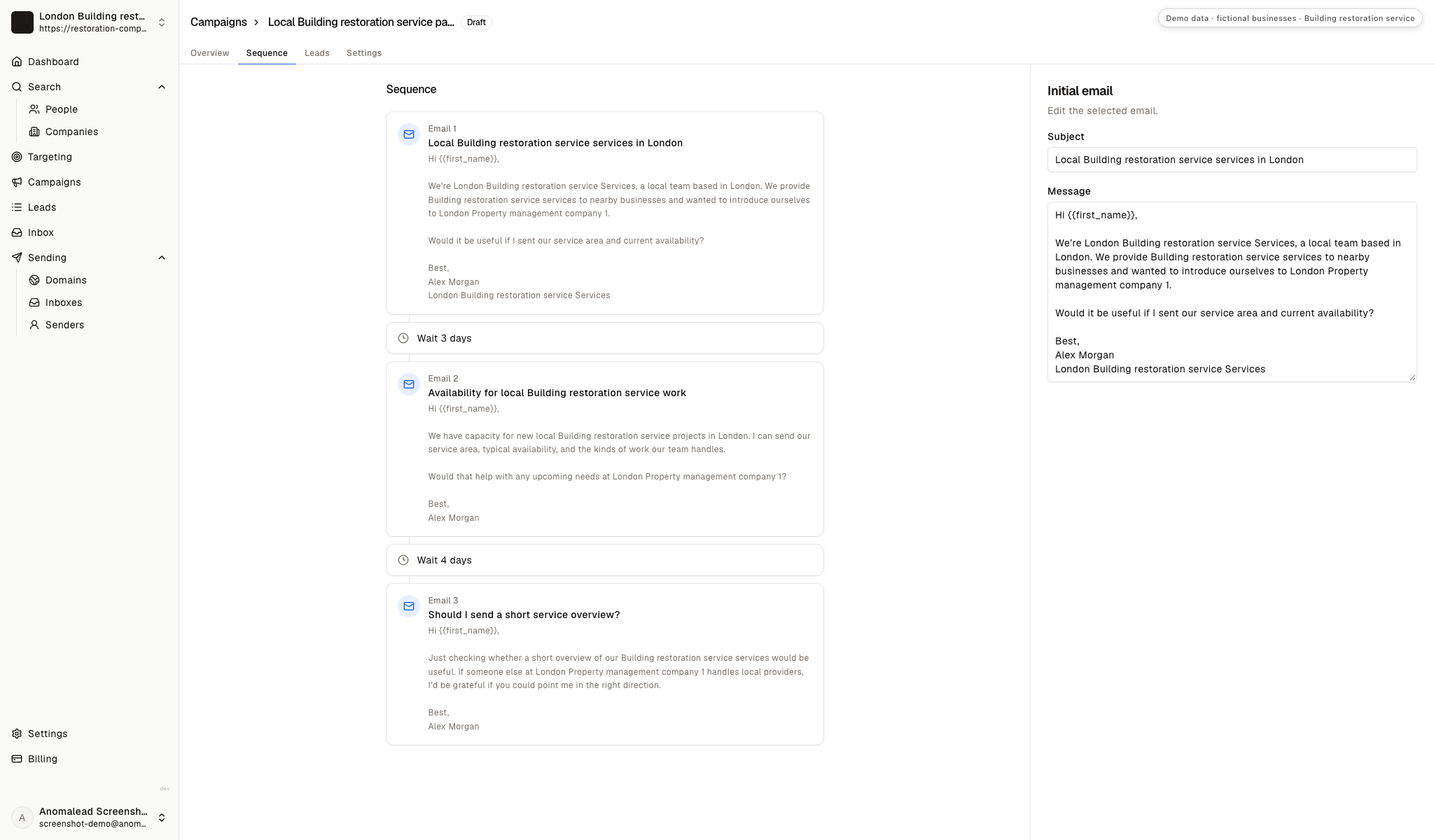
Section titled: Check the sequence for accurate promisesThe sequence editor displays one opening email and two follow-ups, with a three-day wait and a four-day wait. Rewrite generic demo claims, confirm each service statement, and stop future messages after a reply or refusal.
Write to the vendor-review process
Section titled: Write to the vendor-review processReplace the sample details with services, coverage and documents your business can verify. These examples open a conversation before an incident; they do not claim knowledge of a property loss.
First note about restoration coverage
Subject: Restoration vendor coverage for your buildings
Hi Jordan,
I’m Alex Morgan with a local restoration team. We help property managers plan who to call for building losses, from initial stabilization through the stages our crew is equipped to complete. Our coverage area and work boundaries are clear before anyone discusses a site.
Who handles the review of restoration vendors for your managed properties?
Best,
Alex Morgan
Follow-up about vendor documents
Subject: What your team needs from a restoration provider
Hi Taylor,
I’m following up with a short outline of the restoration work our team accepts, our service boundary and the records we can provide for vendor review. We separate mitigation from contents handling or repairs when those steps need a different authorization or trade.
Would a brief service and credential summary help with your next vendor review?
Regards,
Alex Morgan
Jordan Morgan, Taylor Reed and Alex Morgan are fictional fixture names. Add only current credentials and response coverage to a real email. For stronger subject lines, see cold email subject line guidance.
Read replies as requests for specific proof
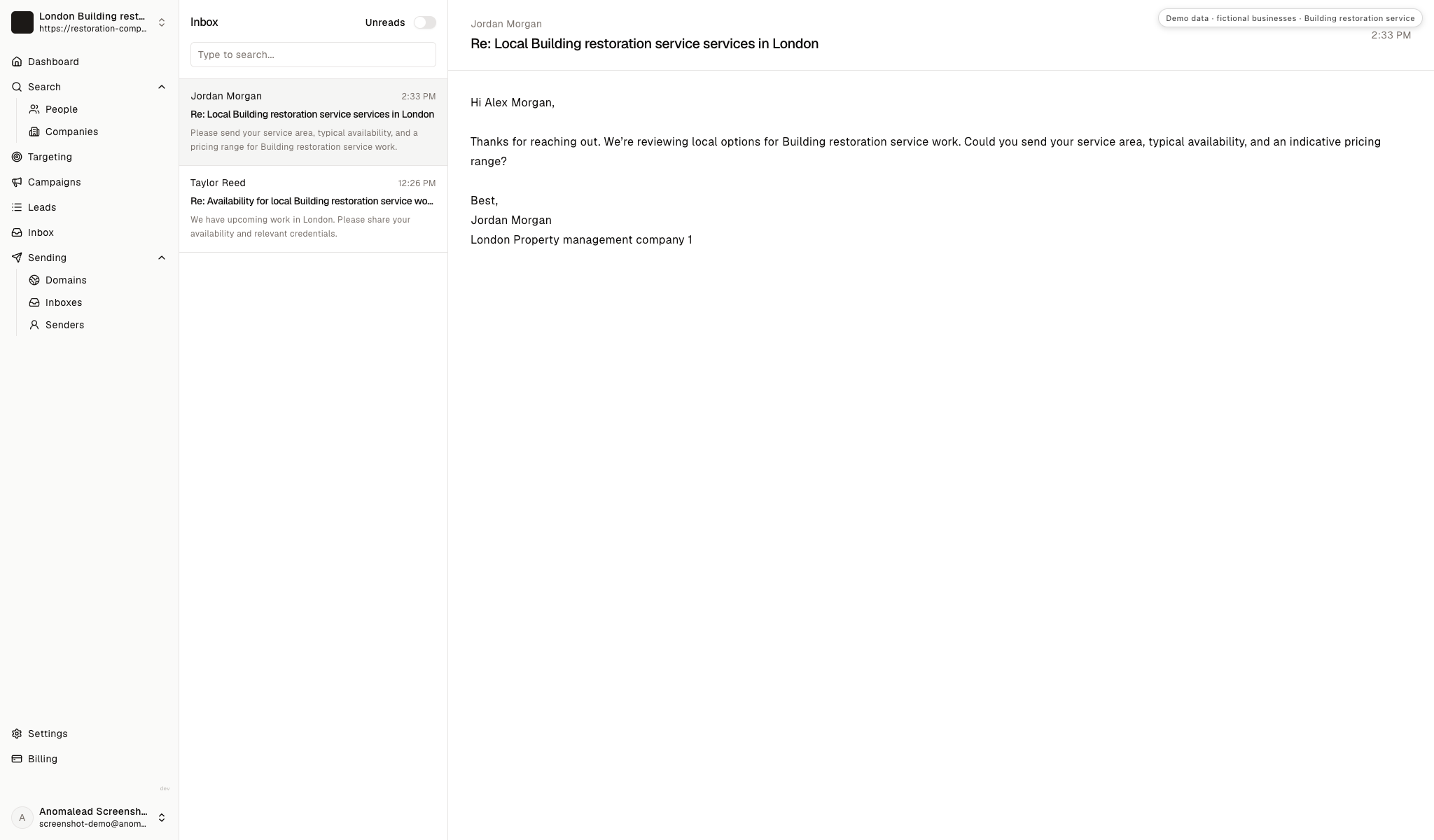
Section titled: Read replies as requests for specific proofThe inbox shows two fictional replies asking about service coverage, availability, pricing and credentials. Answer what was requested with information you can confirm, then clarify whether the contact can direct vendor approval.
Handle the questions a property manager will ask
Section titled: Handle the questions a property manager will askUse each reply to clarify scope, documents or approval. State current capabilities accurately, and do not commit to dispatch before the site and authorization are understood.
Jordan asks about coverage, availability and pricing
Section titled: Jordan asks about coverage, availability and pricingPlease send your service area, typical availability, and a pricing range for Building restoration service work.
Send the areas and staffed response windows you can confirm. Explain that pricing depends on cause, materials, access and authorized scope; do not quote without site details.
Ask whether they are reviewing vendors or have a property with an approved assessment route.
A reply could say:
Thanks, Jordan. We cover the areas listed in our service sheet and can confirm current availability when we know the site and requested work. Our estimate depends on the affected rooms, materials, access and whether the request is for mitigation or reinstatement.
Are you adding providers to a vendor list, or is there a property you are currently assessing?
Taylor requests availability and relevant credentials
Section titled: Taylor requests availability and relevant credentialsA restoration project may be coming up. Could you share your current capacity, the work your team accepts and the credentials that apply?
List only work the team accepts and attach current, relevant documents. Separate credentials from capacity; one certificate may not cover every restoration activity.
Ask which documents onboarding requires and whether the work is emergency attendance, mitigation or repair.
A reply could say:
Thanks, Taylor. I can send the current insurance and training records that apply to our stated services, along with our coverage and availability limits. We confirm the right crew and partner trades after the loss type and access needs are known.
Which documents does your vendor review require for the work you expect to refer?
The manager already has an emergency contractor
Section titled: The manager already has an emergency contractorWe already have a contractor for emergency call-outs.
Respect the arrangement. Ask whether a backup is considered for overflow, another loss type or later repairs; do not ask them to replace a provider meeting its obligations.
A reply could say:
That makes sense. We can outline the services and areas where our team has capacity, so you can compare them with your current coverage if your process allows a backup provider.
Does your vendor review include a secondary option for a different loss type or an overflow period?
The buyer asks whether tenants can remain in the building
Section titled: The buyer asks whether tenants can remain in the buildingCan your team work while residents or tenants are still on site?
Occupancy depends on affected areas, hazards, containment, noise, utility isolation and access. Do not promise residents can stay before assessing the loss and getting site approval.
A reply could say:
We assess occupied-site work case by case. Before confirming an approach, we need to understand the affected area, access restrictions, required isolation and how the property team will communicate with occupants.
Is the site occupied now, and who coordinates resident access?
Choose one service profile for the next prospecting batch
Section titled: Choose one service profile for the next prospecting batchBefore adding contacts, record the buildings you can reach, losses and stages you handle, documents ready for review, and who approves access. This keeps a broad restoration label from becoming a promise to solve every loss.
Select matching property managers, verify their vendor route and ask one direct question. If the work belongs to a separate trade, document the handoff; the contractor lead generation guide applies to planned repair work.
Restoration company lead generation questions
Section titled: Restoration company lead generation questionsHow can a restoration company find property management clients?
Section titled: How can a restoration company find property management clients?List property managers in areas your crew can serve, verify their building types and vendor process, then contact the role that handles review. Describe covered losses, service boundaries and current credentials.
What should a restoration company say about emergency availability?
Section titled: What should a restoration company say about emergency availability?Give staffed hours, locations and limits for nights, weekends or specialist work. Explain how you confirm availability for a specific site rather than promising immediate attendance.
Should I contact an insurer before a property manager?
Section titled: Should I contact an insurer before a property manager?Start with the property manager, who can explain access, vendor onboarding and owner approval. An insurer or adjuster may join later; describe your records and coordination without implying that they appointed you.
Are the companies and replies in the screenshots real?
Section titled: Are the companies and replies in the screenshots real?No. The business records, contacts, messages and replies shown in the demo are fictional examples. They do not identify Anomalead customers, live restoration needs, approved vendors or campaign outcomes.
What does the restoration company ROI calculator predict?
Section titled: What does the restoration company ROI calculator predict?It does not predict incidents, vendor selection, insurer approval or revenue. It tests your own assumptions about job contribution and the time and capacity needed to pursue an account.