


Contractor lead generation works when a general contractor reaches property managers whose repair and building work fits the crews they can dispatch. A manager may need a dependable route for tenant-reported repairs, common-area work, or a scoped improvement, but a company profile does not prove that work is open. Start by defining the trades, service area, response process, and project size your team can support.
This guide explains how to research property management accounts, qualify a real work-order or project pathway, and introduce your team without promising an unconfirmed start time. Use these property maintenance buyer research steps to separate a useful account signal from a job request, then ask who assigns contractors and approves the work.
Key takeaways
- Target property managers with buildings in your service area and repair scopes that match your crew's licenses, trades, and capacity.
- Qualify how work orders are reported, approved, scheduled, accessed, documented, and paid before proposing ongoing coverage.
- Show current insurance, safety procedures, trade qualifications, dispatch boundaries, and closeout records only when you can verify them.
- Offer to review one representative work order or defined building project; a portfolio search is not proof of a maintenance contract.
Which property teams are worth approaching?
Section titled: Which property teams are worth approaching?A good contractor prospect manages buildings where your team can complete a defined scope under the site's access and approval rules. Focus on the person who routes work and the person who authorizes spend, since those roles may sit in different parts of the property organization.
- Residential portfolio managers: They may coordinate repairs across apartment buildings, arrange tenant access, and track recurring issues. Ask whether work is assigned by a central office or a site manager, and which trade requests your company can accept.
- Commercial property operations teams: Office, retail, and mixed-use managers often need contractors to work around tenants, deliveries, security procedures, and operating hours. Explain your occupied-site process and ask what induction or insurance documents are required before a visit.
- Facilities coordinators for multi-site owners: A facilities coordinator may log defects and route approved tasks to vendors while an owner or asset manager controls the budget. Find out who can authorize a site visit, who approves the estimate, and where completion evidence should be sent.
- Managers preparing a building improvement: A manager planning common-area upgrades or a repair package may need a contractor who can define exclusions and coordinate related trades. Confirm whether the scope is approved, which drawings or specifications exist, and whether the project is being tendered.
Choose a buyer by the way its team assigns work, not by the number of properties shown on a portfolio page.
Qualify the work-order path before you promise coverage
Section titled: Qualify the work-order path before you promise coverageA useful contractor lead has a clear work request, an authorized decision path, and conditions your team can meet. Learn how a task moves from a resident or building inspection to a completed, documented job.
- The requested trades fit your team: Ask which repair categories the manager expects you to cover and whether any work requires a licensed specialist or approved subcontractor. Do not present a general contractor profile as evidence that every trade falls within your scope.
- Request intake is defined: Find out whether jobs arrive through a portal, a property manager, or a facilities desk, and what information must be included. Clarify how photos, tenant notes, access windows, and urgent hazards are handled before accepting a dispatch process.
- Access and tenant coordination are workable: Confirm who books entry, provides site instructions, and contacts occupants. Ask about keys, sign-in, escorts, permitted work hours, and any occupied-area protection. Never request access codes or sensitive floor plans in an introductory email.
- Approval happens before extra work: Ask whether each job needs an estimate, purchase order, not-to-exceed approval, or sign-off from an owner representative. Clarify how hidden conditions and change requests are documented so a technician is not left to approve unbudgeted work on site.
- Closeout records match the manager's process: Learn what the property team expects after a visit: a completion note, before-and-after photos, a parts record, a follow-up recommendation, or an invoice reference. Send only records your company can produce consistently.
- Capacity and coverage are current: Check travel time, crew calendars, material availability, subcontractor commitments, insurance, and safety procedures before agreeing to a response window. Describe the hours and locations you actually cover, and update the manager when capacity changes.
What appears in the demo
The walkthrough uses fictional London General contractor Services, generic London Property management company records, and the fictional contacts Jordan Morgan and Taylor Reed. The businesses and inbox replies are demo fixtures, not Anomalead customers, active work orders, service agreements, or campaign results. No repair request, site condition, or contractor approval appears in the screens.
Build a local list around buildings you can reach
Section titled: Build a local list around buildings you can reachUse local property-management records to create an account list, then verify the building types and service locations from the manager's own public materials. The walkthrough shows a location and category search, three generic company records, two saved results, contact enrichment, a lead list, a campaign draft, a three-message sequence, and inbox replies. It does not show a work-order system or a company asking for a contractor.
Record the property source, likely operating role, and one question that would establish a real route to work. A manager's portfolio page is not a promise of access or recurring jobs. Keep a local service portfolio map that separates known building facts from the service and approval details you still need to ask about.
Set the search within your dispatch area
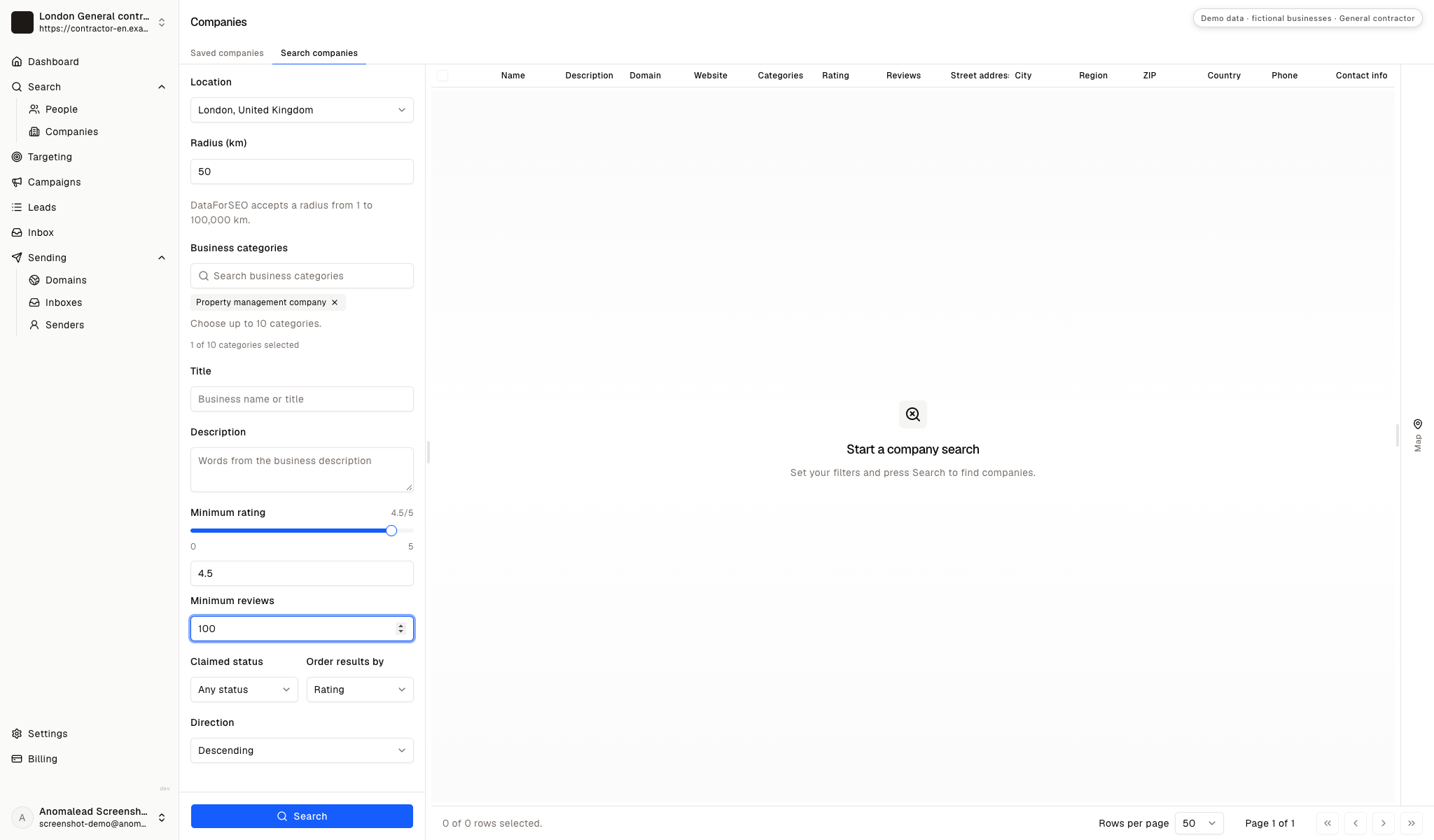
Section titled: Set the search within your dispatch areaChoose a service area your crews can reach and the property-management category shown in the demo. The radius finds company records; it does not establish travel time, building access, or an open repair request.
Review property firms before saving accounts
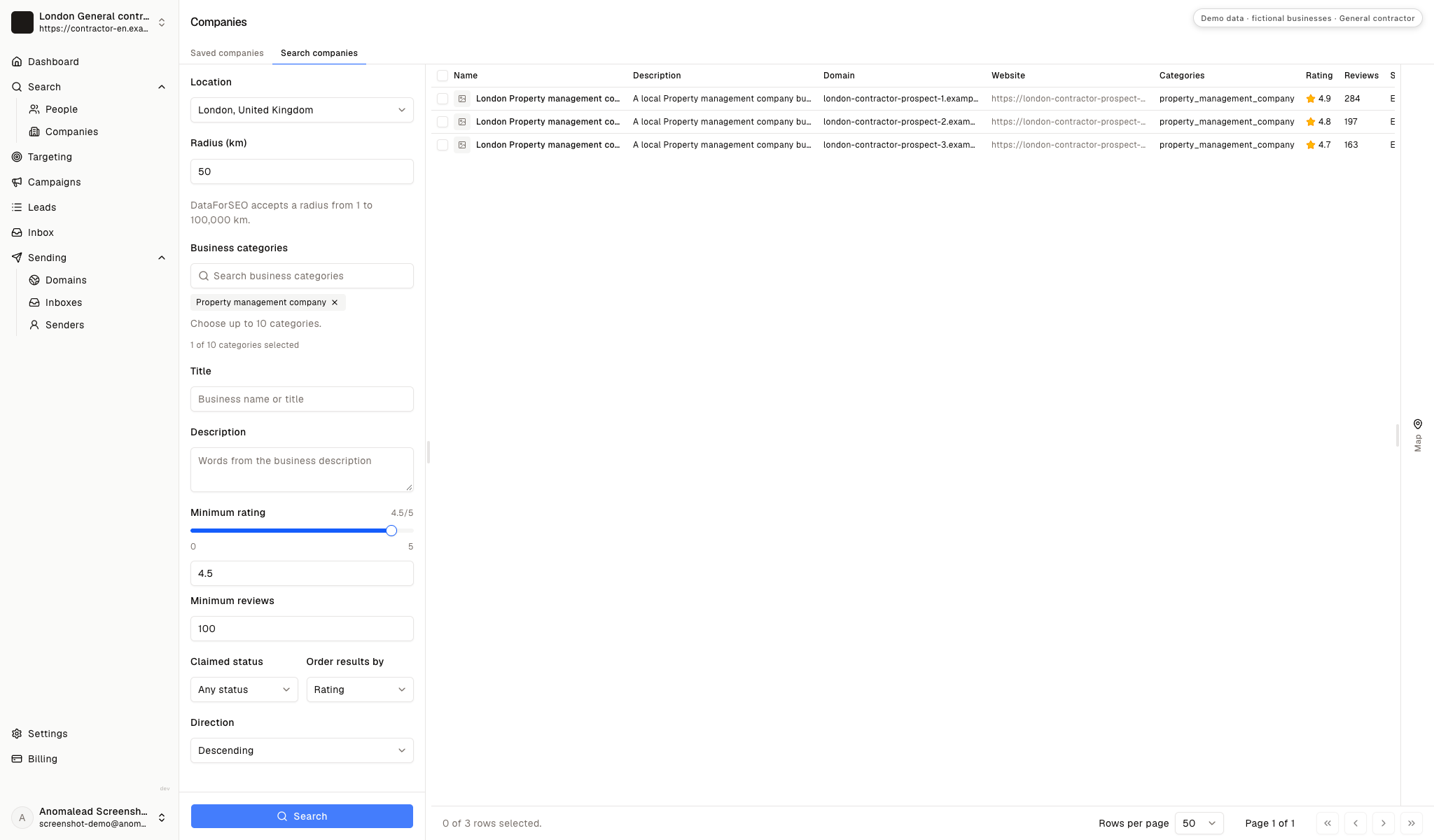
Section titled: Review property firms before saving accountsThree fictional management-company records appear with generic descriptions, domains, ratings, and review counts. The fixture has no building address, repair ticket, trade request, or vendor status.
Save managers with a plausible service-area fit
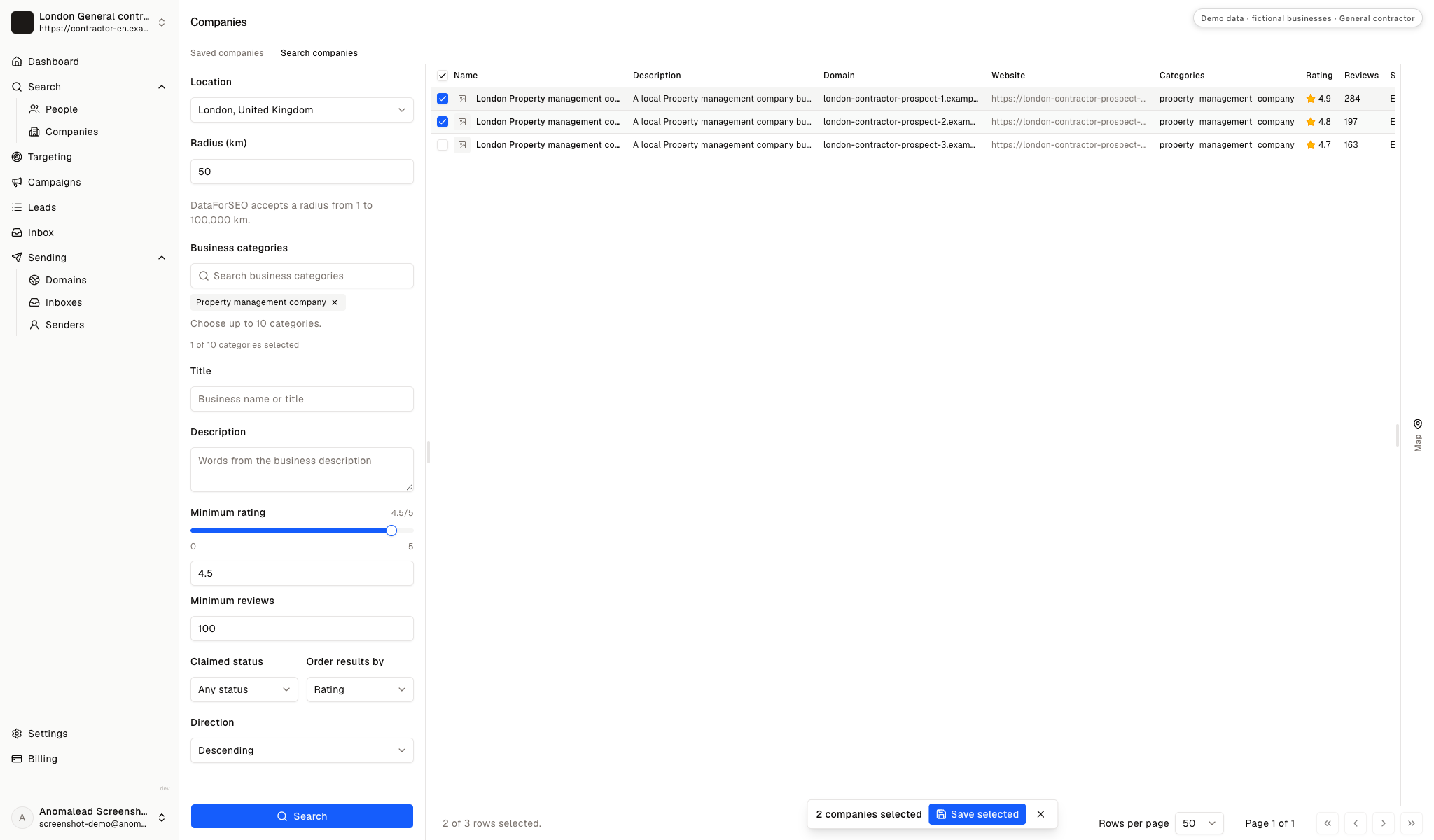
Section titled: Save managers with a plausible service-area fitThe demo marks two of three companies for saving. Keep a property firm when its public portfolio includes buildings your team can cover and a contact can clarify how repair work is routed.
Find the person who sends work and approves estimates
Section titled: Find the person who sends work and approves estimatesStart with the person who owns contractor dispatch for the building type you serve, then identify who approves estimates and additional work. The fixture labels Jordan Morgan and Taylor Reed as fictional Partnerships Managers, which does not confirm authority over property repairs. A real firm may route requests through a property manager, maintenance coordinator, facilities director, or procurement contact.
Check a current company page or professional profile before outreach. Ask who handles contractor onboarding, what records are required, and whether a site-level manager or central office assigns jobs. Keep tenant details and building access instructions out of the prospect record until the property team provides an approved process.
Check building fit before enriching people
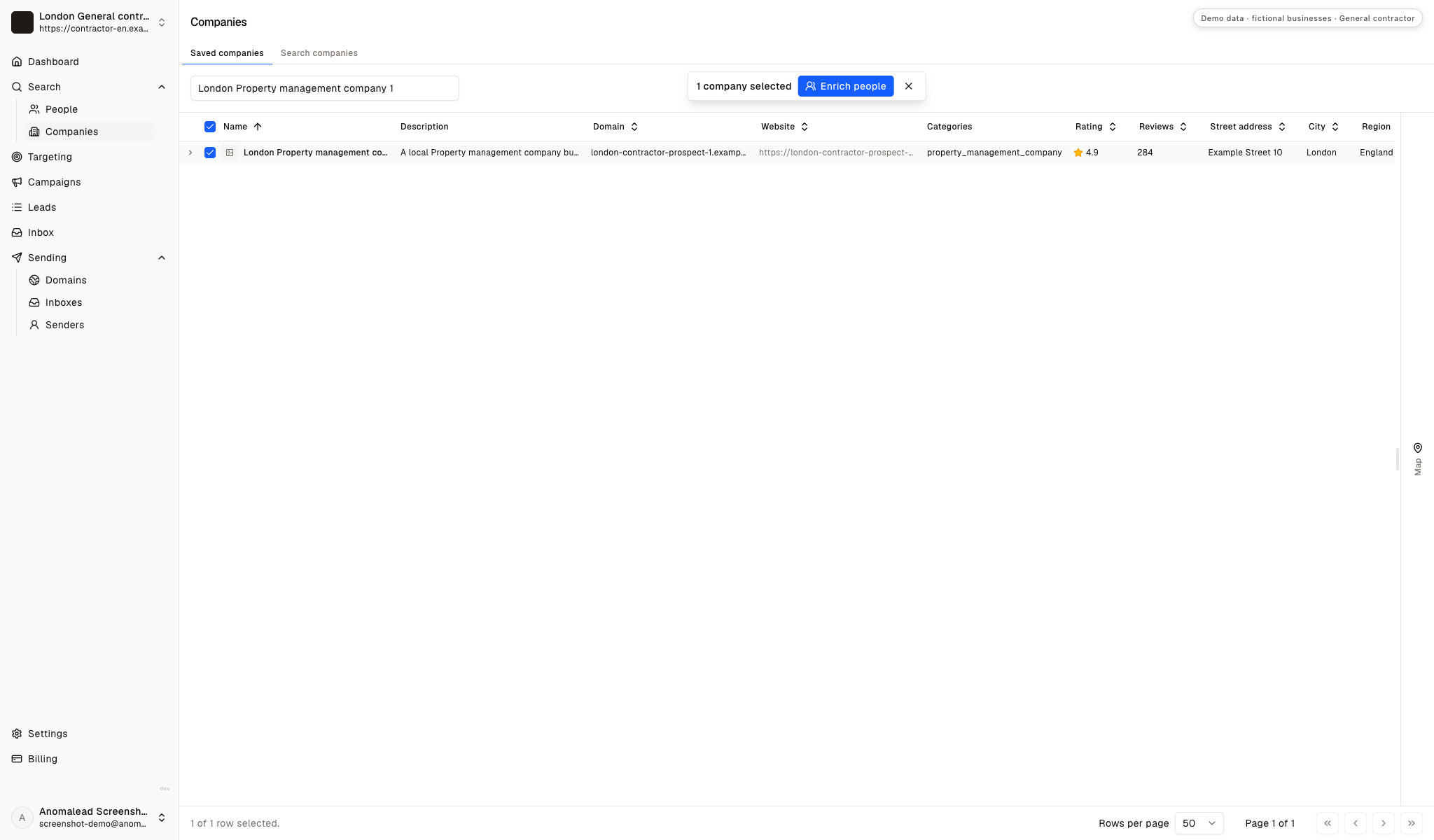
Section titled: Check building fit before enriching peopleThe saved view shows one fictional management company selected with an Enrich people action. Review its public service locations and property types before adding individuals to a contractor list.
Check each contact's role in work assignment
Section titled: Check each contact's role in work assignmentThe demo lists Jordan Morgan and Taylor Reed as fictional Partnerships Managers. A working property team may place dispatch, vendor approval, and budget authority with different people.
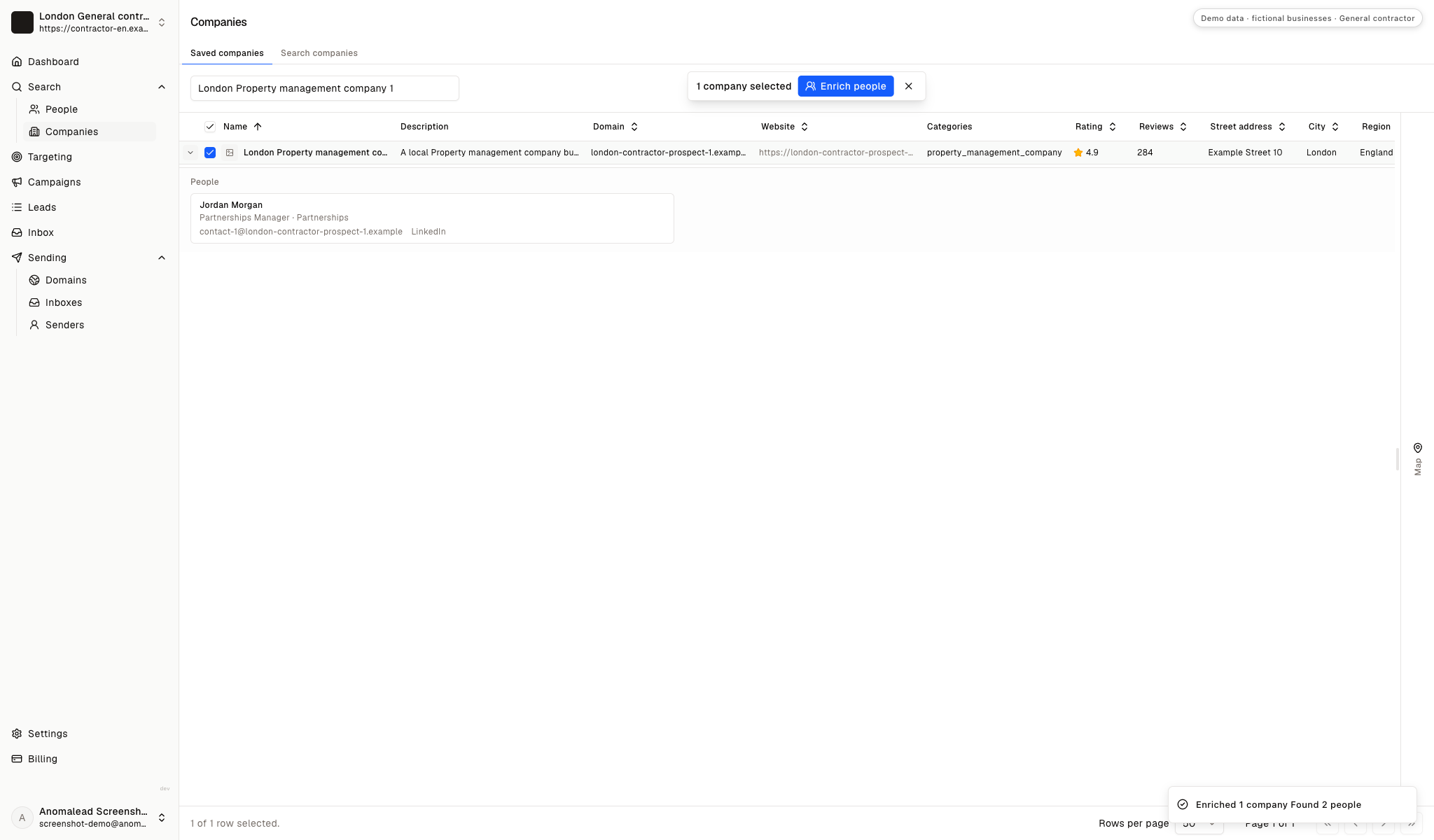
Keep the account and its open questions together
Section titled: Keep the account and its open questions togetherThe list contains two fictional contacts with email status. Add the building type, public service-area evidence, and the question that will clarify dispatch or estimate approval.
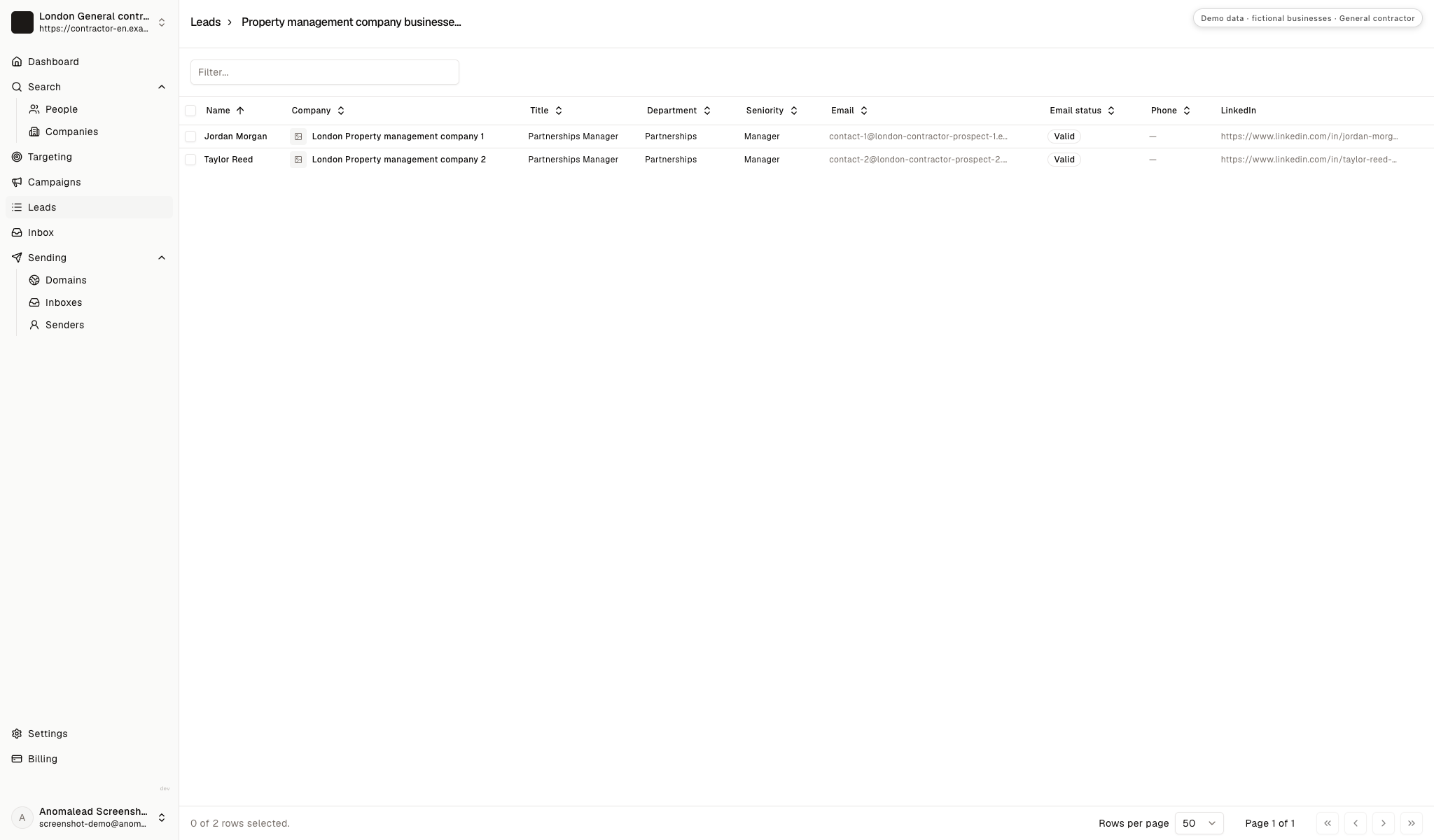
Estimate whether a property account merits a bid
Section titled: Estimate whether a property account merits a bidRecurring contractor coverage has an operating cost beyond labor on site. Include dispatch, travel, tenant coordination, reporting, and the time needed to price work before you decide whether the account fits.
Enter your own assumptions for crew time, travel, service-call administration, materials, subcontracted trades, closeout records, and the job scopes your company can accept. The calculator does not forecast call volume, contract awards, profit, or future revenue.
Do the math on one good deal
If one new customer is worth thousands, you don’t need magic. You need a few more meetings a month.
Projected monthly results
- Deals closed
- 2.0
- Projected revenue
- £10,000
- Growth plan (1 business)
- £79/mo
- ROI
- 12,558%
Conservative math on meetings you already believe you can book. One closed deal often pays for a year of Anomalead.
Model only services you can staff and document. A property manager's portfolio is not a forecast of repair frequency, so confirm the work-order process and expectations before relying on an account estimate.
Introduce the crew through a clear service boundary
Section titled: Introduce the crew through a clear service boundaryA first message should name the types of building work you handle, the locations you serve, and how a manager can check your qualifications. Ask who reviews contractor onboarding or whether there is a defined repair package to discuss. A practical introduction gives the property team a way to assess fit without implying that you already know a building's condition.
Mention response windows only after checking current dispatch capacity. Explain how estimates, purchase approvals, access coordination, and closeout records work for your company, and make clear which specialist trades fall outside your scope. Use these property manager introduction notes to keep the first message focused on the next useful conversation.
Confirm the campaign recipients handle property work
Section titled: Confirm the campaign recipients handle property workThe draft shows two fictional recipients and the London contractor name from the fixture. Verify each role and tailor the note to property operations rather than assuming a partnership title assigns repair work.
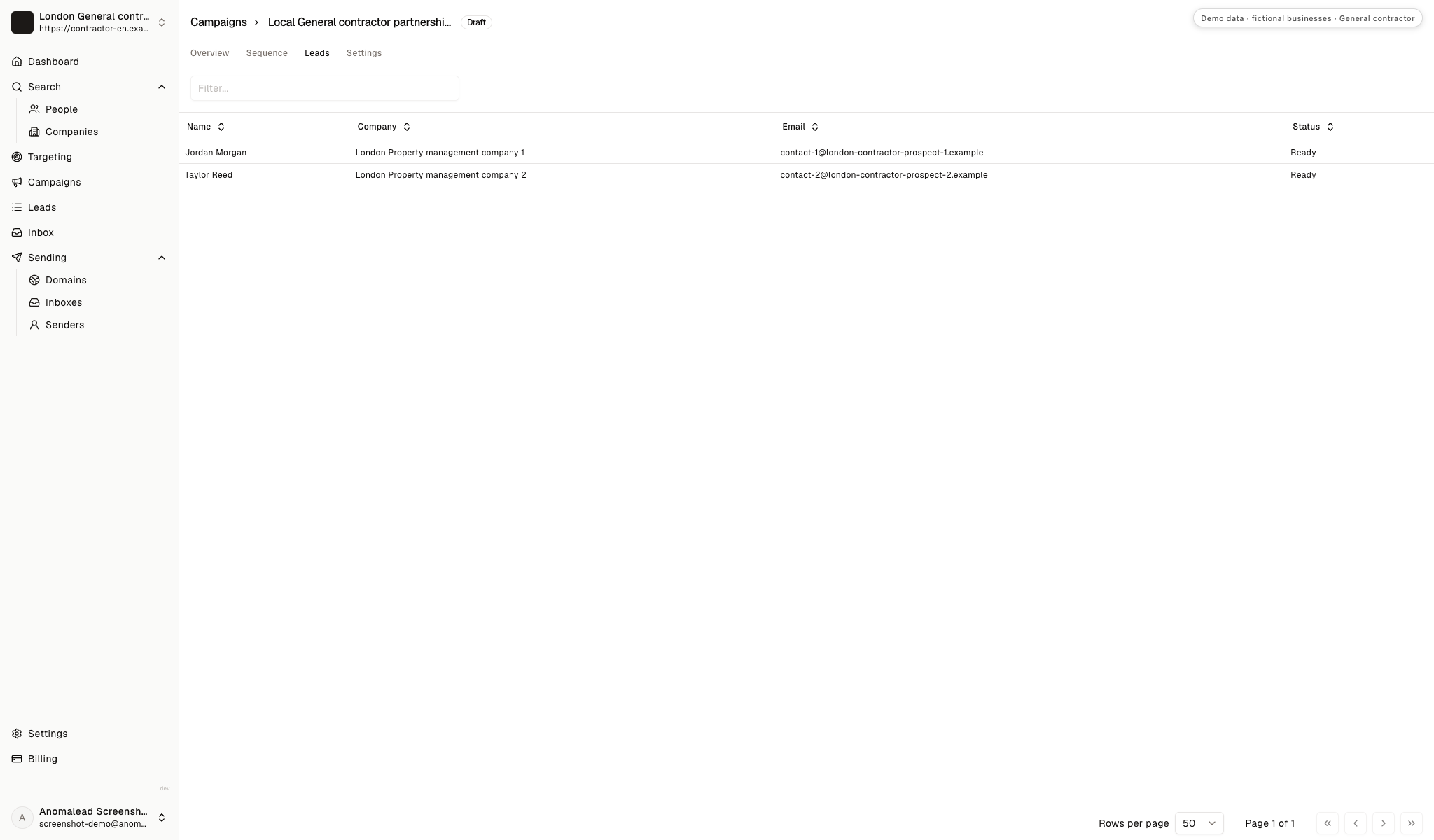
Make each follow-up useful to a facilities team
Section titled: Make each follow-up useful to a facilities teamThe example sequence has three generic emails and scheduled waits. Replace them with your real trade coverage, vendor documents, work-order process, and a single question; stop after a decline or opt-out.
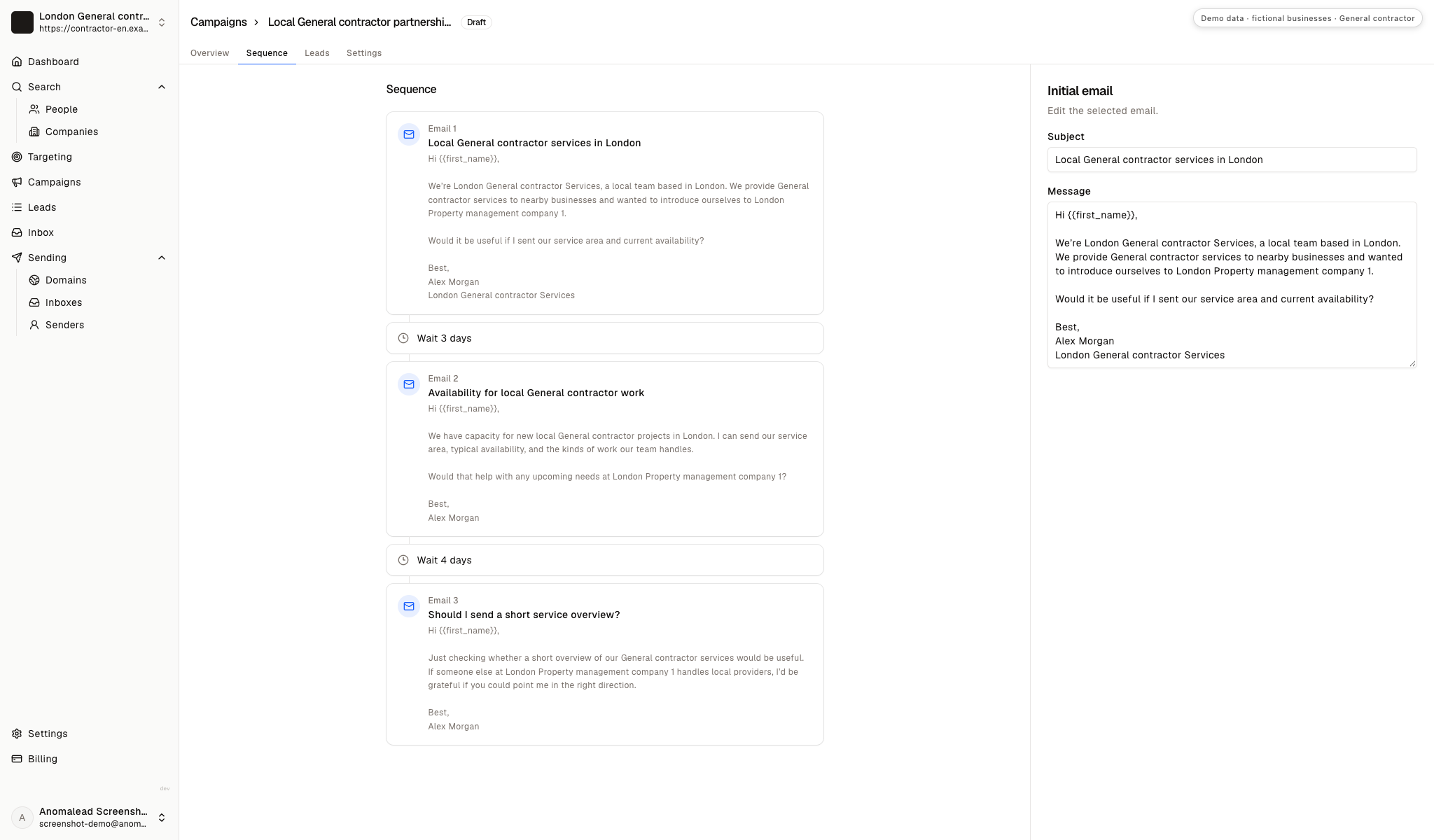
Ask how a property manager assigns repair work
Section titled: Ask how a property manager assigns repair workThe example asks for the vendor process before pitching blanket coverage. Replace the fictional company and contact details with verified information from your own team.
First note to a property manager
Subject: Local contractor coverage for managed buildings
Hi Jordan,
I’m writing from London General contractor Services. Our team handles planned building repairs and defined improvement work in the areas where our crews can travel and meet site requirements.
If your property team reviews local contractors, could you point me to the person who manages vendor onboarding and work-order assignments? I can send our current insurance, safety documents, trade scope, and closeout process for review.
Best, Alex Morgan, London General contractor Services
Follow-up after a request for service details
Subject: Re: Local contractor coverage for managed buildings
Hi Taylor,
I can outline the repair categories and building projects our team can take on. Before confirming a response window or estimate, we would need the site location, requested scope, access conditions, and approval process.
Could you share the contractor onboarding requirements or the property contact who routes these requests? I will send only the current documents your team needs.
Best, Alex Morgan
Check service boundaries, crew availability, trade qualifications, insurance, and closeout records before sending. These maintenance contractor email samples show how to keep a vendor introduction concise.
Read replies as a request to define coverage
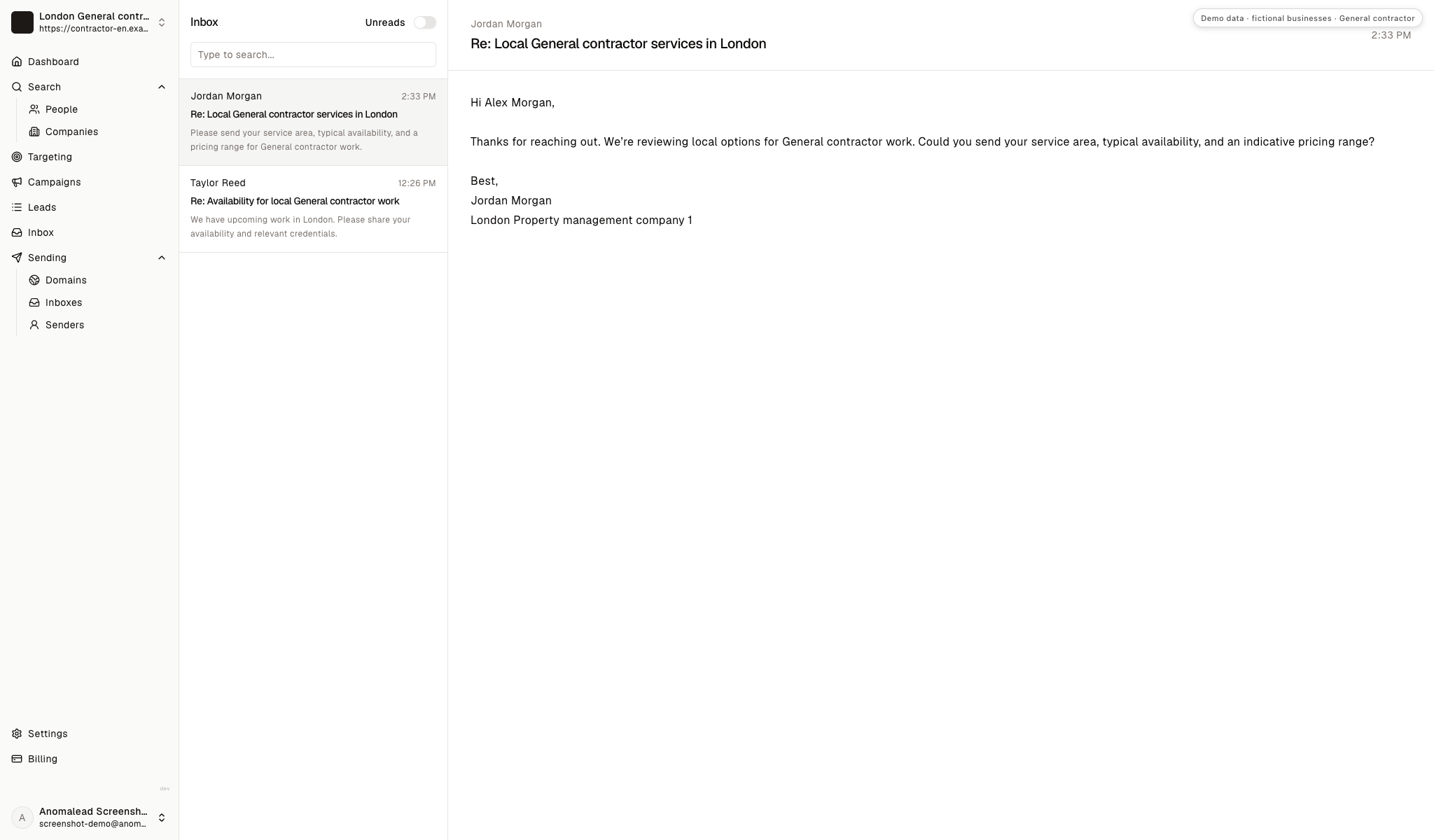
Section titled: Read replies as a request to define coverageThe fictional inbox shows one contact asking about service area, availability, and an indicative price range; another asks about upcoming work and credentials. No building address, work order, or vendor approval appears.
Answer the manager's request with a defined next step
Section titled: Answer the manager's request with a defined next stepA property manager's reply is a chance to clarify the site, request, and approval route. Share current evidence, ask for the work-order details that affect scope, and avoid promising an arrival or price before dispatch and estimating confirm feasibility.
A manager requests a coverage area, availability, and indicative pricing
Section titled: A manager requests a coverage area, availability, and indicative pricingPlease send your service area, typical availability, and an indicative price range for contractor work.
Describe the locations and work types your team can verify. Explain that estimate assumptions depend on the repair scope, access, materials, and approval requirements. Offer to review a defined work order rather than price an entire portfolio.
A useful answer could be:
Hi Jordan, thanks for your note. I can confirm the areas and repair scopes our team currently covers. A useful estimate depends on the site, requested work, access window, materials, and who approves changes. Could you share one representative work order and the required vendor documents? Best, Alex Morgan
A contact asks about upcoming work and contractor credentials
Section titled: A contact asks about upcoming work and contractor credentialsWe may have building work coming up. Please share your availability, the tasks your team covers, and relevant licenses or credentials.
Send current licenses where required, insurance records, safety material, and a verified list of repair categories. Check the crew schedule and any subcontractor commitments before giving a start window. Ask whether the manager uses an onboarding form or a specific estimate template.
Keep capacity claims current:
Hi Taylor, I can send our current insurance, safety documents, and the work scopes we can substantiate. We will check crew availability after reviewing the building, access window, and requested tasks. Could you share the vendor onboarding form and the person who approves estimates? Best, Alex Morgan
The manager already has an incumbent contractor
Section titled: The manager already has an incumbent contractorOur current contractor handles maintenance and repair requests.
Respect the existing arrangement and do not question the incumbent's performance without evidence. Ask only whether a separate building or future package has an open vendor review, and stop if the manager is not inviting alternatives.
A low-pressure close is enough:
Thanks for clarifying. I understand your current contractor covers this work, so I will leave that arrangement as it is. If your team opens a vendor review for another building or a future project, I can share our current scope and documents then. Best, Alex Morgan
Choose one building and ask for its work-order process
Section titled: Choose one building and ask for its work-order processFor your next prospecting batch, choose a property manager with buildings inside your practical coverage area. Confirm who routes repairs, ask how estimates and site access are approved, and send a current qualification pack only when requested. Start with one defined task before proposing portfolio-wide coverage.
Use a repair-scope follow-up to request the missing work-order details or confirm the next review step, then stop if there is no open vendor process.
Contractor lead generation questions
Section titled: Contractor lead generation questionsHow can a general contractor find property management clients?
Section titled: How can a general contractor find property management clients?Research local managers through company portfolio pages, building directories, and public vendor information. Confirm that their sites fit your service area and ask how they route repair requests before presenting a coverage offer.
What should a contractor confirm before accepting a property repair?
Section titled: What should a contractor confirm before accepting a property repair?Clarify the building, requested scope, access window, tenant coordination, estimate approval, safety requirements, and closeout records. Check crew and trade capacity before promising a visit or deadline.
Should a contractor offer a fixed rate for an entire portfolio?
Section titled: Should a contractor offer a fixed rate for an entire portfolio?Only if the work categories, response expectations, exclusions, and approval process are clear enough to assess. Otherwise, propose reviewing a representative work order and document the assumptions before discussing broader coverage.
Are the property management businesses in the screenshots real?
Section titled: Are the property management businesses in the screenshots real?No. The screens use fictional company records, contacts, and reply text. They are not Anomalead customers, active work orders, or service results.
What does the account calculator predict?
Section titled: What does the account calculator predict?It uses assumptions you enter to help evaluate the effort and costs involved in pursuing an account. It does not forecast repair volume, contract awards, profit, or future revenue.