


Water damage lead generation works best when a restoration provider approaches property managers whose buildings fall within its real dispatch area and whose vendor process is clear. A useful account is not simply a company that manages property; it has sites the team can reach, a way to control access, and a person who can review water response coverage before a leak spreads.
The work often starts after a pipe failure, roof leak or appliance overflow, but extraction and drying should not be confused with repairing the source. Define what your crew does, what building maintenance or a plumber handles, and how moisture readings and work records are shared. The B2B buyer-finding process covers the general method; this guide is about qualifying water-loss work in managed buildings.
Key takeaways
- Choose property managers whose buildings are reachable within the crew’s actual water-response area and equipment capacity.
- Separate stopping the leak from extraction, structural drying and later repairs so each trade and approval has a clear owner.
- Ask how the site controls entry, tenant notices, equipment placement and authorization before a wet-area assessment.
- Use outreach to explain your covered water services and ask who reviews the property’s response vendors, without implying that a leak has happened.
Which property managers can route a water response?
Section titled: Which property managers can route a water response?Start with property-management firms that oversee buildings in your operating area and can explain how a water-response provider is selected.
- Portfolio manager: This contact can identify the buildings covered by one vendor arrangement, how after-hours calls are routed and which owner or regional lead approves a new provider.
- Building or facilities manager: A site manager can explain shutoff access, occupied areas, plant rooms, lift or loading restrictions, and where extraction or drying equipment could be placed.
- Preferred-vendor coordinator: This person may collect insurance records, training documents, service boundaries and emergency contacts before a company is added to a supplier list.
- Residential operations manager: For occupied buildings, ask who coordinates tenant notices and entry to affected units. The operations contact can shape the response plan even if another role authorizes the work.
Property managers remain the target buyer in this workflow. A plumber may control source repair and an insurer may review documentation later, but neither replaces the person responsible for site access and vendor coordination.
Qualify a water-loss account before researching contacts
Section titled: Qualify a water-loss account before researching contactsResearch an account when the site and response route match the services your crew can safely provide. Check these operating conditions before looking for a named contact.
- Dispatch range and staffing: Set service boundaries from travel, call-out coverage, crew availability and equipment transport. Describe after-hours capacity only when someone can actually take and route the call.
- Source control: Clarify whether the leak must be isolated before extraction begins. Water technicians can document and dry affected materials, while a plumber or building engineer may need to repair a supply line, roof detail or drain.
- Materials and hidden moisture: Find out whether your service includes moisture mapping, readings in wall or floor cavities, drying equipment placement and follow-up checks. Do not promise that every assembly can be dried in place.
- Occupied-site logistics: Ask how staff will arrange unit entry, protect walkways, manage noise and power, and communicate with residents while air movers or dehumidifiers remain on site.
- Records and handoff: Prepare a clear record of affected areas, readings, equipment and changes in scope. Keep extraction, drying, removal and reinstatement distinct when different approvals or contractors are involved.
A water-only operator should lead with leak response and drying rather than claiming fire, smoke or contents work. Providers with mixed-loss capabilities may need the wider building restoration partner approach. For source repair and referral boundaries, see the plumbing contractor buyer guide.
About the demo data
The demo operator label is London Water damage restoration service Services. The property-management companies, people, campaign messages and replies are fictional records used to illustrate the workflow. They are not Anomalead customers, active water-loss reports, approved vendor placements or campaign results.
Build a search around water-response coverage
Section titled: Build a search around water-response coverageChoose locations from the distance your team can cover with its equipment and staffing, not from a broad service-area label. Travel time matters when a call needs assessment, extraction equipment and return visits to record drying progress. Keep the first search to property managers with buildings that fit those operating limits.
Company category and public descriptions help create candidates, but they do not confirm a current leak or a service contract. Review the portfolio, building types and likely route to facilities staff before saving an account. Use the small-business prospecting workflow to organize the search, then apply water-specific operating criteria.
Set a search radius your crews can cover
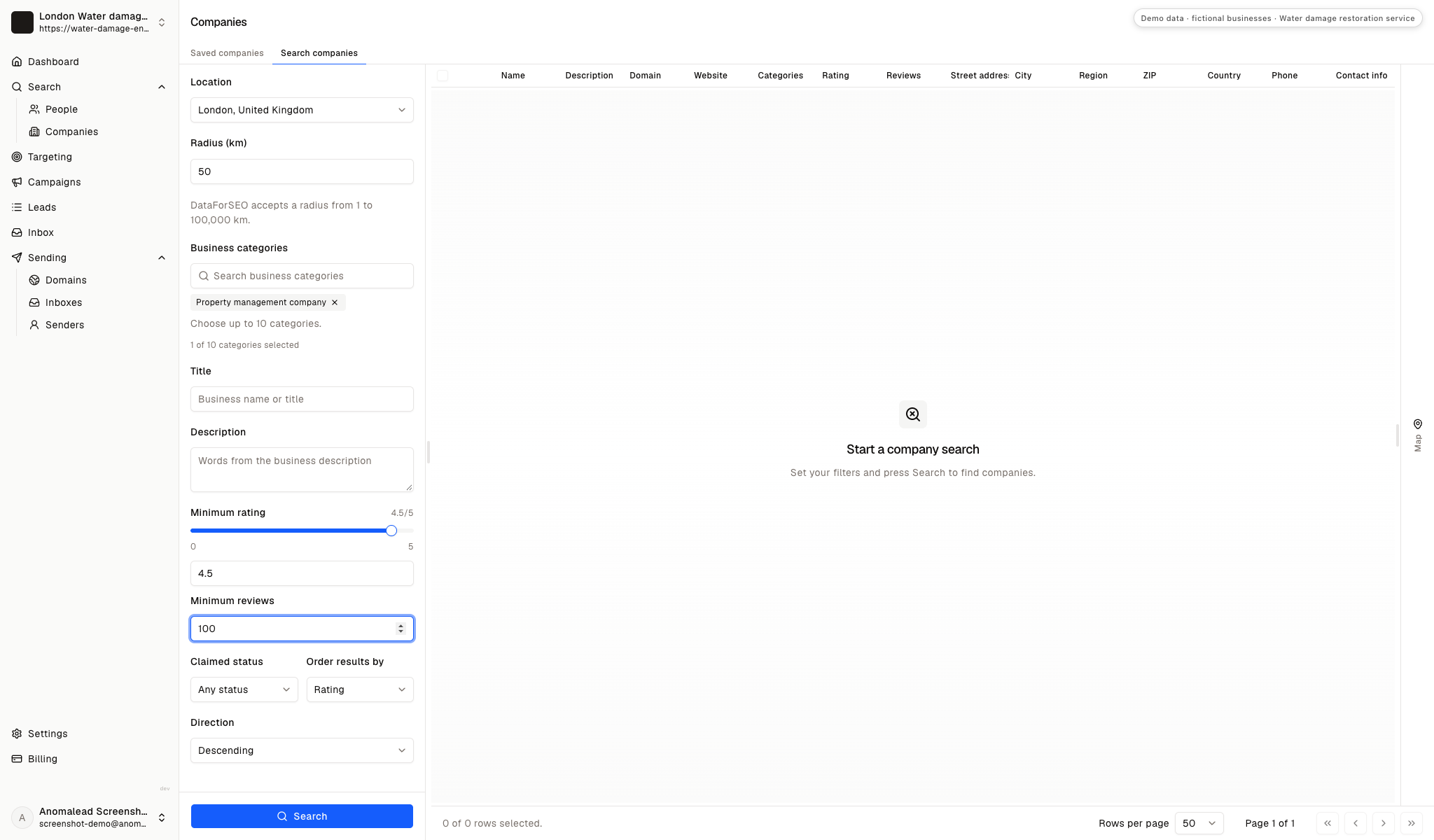
Section titled: Set a search radius your crews can coverThe search form includes a location, radius, property-management category and rating controls. Set these to the area and account type your team serves; the form does not show active leaks, water readings or a request for emergency attendance.
Review company records before saving them
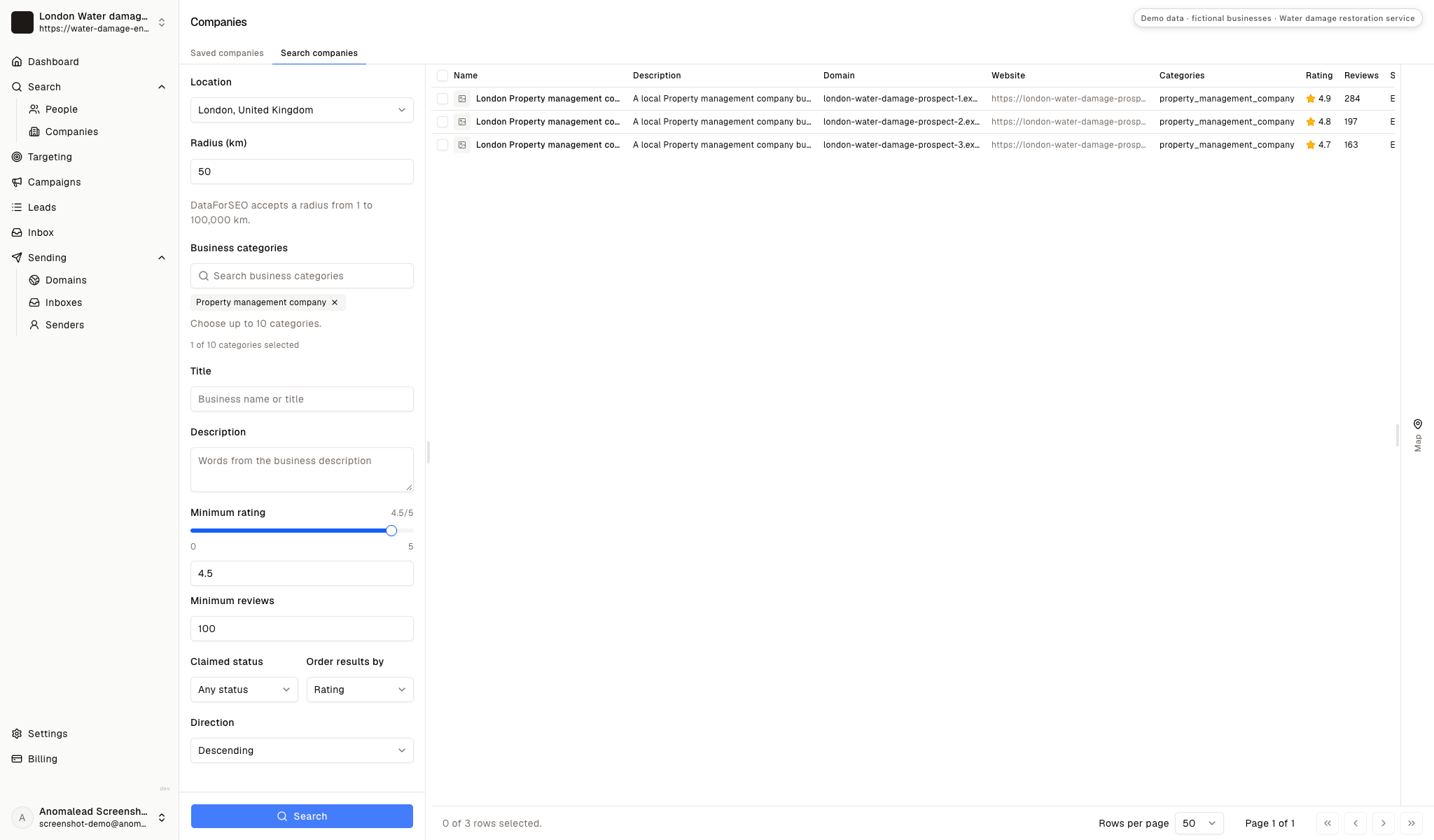
Section titled: Review company records before saving themThe results view returns three fictional companies. Check whether their managed buildings could fit your route and service mix, then verify useful account details before deciding that a contact search is worth the effort.
Save accounts that match the response plan
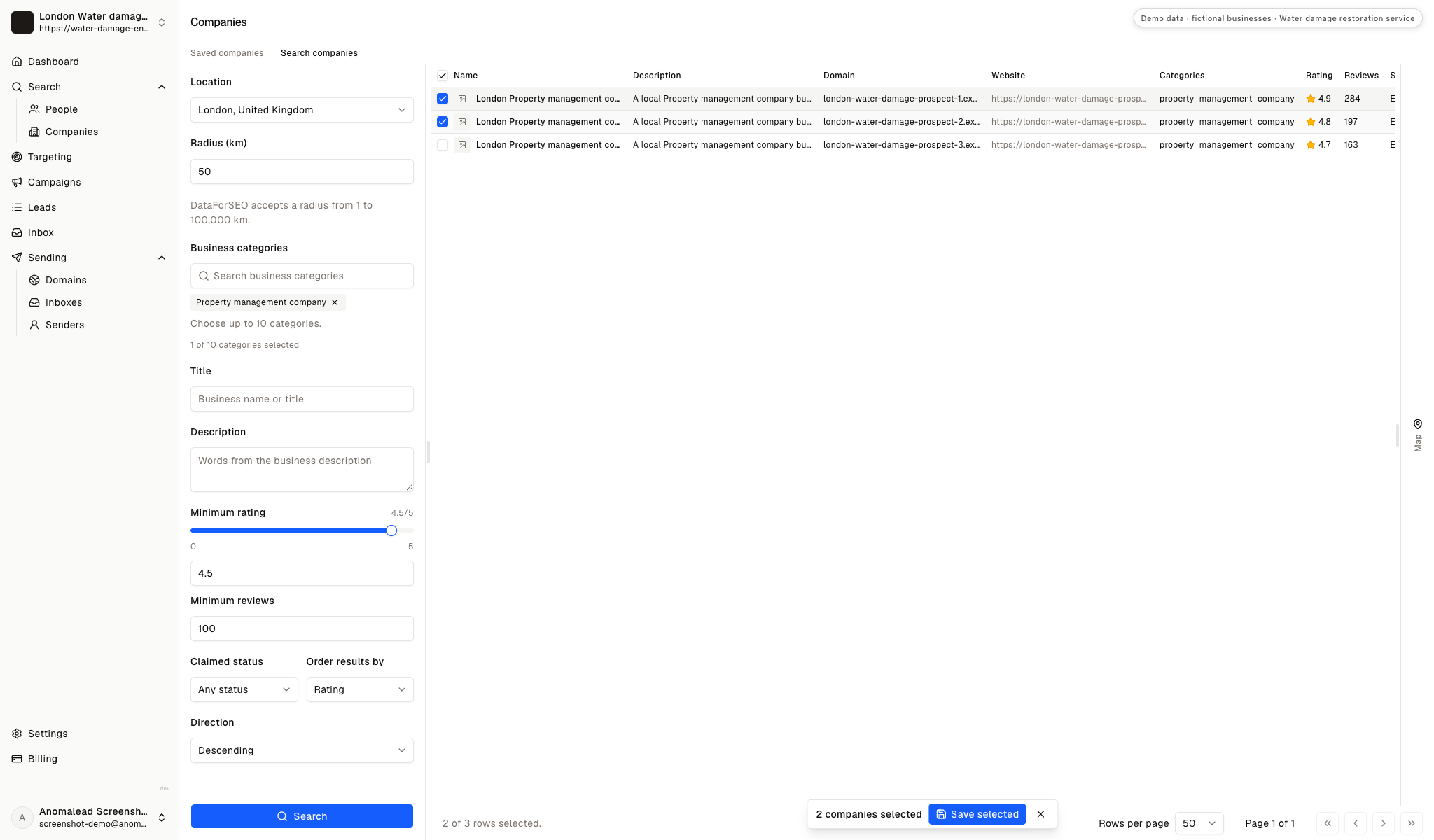
Section titled: Save accounts that match the response planTwo of the three demo results are selected for saving. Keep your own list smaller when only some accounts have reachable buildings, a relevant property profile or a plausible vendor-review route.
Find the person who controls access and vendor review
Section titled: Find the person who controls access and vendor reviewThe right contact can explain how crews enter affected areas and who approves an outside water-response company. A facilities manager may arrange access while a portfolio manager or procurement lead reviews the supplier; an enriched title alone does not identify the decision path.
Before writing, confirm what the contact handles and whether they can route a vendor question to the person responsible for buildings. Distinguish a general vendor conversation from permission to inspect a wet unit, place equipment or remove material.
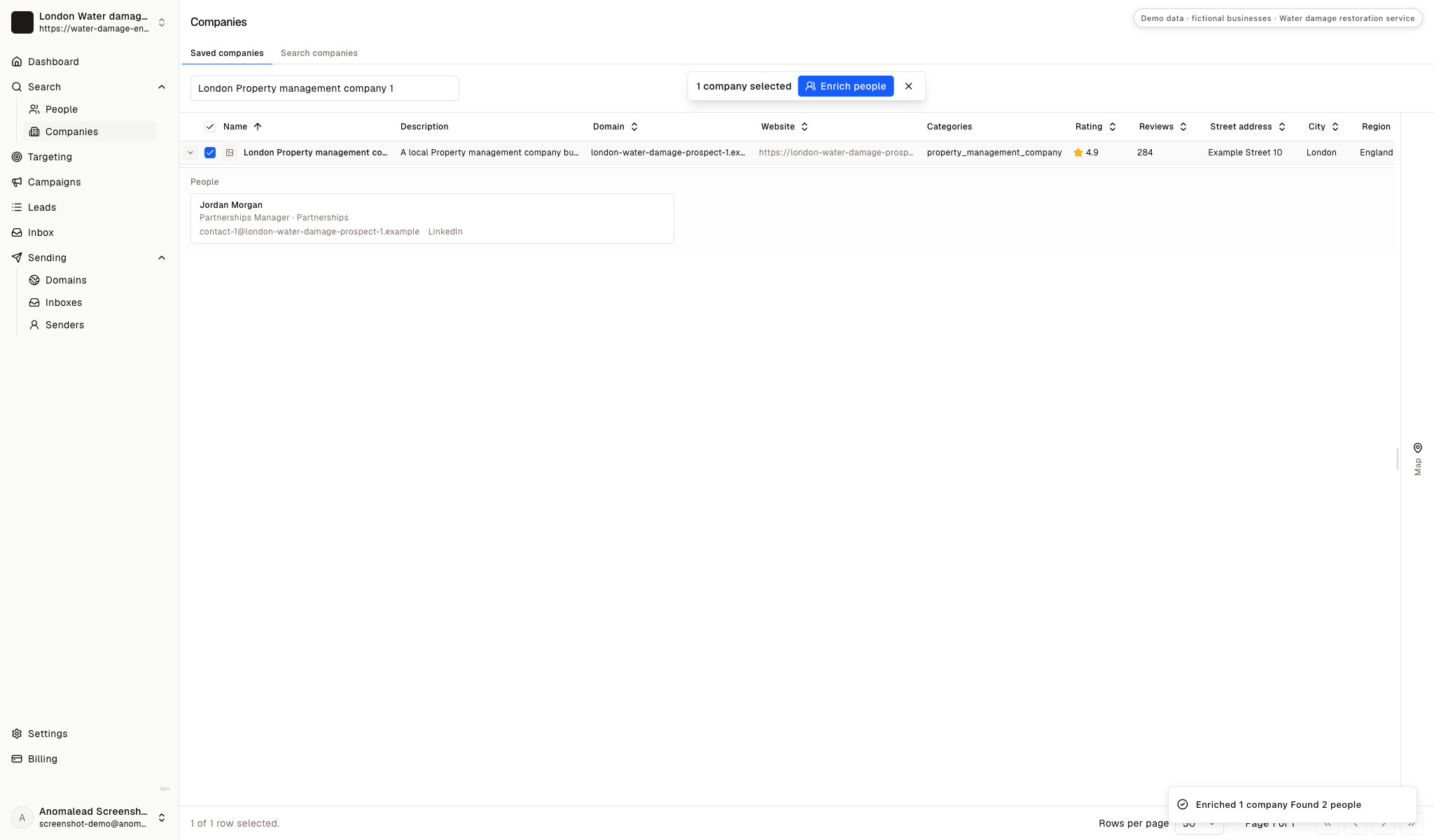
Check the saved account before enrichment
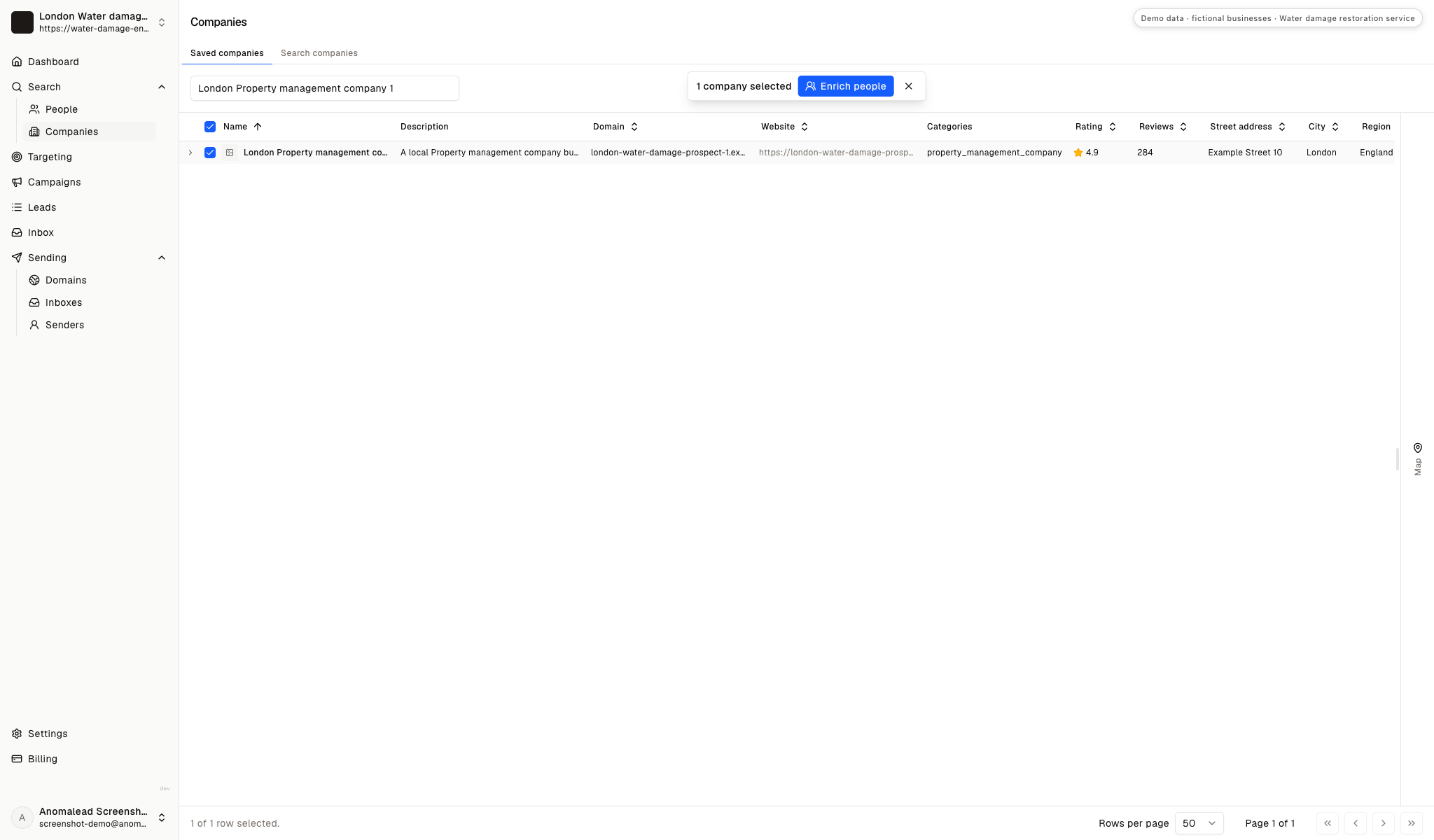
Section titled: Check the saved account before enrichmentThe saved-company view has London Property management company 1 selected, with an Enrich people action available. Recheck its service-area fit and property-management relevance before spending time on contact discovery.
Match enriched contacts to site decisions
Section titled: Match enriched contacts to site decisionsTwo fictional contacts appear with company and role information. Decide whether each can answer a question about dispatch coverage, building access or supplier approval; do not infer authority from a partnerships title.
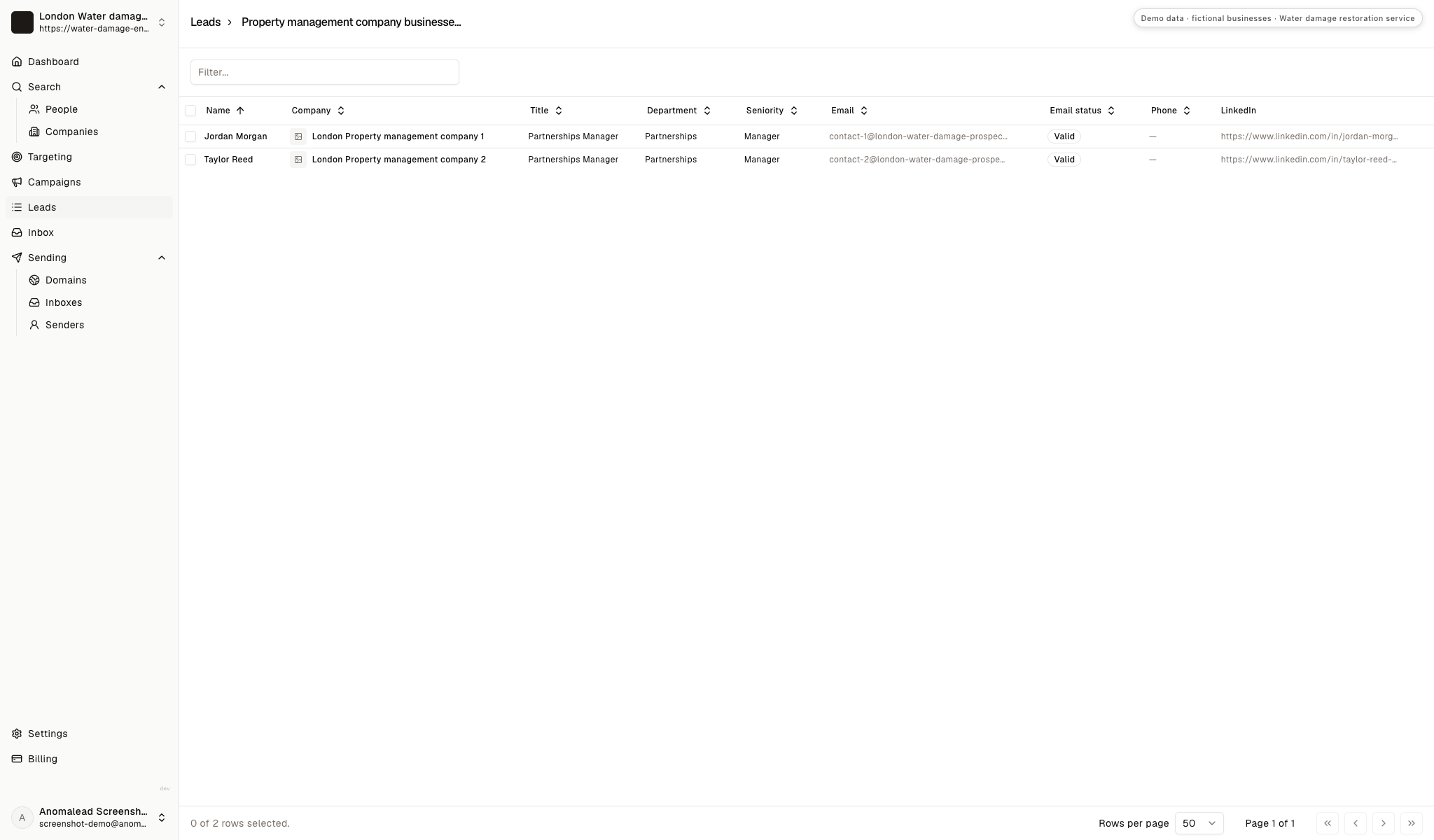
Keep the contact list connected to a real question
Section titled: Keep the contact list connected to a real questionThe lead list contains two selected people for review. Retain each record only when the property account fits your coverage and the contact has a reason to receive a vendor-readiness question.
Is water damage lead generation worth the operating time?
Section titled: Is water damage lead generation worth the operating time?A property-management relationship can cover multiple sites, but a supplier conversation does not guarantee a call-out. Consider the time and equipment capacity needed to pursue the account alongside the contribution from work your team can actually accept.
Use your own assumptions for a typical assessment and drying job, staff time for outreach and vendor onboarding, equipment availability, and the portion of work your crew performs. The calculator is a planning aid, not a forecast of leaks, approvals, assignments or return.
Do the math on one good deal
If one new customer is worth thousands, you don’t need magic. You need a few more meetings a month.
Projected monthly results
- Deals closed
- 2.0
- Projected revenue
- £10,000
- Growth plan (1 business)
- £79/mo
- ROI
- 12,558%
Conservative math on meetings you already believe you can book. One closed deal often pays for a year of Anomalead.
Do not combine source repair, extraction, drying and reconstruction when they have different providers or approval paths. Revisit the assumptions when your service mix or capacity changes.
Introduce the response process before a leak occurs
Section titled: Introduce the response process before a leak occursA concise introduction tells the property manager what water work you perform and how your response is bounded. Do not suggest that you know about a current leak, guarantee arrival that staffing cannot support, or promise a drying outcome before the materials and conditions are assessed.
Ask who reviews water-response vendors and offer a useful next step, such as a coverage summary or document pack. Keep the question specific to building access, source control or service limits. These cold email writing principles can help shape the note without turning it into a generic sales script.
Choose recipients who can route a vendor question
Section titled: Choose recipients who can route a vendor questionThe campaign draft includes two recipients from the fictional lead list. Check the account fit and each person's role before sending, and remove anyone who cannot direct a property-management vendor question.
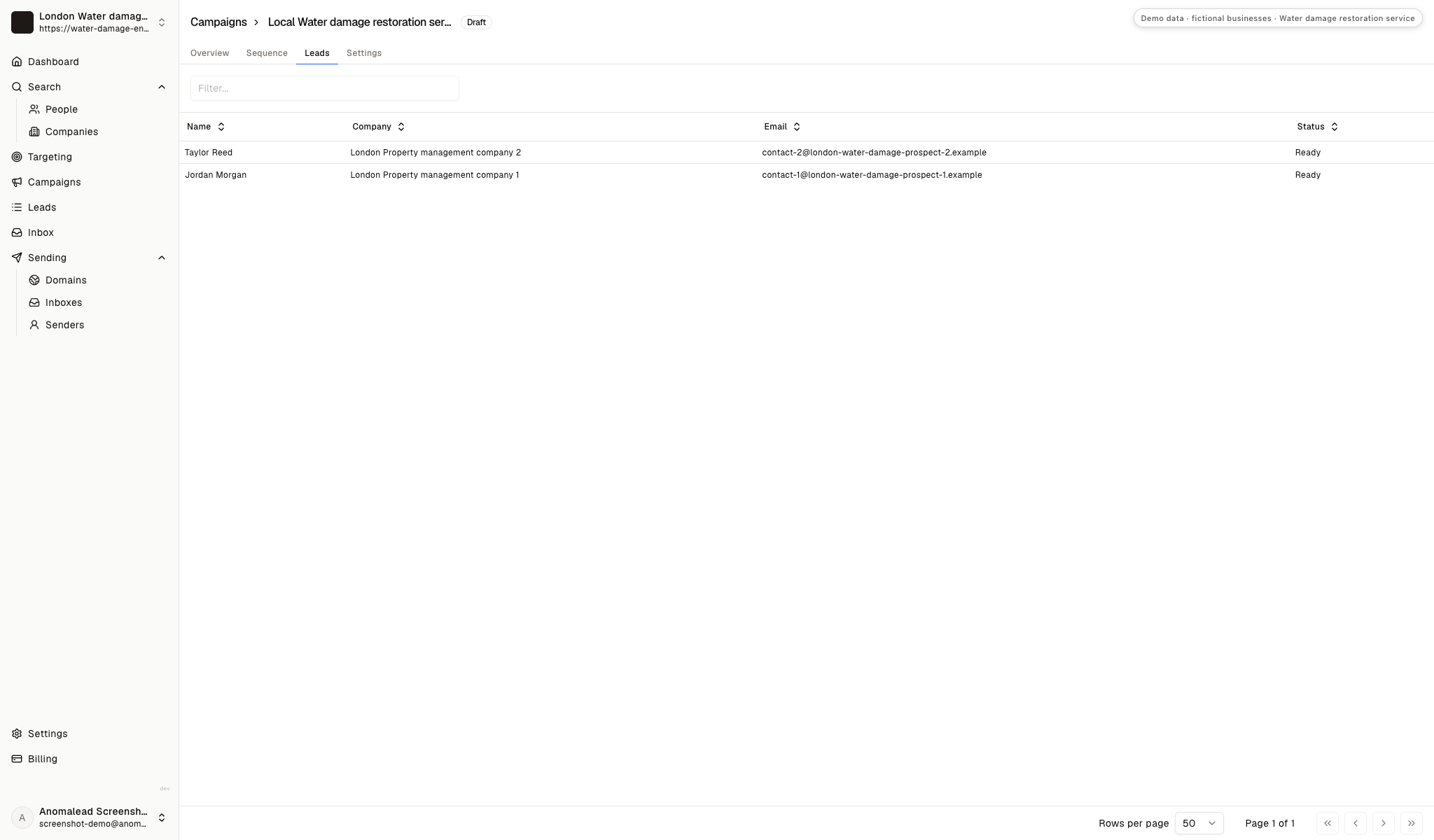
Check follow-ups against a real response window
Section titled: Check follow-ups against a real response windowThe draft sequence has three emails with waits of three days and four days. Replace broad seeded claims with your actual coverage, and stop scheduled follow-ups when someone replies or declines.
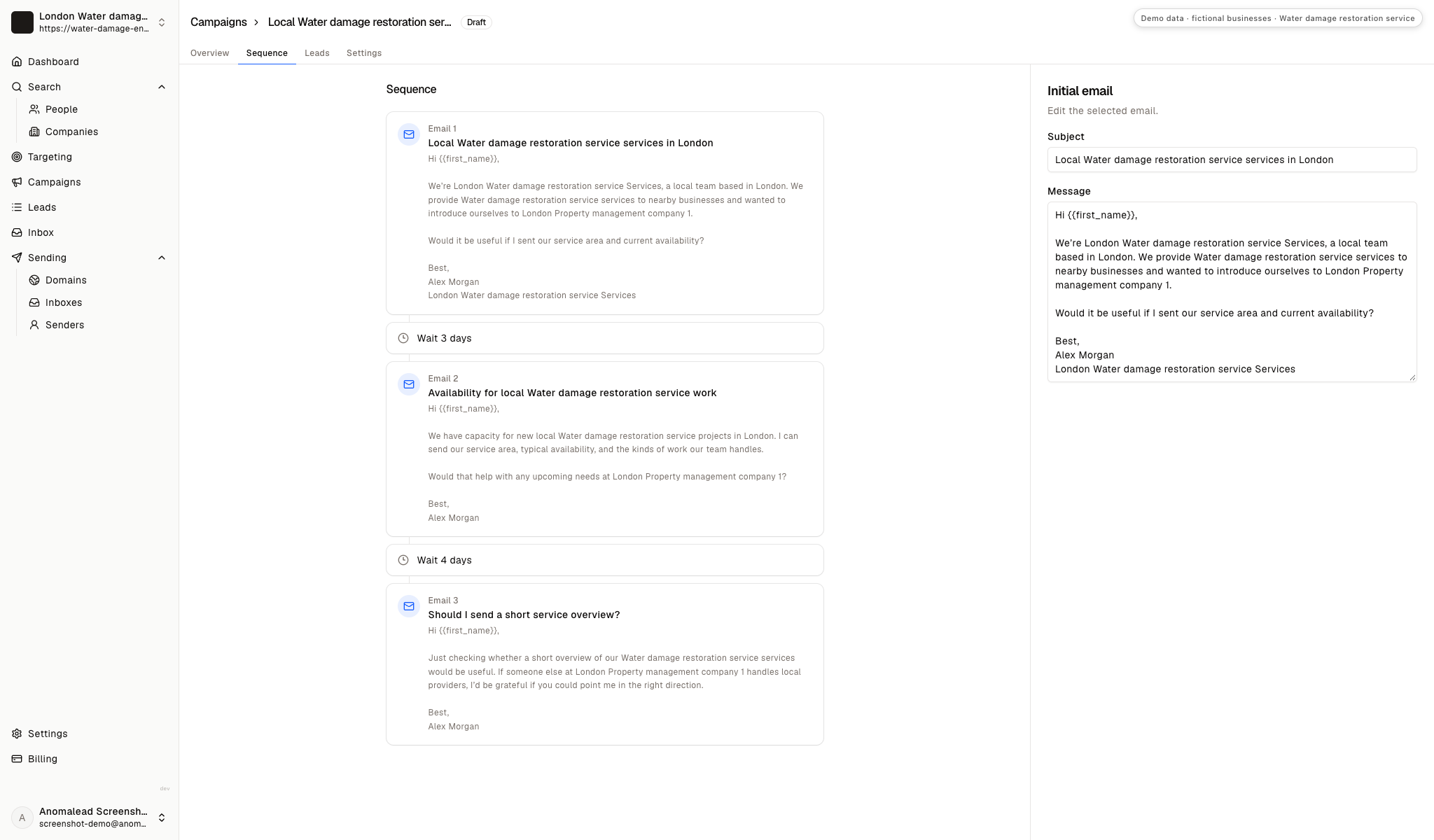
Ask how water-response vendors are reviewed
Section titled: Ask how water-response vendors are reviewedAdapt these messages with the areas, services and records your own team can support. They are introductions before an incident, not claims that a managed building has a leak.
First note about water-response coverage
Subject: Water response coverage for managed buildings
Hi Jordan,
I’m Alex Morgan with a local water-response team. We assess affected areas, coordinate extraction and drying within our service scope, and share the readings and work notes our process records. Source repair remains with the property’s maintenance or plumbing provider.
Who reviews water-response vendors for the buildings you manage?
Best,
Alex Morgan
Follow-up about access and records
Subject: Planning access for a water-loss response
Hi Taylor,
I’m sending a short outline of our operating area, drying services and the information we record during a water-loss job. A site manager can help clarify entry, occupied areas and whether the leak source has been isolated before the crew arrives.
Would a coverage and documentation summary help with your next vendor review?
Regards,
Alex Morgan
Jordan Morgan, Taylor Reed and Alex Morgan are fictional names from the demo fixtures. Add only current service limits and records your team can verify. These B2B outreach email examples are a structure reference, not a script to send unchanged.
Read replies as requests about service fit
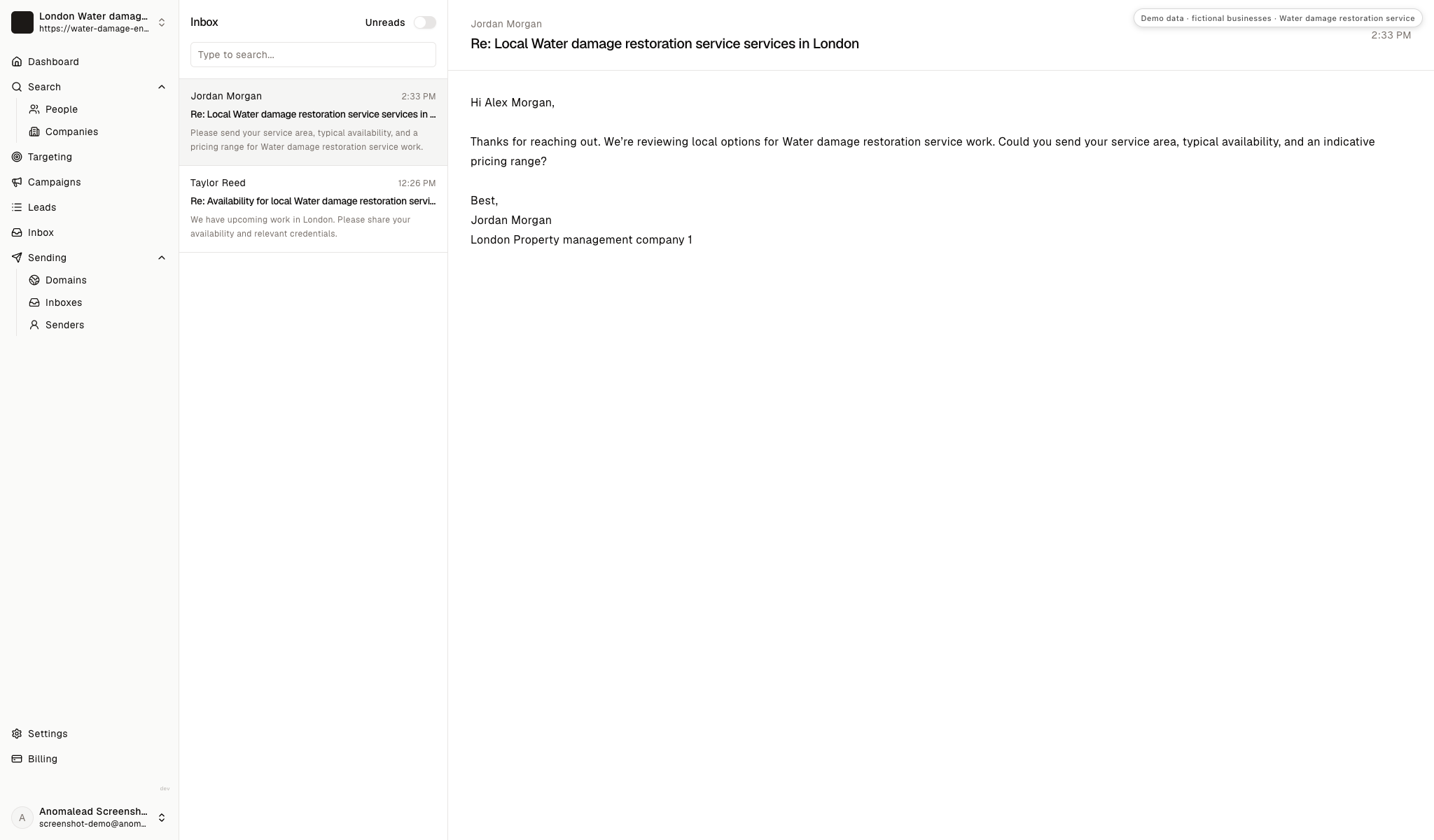
Section titled: Read replies as requests about service fitThe inbox displays two fictional replies about service area, availability, pricing and credentials. Respond to the specific request, then clarify whether the property manager is reviewing suppliers or has a site that needs assessment.
Handle water-loss questions without overpromising
Section titled: Handle water-loss questions without overpromisingThe two first situations below reflect the demo inbox. The later objections are common planning questions; answer within your actual service scope and leave site authorization with the responsible property contact.
Jordan asks about coverage, availability and pricing
Section titled: Jordan asks about coverage, availability and pricingJordan wants to know which areas the crew serves, when it can respond and how an initial price range is prepared.
Share only the locations and call windows the team can staff. Explain that the scope depends on the source, affected materials, access and whether the request covers assessment, extraction or drying. Do not quote a job from the company name or a generic inbox message.
Find out whether Jordan is reviewing a provider list or asking about a particular property.
A possible reply:
Thanks, Jordan. Our service sheet lists the areas we cover and when a crew can be contacted. For an initial assessment we would need the affected location, the type of water source if known, and confirmation that site access can be arranged.
Are you reviewing water-response vendors, or is a managed building waiting for an assessment?
Taylor asks about an upcoming job and credentials
Section titled: Taylor asks about an upcoming job and credentialsTaylor says a water-related project may be coming up and requests available capacity, covered work and relevant credentials.
Send current documents that apply to your team's stated services, plus honest limits on availability. Separate water extraction and drying from source repair or rebuilding if other providers perform those tasks.
Ask which building or vendor-review step is involved before treating the message as a dispatch request.
A possible reply:
Thanks, Taylor. I can send our current service area, availability limits and the records that apply to our water-response work. We confirm the crew and equipment after the affected materials and access needs are understood.
Is this for a particular property, or are you collecting details for supplier review?
The leak source has not been isolated
Section titled: The leak source has not been isolatedWe are still arranging for maintenance to stop the leak. Can your team assess the affected area while that is underway?
Do not promise a drying plan before confirming safe access and the status of the water source. Explain whether your team can perform a limited assessment, and coordinate with the building's maintenance lead or plumber about isolation and entry.
A possible reply:
We can confirm whether an assessment is appropriate once the site lead has shared the affected area and access conditions. Source repair needs to be handled by the responsible maintenance or plumbing contractor.
Who is coordinating access and the source repair at the property?
The manager asks whether drying includes repairs
Section titled: The manager asks whether drying includes repairsDo you replace damaged finishes as well as extract water and dry the structure?
Describe exactly where your contract ends. Drying records may inform a repair scope, but material removal, rebuilding and finish matching can require separate approval or a different trade.
A possible reply:
Our proposal separates extraction and drying from reinstatement so the property team can review each part. We can identify the affected materials and share the records from our work, then confirm who will price the finish repairs.
Would you like us to outline the drying scope first?
Choose one water-loss service profile for the next search
Section titled: Choose one water-loss service profile for the next searchWrite down the buildings you can reach, water events your team handles, equipment you can deploy, drying records you provide, and tasks that belong to a plumber or repair contractor. That profile keeps an account search tied to a real operating fit rather than a broad property label.
Select property managers whose sites match those boundaries, identify the person who controls access or vendor review, and send one useful question. For a practical subject line, use this cold outreach subject guide as a check, then make the wording specific to water response.
Water damage lead generation questions
Section titled: Water damage lead generation questionsHow can a water-damage company find property management clients?
Section titled: How can a water-damage company find property management clients?Build a list of property managers with buildings your team can reach and verify the vendor-review route before looking up individual contacts. Explain your water-response scope, dispatch limits and the records you can provide.
What details are needed before estimating water-damage work?
Section titled: What details are needed before estimating water-damage work?The initial assessment needs the source if known, affected areas and materials, access conditions, and whether the leak has been isolated. A price or drying plan should wait until the site and authorized scope are understood.
How is water-damage lead generation different from broader restoration work?
Section titled: How is water-damage lead generation different from broader restoration work?This guide focuses on water intrusion, extraction, structural drying and the repair handoff. A broader restoration provider may also cover fire, smoke, contents or other loss types, which require a different service offer and qualification conversation.
Are the companies and replies in the screenshots real?
Section titled: Are the companies and replies in the screenshots real?No. The business names, contacts, campaign messages and replies are fictional demo records. They are not Anomalead customers, active leaks, confirmed vendors or campaign results.
What does the water-damage ROI calculator estimate?
Section titled: What does the water-damage ROI calculator estimate?It lets you test your own assumptions about a water-response account, such as job contribution, staff time and equipment capacity. It does not forecast leak frequency, approval, awarded work or a financial return.