


Remodeling lead generation works when a property manager has a defined upgrade, a route to approve it, and a practical way to schedule the work. A managed building is not a project by itself. The useful account is one where the manager can identify the rooms or shared areas in scope, the people affected, and the decision owner who will review a proposal.
Build outreach around a project type your crew can deliver, such as unit-turn renovations, common-area refreshes, or phased improvements to occupied buildings. Ask what is known about scope and timing before promising a start date. This B2B prospecting guide covers the general process; the steps here focus on how remodelers qualify property work.
Key takeaways
- Approach property managers with a specific renovation type and a reason their building portfolio fits your crew.
- Qualify scope, occupancy, access, finish decisions and approval path before preparing a detailed proposal.
- Ask whether the project is at planning, budgeting, procurement or ready-to-schedule stage, then offer the next document or visit that fits.
- Separate unit-turn work from occupied-building upgrades because resident coordination and trade sequencing change the plan.
Which property teams commission remodeling crews?
Section titled: Which property teams commission remodeling crews?Start with property operators who coordinate recurring renovation work and can connect an on-site need to an owner or asset decision. Their role may surface the project, but confirm who approves the scope, budget and contractor before investing in a full estimate.
- Multifamily property managers: Look for managers overseeing apartment buildings with planned unit turns, repeated interior repairs or a common-area upgrade. They can describe how residents are scheduled and where work can be staged. Ask whether the owner handles larger improvements directly or uses an asset manager to approve them.
- Commercial facilities teams: Facilities managers may coordinate office, retail or mixed-use refurbishments around business hours and building operations. Ask how noisy work, deliveries, access badges and temporary service interruptions are handled before proposing a sequence that affects tenants.
- Owner representatives and asset managers: An owner-side contact may set the investment brief, finishes and procurement route for a multi-property programme. They are a better fit when the scope is defined enough to compare contractors, not when all the manager has is a general wish to modernize.
For a project that includes structural changes or several specialist trades, coordinate your role with a construction company partner instead of implying your remodeling crew covers every discipline.
Check the renovation scope before offering a crew
Section titled: Check the renovation scope before offering a crewA remodeling opportunity becomes quote-ready only when the work area, decision path and site conditions are understood well enough to define what your team will deliver. A company listing cannot tell you whether a room is vacant, what sits behind a wall, or which finishes the owner has selected.
- Work package and boundaries: Clarify whether the request covers demolition, carpentry, drywall, cabinetry, paint, floor finishes, or coordination with separate electrical and plumbing trades. List what your team performs and what must be supplied by another contractor so the proposal has a clear edge.
- Occupied or vacant areas: A vacant unit allows a different work plan from a home or office that remains in use. Find out who moves furniture, protects corridors, posts notices, controls keys, and handles questions when occupants remain on site.
- Finish decisions and allowances: Ask whether the buyer has selected flooring, tile, cabinets, fixtures, paint and hardware. If choices remain open, explain how the estimate treats allowances and what must be approved before materials are ordered.
- Trade sequence and dependencies: A renovation may move from removal to rough-in, inspection, wall repair and finish installation. Identify which subcontractors or building systems must be ready before your crew can close a wall or install a finish, and who coordinates those handoffs.
- Procurement, permits and schedule: Find out whether the manager needs insurance documents, references, a written work method, tender forms or a permit plan. Ask who reviews the proposal and what decision meeting or budget window will control scheduling; avoid promising a start before approvals and long-lead selections are clear.
Use a lead generation marketing plan to organize account research, but keep the first project conversation grounded in details the property team can confirm.
About the sample workspace
The sample screens use the fictional operator London General contractor Services, three generic property-management company records, fictional contacts Jordan Morgan and Taylor Reed, and invented inbox replies. These records demonstrate a workflow; they are not Anomalead customers, approved projects, signed contracts or actual campaign outcomes.
Build a remodeling prospect list around planned work
Section titled: Build a remodeling prospect list around planned workSearch for property-management companies that oversee sites within your working radius and handle the kind of renovation your team can staff. A company result is only a research lead; it does not show that a building has a budget, an open tender or an approved scope.
Review each account for building type, portfolio responsibilities and signs that a project could be coordinated across more than one unit or shared area. Keep planned upgrades separate from emergency maintenance, then record what you know and what a manager still needs to confirm.
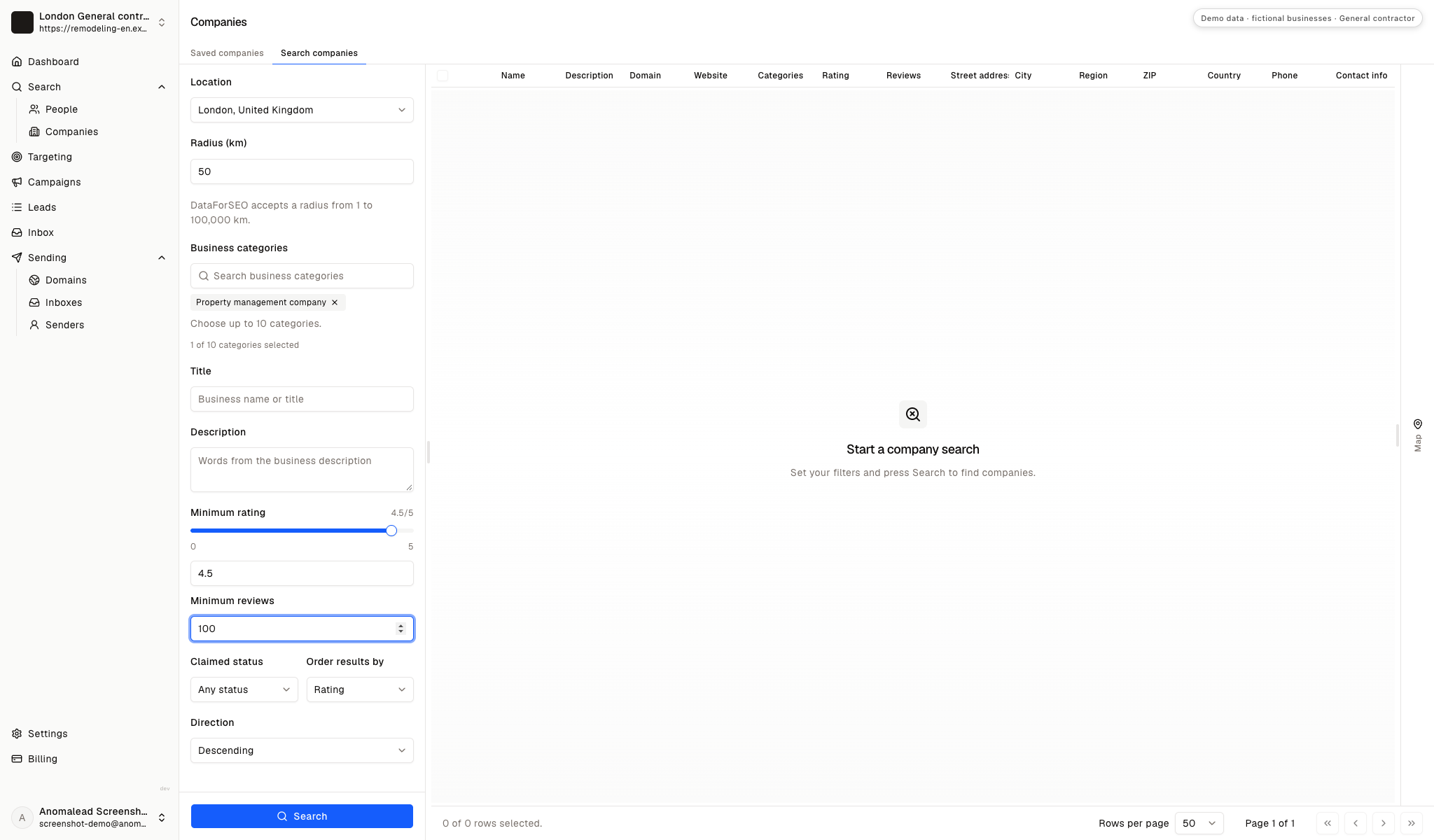
Set the search area around the crew and project type
Section titled: Set the search area around the crew and project typeChoose a location and the property-management category your team wants to research. The filters describe a company search, not a renovation brief or a property with an approved project.
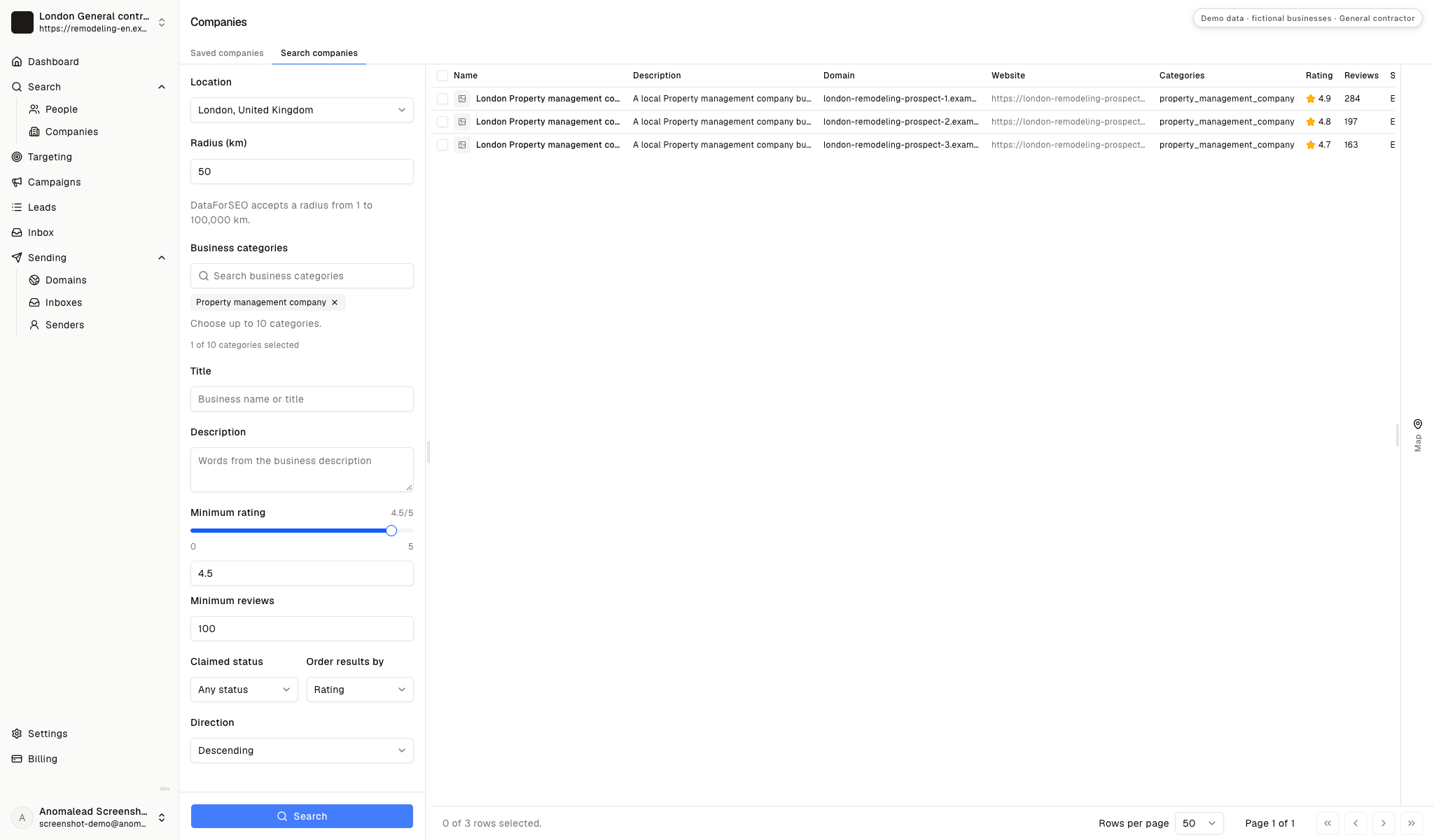
Review account records before assigning project fit
Section titled: Review account records before assigning project fitThe table contains fictional company profiles, not building condition reports or active renovation requests. Check each organization’s actual portfolio and service area elsewhere before deciding whether its properties match your crew.
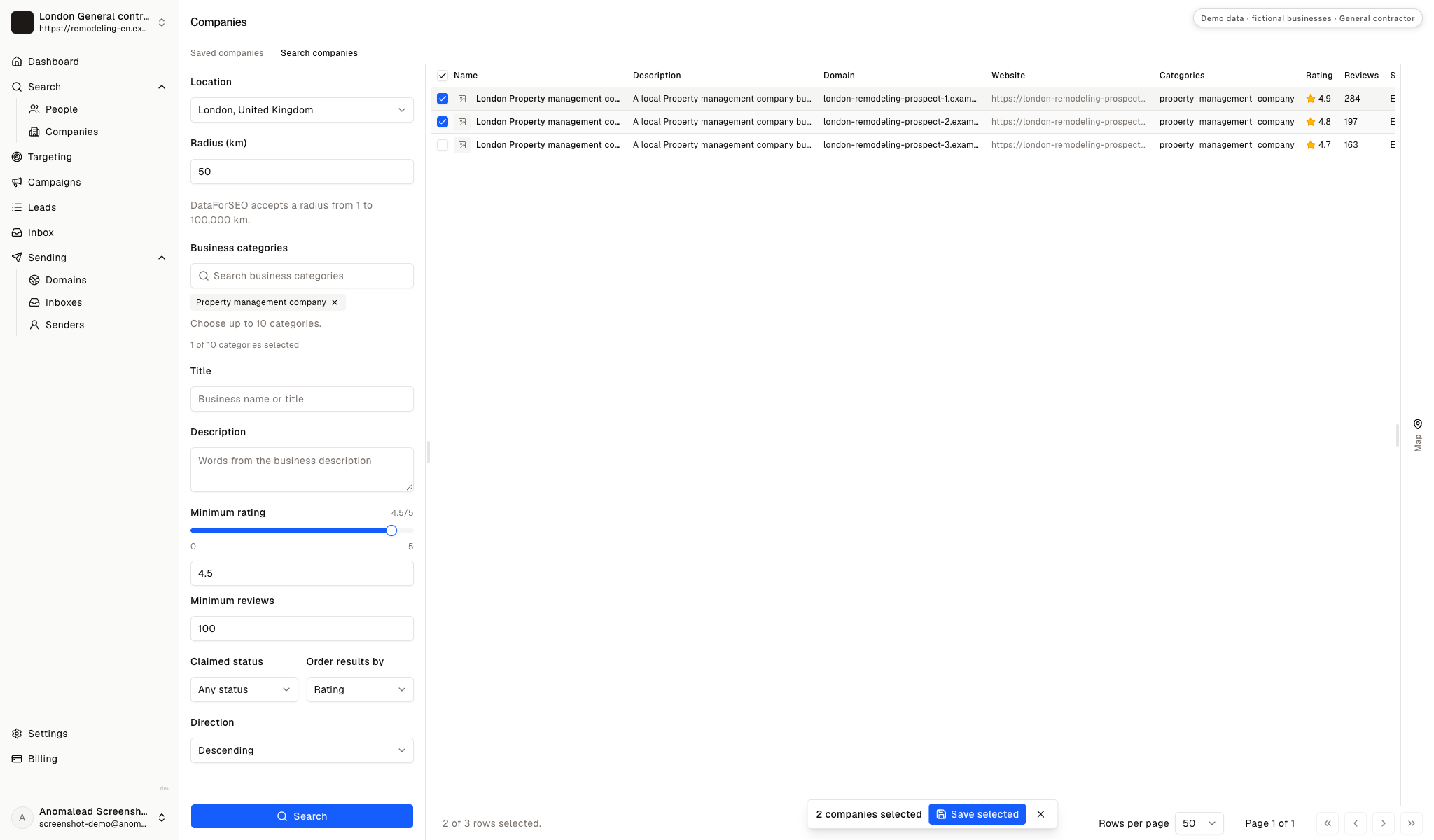
Save accounts with a plausible renovation route
Section titled: Save accounts with a plausible renovation routeKeep a property firm only when its portfolio and responsibilities justify further research. Treat the saved companies as a working queue, not as evidence that the manager needs a remodeling contractor.
Identify who owns scope, site access and approval
Section titled: Identify who owns scope, site access and approvalA property manager can route a renovation discussion and explain how tenants or residents are notified. A facilities lead may know the building rules and site constraints, while the owner or asset manager can approve a broader scope. Confirm these responsibilities instead of assuming a job title reveals purchasing authority.
Project coordinators and surveyors can help clarify drawings, finish schedules and contractor submissions. Ask who gathers those materials and whether procurement requires a formal tender, then approach the contact who can move the project into review.
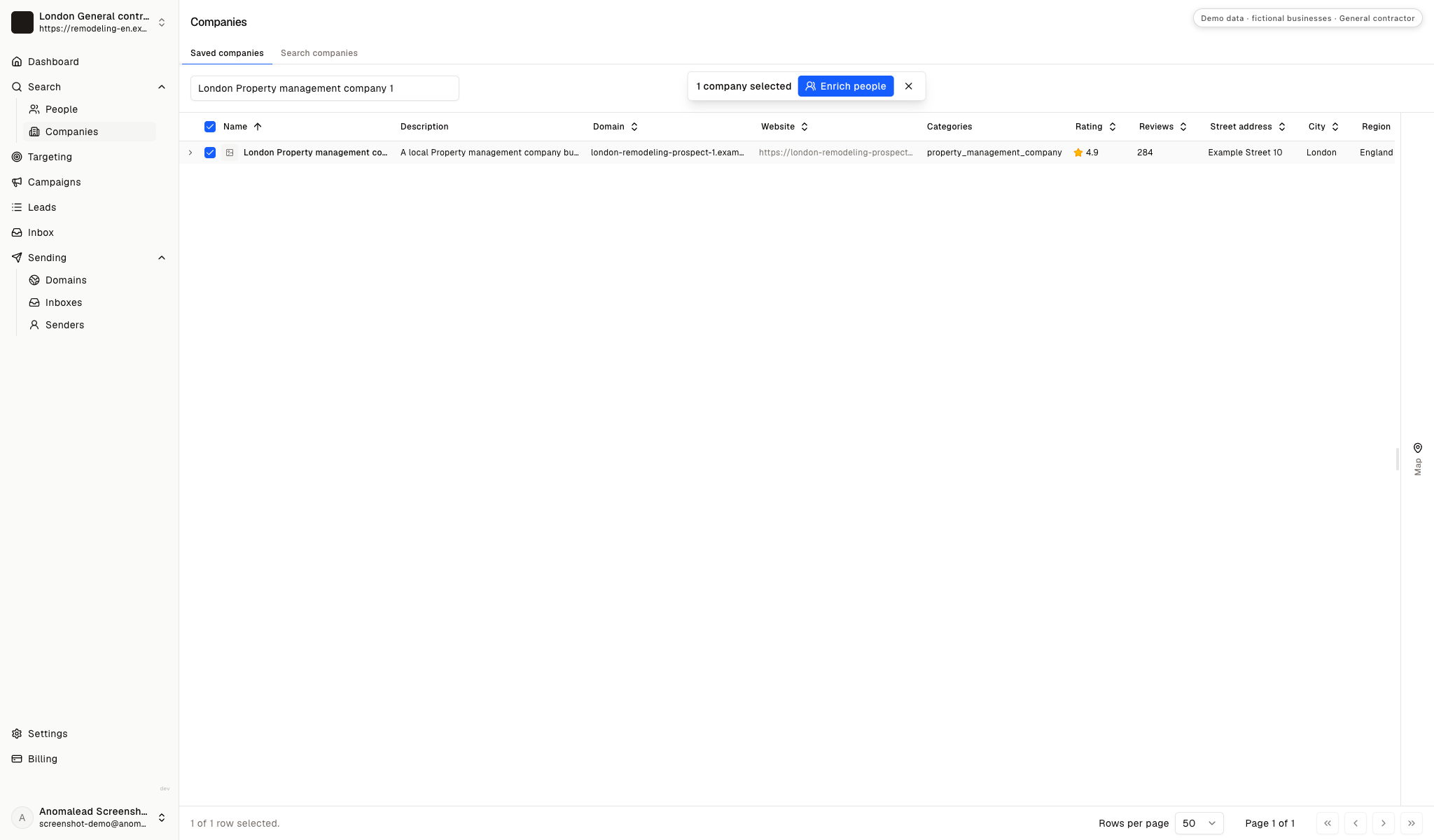
Recheck the property account before finding people
Section titled: Recheck the property account before finding peopleConfirm the organization manages properties in your service area and is relevant to the renovation work your crew performs. If its role or portfolio is unclear, verify those facts before enriching contacts.
Compare the contacts with the project decision
Section titled: Compare the contacts with the project decisionThe example account returns two contacts. Check their responsibilities and find out who handles building operations, contractor coordination or owner approvals; a contact record alone does not confirm authority over renovation work.
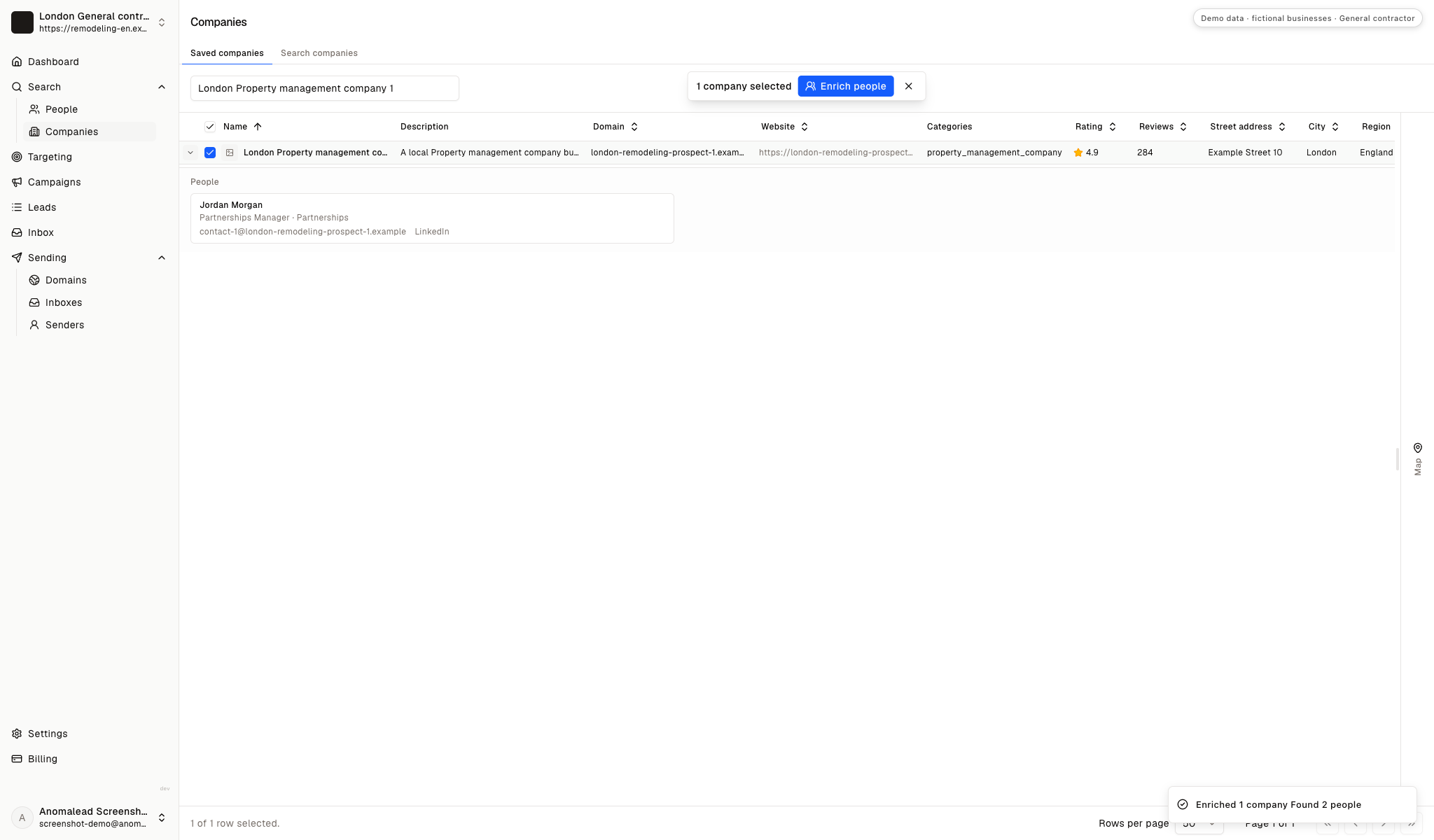
Keep the working list connected to a project route
Section titled: Keep the working list connected to a project routeInclude contacts who can route a scope discussion or identify the facilities and asset team. Leave out names with no connection to property operations unless the manager confirms they handle contractor introductions.
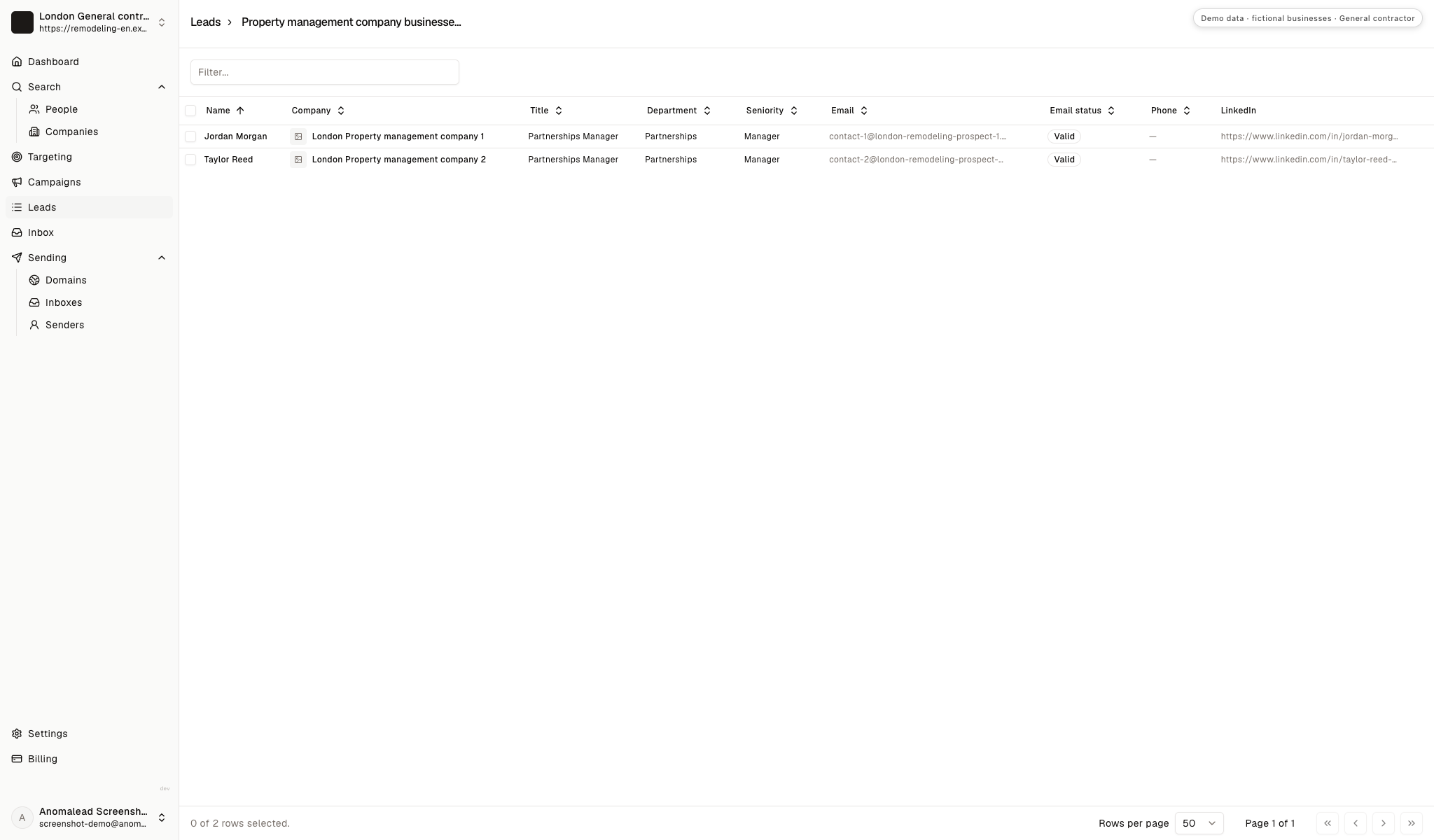
Estimate project value from the work package
Section titled: Estimate project value from the work packageA remodeling project can combine demolition, finish work, site protection, specialist trades and coordination with occupants. A room refresh and a phased renovation across occupied units have different labor and management demands, so a generic company profile cannot establish what a contract is worth.
Use the calculator to explore your own assumptions about qualified projects and sales progression. It does not measure a building, select a finish package, estimate labor, price a subcontractor or predict whether an owner will approve a proposal.
Enter your own assumptions about project value and sales activity. The output is a planning aid, not a contractor quote, industry benchmark or forecast of a specific property contract.
Do the math on one good deal
If one new customer is worth thousands, you don’t need magic. You need a few more meetings a month.
Projected monthly results
- Deals closed
- 2.0
- Projected revenue
- £10,000
- Growth plan (1 business)
- £79/mo
- ROI
- 12,558%
Conservative math on meetings you already believe you can book. One closed deal often pays for a year of Anomalead.
Before treating the result as an opportunity, confirm the room or area list, finish decisions, occupied-site rules, trade dependencies and approval route with the property team.
Lead with the project sequence and occupant plan
Section titled: Lead with the project sequence and occupant planProperty managers need to know how a contractor will define the work and limit disruption. Say whether you begin with a site review, how you separate confirmed tasks from open selections, and what information you need before setting a schedule.
Send one message to one kind of buyer with one useful request, such as a discussion about an upcoming unit-turn package. A plain cold email framework can keep the note focused, while your actual question should reflect the project stage and the person receiving it.
Choose recipients who can move a project to review
Section titled: Choose recipients who can move a project to reviewThe draft includes two fictional contacts. For real outreach, check whether each person handles property operations, contractor procurement or owner-side planning before adding them to a remodeling sequence.
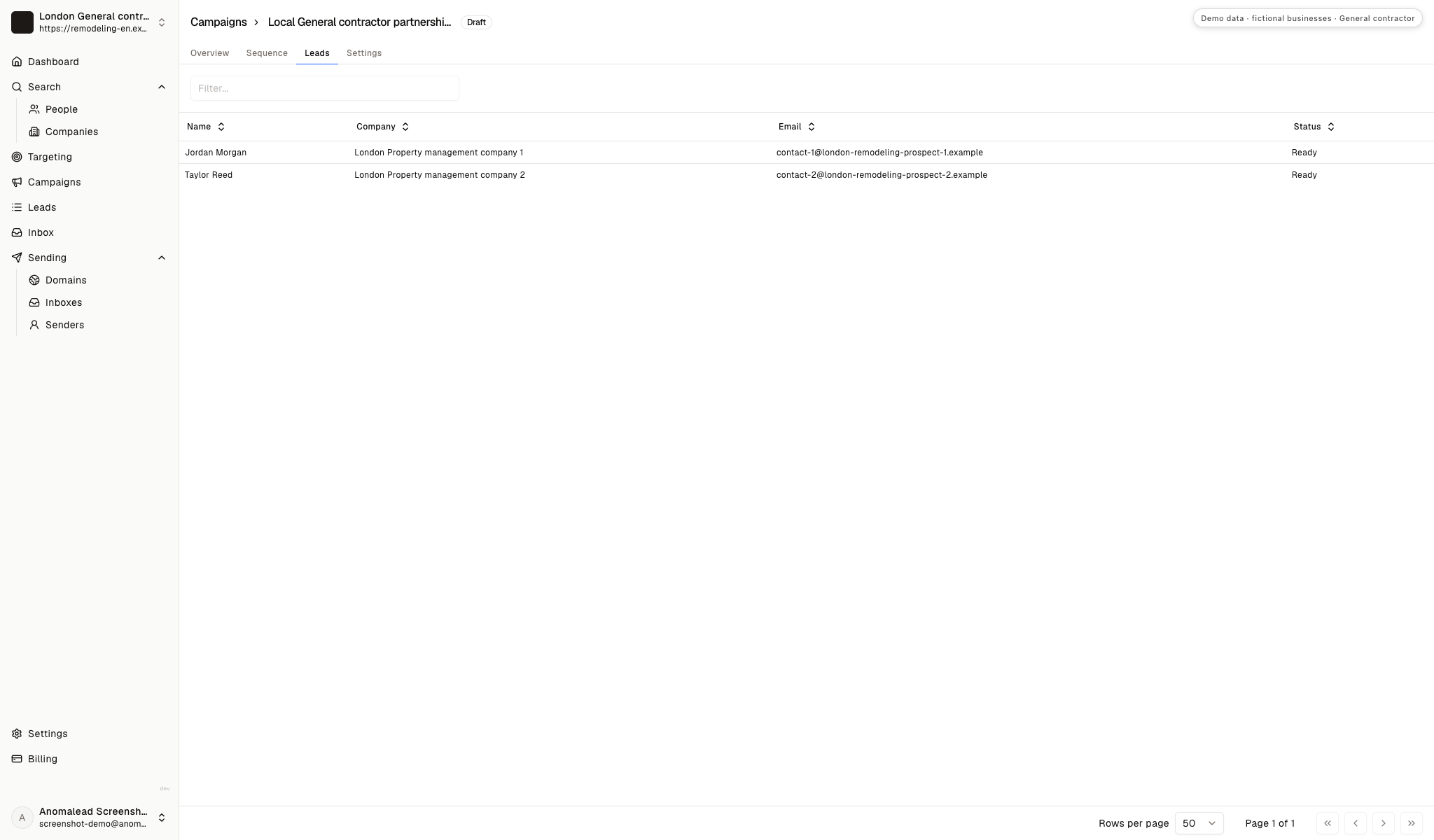
Review the follow-up plan before activation
Section titled: Review the follow-up plan before activationThe sequence contains an opening email and two later messages with scheduled waits. Replace generic claims with a project-specific request, and stop future notes if the recipient responds or declines.
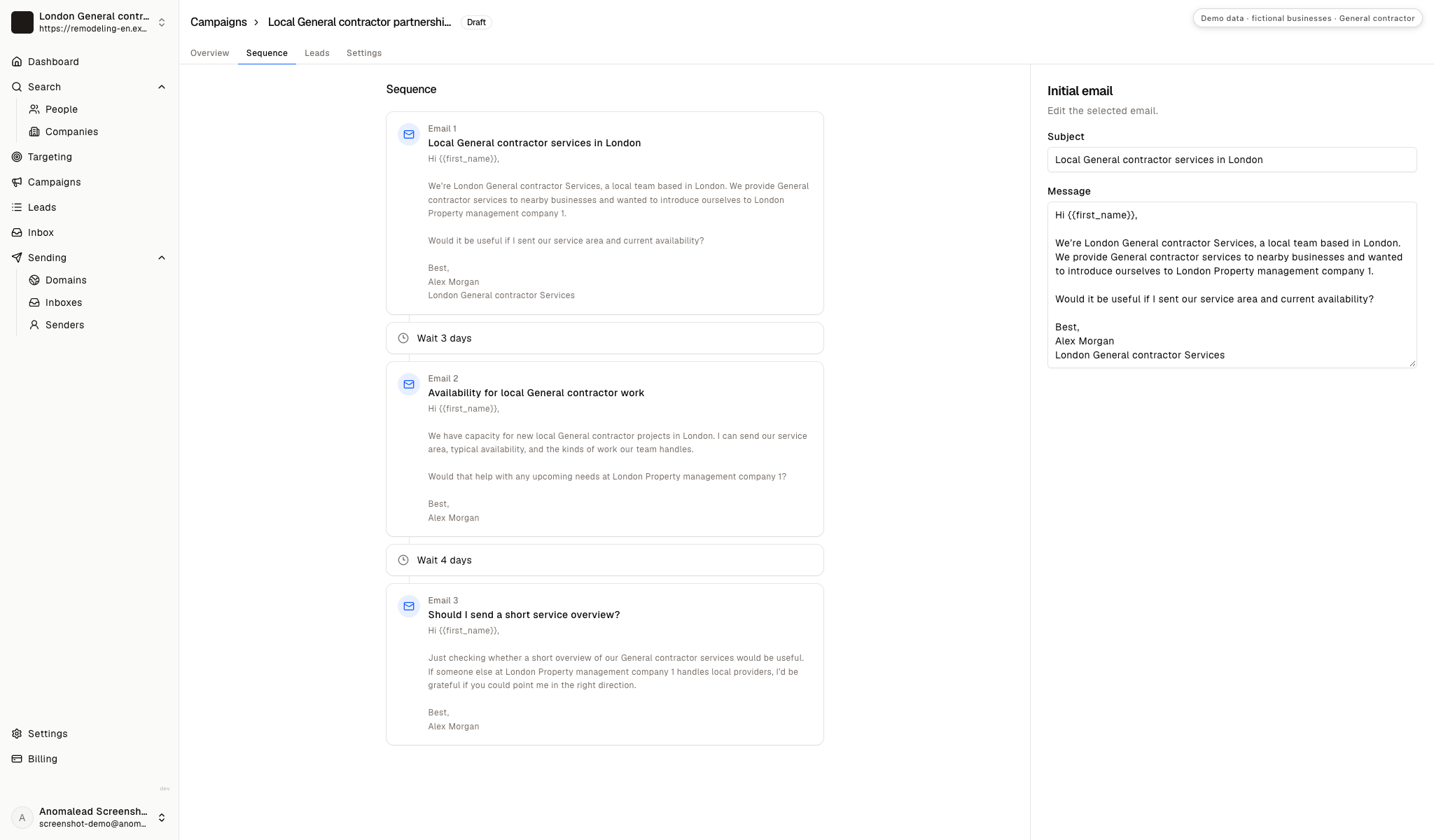
Ask for a useful project conversation
Section titled: Ask for a useful project conversationThese messages are written for property managers who can identify a renovation route. Replace the sample context with a verified building or project detail, and promise only work your crew is prepared to deliver.
First email about a managed property
Subject: Planning a phased renovation at your properties
Hi Jordan,
I’m Alex Morgan from London General contractor Services. Our remodeling crew helps property teams define interior upgrade work, coordinate access and separate confirmed tasks from finish choices that still need approval.
Would you be the right person to discuss how your team plans a renovation before contractors prepare a scope?
Best, Alex Morgan
Follow-up about contractor requirements
Subject: What does your team need before a renovation visit?
Hi Taylor,
I’m following up in case your team is planning an apartment turn or a shared-area refresh. Before setting a visit, we would want to understand whether the area is occupied, what trades are in scope and how your team reviews contractor proposals.
Is there a project where a short scope discussion would help?
Regards, Alex Morgan
Jordan Morgan, Taylor Reed and Alex Morgan are fixture names for this fictional example. Keep qualifications and past-work claims limited to documents your business can supply. For more business email templates, use the structure as guidance and write the project details yourself.
Read replies as requests for scope, timing or proof
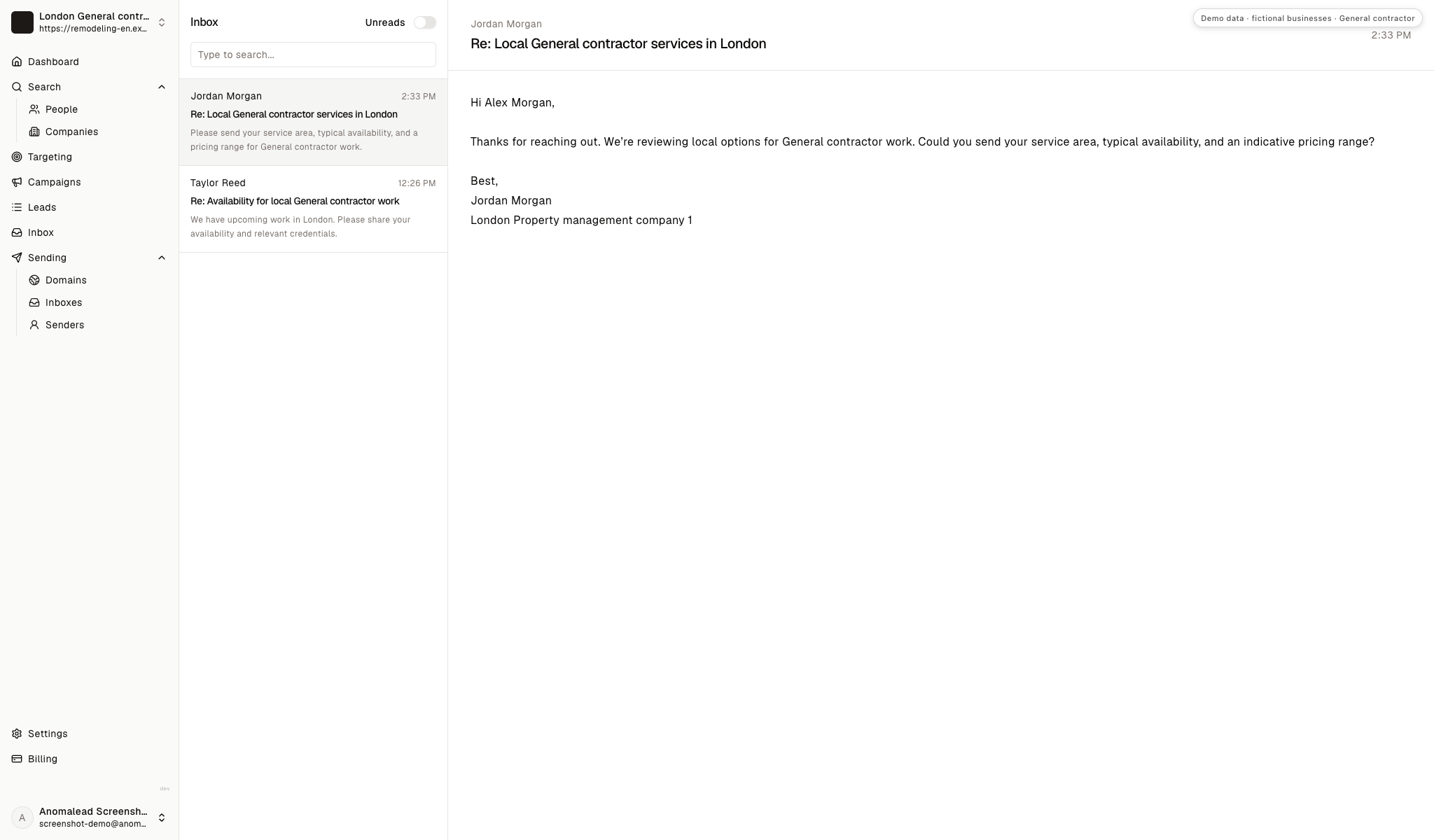
Section titled: Read replies as requests for scope, timing or proofThe inbox shows a question about service coverage and price, and a possible project request for availability and credentials. Neither reply gives enough detail to price work or reserve a crew.
Turn a remodeling enquiry into a scope review
Section titled: Turn a remodeling enquiry into a scope reviewAnswer the specific request, then find the project stage and the next decision the property team must make. Keep the proposed next step small, such as sharing contractor documents or reviewing an area list, rather than sending a full estimate before the work is defined.
Jordan asks for service coverage, availability and pricing
Section titled: Jordan asks for service coverage, availability and pricingPlease send your service area, usual availability and an indicative price range for remodeling work.
This fictional note from Jordan Morgan at London Property management company 1 is a useful opening, but the project scope is missing. Share your actual coverage and the kinds of interior work your crew undertakes. Explain that price depends on areas, finishes, access and trade coordination, then ask whether the request concerns a vacant unit or occupied building.
A clear response might read:
Thanks, Jordan. I can confirm our service area and the remodeling work we take on. Cost depends on the rooms, selected finishes, site access and which trades are required. Is there a particular property or package you are reviewing?
Taylor asks about a possible project and credentials
Section titled: Taylor asks about a possible project and credentialsWe may have a project coming up. Please send availability and the qualifications relevant to your work.
Taylor Reed’s fictional reply at London Property management company 2 indicates a possible project but does not define its stage. Send current insurance and relevant trade qualifications, then establish whether the buyer is budgeting, requesting bids or preparing a site review.
Tie your follow-up to the project stage:
Thanks, Taylor. I can share our current contractor information and the qualifications that match our work. Could you tell me which areas are under consideration and whether your team has a brief or site plan yet?
The manager already has a contractor for building work
Section titled: The manager already has a contractor for building workWe have a contractor handling our current renovation work.
Respect an existing appointment and do not imply that the property team should replace a contractor mid-project. A future unit-turn programme or a separately scoped phase may use a different selection process; ask only whether another bid would be useful and when.
A respectful answer could be:
Understood. I would not interrupt an active project. If your team scopes a separate phase or a later programme, would it be appropriate for us to introduce our crew then?
A buyer wants a fixed price before selections are made
Section titled: A buyer wants a fixed price before selections are madeCan you confirm the total before we choose materials and finishes?
Do not disguise allowances or assumptions as a firm contract sum. Explain how missing finish choices, hidden conditions, trade dependencies and change approvals affect the scope. Offer a site review or an estimate with clearly stated exclusions if that matches your process.
Set the boundary and offer a next step:
We can outline a preliminary scope, but a firm proposal needs the area list, finish decisions and any trade work included. Could we review those together before I prepare a price?
Choose a project type for the next prospecting batch
Section titled: Choose a project type for the next prospecting batchPick one project segment your crew can deliver, such as vacant-unit turns or common-area refurbishment, and research property managers responsible for similar buildings. Before reaching out, write down the project evidence you need and the documents you can provide.
Use your first conversation to learn who defines the work, who approves it and how the property schedules access. If the brief grows into a wider build, coordinate with the right construction team; keep your own proposal honest about its scope and trade coverage. Compare possible subject lines with these cold email subject examples.
Remodeling lead generation questions from contractors
Section titled: Remodeling lead generation questions from contractorsWhich property managers are worth approaching for remodeling work?
Section titled: Which property managers are worth approaching for remodeling work?Start with managers overseeing buildings where your crew can handle the likely renovation scope and access requirements. Confirm that they coordinate contractor selection or can introduce the owner-side approver before preparing a detailed proposal.
What should I know before estimating a managed-property renovation?
Section titled: What should I know before estimating a managed-property renovation?Ask for the area list, occupancy status, known drawings, finish decisions, building rules and procurement path. The estimate should state what your team includes, which trades are separate, and how open selections or hidden conditions will be handled.
How do I win work in an occupied building?
Section titled: How do I win work in an occupied building?Explain how you will coordinate resident notices, access windows, dust protection, material deliveries and daily site handover. The manager needs a plan that respects operations as well as a description of the finished rooms.
Are the property companies and contacts in the screenshots real?
Section titled: Are the property companies and contacts in the screenshots real?No. London General contractor Services, the property-management firms, Jordan Morgan, Taylor Reed and their replies are fictional demo records. They are not Anomalead customers, awarded projects or campaign results.
Does the ROI calculator estimate a renovation quote?
Section titled: Does the ROI calculator estimate a renovation quote?No. It combines only the sales and project assumptions you enter. It cannot inspect rooms, confirm hidden conditions, choose finishes, calculate a contract price or predict an award.