


Plastic surgery lead generation through local employers works when the practice offers something an HR team can safely hand to staff: a clear route to a consultation with a qualified surgeon and plain information about what that involves. Employers do not buy surgery and should never be asked to promote it, but they do keep health resources and field staff questions about time off and recovery.
This guide shows a surgical practice how to pick employers worth contacting, reach the person who maintains those resources, and write outreach that stays informational. It is a slow, relationship-based channel. If email prospecting is new to the practice, read what cold outreach to employers involves before sending anything.
Key takeaways
- A plastic surgery practice should approach local employers as a source of trusted patient information, not as a channel for promotions, staff discounts or group bookings.
- HR benefits leads can decide whether neutral patient information belongs on a resource page; occupational health advisers may help with return-to-work logistics while leaving treatment choices with the patient.
- Offer a factual information sheet covering how consultations work, how to check a surgeon's registration and what recovery planning involves.
- Promise confidentiality in writing: the employer never learns which employees contacted the practice.
- Check the medical advertising, referral and professional-conduct rules that apply to your practice before any employer outreach goes out.
Plastic surgery lead generation through employer health resources
Section titled: Plastic surgery lead generation through employer health resourcesAim at the people who already answer health questions from staff. They want a local provider they can point to without appearing to endorse a procedure.
- HR benefits and wellbeing leads: They maintain the intranet page or benefits handbook listing health resources, and they worry that anything they share could look like the company recommending cosmetic treatment.
- Occupational health advisers: Some coordinate a phased return when an employee has a medical absence, but they do not choose the surgeon or make clinical decisions. A named practice contact can answer logistical questions about appointments and documents when the patient chooses to share them.
- People or office managers at mid-sized firms: Without a benefits team, one person handles leave requests. They need a short, factual document they can forward.
Where your surgeons offer reconstructive work, lead with it: it gives occupational health a clearer reason to talk. The dental approach to employee care partnerships with offices is a useful comparison, though a surgical practice has to be far more careful about tone.
Signs an employer suits an information partnership
Section titled: Signs an employer suits an information partnershipAn employer that fails the last two checks is not a fit, however large it is.
- A people function that curates resources: Look for a benefits page, a wellbeing programme or an occupational health provider. Someone must own the list your information would sit on.
- Staff within reach of follow-up appointments: Surgery means several post-operative visits, so offices near the clinic beat big names far away.
- How health benefits are routed: Some employers only list providers through a health plan, an insurer's network or an employee assistance service, which may rule out a direct listing.
- Appetite for neutral information: An employer asking for a staff discount or a sponsored event wants a perk your rules may not allow. Politely leave it.
- Acceptance of patient confidentiality: An employer that expects reports on which staff made contact should not go on the list.
About the demo workspace
The screenshots use the fictional practice London Plastic surgeon Services. London Corporate office 1, London Corporate office 2, London Corporate office 3, Jordan Morgan, Taylor Reed and both inbox replies are demo data, not Anomalead customers, real employers, patients or campaign results.
Search for employers near the practice
Section titled: Search for employers near the practiceStart with the corporate office category and an area your patients can realistically travel from for consultations and aftercare. The search gives you companies to research, not employers who have agreed to anything.
Base the area on where current patients live and where your theatre sessions run, not only on the clinic address.
Set the office category and an aftercare-friendly radius
Section titled: Set the office category and an aftercare-friendly radiusChoose corporate offices as the prospect category, then set a location and radius that fit where your practice can actually see and follow up with patients. The rating filter only narrows the results; it does not show employer size, benefits or interest, so verify a people or health-resource role separately.
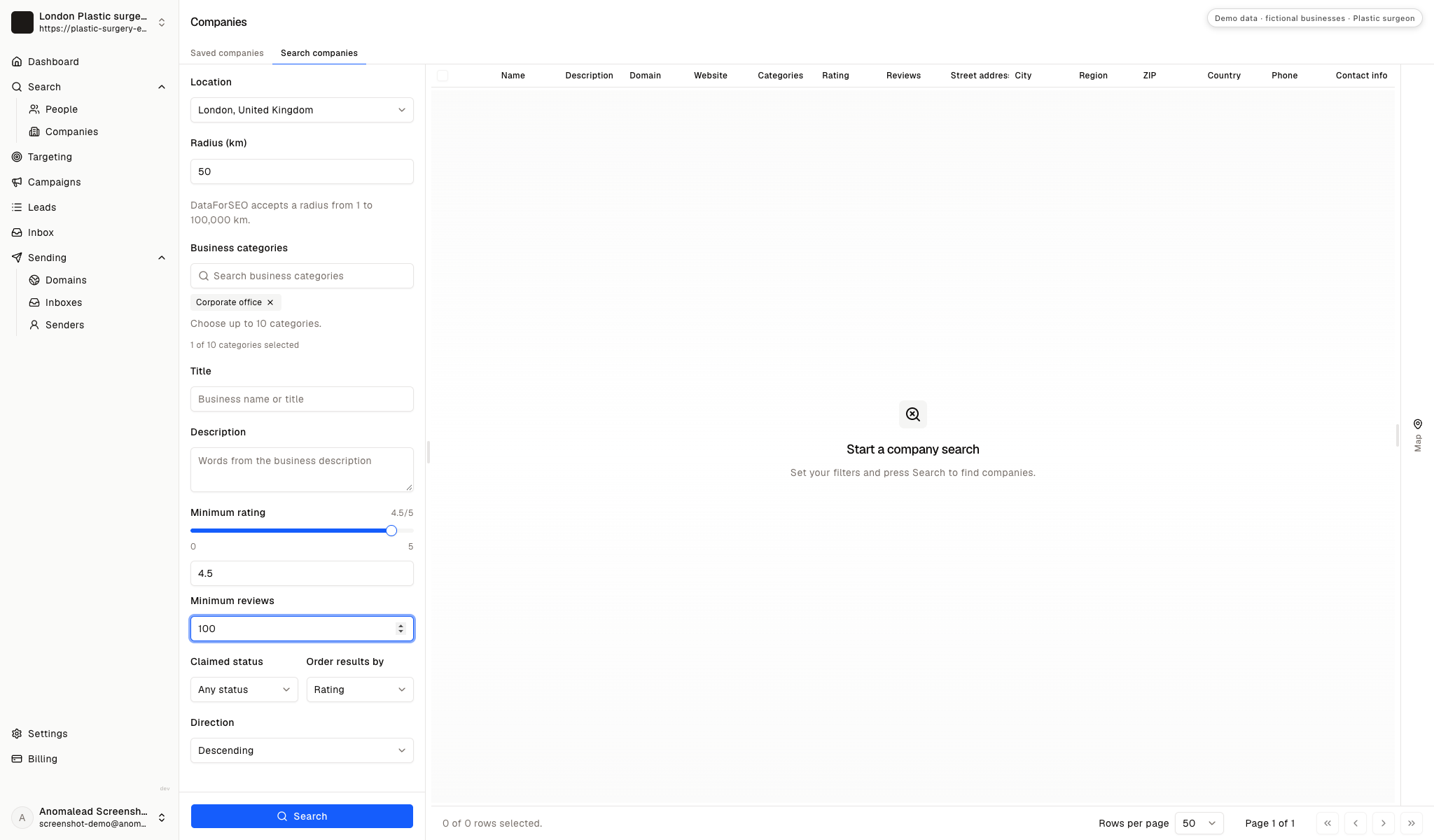
Read the three office results for fit
Section titled: Read the three office results for fitThe results list three fictional offices with ratings and review counts. A high rating says nothing about staff numbers, benefits or occupational health.
Open each company's site and look for a careers page or benefits section before deciding.
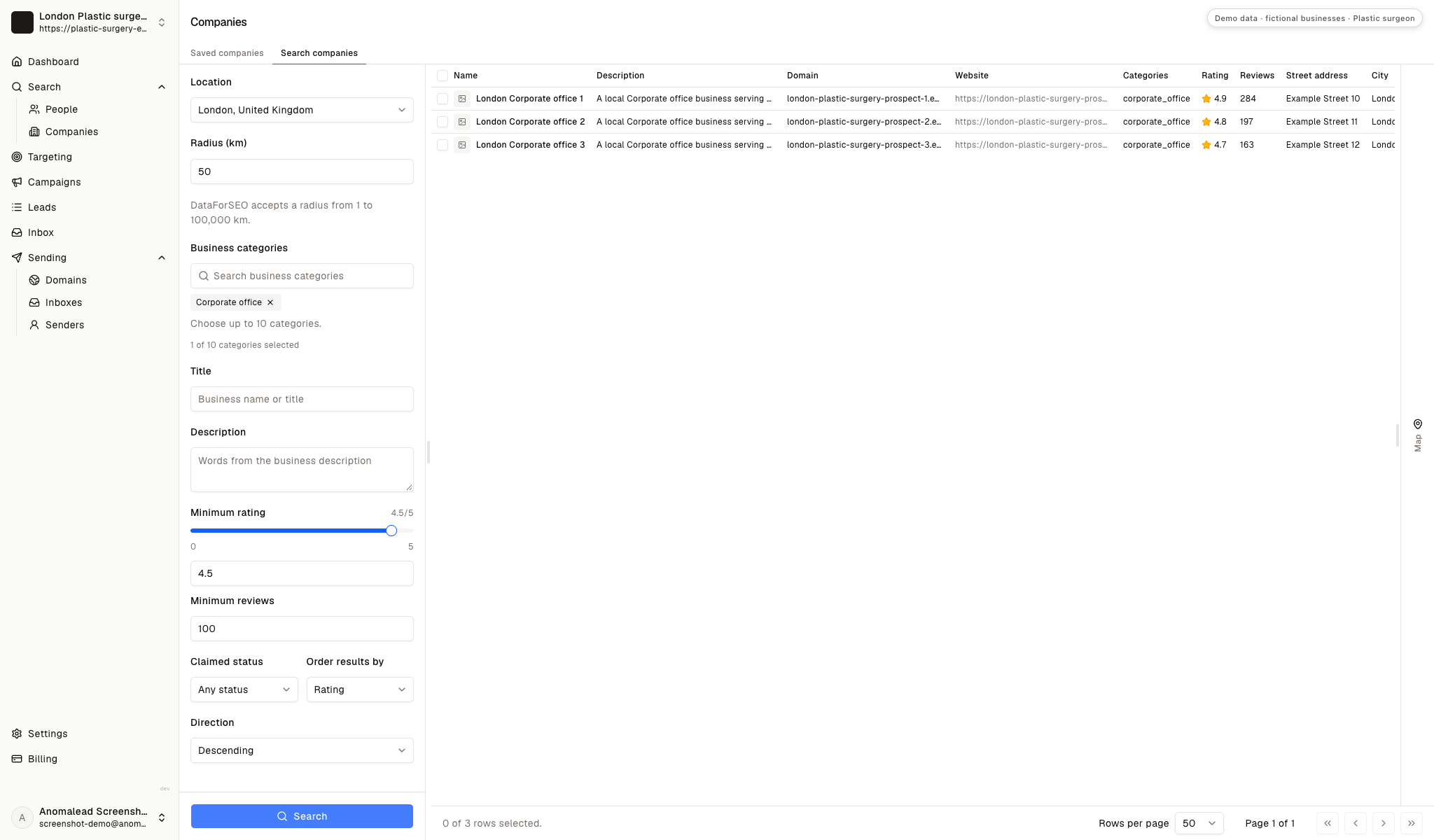
Keep two offices that could use patient information
Section titled: Keep two offices that could use patient informationTwo of the three offices are ticked and ready to save. Save only employers where you have seen evidence of a people function; the third can wait until you know more.
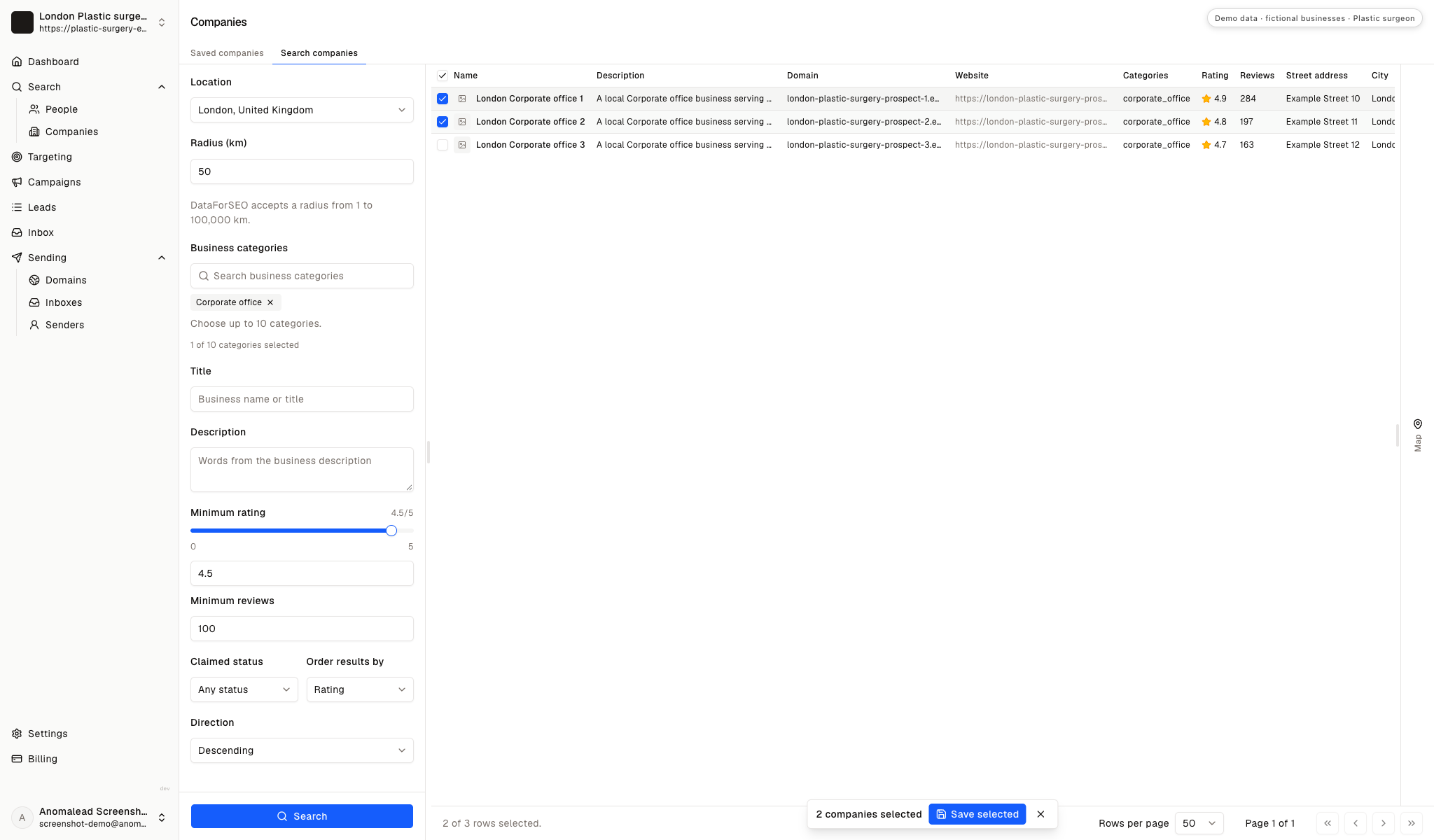
Reach the people who keep staff health information
Section titled: Reach the people who keep staff health informationFind the person who decides what goes on the employer's health resource list, or the adviser who manages returns to work. A generic partnerships inbox usually forwards messages to one of them.
Never contact employees directly or use an employer as a way to reach individual staff. Your outreach goes to the organisation's resource owner, and patients reach you on their own terms.
Look at the saved office before enrichment
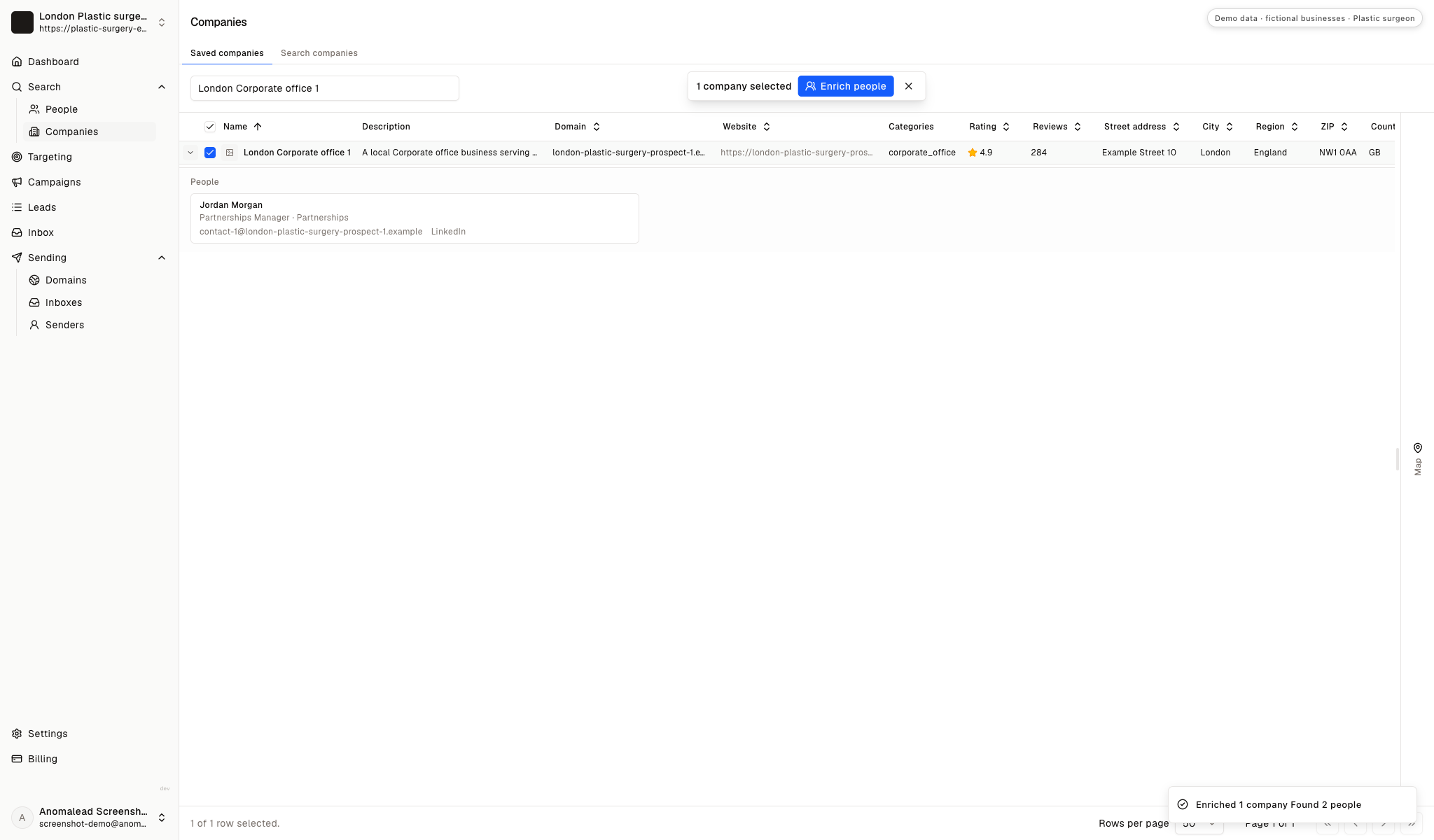
Section titled: Look at the saved office before enrichmentLondon Corporate office 1 is selected in the saved companies view, with the Enrich people action available. Confirm the office still fits your area and your qualification notes before paying attention to names.
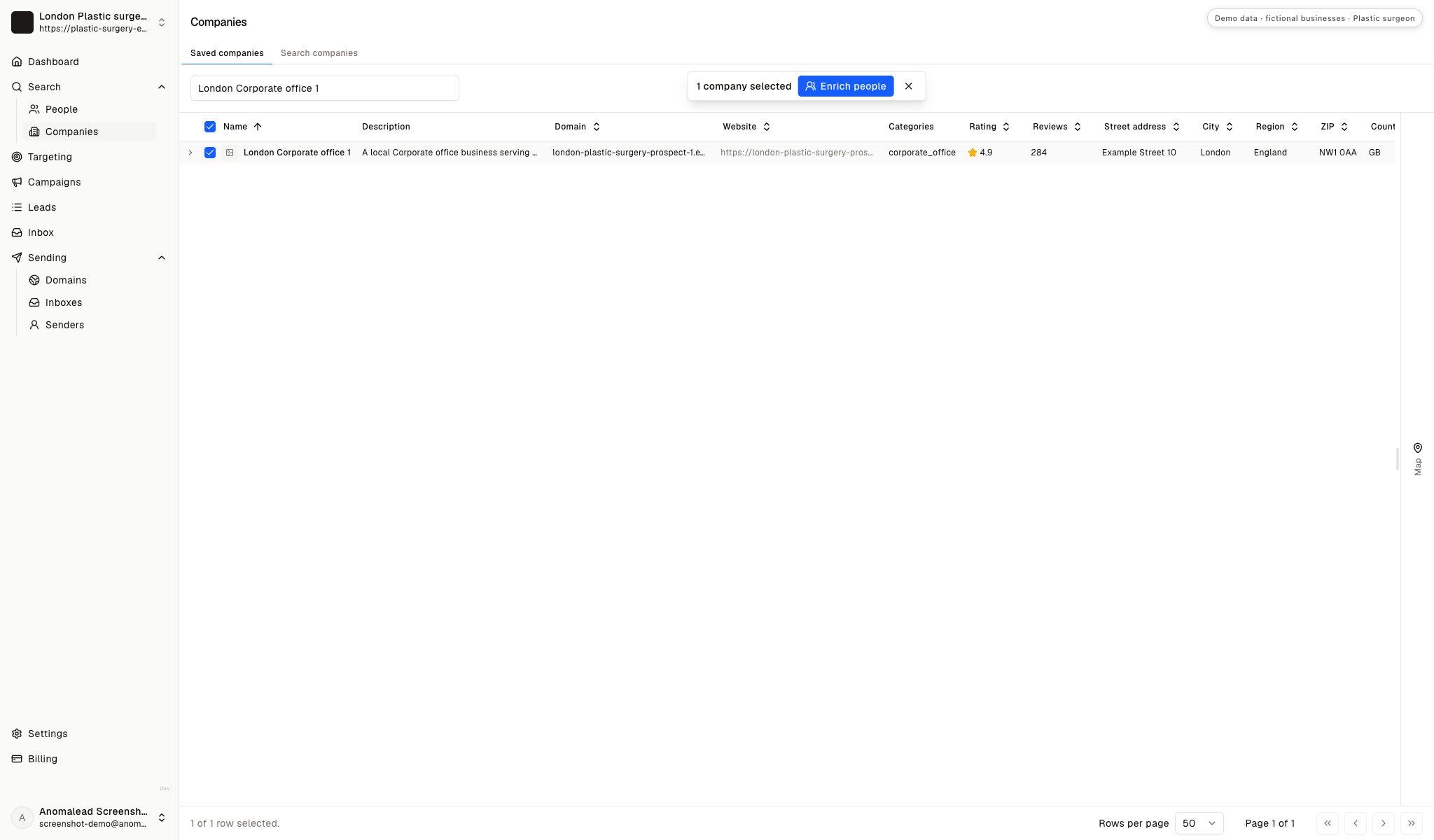
Decide whether a partnerships title fits
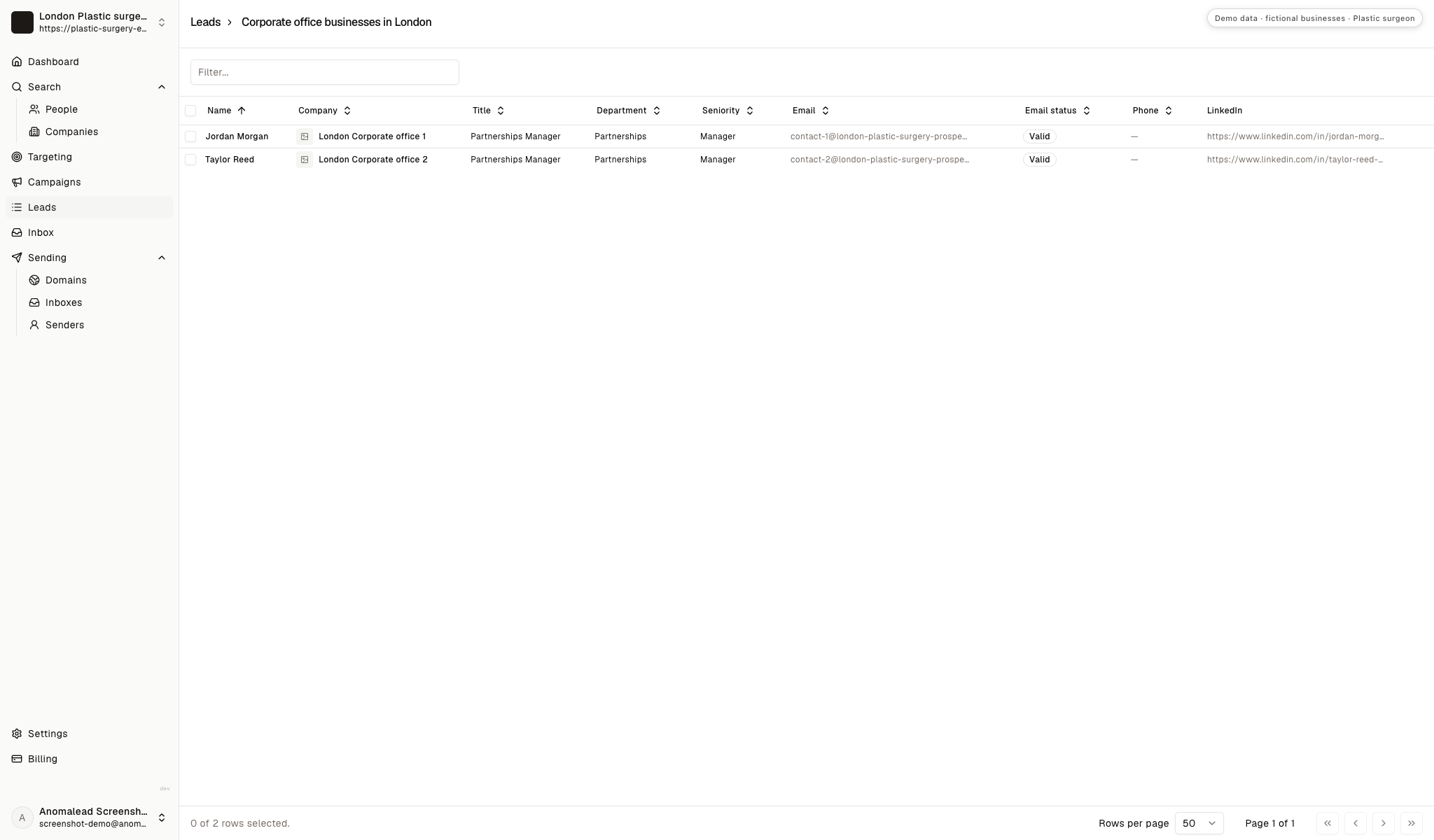
Section titled: Decide whether a partnerships title fitsEnrichment returns Jordan Morgan and Taylor Reed, both listed as Partnerships Managers. That title can work as a first contact who routes the note to HR or occupational health, but it rarely owns health benefits itself.
Check the two names on the lead list
Section titled: Check the two names on the lead listThe lead list holds Jordan Morgan and Taylor Reed. Add a note beside each on which angle fits, benefits information or return-to-work support, so the email matches their company.
What an employer relationship is worth to a surgical practice
Section titled: What an employer relationship is worth to a surgical practiceAn employer listing brings enquiries slowly, because each employee decides privately whether to contact you, and many consultations should not become procedures.
Model the value of a relationship, not of a patient, and be conservative. Because you will not track which employees came through an employer, you are judging the channel as a whole.
Every figure in the calculator is your own assumption about deal value, meetings and close rate. It is a planning aid, not a forecast of patients, procedures or revenue.
Do the math on one good deal
If one new customer is worth thousands, you don’t need magic. You need a few more meetings a month.
Projected monthly results
- Deals closed
- 2.0
- Projected revenue
- £10,000
- Growth plan (1 business)
- £79/mo
- ROI
- 12,558%
Conservative math on meetings you already believe you can book. One closed deal often pays for a year of Anomalead.
If the result only works with optimistic inputs, spend the time on the relationships you already have with local doctors instead.
Send employers information, not an offer
Section titled: Send employers information, not an offerThe first email should offer a factual resource and ask one question about who maintains the employer's health information. Leave out prices, promotions, testimonials and any mention of results.
The structure of a short cold email applies, with one extra rule: every claim must also meet your advertising and conduct obligations.
Confirm both recipients belong to one campaign
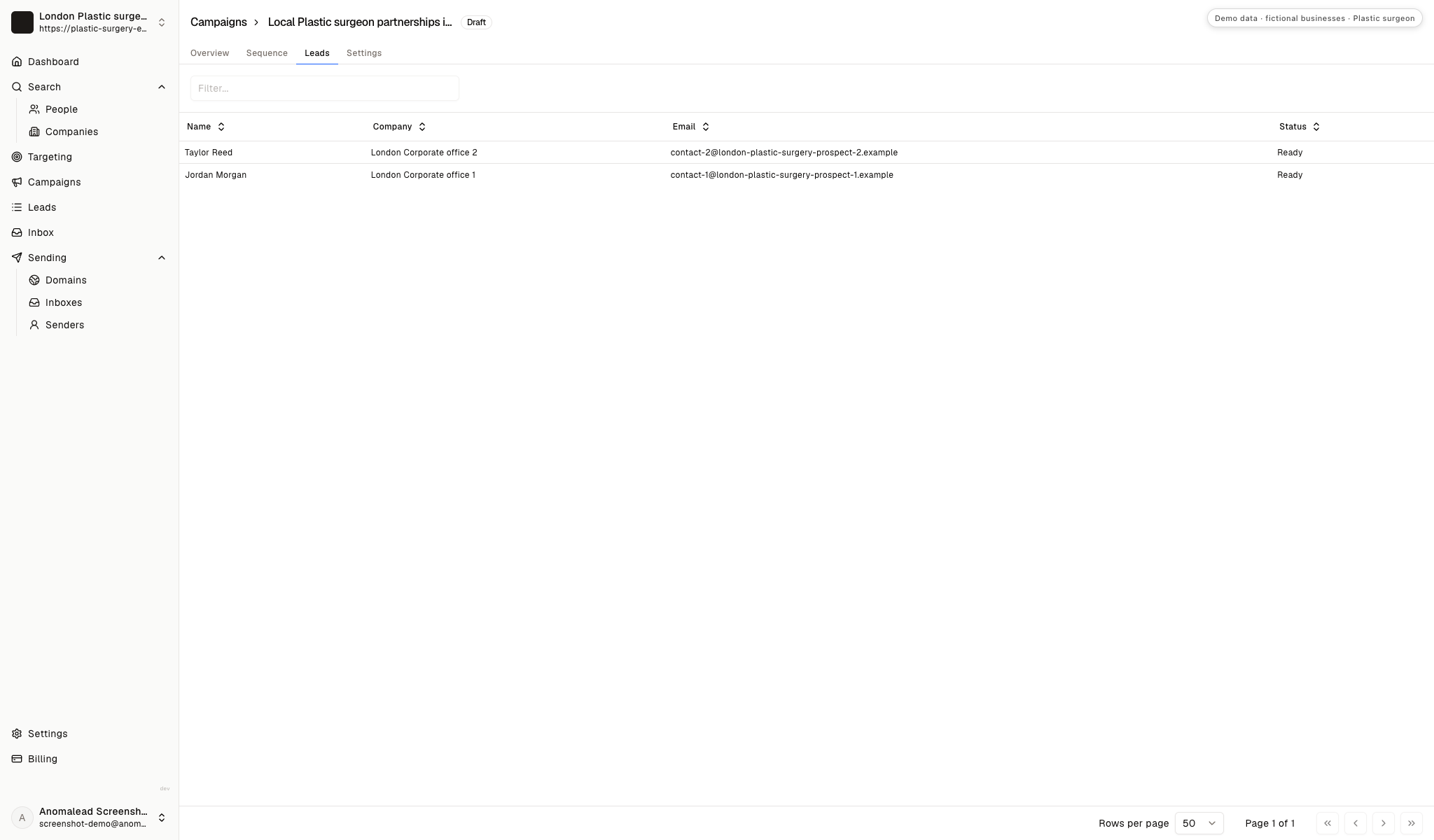
Section titled: Confirm both recipients belong to one campaignThe draft campaign lists two recipients. Split them into separate campaigns if one gets the benefits angle and the other the occupational health angle.
Replace the seeded sequence with patient-information copy
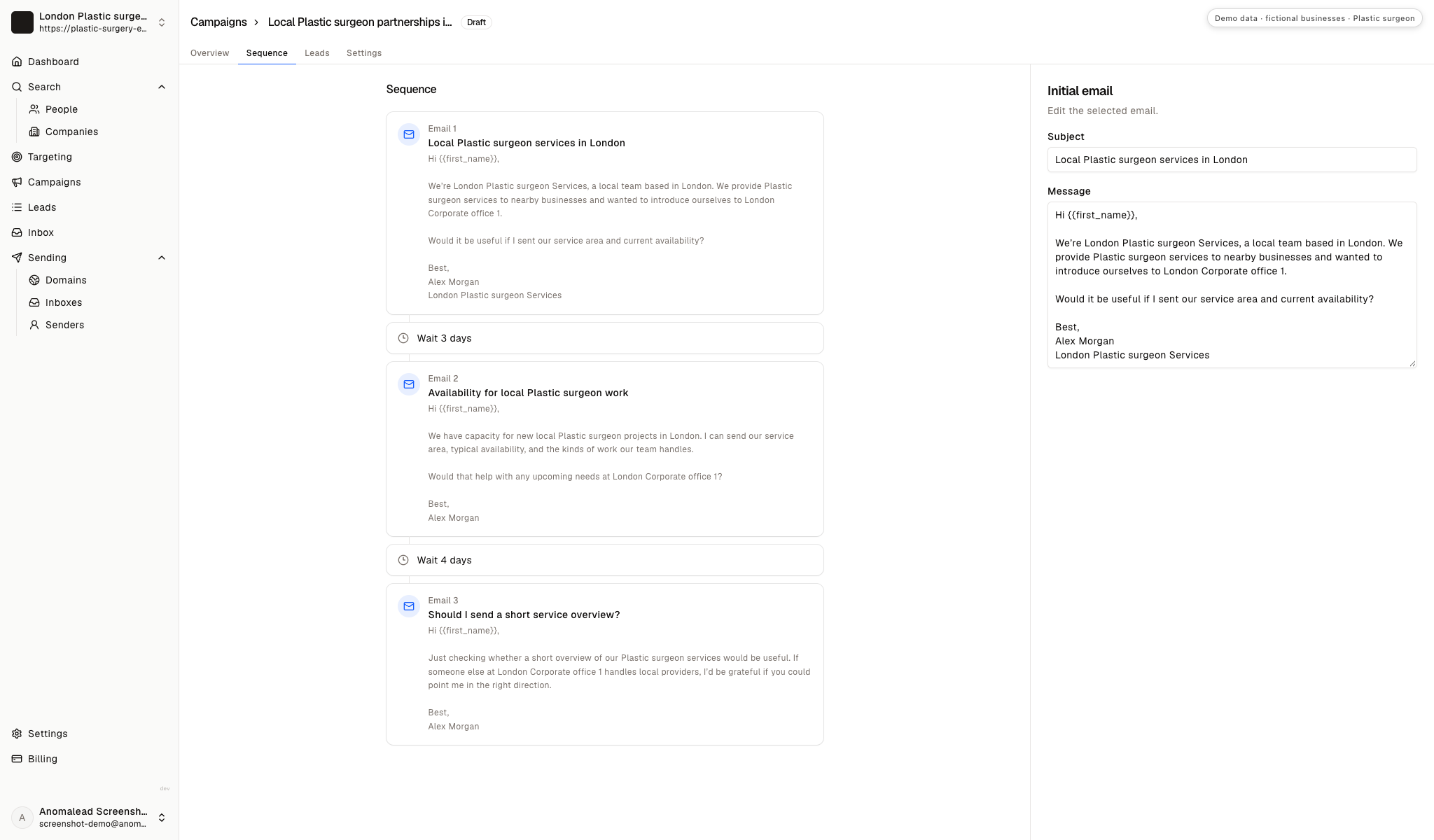
Section titled: Replace the seeded sequence with patient-information copyThe demo sequence holds three emails separated by a three-day wait and then a four-day wait. Its seeded copy talks about service areas and capacity like a trade supplier, which is the wrong register for a surgical practice.
Rewrite all three, and let each follow-up add one useful fact, such as how aftercare appointments work.
Example emails to HR and occupational health
Section titled: Example emails to HR and occupational healthBoth drafts offer information only. Adjust the wording to what your practice really provides and have it checked against the rules that apply to you.
Benefits and wellbeing resources
Subject: Factual consultation information for your staff resources
Hi Jordan,
I look after practice relations at London Plastic surgeon Services. I can send a short, factual information sheet for employers’ staff health resources, explaining how a consultation works, how to verify a surgeon’s registration and what recovery planning involves.
Our practice handles enquiries directly and does not report individual contacts to employers.
Does London Corporate office 1 keep a resource list like that, and if so, who looks after it?
Best regards,
Alex Morgan
London Plastic surgeon Services
Return-to-work support for occupational health
Subject: A named contact for post-surgery return-to-work questions
Hi Taylor,
I am Alex Morgan from London Plastic surgeon Services. When staff recover from reconstructive surgery, occupational health teams often need to know how follow-up visits are scheduled and what documentation the patient receives.
With the patient's consent, one named contact here can answer those practical questions.
Would that be useful for London Corporate office 2, or is occupational health handled by an external provider?
Kind regards,
Alex Morgan
London Plastic surgeon Services
Keep the subject line as plain as the body; these subject lines that stay factual show the tone. Drop the reconstructive angle entirely if your practice does not offer it.
Read the two employer replies in the inbox
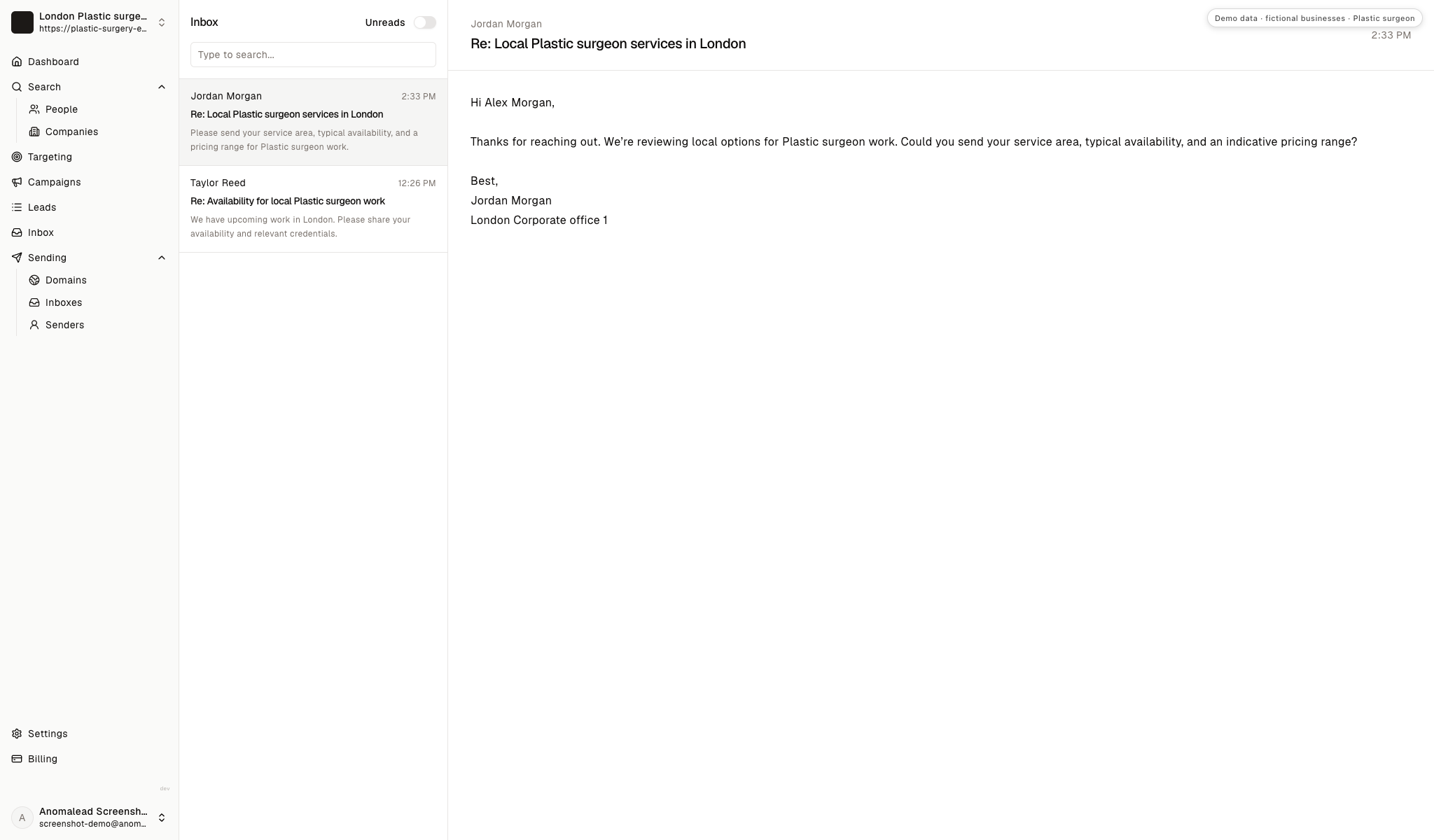
Section titled: Read the two employer replies in the inboxThe demo inbox shows two fictional replies. Jordan Morgan asks about coverage, typical availability and a rough price range, while Taylor Reed mentions an upcoming project and asks for availability, scope and credentials.
Both read like requests to a trade supplier, which is what the seeded sequence invited.
Answer employer replies within medical advertising limits
Section titled: Answer employer replies within medical advertising limitsTreat every reply as a request for accurate information. Answer the question, restate what the practice does not do, and ask one thing that moves the relationship forward.
The employer asks for your area, availability and a price range
Section titled: The employer asks for your area, availability and a price rangeJordan Morgan thanks you for the note, says the company is comparing local options and wants to know where you operate, how soon you can see people and roughly what it costs.
If local rules allow, share a published consultation fee. Do not quote a procedure price before an individual assessment or frame it as a staff offer.
Use the reply to confirm who maintains the resource list.
A reply that stays factual could read:
Thanks, Jordan. Our practice can confirm where consultations take place and the next available appointment directly. Procedure options and costs are discussed only after a clinical assessment. I can send the factual information sheet for your resource list; who should receive it?
The contact mentions a project and asks for credentials
Section titled: The contact mentions a project and asks for credentialsTaylor Reed says something may be coming up soon and asks for your availability, the work your team covers and any licences or credentials.
Ask what the project is first. If it is a wellbeing week or health talk, check your rules and keep any session to general recovery planning, never procedures or results.
Ask which details the employer needs, then share only current, verifiable registration, qualification and facility information through an appropriate channel. Do not assume a generic document will satisfy the employer or local rules.
A helpful first answer:
Thanks, Taylor. I can share current registration and qualification details for the surgeons involved, along with the facilities we use, if they are relevant to your project. Could you describe the project and tell me what information your team needs so I can confirm what we can provide?
The employer asks for a staff discount
Section titled: The employer asks for a staff discountWe like the idea. Could you offer our employees a special rate or a free first consultation?
Decline any offer to promote a discount or free consultation until you have checked the advertising and professional-conduct rules for your location. Keep the employer relationship limited to neutral information and a direct, confidential enquiry route.
A polite refusal that keeps the door open:
Thank you, that is kind. We do not offer employer rates or incentives, because people should decide about surgery without a deal attached. What we can offer is clear information and a direct, confidential way for staff to ask questions.
The employer wants to know which staff have booked
Section titled: The employer wants to know which staff have bookedIf we list you, can you let us know who uses the service so we can plan absence?
Say no. Absence planning goes through the employee's own leave request, and any contact with occupational health about a named patient needs that patient's consent.
Review the first employer conversations before the next batch
Section titled: Review the first employer conversations before the next batchNote which role answered, which angle they responded to and whether anyone asked for a perk. If only occupational health advisers reply, build the next list around employers with an occupational health provider.
Update the information sheet with the questions employers actually asked, and have it reviewed again before sending more. The route chiropractors use for workplace care shows another way health providers approach the same buyers.
This week, pick ten employers within reach of your clinic, confirm who owns their health resources, and send the information-only email to those contacts.
Plastic surgery practices asking about employer outreach
Section titled: Plastic surgery practices asking about employer outreachIs it appropriate for a plastic surgery practice to contact employers at all?
Section titled: Is it appropriate for a plastic surgery practice to contact employers at all?It can be, if the contact is limited to factual information and a confidential route for staff questions. Check the advertising and conduct rules for your profession and location before starting.
Should the outreach mention cosmetic procedures or reconstructive work?
Section titled: Should the outreach mention cosmetic procedures or reconstructive work?Lead with recovery planning and reconstructive care, which give an employer a practical reason to care. Mention cosmetic procedures only in neutral terms, and never describe outcomes or show before and after images.
What should the employer information sheet contain?
Section titled: What should the employer information sheet contain?Explain who the patient meets at a consultation, how to check a surgeon's registration, what recovery planning means for time off and how to contact the practice privately. Leave out prices, testimonials and results.
Are the offices, contacts and replies in the screenshots real?
Section titled: Are the offices, contacts and replies in the screenshots real?No. London Plastic surgeon Services, the three corporate offices, Jordan Morgan, Taylor Reed and both replies are fictional demo data. They are not Anomalead customers, real employers or campaign results.
Can the ROI calculator predict how many patients an employer will send?
Section titled: Can the ROI calculator predict how many patients an employer will send?No. It combines the deal value, meetings and close rate you type in, so the result is only as sound as your assumptions.