


Chiropractor lead generation works best when a local practice builds employer partnerships around workplace wellness and convenient access to musculoskeletal care, not promises to solve employees’ health problems. A nearby office is only a possible partner. The useful question is whether its people team is reviewing local wellbeing resources and whether your practice can offer an appropriate, clearly explained route to care.
This guide shows how to identify that fit, find the person who coordinates benefits or workplace wellbeing, and propose a low-pressure conversation. It also covers the boundaries that matter: employees choose whether to contact a provider, clinical details stay private, and any service description must match your credentials and current capacity. Start with these B2B lead generation basics, then adapt the workflow to your practice.
Key takeaways
- Approach employers whose public information suggests an active interest in staff wellbeing, then confirm who reviews local providers.
- Make the partnership useful through clear clinic location, appointment access, service scope, and a voluntary route for employees to ask questions.
- Do not infer employee symptoms from a job or office profile, and never offer employers identifiable patient, appointment, or treatment information.
- Describe only services, credentials, hours, fees, and capacity that the practice can verify, and check the professional and advertising rules that apply.
Chiropractor lead generation starts with employer fit
Section titled: Chiropractor lead generation starts with employer fitA good employer prospect is one that may want a local, voluntary wellbeing option and has a clear person who reviews it. A company record cannot show whether staff want chiropractic care, so use it to research fit rather than to infer a health need.
- People, benefits, or wellbeing teams: These teams may maintain employee resource lists or evaluate local wellbeing partners. Ask how they assess providers and what information they share with staff. Do not assume that a wellbeing title controls clinical referrals or employee health benefits.
- Workplace experience and office operations: An office or workplace manager may coordinate optional talks, room access, or notices about nearby services. Confirm whether the employer permits outside providers on site before proposing an event. If your practice does not offer workplace sessions, keep the proposal focused on clinic access.
- Occupational health coordinators: Some employers have a designated team for workplace health information. They may need a clear account of scope, credentials, privacy boundaries, and how employees can make their own enquiries. Keep a chiropractic introduction separate from medical assessment or workplace injury decisions.
- Multi-site employers with a local team: A regional people lead may be able to share a provider resource across nearby locations. Check which sites are realistically close to the clinic and whether opening hours suit their staff. One head office does not mean every branch is a useful partner.
The employer is a channel for an optional, informed introduction. The employee remains the prospective patient and decides whether to contact the practice.
Qualify the partnership before you find a contact
Section titled: Qualify the partnership before you find a contactA practice should be able to explain what it offers and how an employee can reach it before it asks an employer to share the resource. Qualify the practical arrangement first; a plausible industry or office location is not evidence of employee demand.
- The route to care is clear: Decide whether the employer would share a clinic information page, allow an optional introduction, or consider another arrangement your practice actually provides. Do not suggest onsite assessment, a staff discount, or a benefit unless the practice has approved the details.
- Clinic access fits the workday: Review travel from the employer’s locations, appointment hours, booking method, and any access needs the practice can accommodate. A convenient clinic is useful only if staff can understand how to make an appointment and what to expect when they enquire.
- The description matches professional scope: Prepare a plain-language description of the services and practitioner credentials that can be verified. Avoid claims about preventing injuries, treating a condition, or guaranteeing a result. The employer is considering a resource, not asking you to assess an employee.
- Payment and responsibility are explicit: An employer introduction does not establish who pays for care. Be ready to distinguish employee-paid appointments from an employer-funded arrangement, and state any approved terms clearly. Do not leave the payer, cancellation terms, or eligibility unclear.
- Privacy can be maintained: The employer should not receive names of employees who booked, attended, or discussed a concern. Explain that staff contact the practice directly and that clinical conversations stay within the appropriate care relationship. Do not request employee lists or health details for prospecting.
What the demo data shows
The screenshots use fictional London Chiropractor Services, three generic London Corporate office records, and the fictional contacts Jordan Morgan and Taylor Reed. The companies and inbox replies are demonstration fixtures, not Anomalead customers or campaign results. Their office categories and partnership titles do not establish staff interest in chiropractic care, a health benefit, or a buying decision.
Build an employer shortlist with a real reason to talk
Section titled: Build an employer shortlist with a real reason to talkUse Anomalead to find and review local organization records, then do separate research before treating one as a workplace-wellness prospect. The walkthrough screens show location and company-category filters, generic office results, saved records, contact enrichment, a lead list, a campaign draft, a sequence, and replies. They do not identify employees who want care or employers searching for a chiropractor.
Choose an area your clinic can serve and a company category that helps you discover local workplaces. Review each organization’s public site for local staff locations, a people or benefits function, and any public description of its wellbeing resources. A high rating or office label is not a healthcare signal. Record the source for your partnership hypothesis and use a focused lead research process to keep the shortlist reviewable.
Set a search around the clinic’s practical area
Section titled: Set a search around the clinic’s practical areaChoose locations employees can realistically reach and the corporate-office category used by the demo. Treat the radius as a search boundary, not proof that a workplace is close to your clinic or that an employer wants a provider.
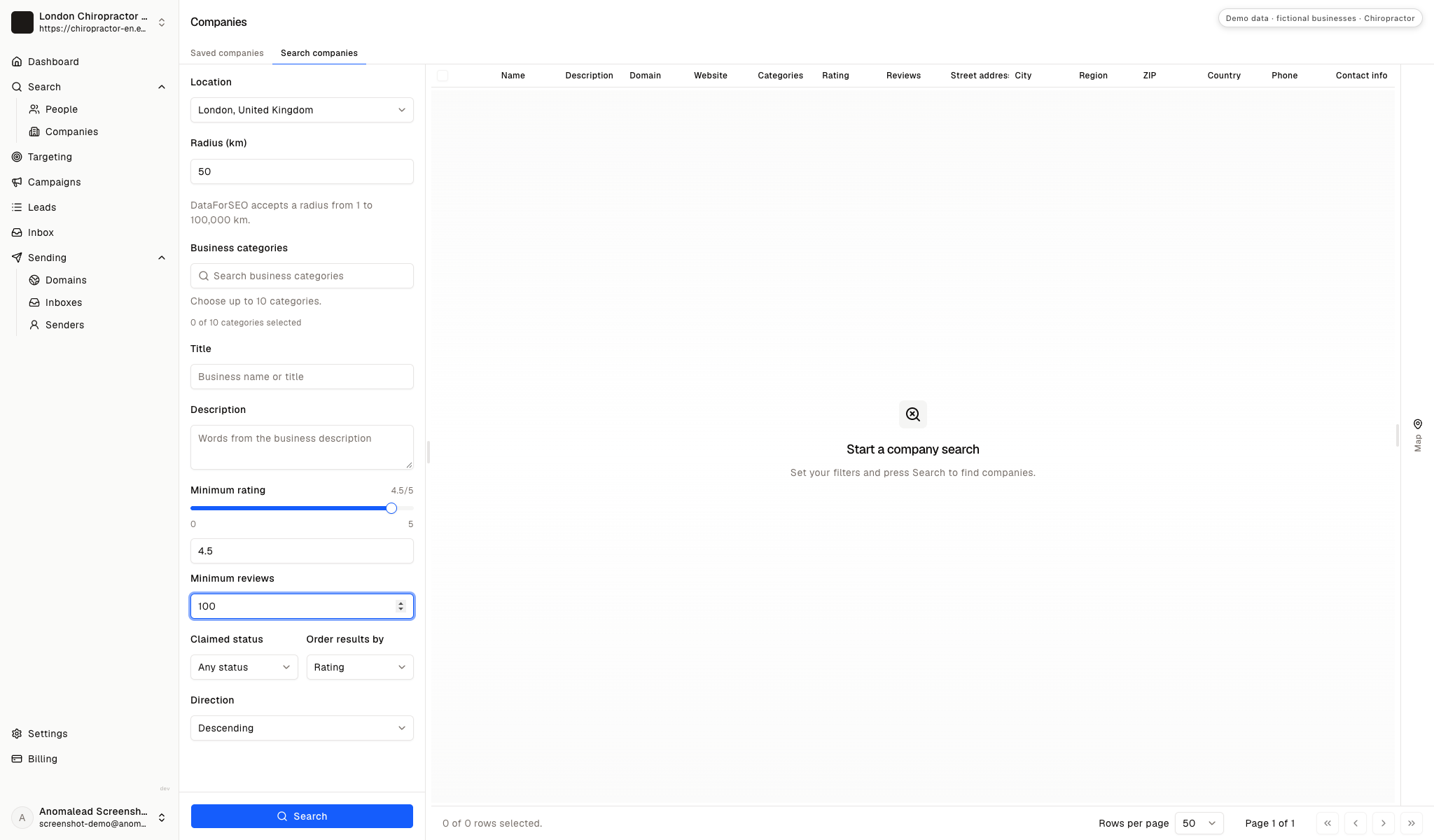
Check each office against the partnership idea
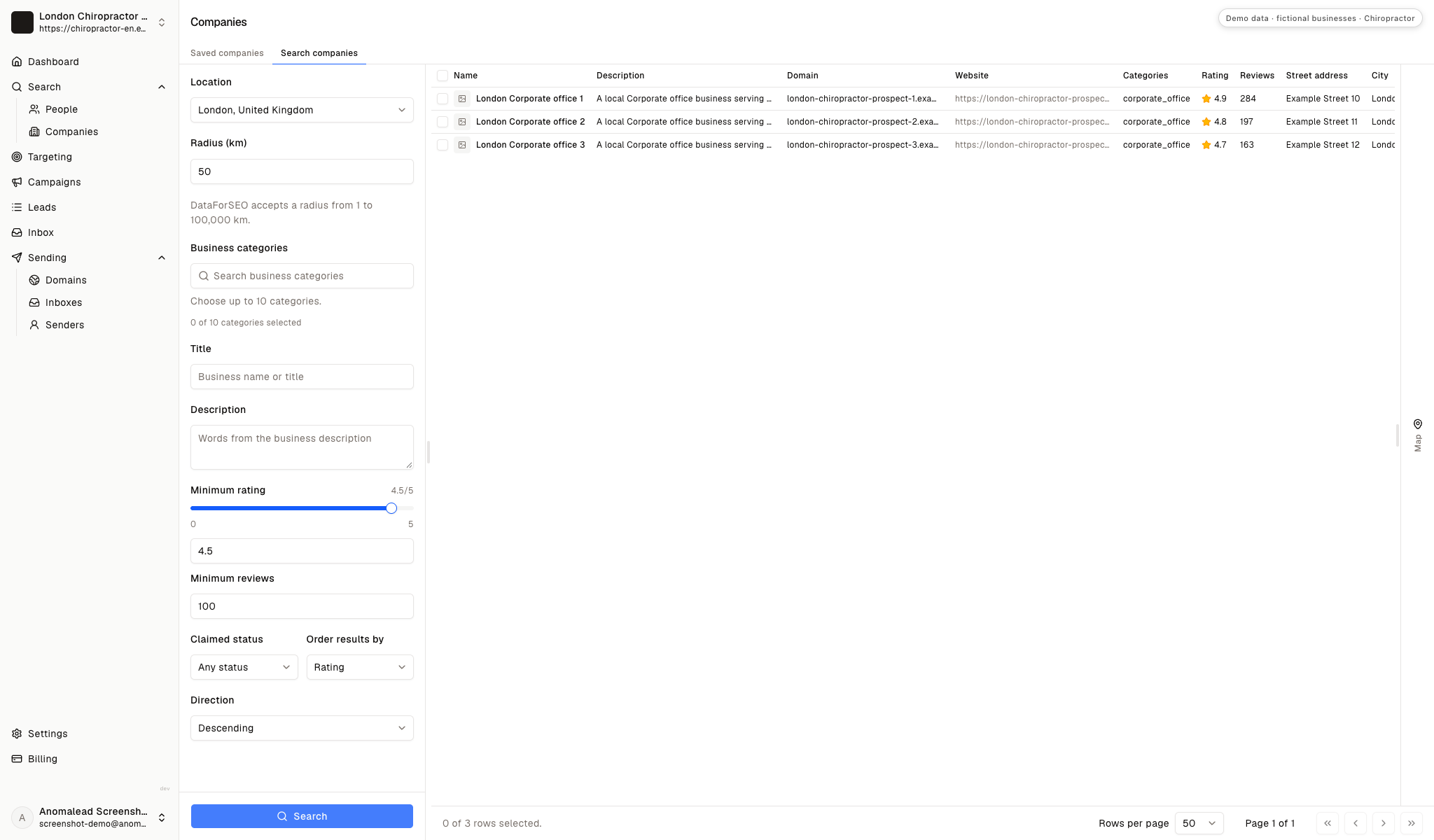
Section titled: Check each office against the partnership ideaThe results contain three fictional corporate offices with basic company descriptions and review information. Open public sources separately to see whether a local team or wellbeing contact exists; the result itself says nothing about staff health or benefits.
Save only organizations your clinic could serve
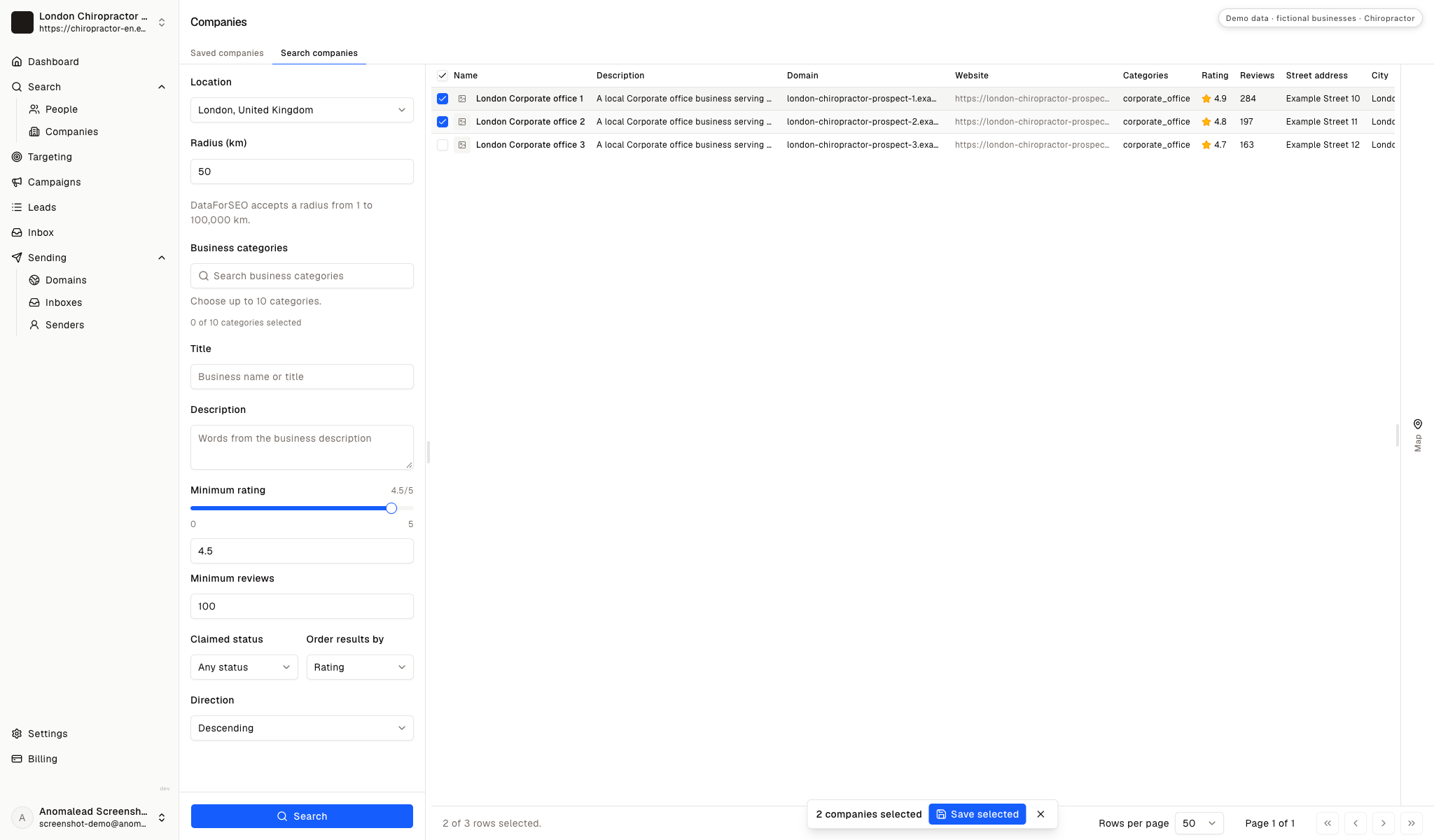
Section titled: Save only organizations your clinic could serveThe demo selects two of the three records. For a real shortlist, save an organization only when its location, staff presence, and a plausible partnership route justify more research.
Model the time and cost of partnership work
Section titled: Model the time and cost of partnership workAn employer relationship can involve research, a provider review, an optional introduction, or an event if your practice offers one. The calculator helps compare your own commercial assumptions; it cannot predict employee interest or care outcomes.
Enter your own assumptions for staff time, any approved partnership expense, appointment capacity, and the revenue your practice can substantiate. The calculation is a planning aid, not a forecast of referrals, bookings, or clinical results.
Do the math on one good deal
If one new customer is worth thousands, you don’t need magic. You need a few more meetings a month.
Projected monthly results
- Deals closed
- 2.0
- Projected revenue
- £10,000
- Growth plan (1 business)
- £79/mo
- ROI
- 12,558%
Conservative math on meetings you already believe you can book. One closed deal often pays for a year of Anomalead.
If the case only works when every employee books, revisit the assumptions. The employer may share information while employees make independent choices about care.
Find the person who reviews workplace resources
Section titled: Find the person who reviews workplace resourcesLook for a people, benefits, employee-experience, or wellbeing contact, then verify what that role owns. The fictional Jordan Morgan and Taylor Reed appear as Partnerships Managers in the demo, but a real employer may route provider reviews through HR, benefits, operations, or another team.
Check current work details on a public company source. Your notes need enough context to ask who reviews local wellbeing resources, not employee names or health information. If the remit is unclear, ask for the right team before enriching more records.
Review saved organizations before enrichment
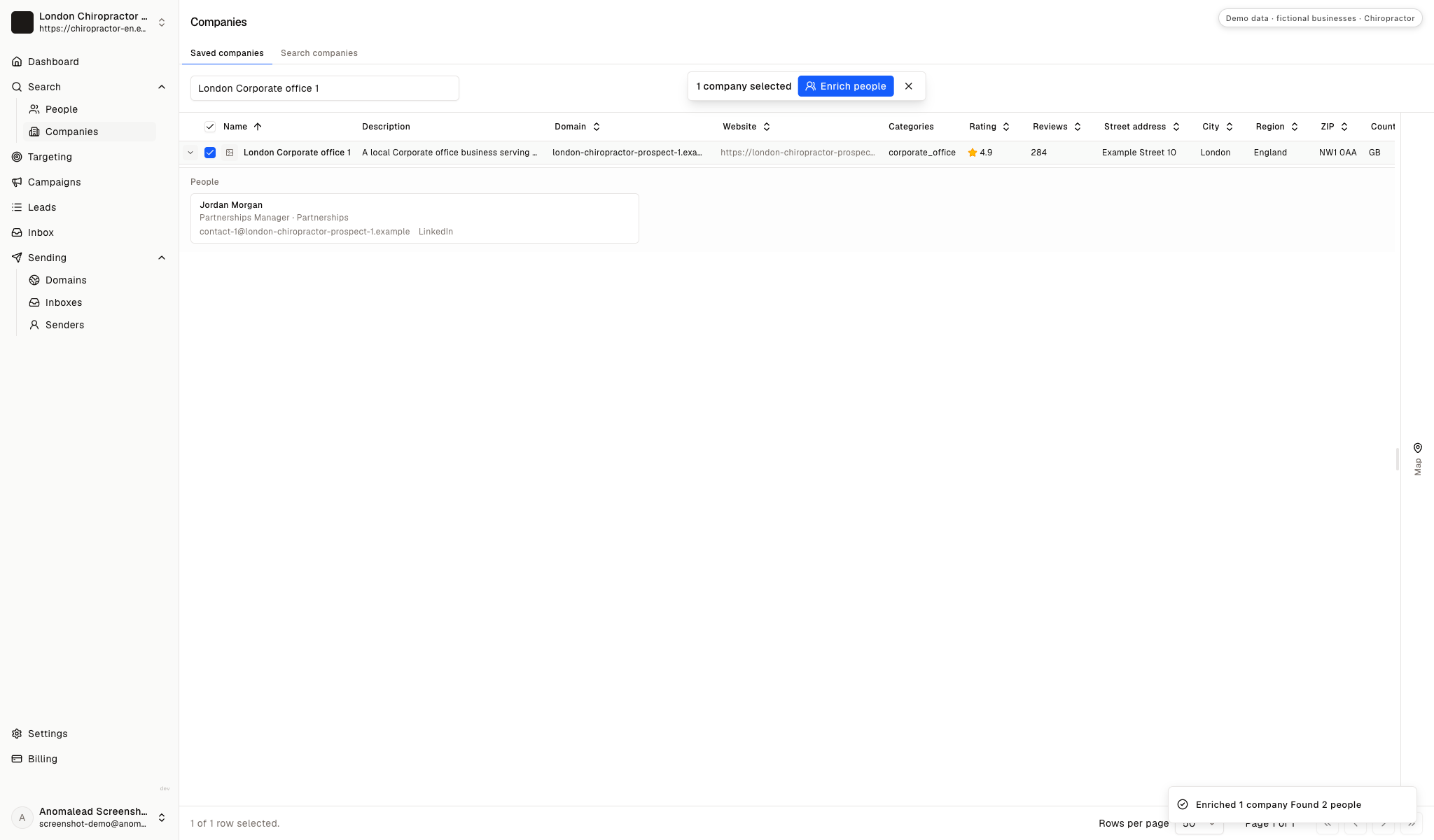
Section titled: Review saved organizations before enrichmentThe saved view shows a fictional company and an Enrich people action. Confirm the company’s local presence and partnership rationale before using contact enrichment.
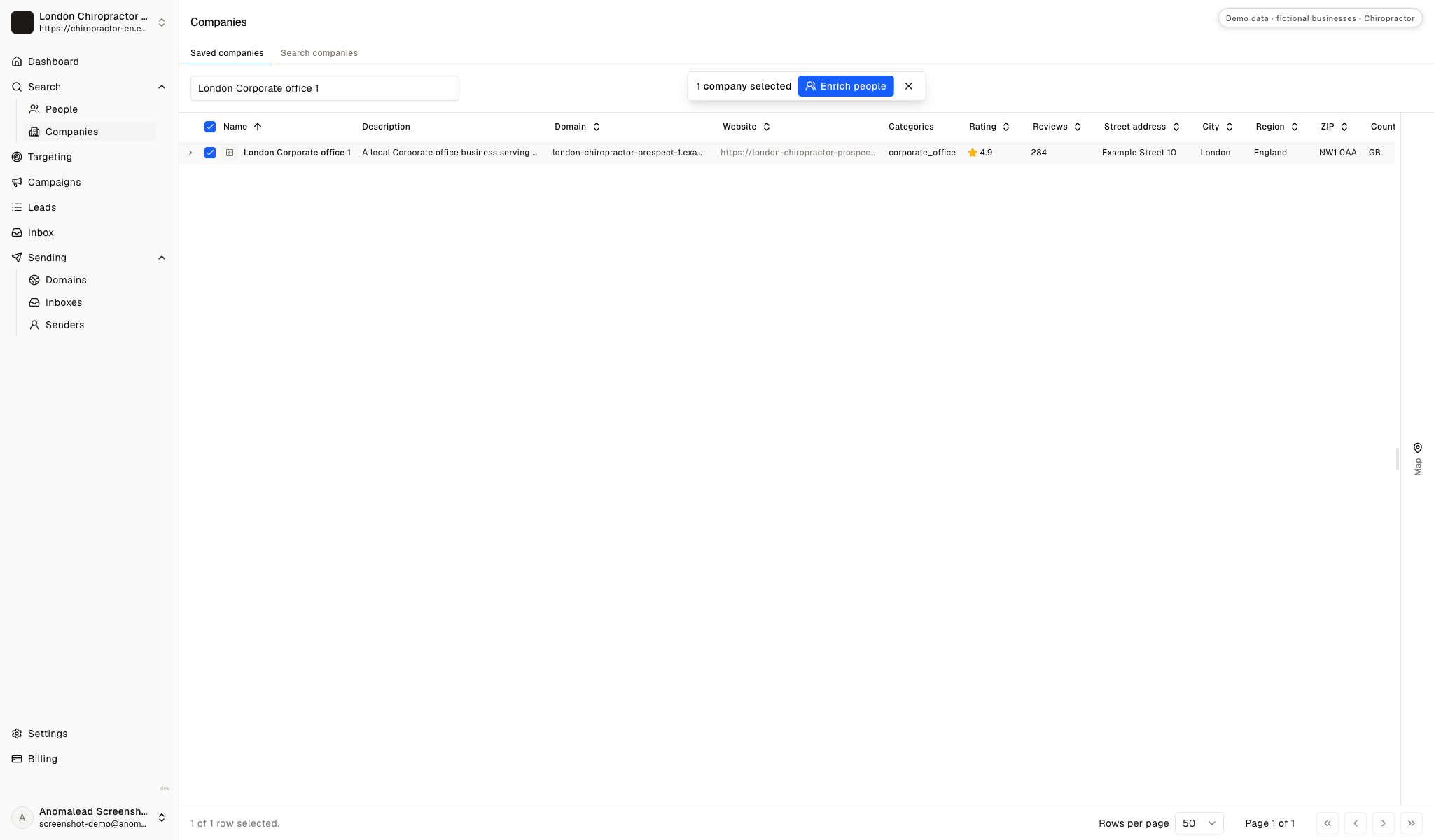
Check who can route a provider enquiry
Section titled: Check who can route a provider enquiryThe fixture shows Jordan Morgan and Taylor Reed as fictional Partnerships Managers. A real employer may route workplace wellbeing through HR, benefits, people operations, or a separate provider-review team.
Keep only the work contacts needed for the next step
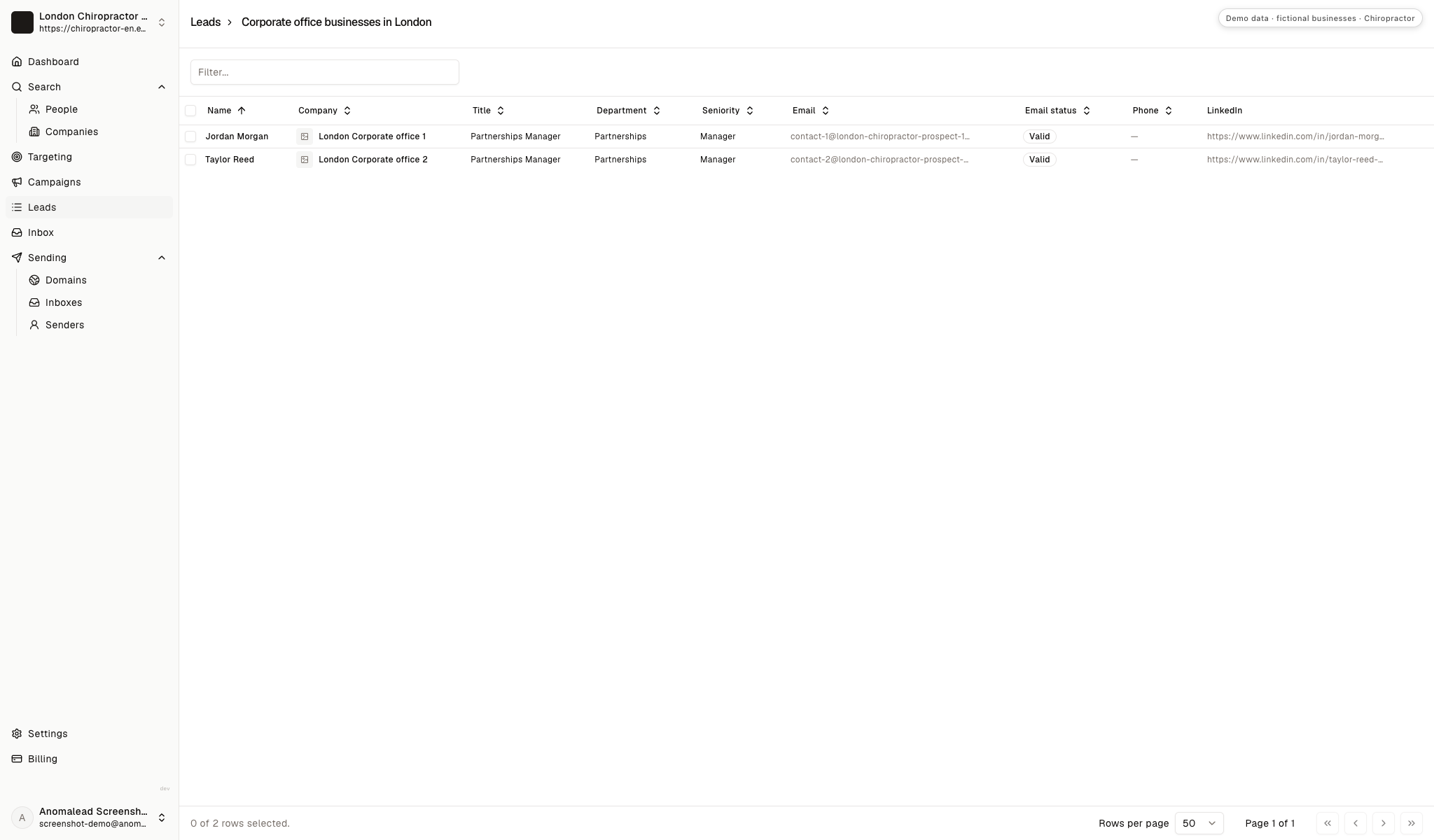
Section titled: Keep only the work contacts needed for the next stepThe demo lead list contains two fictional contacts with valid email status. Review their business roles and the source of each address before outreach; do not append employee health details.
Make the employer offer specific and easy to assess
Section titled: Make the employer offer specific and easy to assessAn employer can assess a provider more easily when the first note describes a practical option instead of implying a clinical benefit. State where the clinic is, what the practice is qualified to offer, how employees can make their own enquiry, and which details you can verify. Leave room for the employer to say which team handles provider information.
Do not suggest that a company’s desk-based or physical work proves employees have pain. Do not ask the employer to identify people with symptoms. If an employer asks about an on-site talk or group session, confirm that your practice offers it, the intended educational scope, and the arrangements before you describe it.
Confirm the audience before sending a campaign
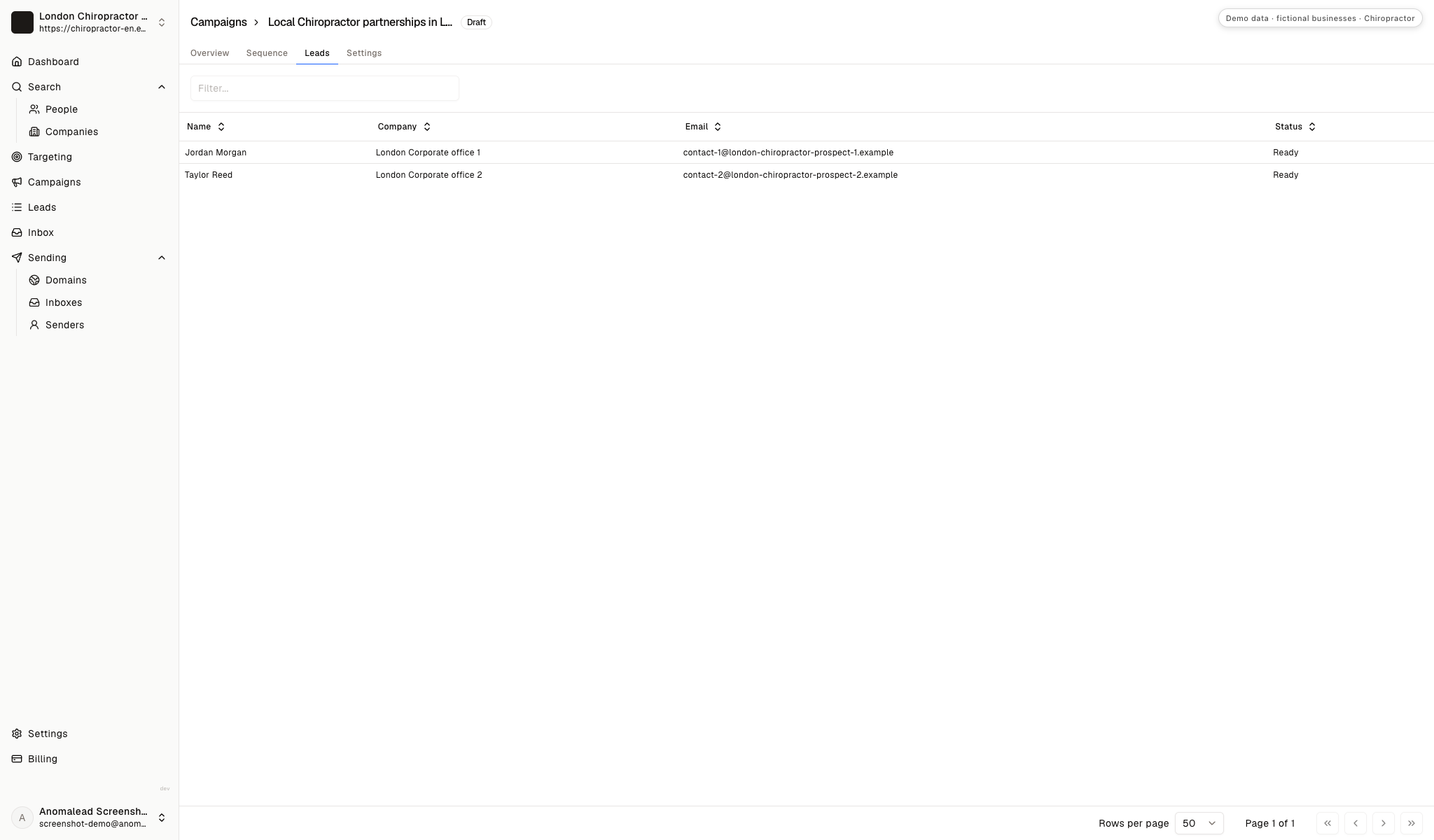
Section titled: Confirm the audience before sending a campaignThe draft screen shows two recipients and a campaign name from the fictional London fixture. Check every recipient’s role, the source and permitted use of the address, and the employer fit before scheduling anything.
Review the sequence for respectful, useful follow-up
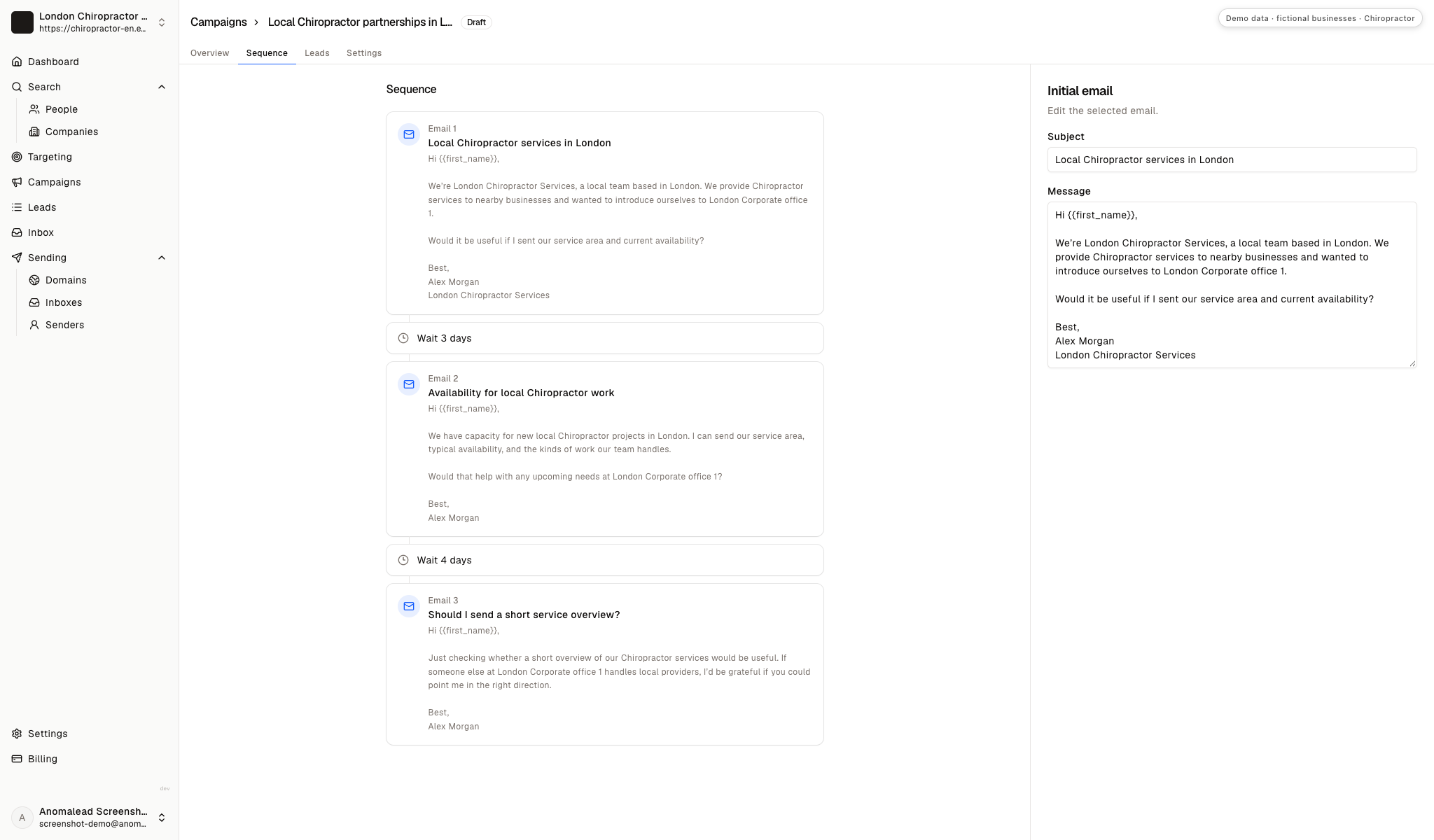
Section titled: Review the sequence for respectful, useful follow-upThe fixture sequence contains three generic chiropractor messages with waits between them. Replace broad claims with current practice details and stop when someone declines or asks not to be contacted.
Write an introduction that protects employee choice
Section titled: Write an introduction that protects employee choiceA useful first email asks whether the recipient reviews local wellbeing resources and offers verifiable information. These examples use the fictional contacts from the demo. Replace clinic details only with facts your practice has checked.
First note to a workplace contact
Subject: A local chiropractic resource for your team
Hi Jordan,
I’m reaching out from London Chiropractor Services, a local practice. Does your team keep information about nearby wellbeing resources for employees?
If you review local providers, I can send our clinic location, booking process, verified credentials, and current service scope. Employees would contact us directly, and we would not report who asks about care. If another team handles provider information, could you point me to the right contact?
Best, Alex Morgan, London Chiropractor Services
Follow-up after an initial enquiry
Subject: Re: A local chiropractic resource for your team
Hi Taylor,
I can share our service area, current appointment availability, and the work our practitioners are qualified to provide. Employees contact the clinic directly, and their care conversations remain private.
Before discussing an employer-funded option, we would confirm the scope, payer, and terms. Would a short provider overview help your review?
Best, Alex Morgan
Confirm the sender’s identity, practice details, credentials, location, appointment availability, privacy wording, and any commercial terms before sending. See these B2B email examples for ways to keep a first note concise.
Use a reply to clarify the partnership process
Section titled: Use a reply to clarify the partnership processA request for service details is permission to answer that question, not proof of a patient referral plan. Reply with information the practice can verify and ask what the employer needs for its review. Keep any discussion of care separate from employee records or individual cases.
Read the inbox as a request for verified details
Section titled: Read the inbox as a request for verified detailsThe fictional inbox contains a request for service area, availability, pricing information, and credentials. Treat those as questions for the practice to answer accurately; the messages do not show a real employer or patient enquiry.
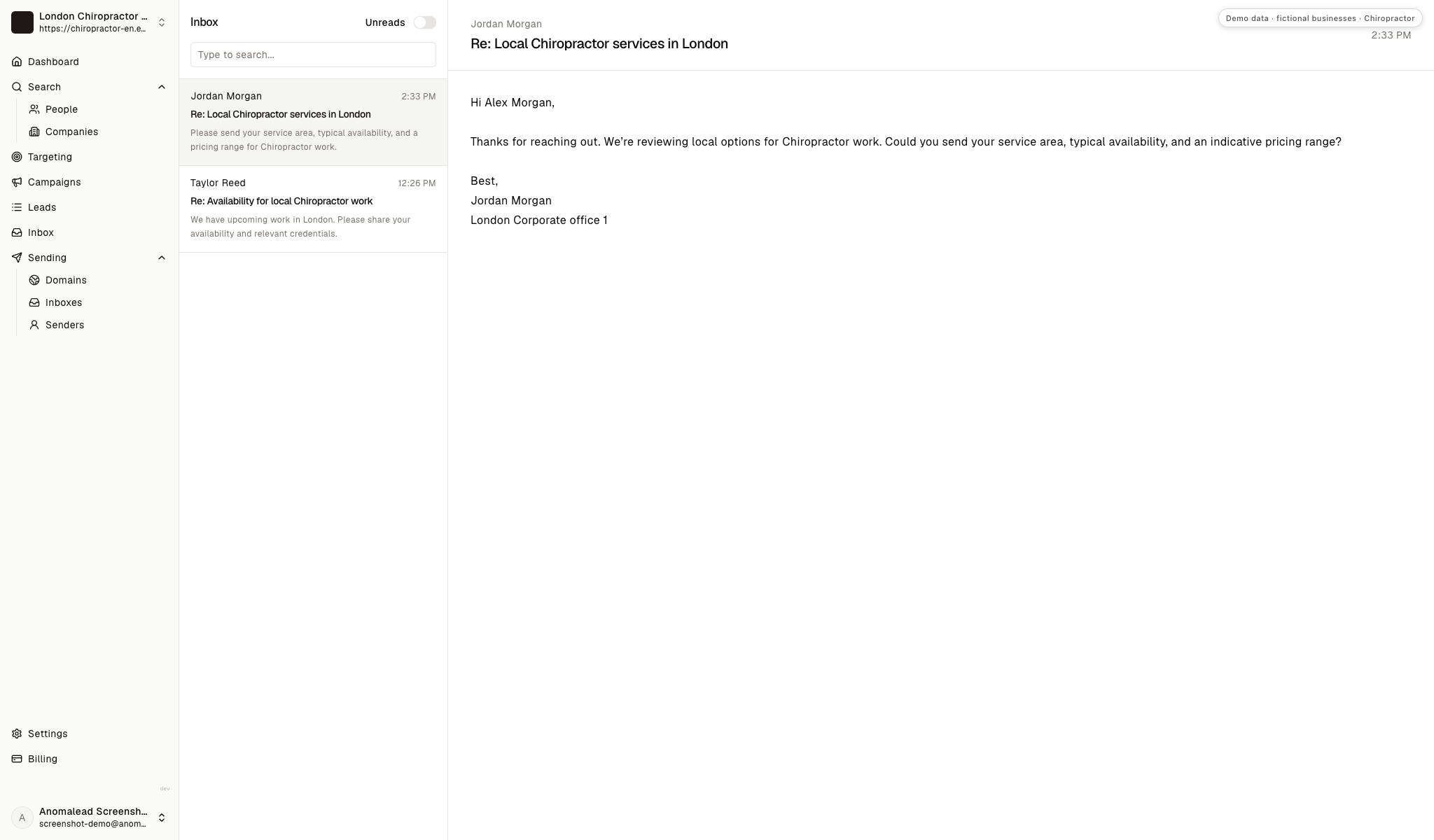
Answer employer questions without promising a clinical result
Section titled: Answer employer questions without promising a clinical resultReply to the question the employer asked, attach only current practice information, and keep the employee’s choice and privacy clear. The inbox examples are fictional; a real conversation still needs a verified contact and an agreed partnership scope.
A workplace contact asks how employees can explore the clinic
Section titled: A workplace contact asks how employees can explore the clinicOur people team is considering a local chiropractic resource. How can an interested employee learn about your clinic, check appointment availability, and understand the fees?
Answer with the clinic’s current catchment and scheduling process. Ask whether the employer means an employee-paid appointment or a specific employer-funded service before quoting. If pricing depends on scope, say what information you need and have the practice confirm the figure; do not make up a range.
A careful response could say:
Hi Jordan, thanks for asking. Our current clinic information is attached, including the locations we serve and how employees can check appointment availability. Before I provide a price, could you clarify whether you are reviewing a resource employees would contact directly or a particular employer-funded arrangement? We can confirm any terms once the scope and payer are clear. Best, Alex Morgan.
Taylor asks about availability, scope, and credentials
Section titled: Taylor asks about availability, scope, and credentialsWe may have a chiropractic project coming up. Please send your availability, the work your team covers, and any relevant licenses or credentials.
Send only credentials the practice can verify and describe services within the practitioners’ scope. Clarify what the word project means: a provider listing, an employee information session, or an employer-funded service. Confirm the schedule before committing, and check the professional and marketing rules that apply.
A reply can separate the options:
Hi Taylor, thanks for the note. I can send the practice’s verified credentials, current service description, and appointment availability for review. Could you tell me whether you are considering a provider resource for employees, an information session, or another arrangement? We will confirm the scope and any terms before making a commitment. Best, Alex Morgan.
The contact asks for reports about employees who attend
Section titled: The contact asks for reports about employees who attendCan you tell us which employees booked or what they discussed?
Do not offer identifiable attendance or clinical details to an employer. Explain the practice’s privacy boundary and discuss only a lawful, agreed administrative arrangement that does not expose patient information. Ask the practice’s privacy lead or qualified adviser before responding to a request that falls outside its existing policy.
State the boundary plainly:
We cannot share identifiable information about who contacts or attends the practice, or what an individual discusses. Employees would communicate with the clinic directly. If you are reviewing a general provider resource, I can explain our service and booking process without any patient information.
Chiropractor lead generation questions
Section titled: Chiropractor lead generation questionsShould a chiropractor approach employers or individual patients?
Section titled: Should a chiropractor approach employers or individual patients?For a workplace-wellness partnership, contact the person who reviews local resources and make clear that employees decide whether to contact the clinic. An employer channel does not prove anyone needs care.
What should a chiropractic practice send to an employer first?
Section titled: What should a chiropractic practice send to an employer first?Share the clinic location, appointment process, verified credentials, service scope, and privacy boundary. Use current details and clarify who pays before discussing a commercial arrangement.
Can an employer receive a list of employees who used the practice?
Section titled: Can an employer receive a list of employees who used the practice?Do not share identifiable booking, attendance, or clinical information with an employer. Employees should contact the practice directly; check applicable privacy and professional rules before agreeing to reporting.
What if the employer asks for an onsite session?
Section titled: What if the employer asks for an onsite session?Confirm that the practice offers that format, who will deliver it, and what it covers. Do not imply an educational session includes clinical assessment or treatment.
Choose one employer segment and make the next step concrete
Section titled: Choose one employer segment and make the next step concreteSelect a local employer whose workplace location fits your clinic and whose people team has a plausible reason to maintain wellbeing resources. Verify the contact, current scope, credentials, appointment access, and privacy wording before you send one concise introduction. If the employer is not reviewing providers, record the answer and move on.
For a practical cold email follow-up, respond to the contact’s stated question, set a respectful next step, and stop when asked. Review the professional-conduct and marketing rules that apply to your practice before launching an ongoing employer campaign.