


Most dentist lead generation is aimed at individual patients: search ads, reviews, referral cards at the front desk. This guide covers a channel many practices overlook. Offices near your surgery employ people who put off check-ups because booking one feels like a hassle, and whoever looks after staff wellbeing there is often looking for simple benefits. A partnership that gives employees easy appointment access can bring a steady flow of new patients without discounting your core treatments.
Here we follow a fictional practice using Anomalead to find nearby corporate offices, pick the right contact, write to an HR or partnerships manager and handle what comes back. If business-to-business outreach is new to you, this short explanation of what B2B lead generation means covers the basics.
Key takeaways
- An employer partnership works when you offer something an office cannot easily arrange itself: reserved appointment slots, a single booking contact and hours that suit a working day.
- Target offices close enough that staff can visit during a lunch break or before work, and only if your practice has real capacity for new patients.
- Write to the people who run benefits or employee wellbeing, and describe the arrangement in plain terms rather than listing clinical services.
- Keep every employee's treatment private: the employer arranges access, while each staff member chooses freely and deals with you directly.
- Before offering any discount, gift or package, check the professional-conduct and advertising rules that apply to dental practices where you work.
Which local employers are worth approaching for a dental partnership?
Section titled: Which local employers are worth approaching for a dental partnership?An office does not buy dentistry. What it can do is make your practice the easy choice for its staff. Three kinds of contact tend to own that decision.
- HR and people managers at mid-sized offices: They handle onboarding, benefits and absence. A nearby practice with predictable booking saves staff a lost morning, and HR can mention it in welcome packs and on the intranet.
- Partnerships or employee perks leads: Larger employers often have someone who collects local offers for staff, such as gym rates or lunch deals. They want a clear description of what employees get, how to claim it and who to contact.
- Office and workplace managers: In smaller companies the office manager often holds the wellbeing budget too. A concrete, easy-to-run idea works best, such as an oral-health talk over lunch or a sign-up sheet for early check-ups.
Choose one of these contacts per campaign, because each of them weighs the offer differently.
Qualifying an office before you add it to the list
Section titled: Qualifying an office before you add it to the list- Distance from the practice: The whole offer rests on convenience. If staff cannot reach your chairs within a short walk or a quick journey, a lunchtime check-up turns into a half day off.
- People actually in the building: A company whose teams are mostly remote will struggle to use a local practice. Look for signs of a staffed office, such as job ads for on-site roles or photos of the workspace.
- Your capacity for new patients: Count the new-patient appointments your clinicians can take in the coming months before you promise reserved slots. Long waiting times would hurt your reputation more than having no partnership.
- Existing health benefits: Some employers already fund dental cover. Your message should then explain how you fit alongside it, including which plans or payment options you accept.
About the demo workspace
Every screenshot in this guide comes from a demo account. London Dentist Services, the corporate offices, the contacts Jordan Morgan and Taylor Reed, and both inbox replies are invented for illustration. None of them are Anomalead customers, and nothing shown is a real campaign result.
Finding nearby offices for your dental partnership campaign
Section titled: Finding nearby offices for your dental partnership campaignThe first three steps turn a map search into a short list of employers worth writing to. Draw the area around your practice, not around a city: the right radius for a dental partnership is much smaller than for a trade that travels to its customers.
Set the office category and a commutable radius
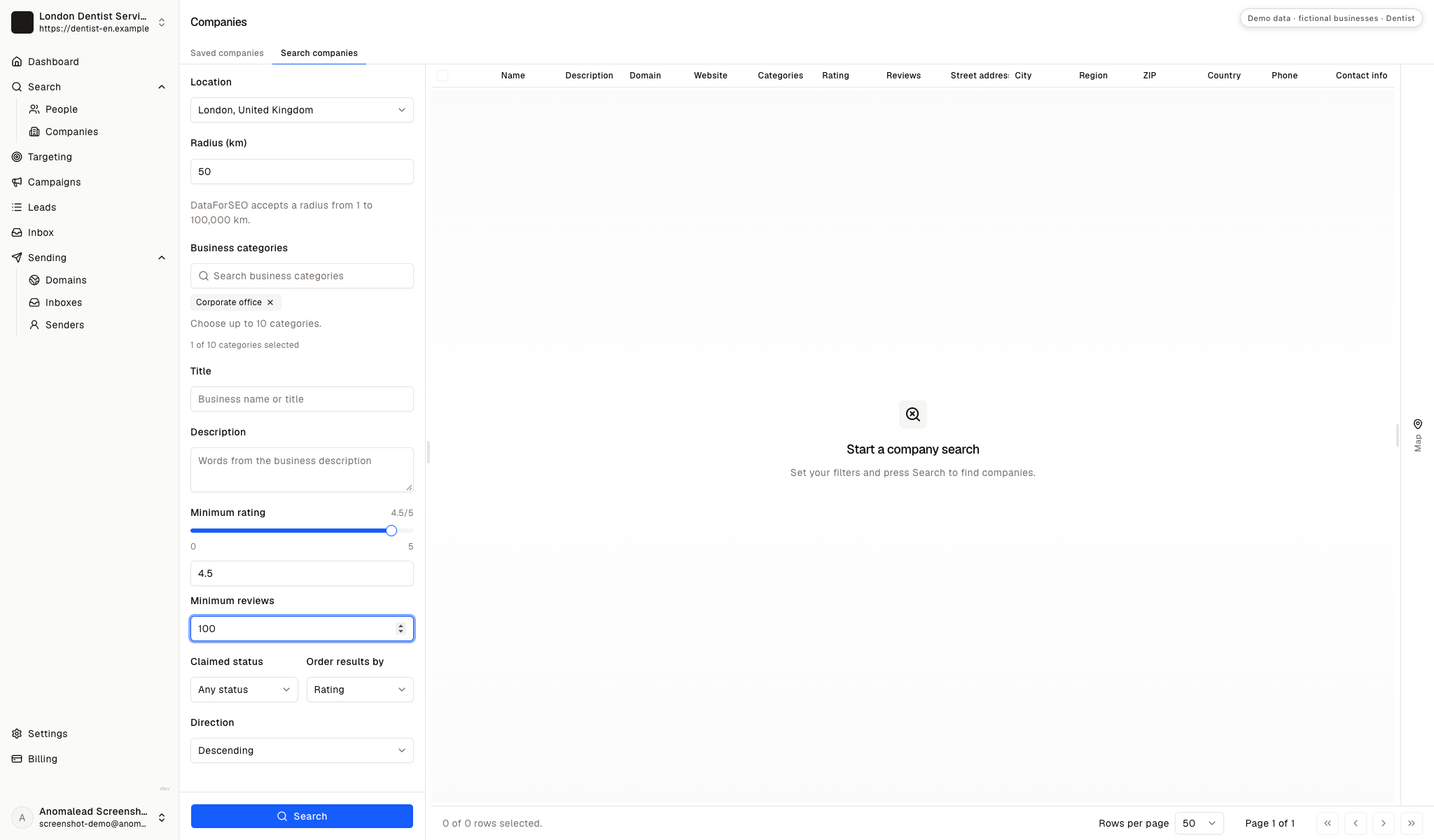
Section titled: Set the office category and a commutable radiusThe demo search uses the Corporate office category with minimum rating and review filters. For your own practice, pick a radius that reflects how far someone would travel on a lunch break, and widen it only if a busy business district sits just outside it.
Ratings and review counts surface established companies, but they say nothing about headcount, so treat them as a first sift.
Scan the office results for real employers
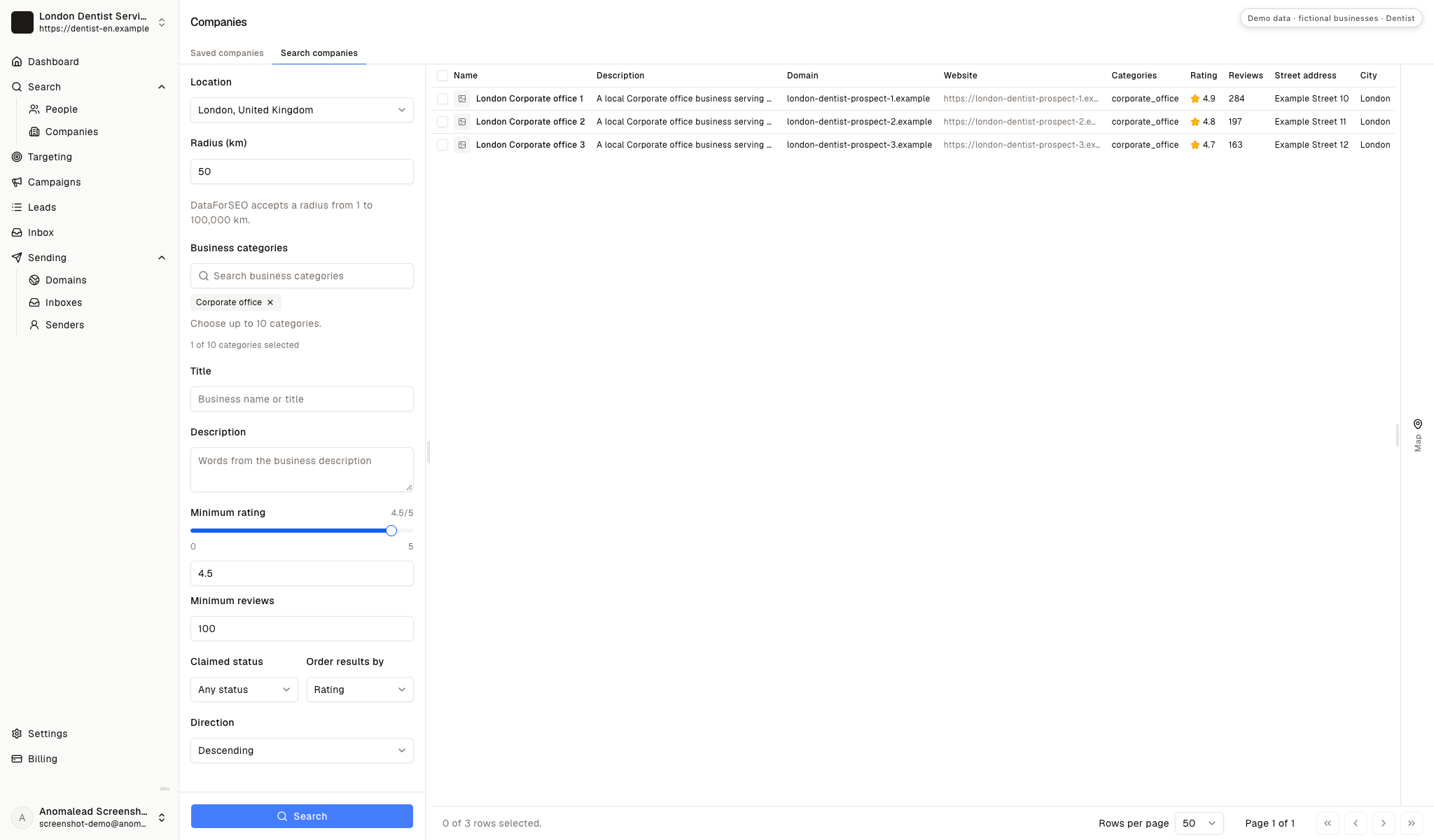
Section titled: Scan the office results for real employersThe demo results are deliberately plain: three fictional corporate offices with generic descriptions, ratings and review counts. Real results will include serviced offices and virtual addresses with nobody at a desk, which rarely make good partners. Check the website of anything promising for a careers or team page.
Save the offices your patients could walk from
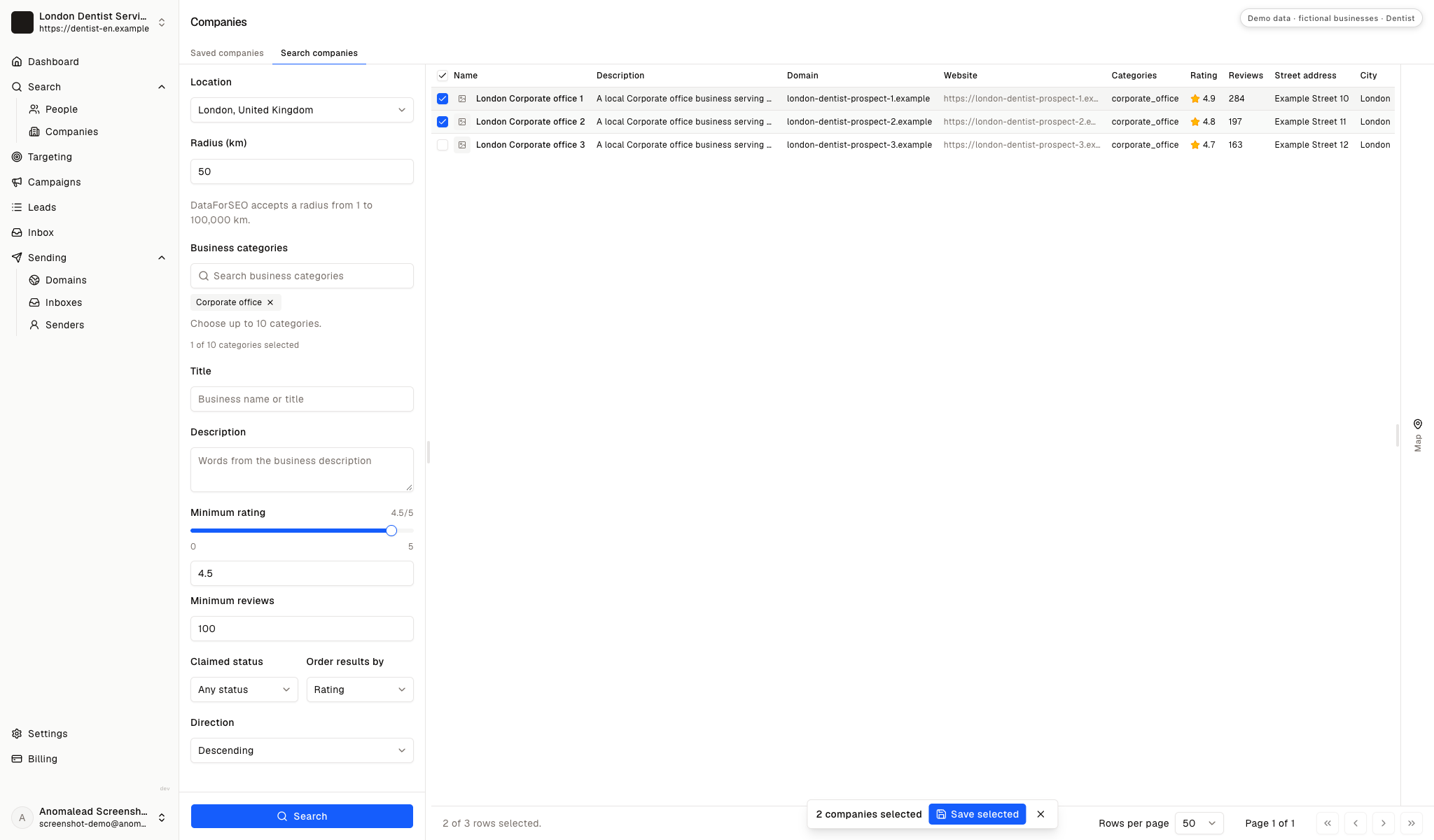
Section titled: Save the offices your patients could walk fromIn the demo, two of the three offices are ticked and the third is left behind. Leave out any office that is too far away, too small or clearly run from a distant headquarters. A short list you can serve beats a long one you cannot follow up.
Choosing the right person at each employer
Section titled: Choosing the right person at each employerA dental partnership depends on reaching the person who looks after staff benefits. A general inbox or a senior executive rarely answers, while the right HR or partnerships contact can approve a simple arrangement quickly.
Check each saved office before enrichment
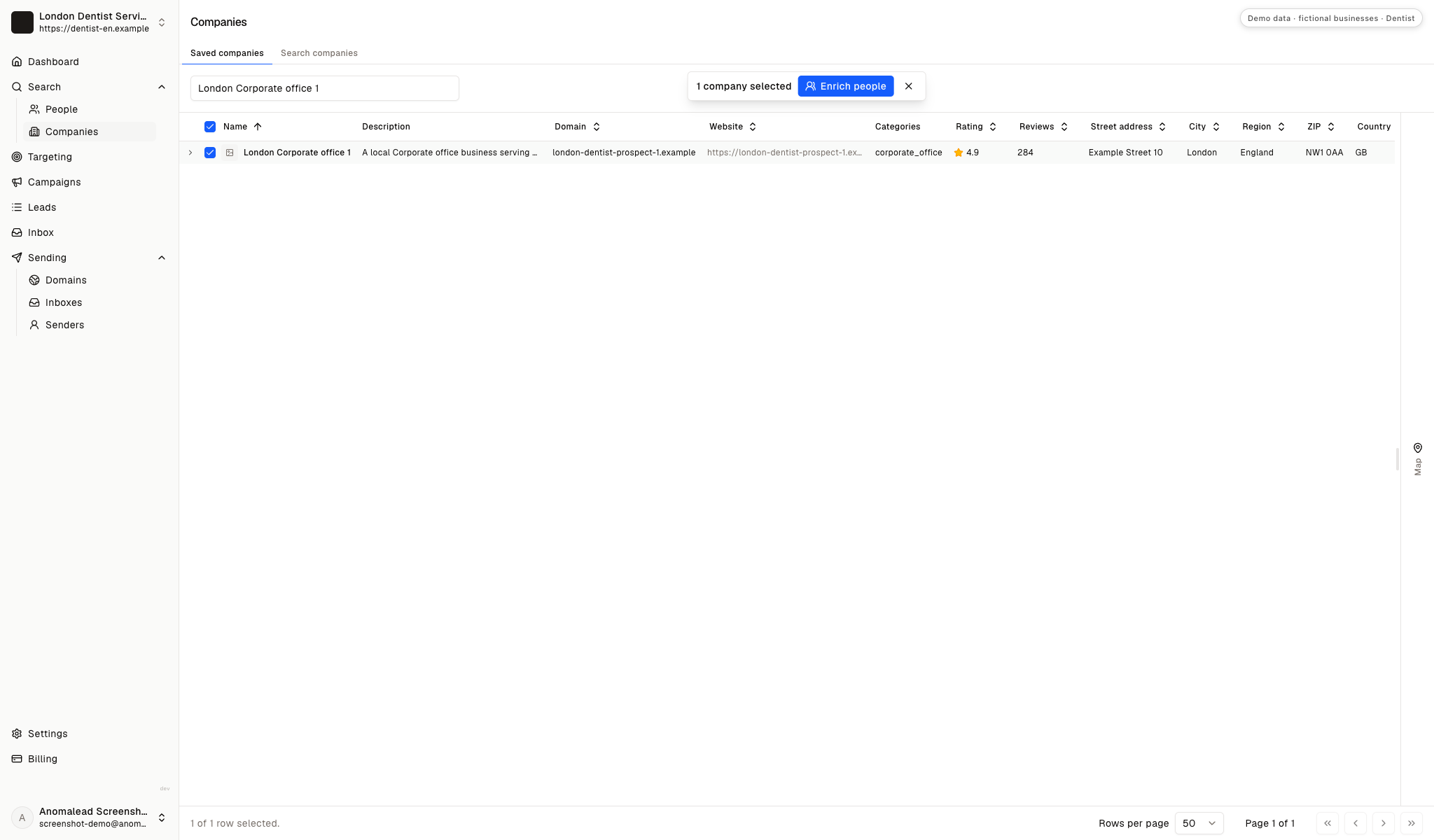
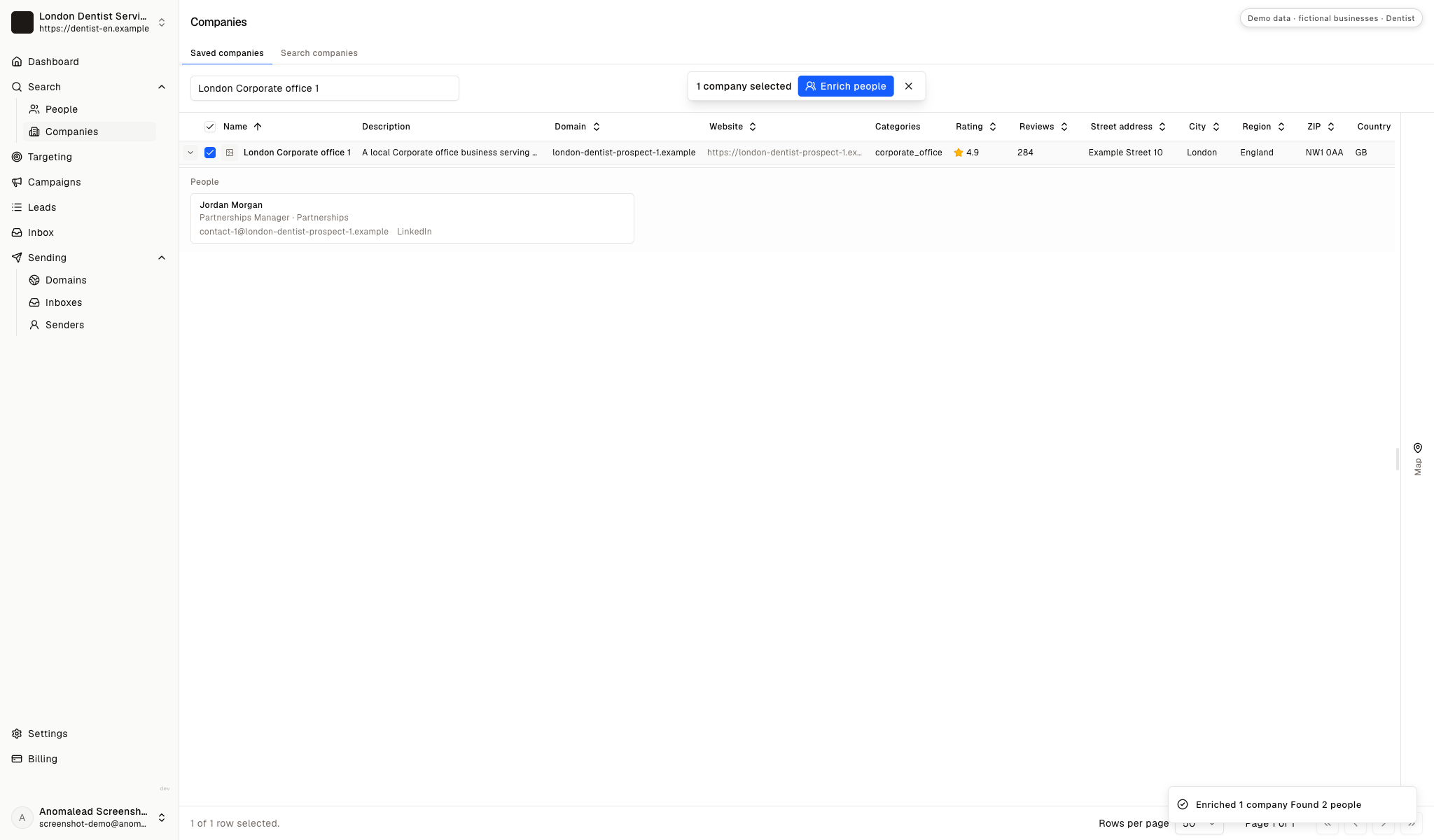
Section titled: Check each saved office before enrichmentThe saved companies view is a good moment for a second look. Could you honestly offer this office reserved appointments next month? If that depends on hiring another hygienist, pause the prospect.
Pick the benefits or partnerships contact
Section titled: Pick the benefits or partnerships contactAfter enrichment, the expanded row shows Jordan Morgan, a Partnerships Manager, with a work email and a LinkedIn link, while a notification reports that two people were found. A partnerships title is a reasonable fit for a staff perk offer.
If enrichment returns someone in finance, sales or IT instead, keep looking for an HR, people, wellbeing or office management role.
Confirm roles and email status on the lead list
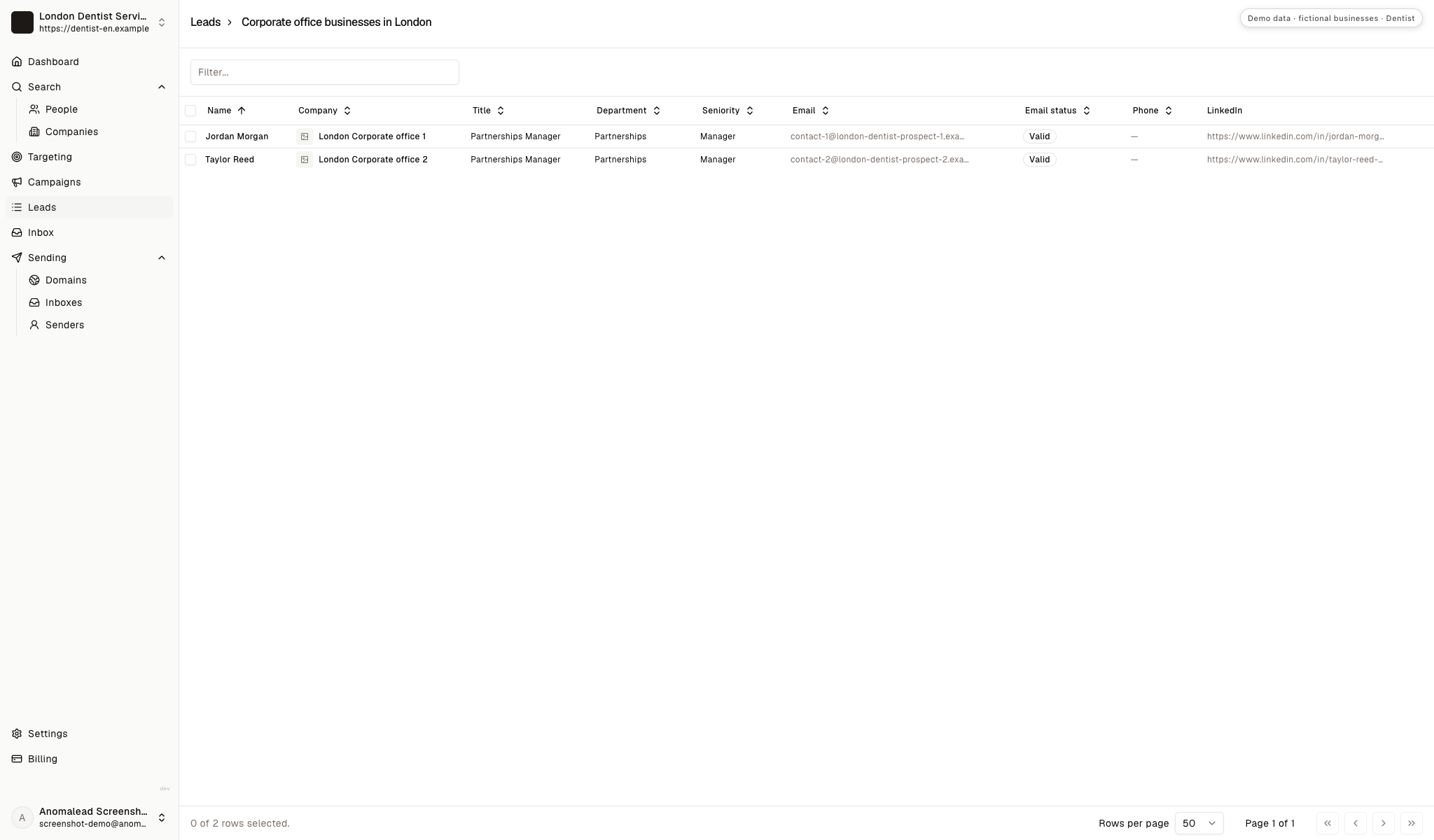
Section titled: Confirm roles and email status on the lead listThe demo lead list holds two partnerships managers, Jordan Morgan and Taylor Reed, at two different offices, both with valid email status. Because they share a role, one message can serve both. HR managers you add later deserve their own campaign.
What could one employer partnership be worth to a dental practice?
Section titled: What could one employer partnership be worth to a dental practice?A partnership is not a single contract. Its value comes from employees who register, attend regular check-ups and hygiene visits, and sometimes need further treatment. Some will never book at all.
Estimate conservatively: how many staff might realistically become patients, what a patient relationship is worth to your practice and how many offices will agree.
Every value in the calculator is an assumption you supply from your own practice. The tool does not contain benchmarks and cannot forecast how many employees or employers will respond.
Do the math on one good deal
If one new customer is worth thousands, you don’t need magic. You need a few more meetings a month.
Projected monthly results
- Deals closed
- 2.0
- Projected revenue
- £10,000
- Growth plan (1 business)
- £79/mo
- ROI
- 12,558%
Conservative math on meetings you already believe you can book. One closed deal often pays for a year of Anomalead.
If a partnership only pays off with generous assumptions, focus on the offices nearest your practice and on employers large enough to fill the slots you set aside.
Launching dentist lead generation outreach to employers
Section titled: Launching dentist lead generation outreach to employersThe last steps move from a list to a conversation. The demo sequence is intentionally generic, so treat it as a skeleton and replace its wording with an offer an HR team can picture. For the principles behind a good opener, read how to write a cold email before you edit anything.
Review who receives the partnership email
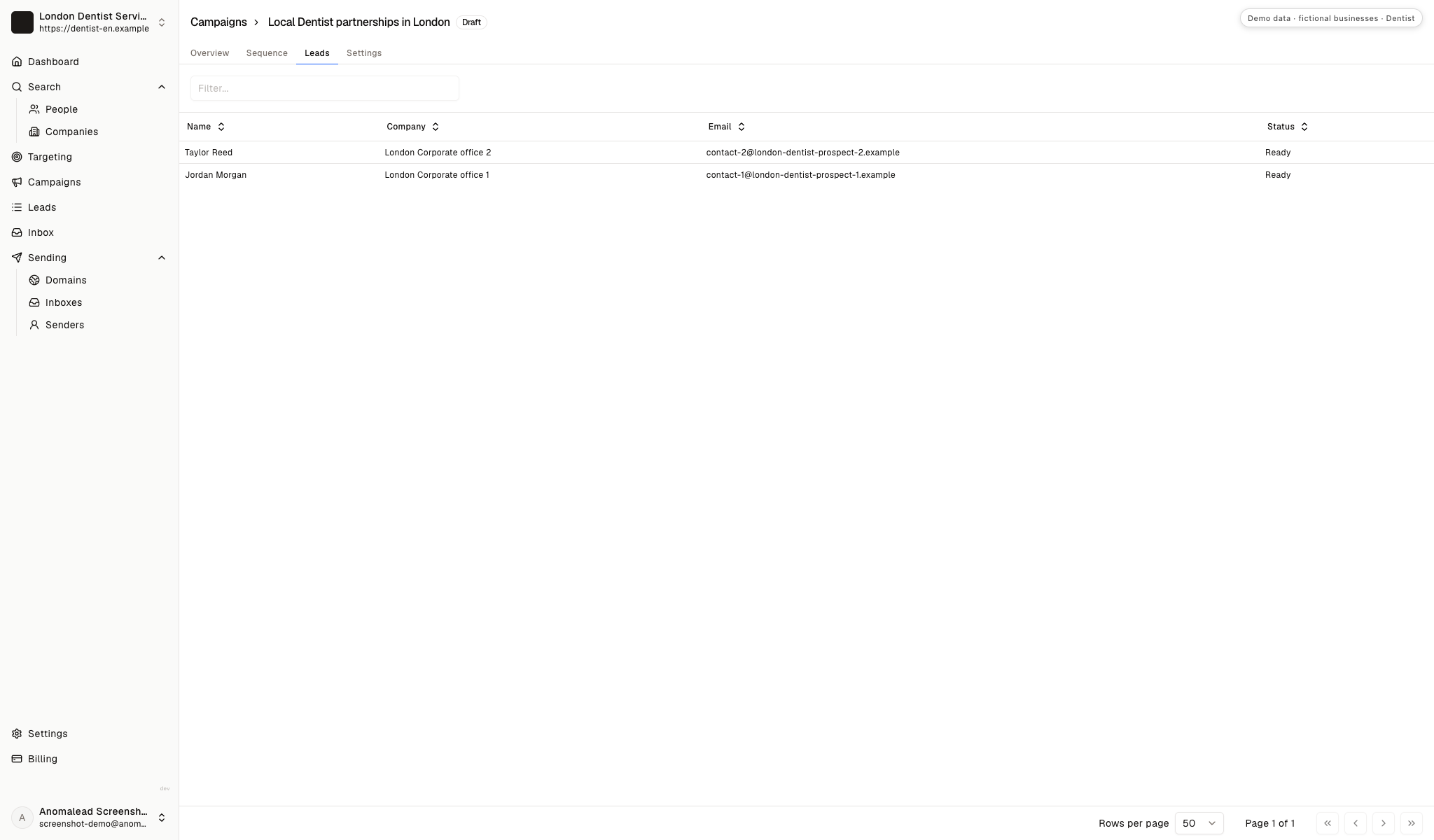
Section titled: Review who receives the partnership emailThe campaign is still a draft with two recipients marked ready. This is the last easy moment to remove anyone who does not fit, such as a contact whose office turned out to be mostly remote.
Rewrite the generic sequence for an HR audience
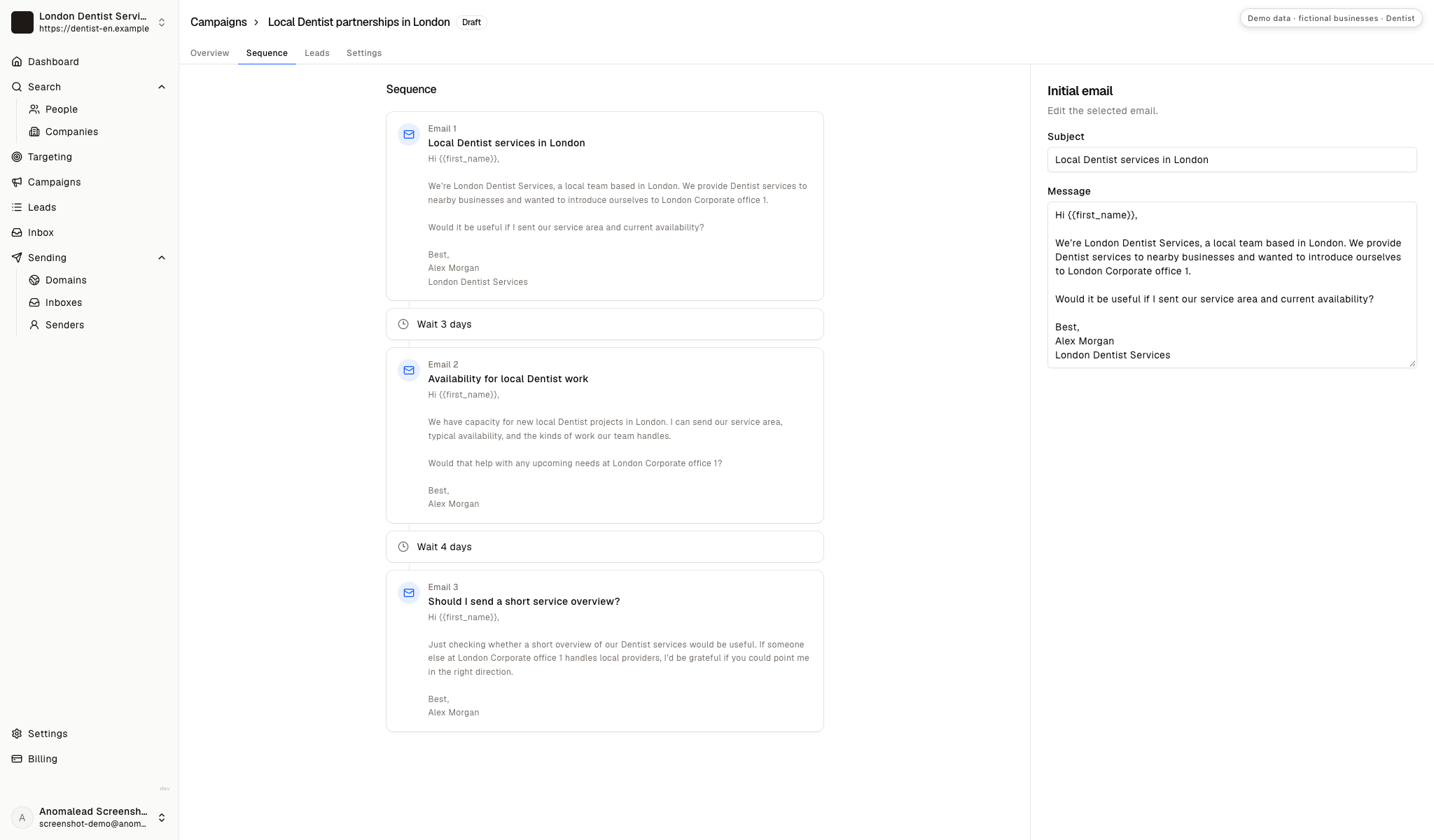
Section titled: Rewrite the generic sequence for an HR audienceThe demo sequence has three short emails separated by waits of three and four days. Its first message offers dentist services to nearby businesses and asks about service area and availability, which is the language of a contractor rather than a dental practice.
An HR or partnerships manager needs to know what staff would get, what it costs the company and how little effort it takes. Let each follow-up add one new detail.
Stronger first emails for an employee dental partnership
Section titled: Stronger first emails for an employee dental partnershipThe two examples below replace the demo wording: a first email to a partnerships contact and a follow-up that adds one concrete idea. Adjust every detail to what your practice actually offers.
First email to a partnerships manager
Subject: Easier dental appointments for your team
Hi Jordan,
I look after partnerships at London Dentist Services, a dental practice a short walk from your office. Many people put off check-ups because fitting one around work is awkward, so we can discuss early-morning and lunchtime appointments for your staff.
Your team would get a dedicated booking contact and a clear list of what we offer. There is nothing for the company to pay or manage, and each person books and deals with us privately.
Would it help if I sent a one-page summary you could share with staff?
Best regards,
Alex Morgan, London Dentist Services
Follow-up with a lunchtime idea
Subject: A short oral-health talk for your office
Hi Taylor,
I am following up on my note about appointment access for your staff. One low-commitment first step is a short oral-health talk during a lunch break, with time for general questions about everyday care.
It needs only a meeting room and gives your colleagues a chance to meet the practice before booking anything.
If that sounds useful, which week would suit your team?
Kind regards,
Alex Morgan, London Dentist Services
Leave out clinical claims, before-and-after promises and anything that sounds like pressure to book treatment. For more structures you can adapt, browse these B2B cold email templates, and check your professional body's guidance before offering reduced fees.
Read the first replies from employers
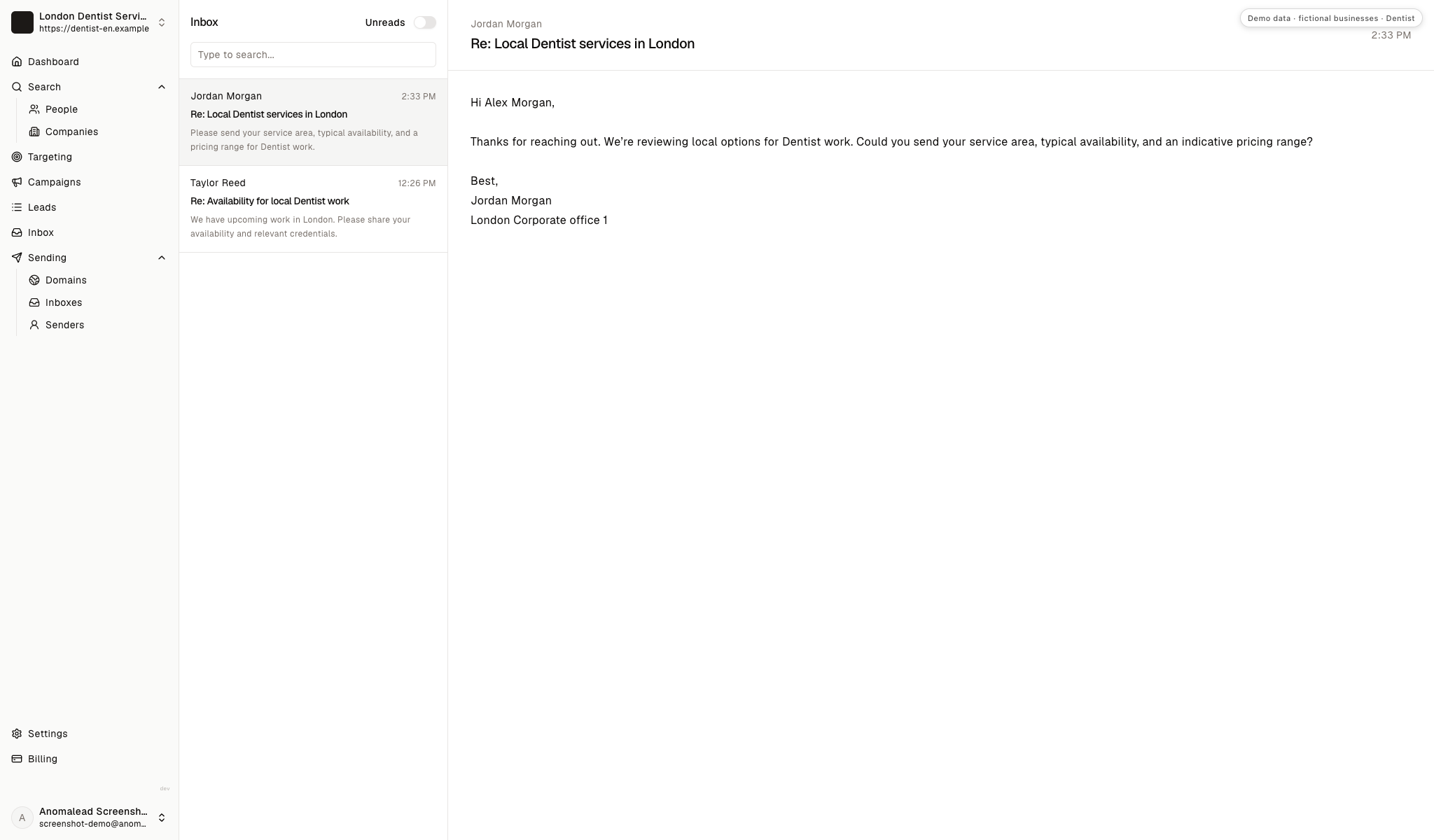
Section titled: Read the first replies from employersThe demo inbox holds two replies. Jordan Morgan asks for a service area, typical availability and an indicative pricing range, and Taylor Reed mentions possible upcoming work and asks for availability, the work your team covers and relevant licences or credentials.
Both read like a supplier review rather than a benefits conversation, which is common when the first email sounds like a service pitch.
Answering HR and partnership replies about staff dental care
Section titled: Answering HR and partnership replies about staff dental careEmployer contacts are rarely in a hurry, but they appreciate a clear answer that is easy to forward. Reply within a working day and keep attachments to a single page.
They ask for your service area, availability and a pricing range
Section titled: They ask for your service area, availability and a pricing rangeThanks for reaching out. We are reviewing local options. Could you send your service area, typical availability, and an indicative pricing range?
Clarify gently that the company is not buying a contract. Explain where the practice is, which appointment times you can hold for their staff and how employees book.
For prices, share your standard fee list for check-ups and hygiene visits; further treatment is discussed with each patient after an examination.
A reply that reframes the request:
Thanks Jordan. We are a short walk from your office and can keep early-morning and lunchtime slots for your team each week. Staff book directly through a dedicated reception contact, so there is nothing for your company to administer.
I have attached our standard fee list for check-ups and hygiene appointments. Would a short call next week help you decide whether to share this with colleagues?
They ask about your credentials and the work you cover
Section titled: They ask about your credentials and the work you coverPlease send your availability, the work your team covers, and any relevant licences or credentials.
This is a fair due-diligence question. Confirm that your clinicians are registered with the relevant professional body and that the practice holds the required indemnity cover, and offer documents rather than listing every certificate.
Then describe the range of care in everyday language: check-ups, hygiene, fillings, emergency appointments and any cosmetic services you provide.
A reply that answers and moves forward:
Thanks Taylor. All our dentists and hygienists are registered with the professional regulator, and I can send our registration and indemnity details for your records. We cover check-ups, hygiene visits, fillings and emergency appointments.
Shall I also send a short note for staff explaining how to book?
They already offer dental cover as a benefit
Section titled: They already offer dental cover as a benefitOur staff already have dental insurance through the company plan, so I am not sure we need this.
Treat this as useful information, not a rejection. Ask which plan they use and say honestly whether you accept it. If you do, staff can use existing cover at a practice close to the office; if not, explain how payment would work.
They cannot endorse one provider to staff
Section titled: They cannot endorse one provider to staffWe are not able to recommend a single healthcare provider to employees.
Respect the policy. Ask whether they keep a list of local offers or a staff noticeboard where your practice could appear alongside others. That keeps employee choice intact and still puts your practice in front of people who work nearby.
What to review before contacting more employers
Section titled: What to review before contacting more employersLook at which roles answered and what they asked. If partnerships managers replied and HR managers stayed silent, write HR a separate message about absence and onboarding. Check your appointment book too, so every new office gets the access you promised the first ones.
Keep batches small so reception is never swamped by new patients from one employer. The chiropractor lead generation guide shows how another clinic approaches local businesses, and these lead generation marketing strategies help you balance this channel with patient marketing.
Questions about employer partnerships for dental practices
Section titled: Questions about employer partnerships for dental practicesDo employers actually pay for a dental partnership?
Section titled: Do employers actually pay for a dental partnership?Usually not. Most arrangements cost the employer nothing: the practice offers convenient access and each employee pays for their own care or uses existing cover. Some employers choose to subsidise check-ups, which should be agreed in writing.
Can a practice share patient information with the employer?
Section titled: Can a practice share patient information with the employer?No clinical or appointment details should reach an employer without the patient's explicit consent. The partnership covers access; treatment stays between each employee and the practice.
Are discounts for employees allowed?
Section titled: Are discounts for employees allowed?That depends on the professional-conduct and advertising rules that apply to dental practices where you work. Check with your professional body or regulator before offering reduced fees, packages or gifts, and describe any offer accurately.
Are the businesses and replies in the screenshots real?
Section titled: Are the businesses and replies in the screenshots real?No. London Dentist Services, the corporate offices, the contacts and the replies are fictional demo data created for this guide. They are not Anomalead customers and do not represent real results.
What does the ROI calculator tell a dental practice?
Section titled: What does the ROI calculator tell a dental practice?It turns the patient value, meeting count and conversion rate you enter into a rough planning figure. It cannot predict how many employees will register or offices will agree, and it contains no benchmarks.