


Personal trainer lead generation with local employers works when you sell one thing an office can say yes to quickly: a short block of small-group sessions, run in a room they already have, at a time their staff are actually in the building. You bring the kit, the screening forms and the insurance; the employer books a room. That decision is far easier than a benefits contract, and it fills weekday slots private clients rarely want.
This guide covers choosing employers, qualifying their space, finding who approves a session and answering replies. If contacting businesses you have never met is new to you, start with what cold outreach actually involves.
Key takeaways
- A personal trainer's easiest employer offer is a fixed block of on-site small-group sessions with a review at the end, not an open-ended wellness retainer.
- Qualify each office on three things before contacting anyone: a usable room or nearby outdoor space, enough staff on site on the same days, and a named person who controls wellbeing spend.
- Keep every participant's health questionnaire with the trainer; the employer receives headcounts and feedback, never individual health details.
- Answer a price question with a scoped proposal for one format and one block length, and offer a single taster session so the employer can judge demand before committing.
Personal trainer lead generation starts with who books the room
Section titled: Personal trainer lead generation starts with who books the roomFour kinds of office contact can bring in workplace sessions, and each needs a different first email.
- People and HR teams: They usually hold the wellbeing budget and worry about fairness across teams and employee health data. Lead with opt-in sessions and private screening.
- Office and workplace managers: They control rooms, building access and the calendar. Expect questions about moving furniture, noise and signing in at reception.
- Founders and managing directors of small firms: In a small company the owner often decides on the spot, and wants low admin, one invoice and a clear end point.
- Wellbeing champions and staff committees: They gather interest but rarely sign anything. Ask them to introduce you to whoever approves spending.
If you run a facility with memberships and a timetable, the gym guide to employer partnerships covers that model.
Check the space, the office days and the budget holder
Section titled: Check the space, the office days and the budget holderAn office can look ideal in a directory and still be impossible to train in.
- A room you can actually train in: Look for a meeting room that clears easily, a roof terrace or a park nearby. Floor surface, ceiling height and the teams next door decide which exercises are realistic.
- Staff on site on the same days: Hybrid offices fill up on a few anchor days, and sessions only work on those days.
- Showers or changing space: Without them, a lunchtime session has to be low-sweat mobility and strength work, so pitch that format instead.
- Someone who controls wellbeing spend: A friendly office manager is not a budget. Find out whether spending sits with HR, a department head or the owner, and when it is set.
- Cover under your insurance and qualifications: Some trainer policies cover one-to-one work in a gym but not groups at a client's premises. Confirm your liability cover, first aid certificate and group-exercise qualifications match the offer.
About the demo workspace
The screenshots show a fictional trainer business called London Personal trainer Services. London Corporate office 1, London Corporate office 2 and London Corporate office 3, the contacts Jordan Morgan and Taylor Reed, and both inbox replies are demo data. They are not Anomalead customers and not results from a real campaign.
Find offices within reach of your training kit
Section titled: Find offices within reach of your training kitSet your search around how you travel with equipment, not a city boundary. Multi-tenant office buildings are worth noting, since one building manager may open doors to several companies. A trainer carrying mats, bands and kettlebells on public transport has a smaller real radius than one with a van.
Set the category and a radius you can travel with kit
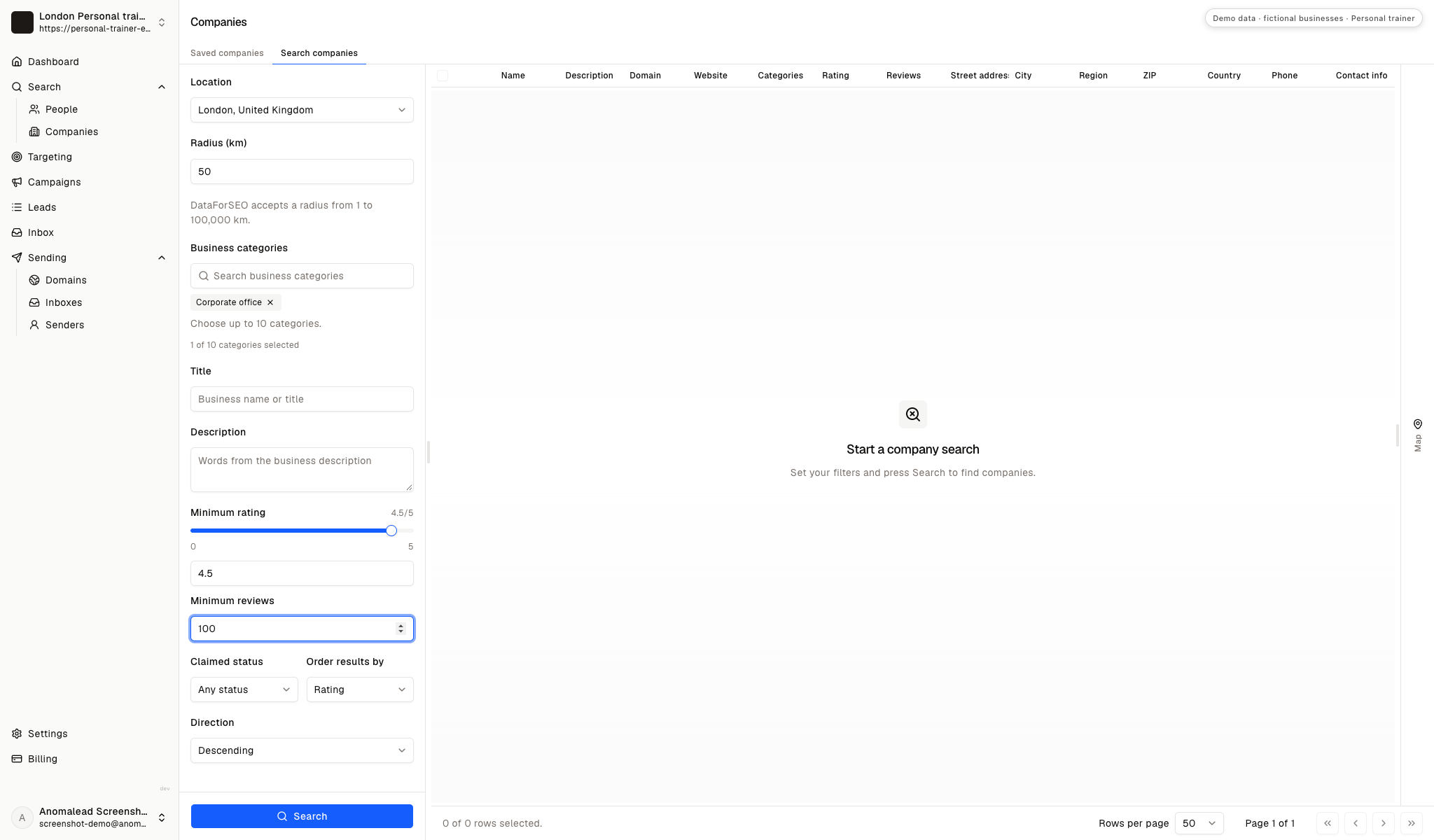
Section titled: Set the category and a radius you can travel with kitThe search targets corporate offices with a location, a radius and a rating filter. Pick a radius you could cover between a morning client and a lunchtime class.
Read the office results for signs of a usable workplace
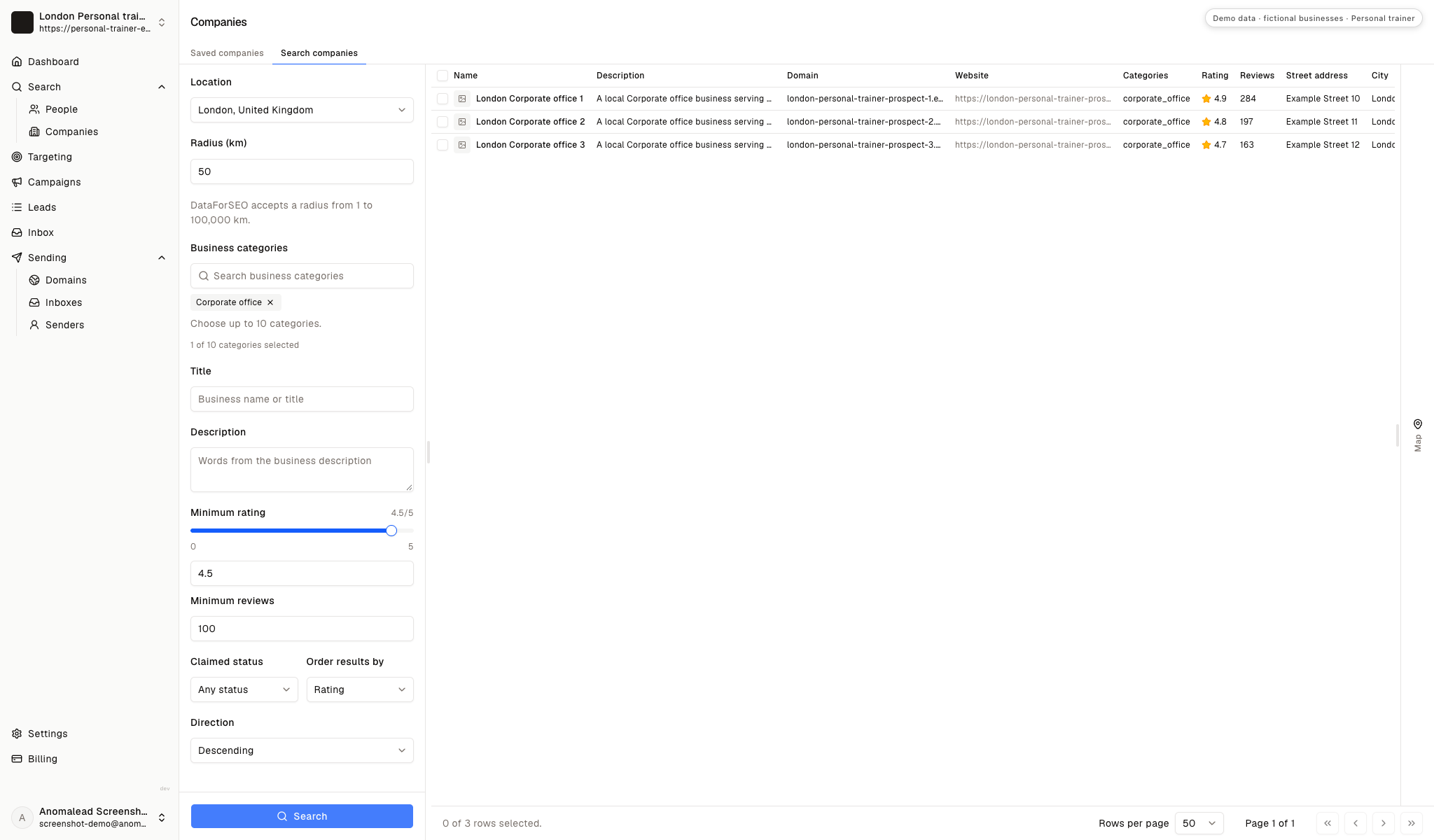
Section titled: Read the office results for signs of a usable workplaceThree fictional offices appear with ratings and review counts. Those numbers only show the listing is active. Check each website for office photos, a careers page mentioning wellbeing or a note about hybrid working.
Save the offices worth a second look
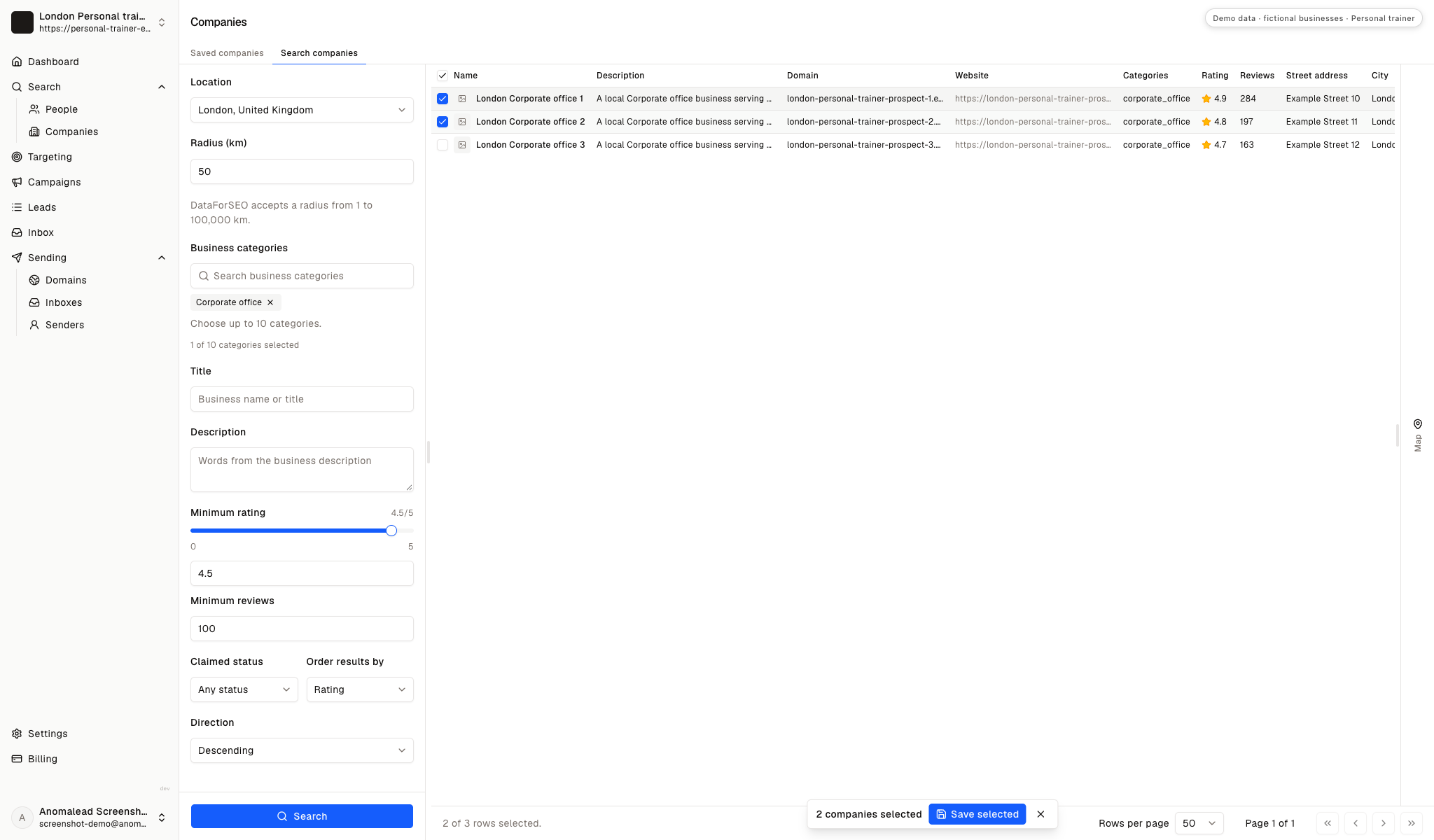
Section titled: Save the offices worth a second lookTwo of the three offices are ticked and ready to save. Leave out any company whose staff are mostly remote or whose building clearly has no spare room.
Reach the person who can approve staff sessions
Section titled: Reach the person who can approve staff sessionsThe right first contact for a personal trainer is whoever can book a room and approve a small spend without a committee: the office manager or owner in a small firm, usually People or HR in a larger one.
A partnerships title may mean commercial deals rather than staff benefits, so check the person's public profile before writing.
Confirm the saved office before looking for people
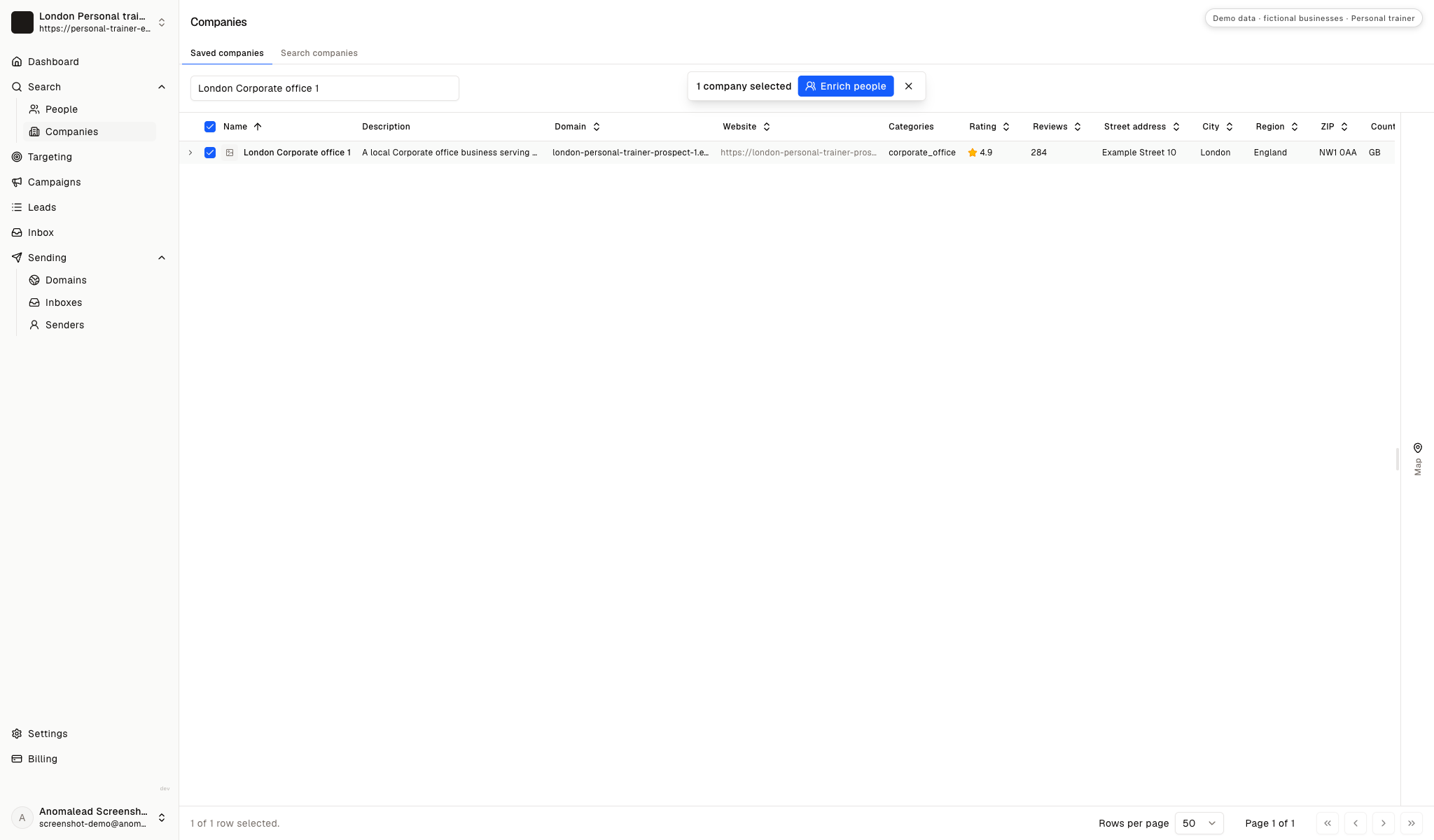
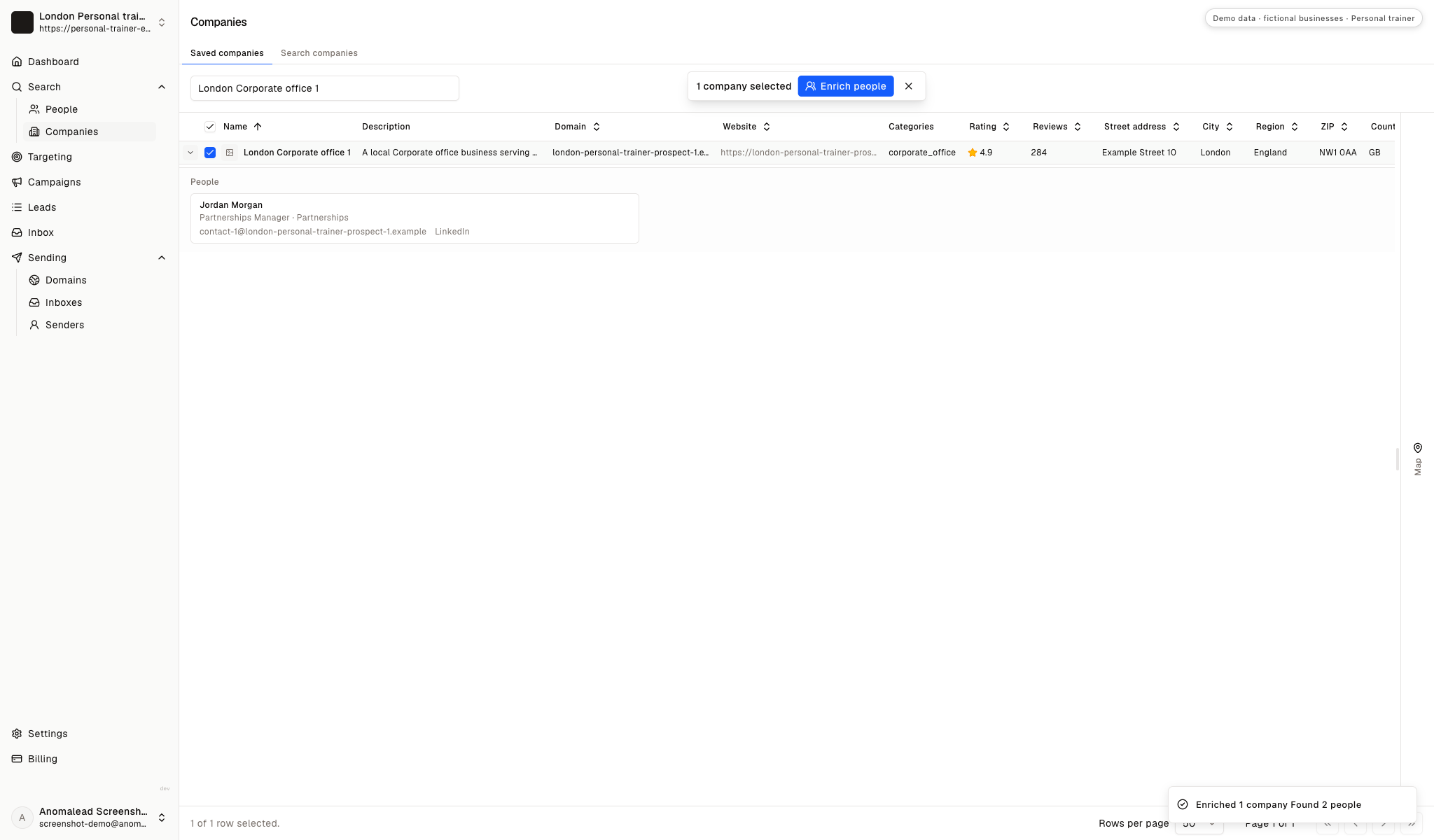
Section titled: Confirm the saved office before looking for peopleLondon Corporate office 1 is selected in the saved companies view, with the Enrich people action available. Check it is inside your travel radius and that nothing on its website rules out on-site sessions.
Pick the contact closest to wellbeing or the office
Section titled: Pick the contact closest to wellbeing or the officeEnrichment returns Jordan Morgan and Taylor Reed, both listed as Partnerships Managers at fictional offices. In a real campaign, prefer someone in People, HR or workplace management, or ask a partnerships contact to point you there.
Keep a short lead list of office contacts
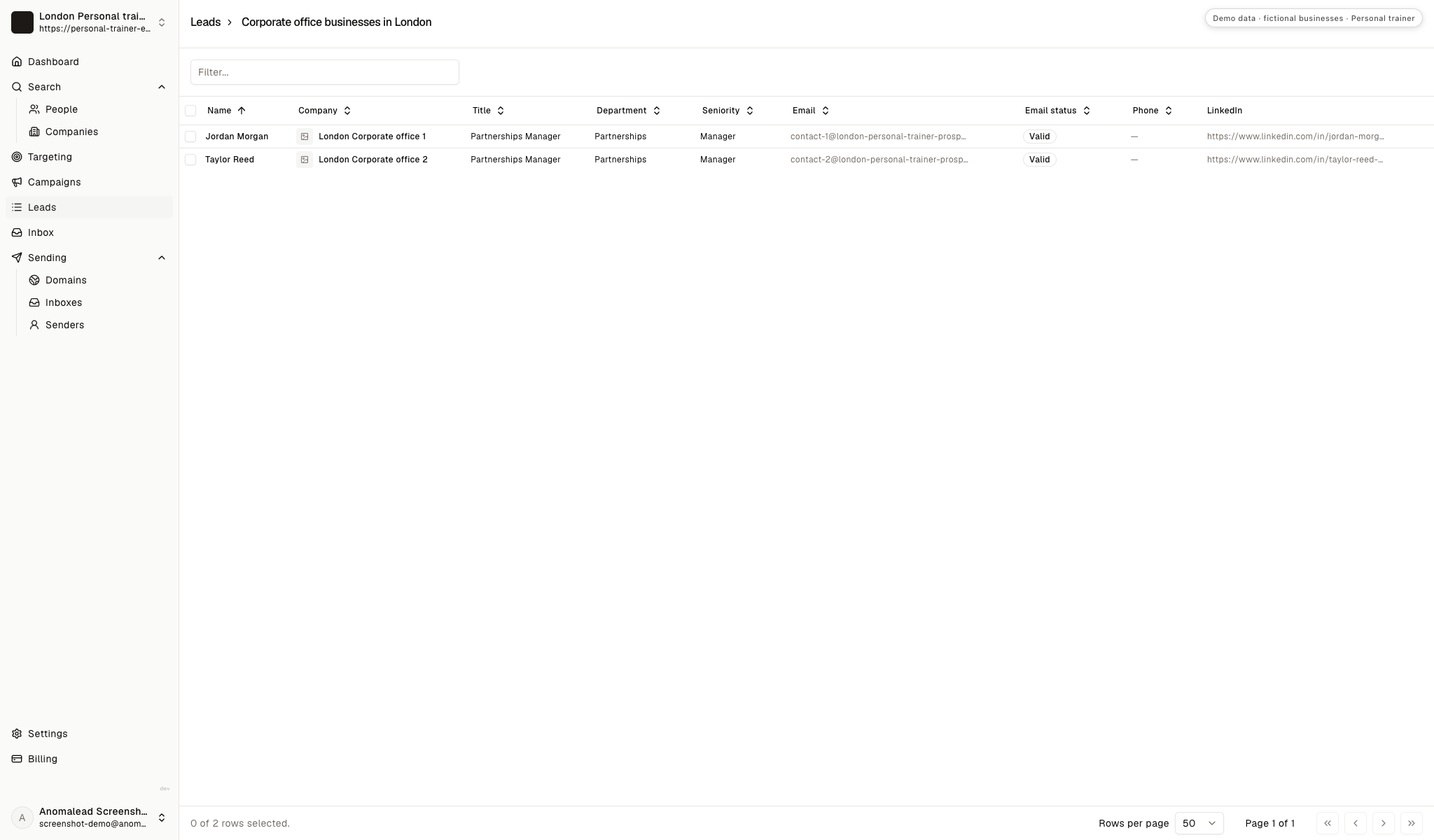
Section titled: Keep a short lead list of office contactsThe lead list holds Jordan Morgan and Taylor Reed. Group lists by format: offices with room for strength sessions in one, buildings where only mobility work fits in another, so each email describes a session they can host.
What could one employer block be worth to your diary?
Section titled: What could one employer block be worth to your diary?An employer account for a personal trainer is usually a block of group sessions, sometimes followed by a renewal or private clients from the group. Its value depends on your rate, travel and set-up time, and how many empty weekday slots it fills.
Count the unpaid parts too: the site visit, the taster, carrying kit and chasing invoices.
The calculator uses only the deal value, meetings and close rate you enter. They are your own assumptions, not benchmarks, and the result is not a forecast.
Do the math on one good deal
If one new customer is worth thousands, you don’t need magic. You need a few more meetings a month.
Projected monthly results
- Deals closed
- 2.0
- Projected revenue
- £10,000
- Growth plan (1 business)
- £79/mo
- ROI
- 12,558%
Conservative math on meetings you already believe you can book. One closed deal often pays for a year of Anomalead.
Pitch a taster session, then a fixed block
Section titled: Pitch a taster session, then a fixed blockA single taster answers the employer's real worry, which is whether anyone will turn up. Offer it in the first email, then propose a fixed block with a start date, a maximum group size and a review at the end.
Say plainly that workplace training is general fitness, not physiotherapy, injury treatment or a nutrition plan. For more on keeping cold messages short and specific, see how to write a cold email people answer.
Check who is on the draft campaign
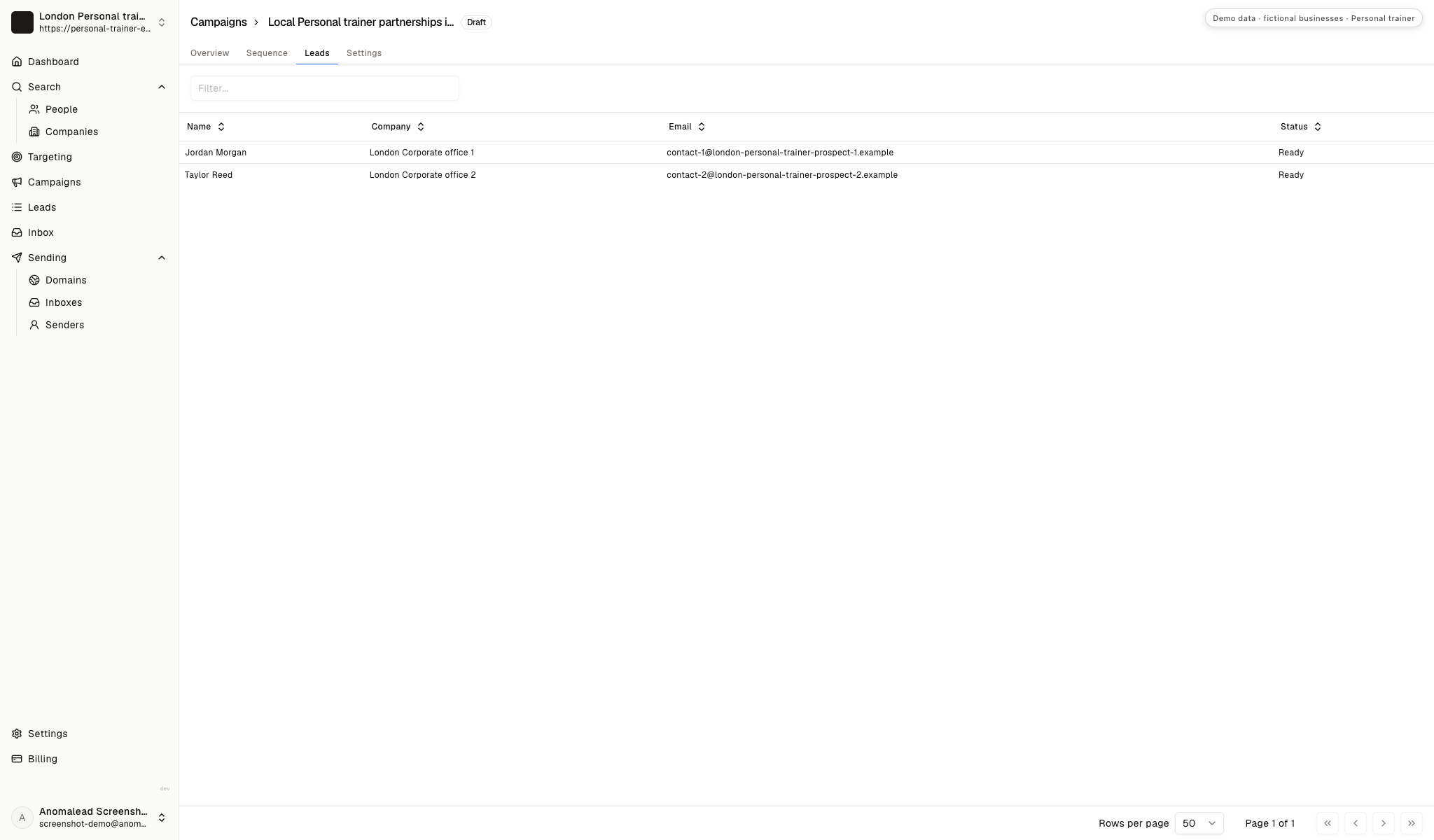
Section titled: Check who is on the draft campaignThe draft campaign has two recipients from the lead list. Confirm both offices suit the same session format; a strength-circuit pitch reads oddly to an office with no showers.
Rewrite the demo sequence around a session they can host
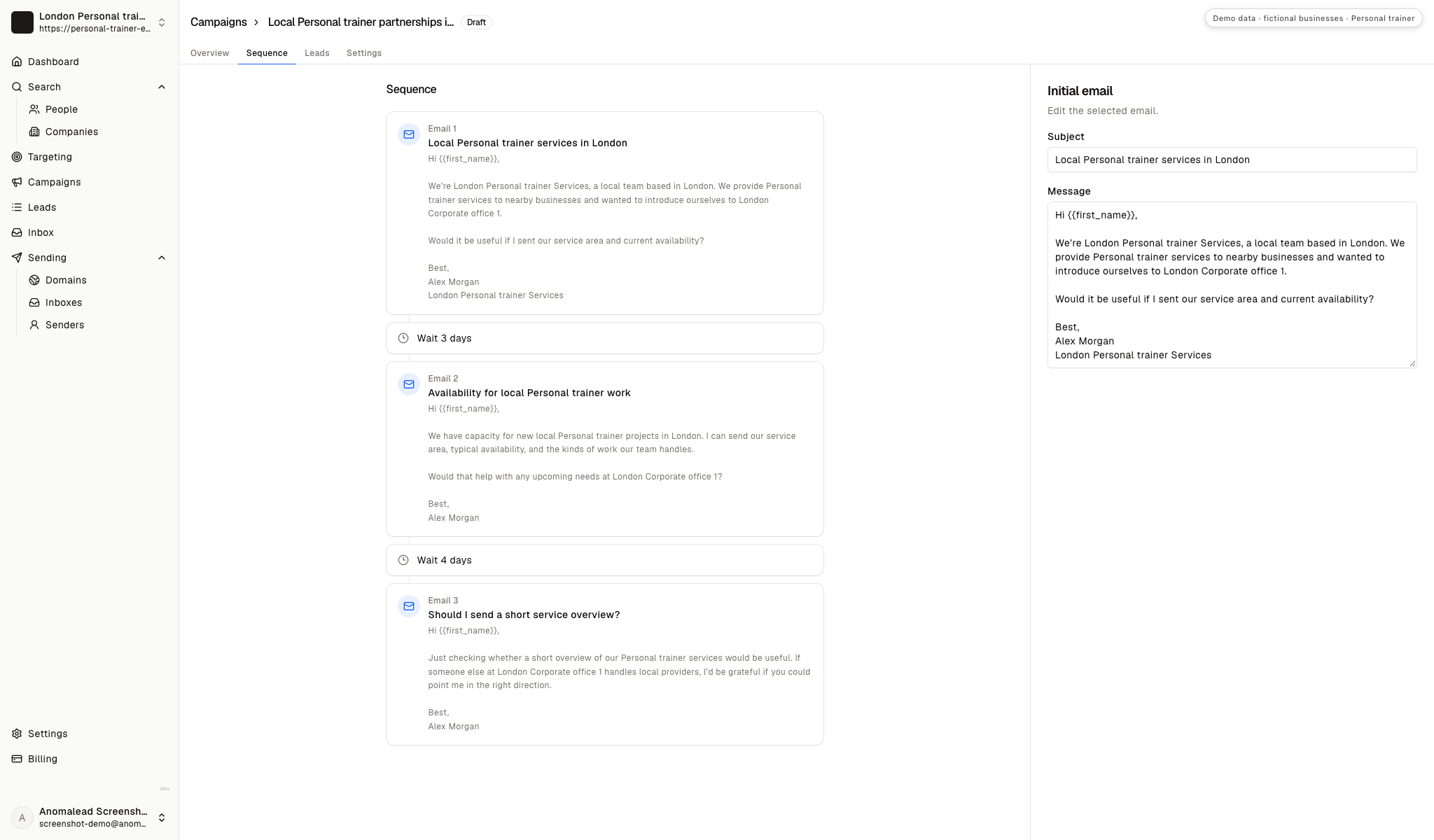
Section titled: Rewrite the demo sequence around a session they can hostThe sequence has three emails with a three-day wait and then a four-day wait. The seeded copy only says the business offers personal trainer services, which gives an office no reason to reply.
Replace it with a concrete session format and one easy question, and add something new in each follow-up, such as a sample session plan.
Example emails to an office manager and an HR lead
Section titled: Example emails to an office manager and an HR leadTwo stronger openers than the demo copy, each describing a specific session and asking one question.
To an office or workplace manager
Subject: Lunchtime strength sessions in one of your meeting rooms
Hi Jordan,
I'm Alex Morgan, a personal trainer at London Personal trainer Services. I run small-group sessions inside offices: bodyweight and band work that fits a cleared meeting room and needs no showers.
I bring all the equipment, handle each person's health questionnaire myself and carry insurance for group sessions at client premises.
Would a single taster session on one of your busier office days be worth trying at London Corporate office 1?
Best,
Alex Morgan
To a People or HR contact
Subject: A short block of opt-in training sessions for staff
Hi Taylor,
I'm Alex Morgan from London Personal trainer Services. I give employers a simple, opt-in fitness option for staff without a membership scheme.
The format is a fixed block of weekly small-group sessions on site, then a short review. Health screening stays between me and each participant.
Is staff wellbeing something you look after at London Corporate office 2, or is there a colleague I should speak to?
Thanks,
Alex Morgan
Keep subject lines as literal as these; the guide to cold email subject lines explains why plain beats clever for a first message. Mention only cover and formats you really have.
Read the two office replies in the inbox
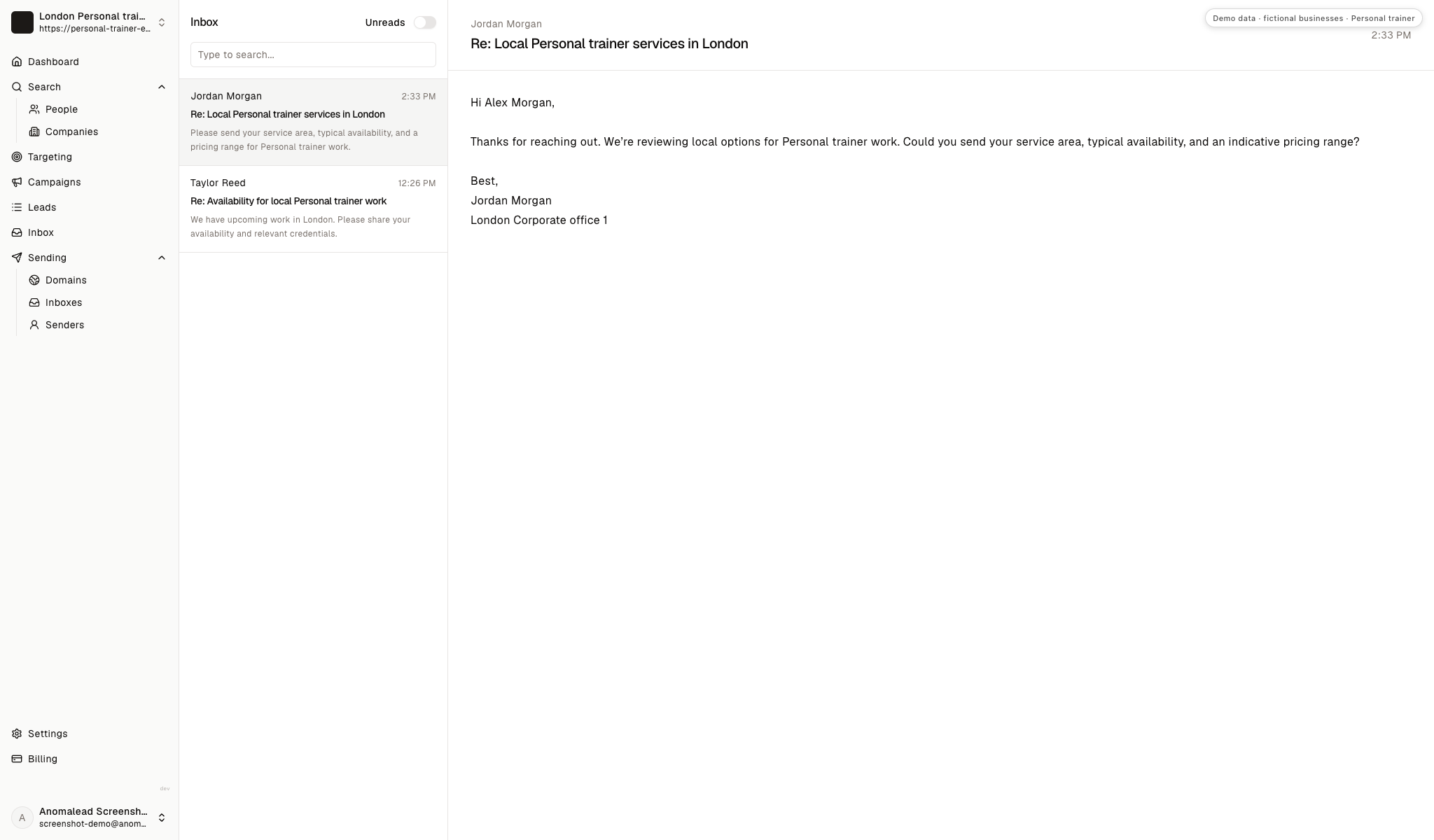
Section titled: Read the two office replies in the inboxThe inbox shows two fictional replies. Jordan Morgan asks for a service area, typical availability and a price range. Taylor Reed mentions a possible project and asks for availability, scope and credentials.
Answer workplace replies with a scoped next step
Section titled: Answer workplace replies with a scoped next stepAn employer reply invites you to scope the work; it is not a booking. Answer what was asked, then propose one step: a call, a look at the room or a taster date.
Jordan Morgan asks for service area, availability and a price range
Section titled: Jordan Morgan asks for service area, availability and a price rangeThanks for reaching out. We're reviewing local options for personal trainer work. Which area do you cover, when are you usually free, and roughly what do you charge?
A price range with no format invites comparison with gym memberships. Tie it to one defined option, a weekly session for a set group size over a fixed block, and ask which days staff are in and what space exists.
Alex Morgan could reply:
Thanks, Jordan. I cover offices near my base and have weekday lunchtime slots open. I quote per block, based on group size and number of sessions. Which days are most of your team in, and could we clear a meeting room for an hour? I'll then send a one-page proposal with a firm figure.
Taylor Reed asks for availability, scope and credentials
Section titled: Taylor Reed asks for availability, scope and credentialsWe may have a personal trainer project coming up. Can you tell us when you're available, what you cover and which credentials you hold?
Send what an HR team files: qualifications, first aid and insurance certificates, and a short note on what you do and do not cover. Then ask whether the project is a one-off wellbeing day or regular sessions.
A reply that makes the next step easy:
Thanks, Taylor. I've attached my qualifications, first aid certificate and insurance details. I run general fitness sessions for mixed abilities and refer anyone with an injury or medical condition to a suitable professional. Is this a single event or regular sessions, so I can suggest dates?
Staff already get a gym discount
Section titled: Staff already get a gym discountWe already offer a discounted gym membership, so I'm not sure we need this.
Don't argue against the gym deal. On-site sessions reach staff who never use a membership, so present yourself as a complement and suggest the taster to test demand.
The manager worries about injuries and liability
Section titled: The manager worries about injuries and liabilityWhat happens if someone gets hurt in one of these sessions?
Treat this as a serious question. Explain your screening, how you scale exercises, your first aid training and insurance, and ask about the building's first aider and rules for shared spaces. Never promise that nobody gets hurt.
A calm answer might be:
Fair question. Everyone completes a health questionnaire with me before their first session, every exercise has an easier option, and I hold first aid and insurance cover for group sessions at client sites. I'll follow any building rules you have for activities on site.
Plan the next batch around your empty weekday slots
Section titled: Plan the next batch around your empty weekday slotsCheck your diary before you look for more offices. The best employer prospects have staff in on the days you are free, so build the next search around those gaps, not the biggest companies nearby.
Note which contact type replied and to which format. If you also offer posture work, the chiropractor guide to employer outreach shows a related angle, and ways to win more local clients covers channels beyond email.
This week, pick one session format you can deliver in a plain meeting room, choose ten offices inside your travel radius, and write one opening email that offers a taster on their busiest office day.
Questions personal trainers ask about corporate clients
Section titled: Questions personal trainers ask about corporate clientsShould a personal trainer charge employers per session or per block?
Section titled: Should a personal trainer charge employers per session or per block?Per block is usually easier to approve, because it is one decision with a clear end date. Set a maximum group size and say what happens if attendance drops. Price from your own costs, including travel and set-up.
Can I share attendance or fitness results with the employer?
Section titled: Can I share attendance or fitness results with the employer?Share only what participants have agreed to, and keep it to headcounts and anonymous feedback. Health questionnaires and individual progress stay with you. Check the data protection rules that apply to you before collecting health information.
Do I need different insurance for sessions at a client's office?
Section titled: Do I need different insurance for sessions at a client's office?Possibly. Some trainer policies cover one-to-one coaching or gym work but not groups on third-party premises. Ask your insurer whether your cover extends to group exercise at client sites before offering it.
Are the offices and people in the screenshots real?
Section titled: Are the offices and people in the screenshots real?No. London Personal trainer Services, the three corporate offices, Jordan Morgan, Taylor Reed and both replies are fictional demo data. None of them are Anomalead customers or real results.
What does the ROI calculator tell me, and what can't it tell me?
Section titled: What does the ROI calculator tell me, and what can't it tell me?It multiplies the deal value, meeting count and close rate you enter to show what those assumptions imply. It cannot tell you how many offices will reply, what they will pay or whether staff will attend.