


Web design lead generation works when you find businesses with a reason to change their website and can connect that change to a specific customer task. A new location, service line, rebrand or booking flow can create a real project, but a company appearing in a search result does not show that its site needs work.
Qualify the intended audience, content owner, platform and approval path before proposing pages or a rebuild. A sound B2B lead generation process helps you identify a business and a useful conversation, rather than treating a visible website feature as proof of a problem.
Key takeaways
- Look for a verified business change that gives the website a job to do, such as serving a new location or making a booking path clearer.
- Ask who owns the site, content, CMS access and customer-flow decisions before scoping design or development.
- Check forms, CRM handoff, analytics, mobile layouts and page migration as part of the project definition.
- Offer a bounded discovery step and define launch checks; do not promise revenue, ranking or conversion gains without evidence.
Web design lead generation starts with a website change
Section titled: Web design lead generation starts with a website changePrioritize businesses whose website has a new or changing role in how customers learn, enquire or buy. Confirm that a decision-maker recognizes the need before you infer a redesign opportunity from the public site.
- Companies opening a location or entering a new market: A new branch may need location pages, updated service details, routing information or a way to send enquiries to the right team. The owner may sponsor the change while an operations contact checks that hours, addresses and service boundaries stay accurate.
- Firms adding a service, product line or booking path: A business that changes what it sells may need new page structure, clearer product information or forms connected to a booking, sales or customer-management system. Ask what the visitor should do and who will maintain the details after launch.
- Marketing teams planning a site rebuild or brand update: A marketing lead can own audience, messaging and review cycles, but may depend on leadership for approval and internal IT for hosting or account access. Find out whether a project is already planned and what the current team expects a design partner to deliver.
- Small firms with a website that cannot support their sales process: An owner or sales lead may notice that visitors cannot request the right service, choose a suitable appointment or reach the correct office. Treat this as a question to verify with them, not a diagnosis based on your own review of the site.
If the buyer needs a broader growth plan, paid media or a continuing marketing program, the marketing agency lead generation guide covers that wider service relationship.
Qualify the website project before you propose a rebuild
Section titled: Qualify the website project before you propose a rebuildA good design opportunity has an agreed audience, a business task the site should support and a person who can coordinate content and approvals. Clarify the current setup before describing screens, integrations or a launch date.
- Name the trigger and visitor task. Find out whether the company is adding a location, changing its offer, consolidating pages or improving a specific enquiry flow. Ask which audience must complete which action.
- Inventory the content and its owners. Identify which page copy, photography, product details and location information already exist, who can approve them and what needs to be written or supplied before design can proceed.
- Check platform ownership and dependencies. Confirm the CMS, hosting account, domain access, forms, booking tools, payment flow, CRM handoff and analytics setup. An implementation plan depends on access and vendor responsibilities, not just the visual design.
- Set migration and launch checks. If URLs or page hierarchy will change, ask for the current page inventory and who will review redirects. Agree how to test forms, mobile layouts, key integrations and analytics events before publishing.
- Define the approval path and aftercare. Establish who signs off on the design, content and technical work, what counts as accepted, and whether training, hosting or later updates are in scope. Avoid implying ongoing support when the project ends at launch.
Before you save a company as a prospect, record the site change it has confirmed, the person who can explain it and the first scope question still open.
About the demo workspace
The demo operator is London Website designer Services. The corporate offices, contacts and inbox replies in this walkthrough are fictional records, not Anomalead customers, verified design buyers or real project results.
Find firms with a reason to update their website
Section titled: Find firms with a reason to update their websiteSearch within the places your studio can serve, then research changes that could affect a company’s website: a new location, changed service offer, rebrand, hiring for a digital role or a published procurement request. These signals can guide a conversation, but only the business can confirm whether it has a project and who owns it.
Review the company’s own pages for its locations, services and customer actions, then verify your hypothesis with a contact. The seeded corporate-office results below do not show a planned redesign or a broken conversion path. Use a business lead research guide to keep an evidence note beside each possible account.
Search in an area your studio can serve
Section titled: Search in an area your studio can serveChoose a location and company category that match the markets your team can support through discovery, review and delivery. A geographic filter helps build a research list, but it says nothing about a company’s content readiness or need for redesign.
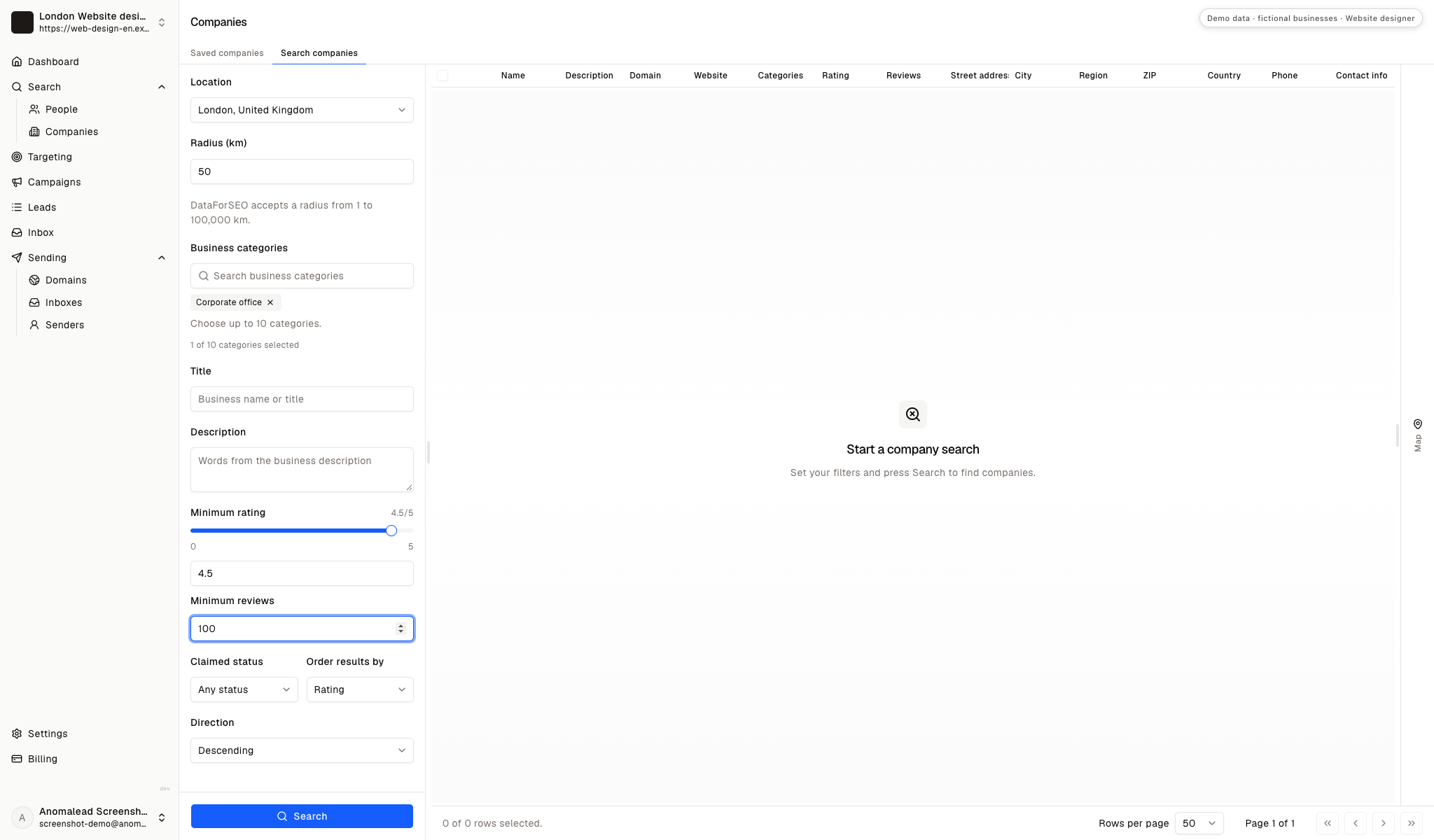
Treat the listed offices as research records
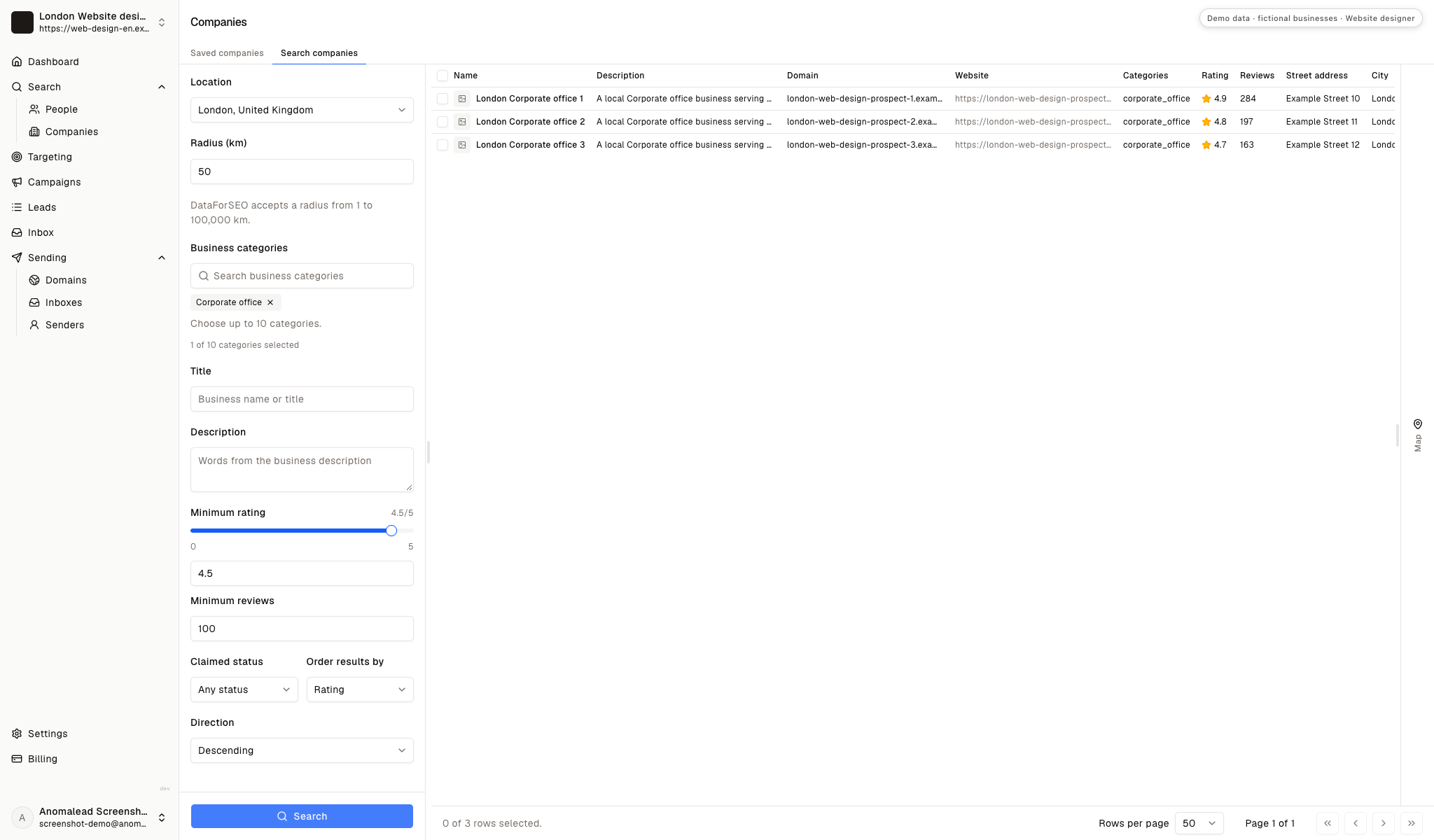
Section titled: Treat the listed offices as research recordsThe results list London Corporate office 1, 2 and 3 with generic descriptions and domains. Those labels are fixture data; they are not businesses that have asked for web design or evidence of a site problem.
Save only accounts with a checkable site hypothesis
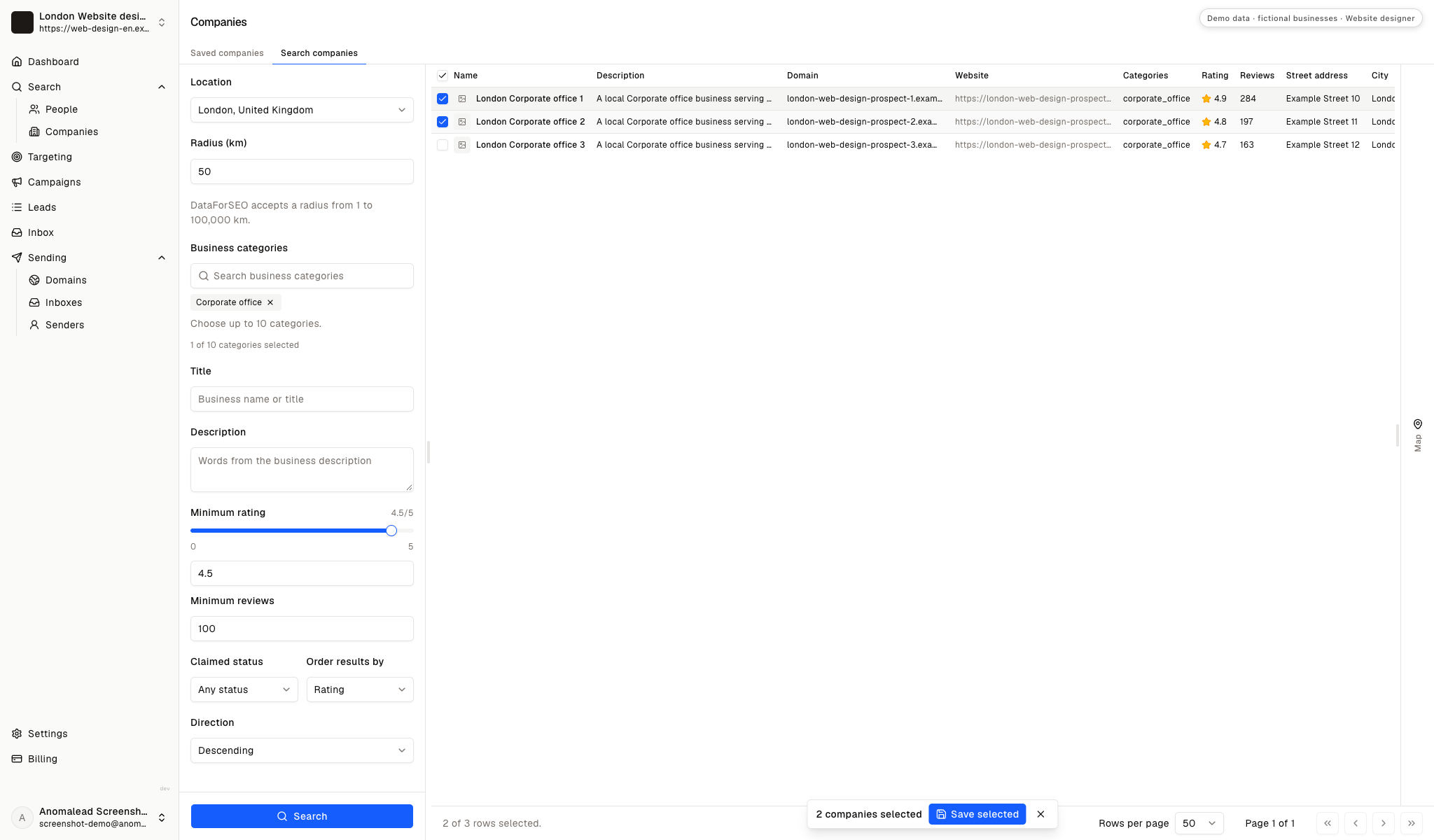
Section titled: Save only accounts with a checkable site hypothesisSelecting a row keeps a company in the research queue. For a real prospect, note the verified business change that could affect its site and confirm the project with a person before treating the record as a design opportunity.
Find who owns the content, site and approval process
Section titled: Find who owns the content, site and approval processA small-company owner may approve the project and supply business details, while a marketing lead shapes the audience and page content. For a booking or ecommerce flow, a sales or operations contact can explain what happens after a visitor submits a form; internal IT may manage hosting and credentials.
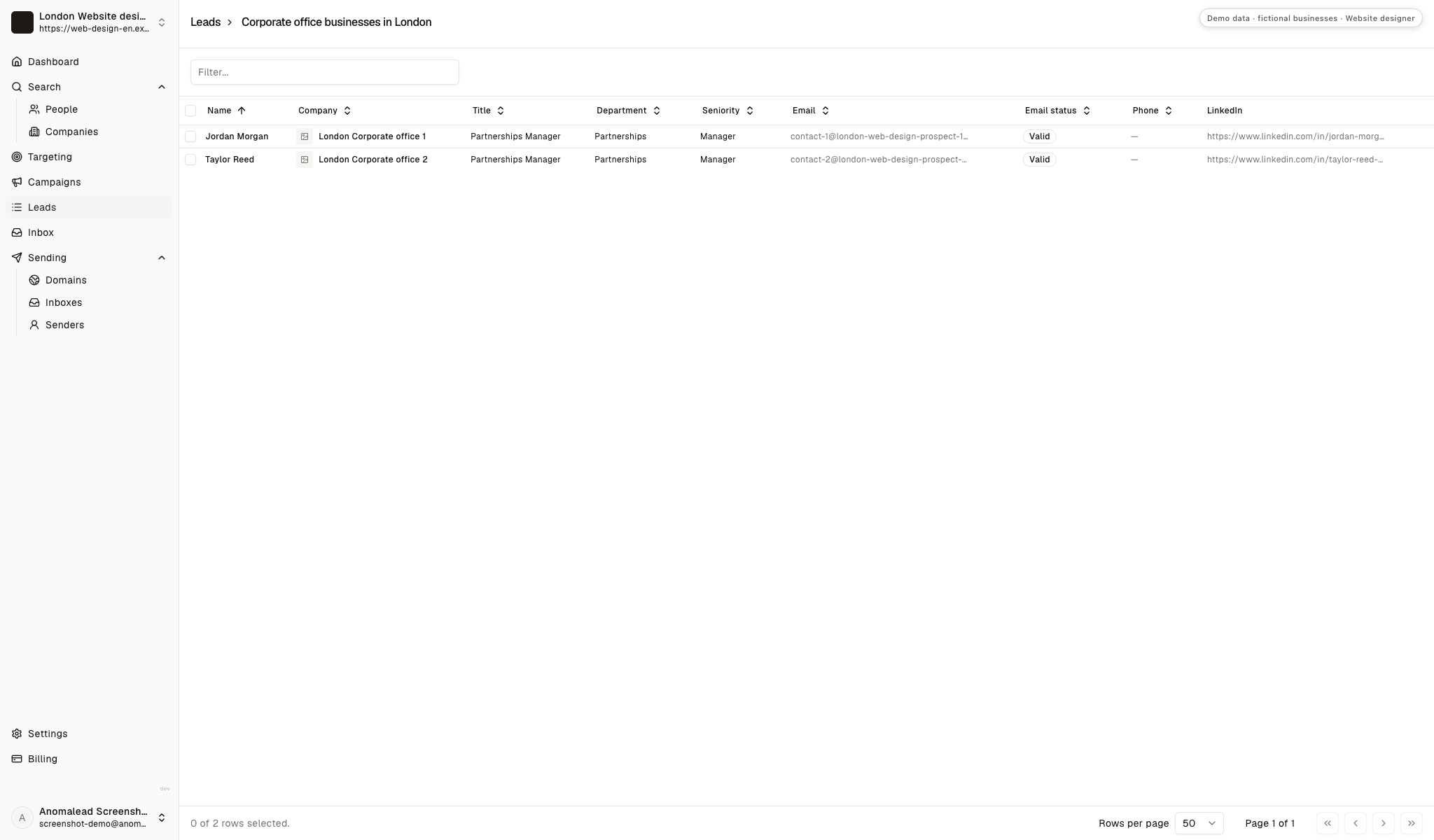
Enrichment can suggest a contact, but verify their role before sending a pitch. Jordan Morgan and Taylor Reed appear as Partnerships Managers in the fictional fixture. That title does not establish who chooses a designer, approves the content or controls the website account.
Review the company before adding contacts
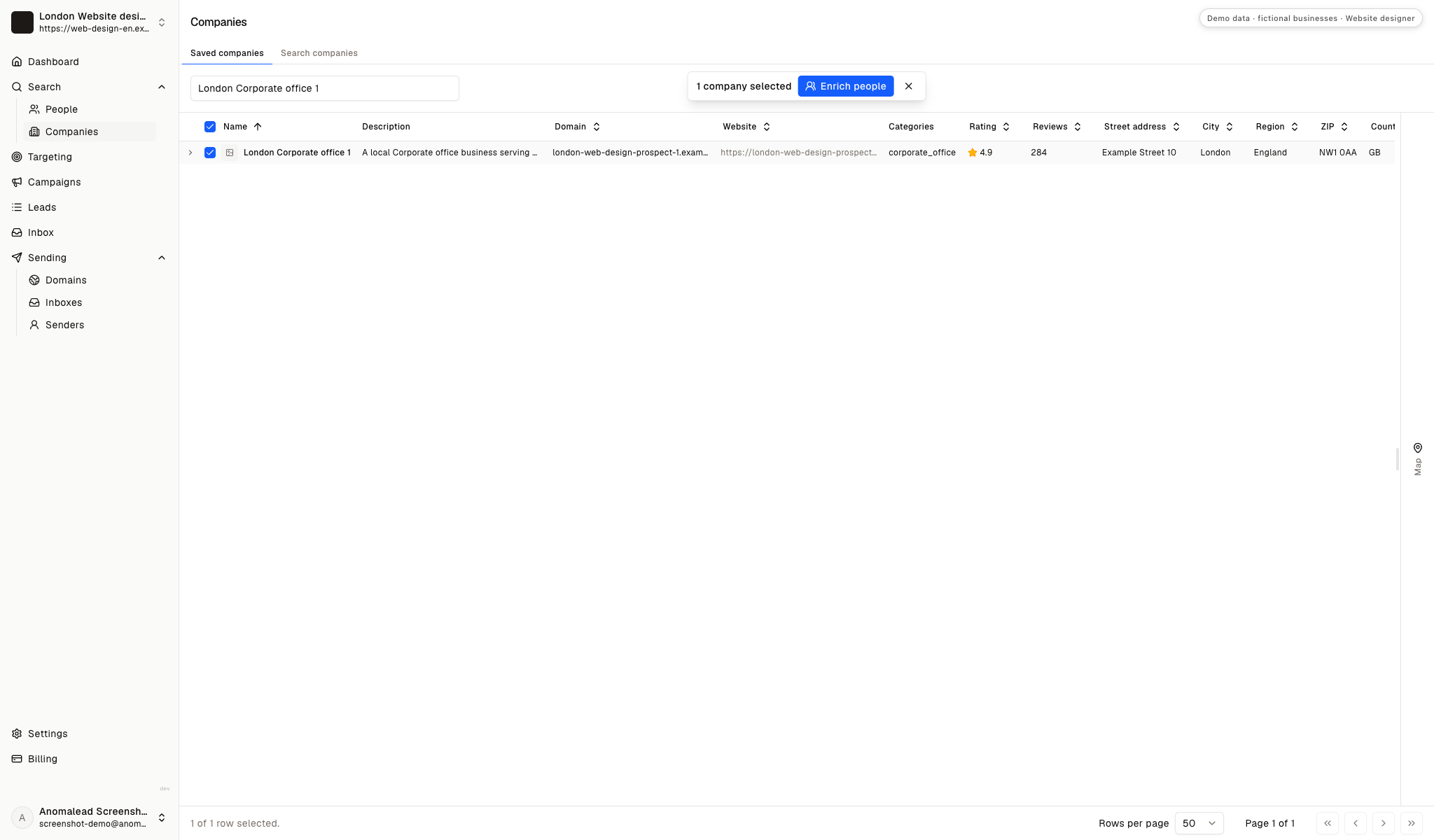
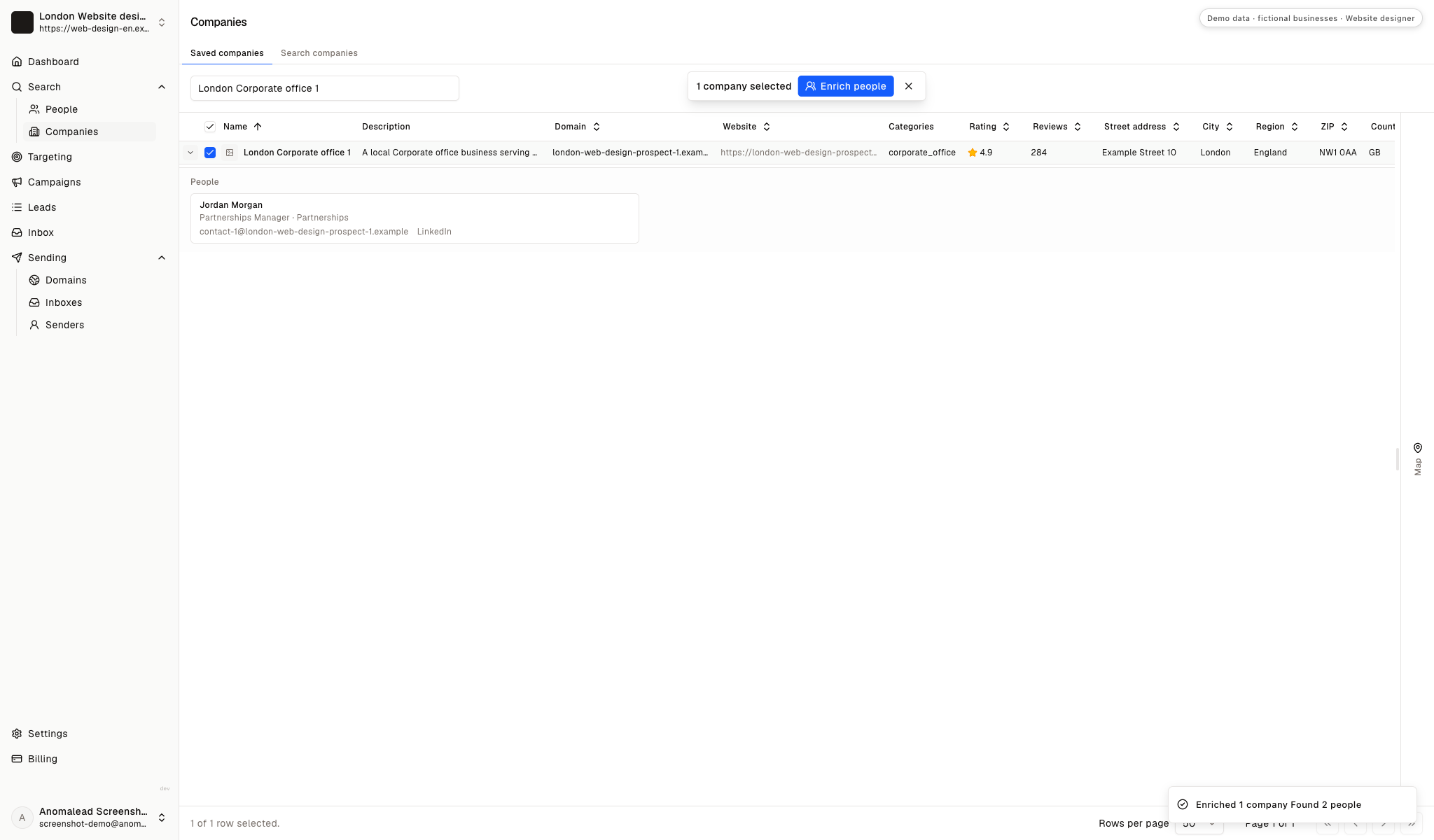
Section titled: Review the company before adding contactsThe saved-company view contains one fictional office record before contact lookup. Check the account’s business model and project signal first; more names do not show whether a redesign is planned.
Verify each person’s role in website decisions
Section titled: Verify each person’s role in website decisionsThe example panel lists Jordan Morgan and Taylor Reed with partnership titles. They are fictional contacts; for a real project, establish who owns the site's content, platform access and final approval.
Keep the contact list tied to project responsibilities
Section titled: Keep the contact list tied to project responsibilitiesThe sample list links two people to different office records. Check their company, title and email status, and keep website credentials, customer records and private analytics exports out of prospect notes.
Would this redesign fit your studio’s delivery model?
Section titled: Would this redesign fit your studio’s delivery model?A redesign fits your studio when its scope, platform dependencies, client approvals and launch duties match the work your team can deliver. A website project may include research, content structure, visual design, CMS implementation, integrations, launch checks and training. The work is commercially different when the client supplies ready content and access than when your team must coordinate both.
A page count alone does not describe the effort if the project also changes forms, CRM routing, booking steps or existing URLs.
The calculator organizes the deal value, meetings and close rate that you enter as planning assumptions. It does not predict signed design work, conversion changes, revenue or project margin.
Do the math on one good deal
If one new customer is worth thousands, you don’t need magic. You need a few more meetings a month.
Projected monthly results
- Deals closed
- 2.0
- Projected revenue
- £10,000
- Growth plan (1 business)
- £79/mo
- ROI
- 12,558%
Conservative math on meetings you already believe you can book. One closed deal often pays for a year of Anomalead.
Confirm deliverables, client responsibilities and review rounds before using a planning estimate to prioritize the opportunity.
Write about the site task, not a vague redesign
Section titled: Write about the site task, not a vague redesignA useful first message connects one confirmed business change to a website task your studio can handle. That might mean helping visitors find a new service, clarifying a booking route or organizing pages for a location launch. Do not tell a company its website is failing based only on your impression.
Use a natural cold email introduction and ask whether the change is being planned, already assigned or still under discussion. Save recommendations about layouts, content and integrations for discovery, after you know who can approve them.
Choose someone who can discuss the site change
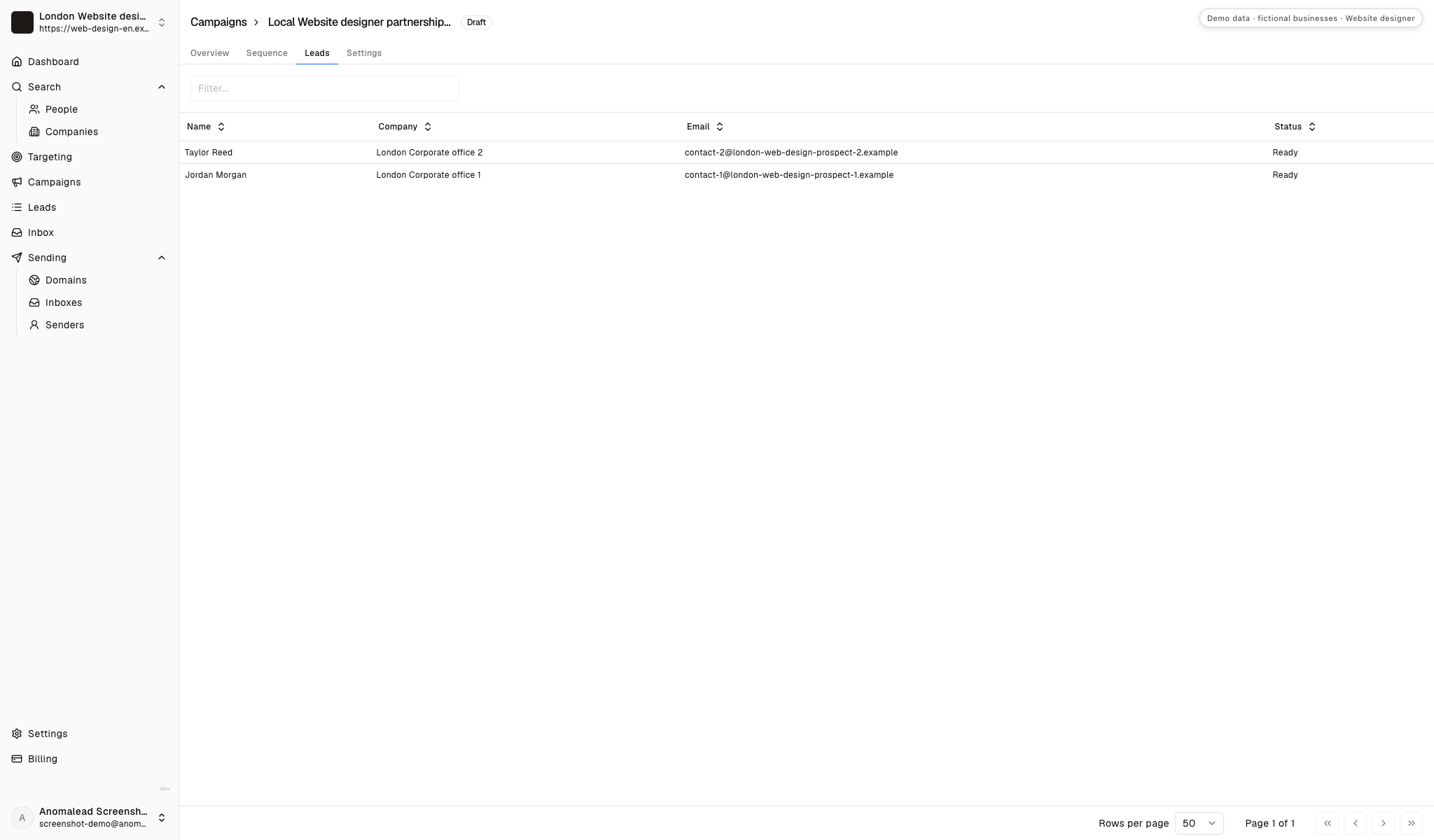
Section titled: Choose someone who can discuss the site changeThe campaign draft lists two fictional corporate-office contacts. For live outreach, select the person who can explain the website project and adapt the note for an owner, marketing lead or operations contact.
Give each follow-up a useful website question
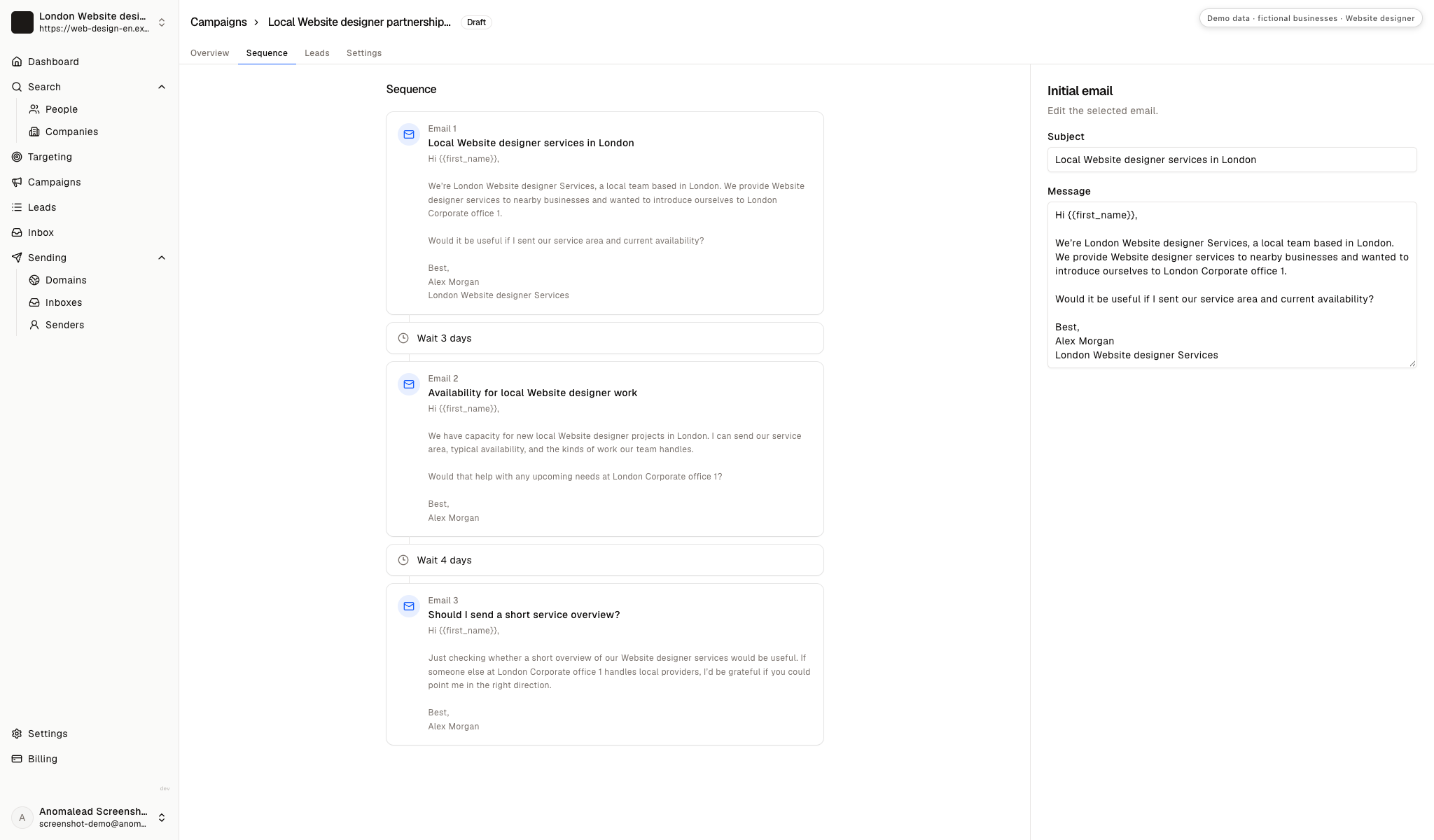
Section titled: Give each follow-up a useful website questionThe sequence editor displays three prepared emails with wait intervals. The seeded messages are generic, so replace them with a relevant question about project timing, content ownership or the customer action the new site should support.
Open with a concrete website project
Section titled: Open with a concrete website projectThe fixture email asks whether a service overview would be useful. This sample connects a possible website change to a clear customer task and avoids diagnosing the prospect’s site from a distance.
First note to a local business contact
Subject: Planning a clearer website enquiry path?
Hi Jordan,
I’m Alex Morgan with London Website designer Services. Our studio works on focused website projects for local firms, including redesigns and enquiry flows when they fit the agreed scope.
We first clarify the audience, content owner and what should happen after someone submits a form. Is your team planning a site change that would benefit from a short scoping conversation?
Best,
Alex Morgan
London Website designer Services
Keep the message specific to work your studio can deliver, and avoid promising a ranking or conversion result. These B2B email examples can help you add a relevant follow-up without repeating the same pitch.
Use replies to clarify the website project
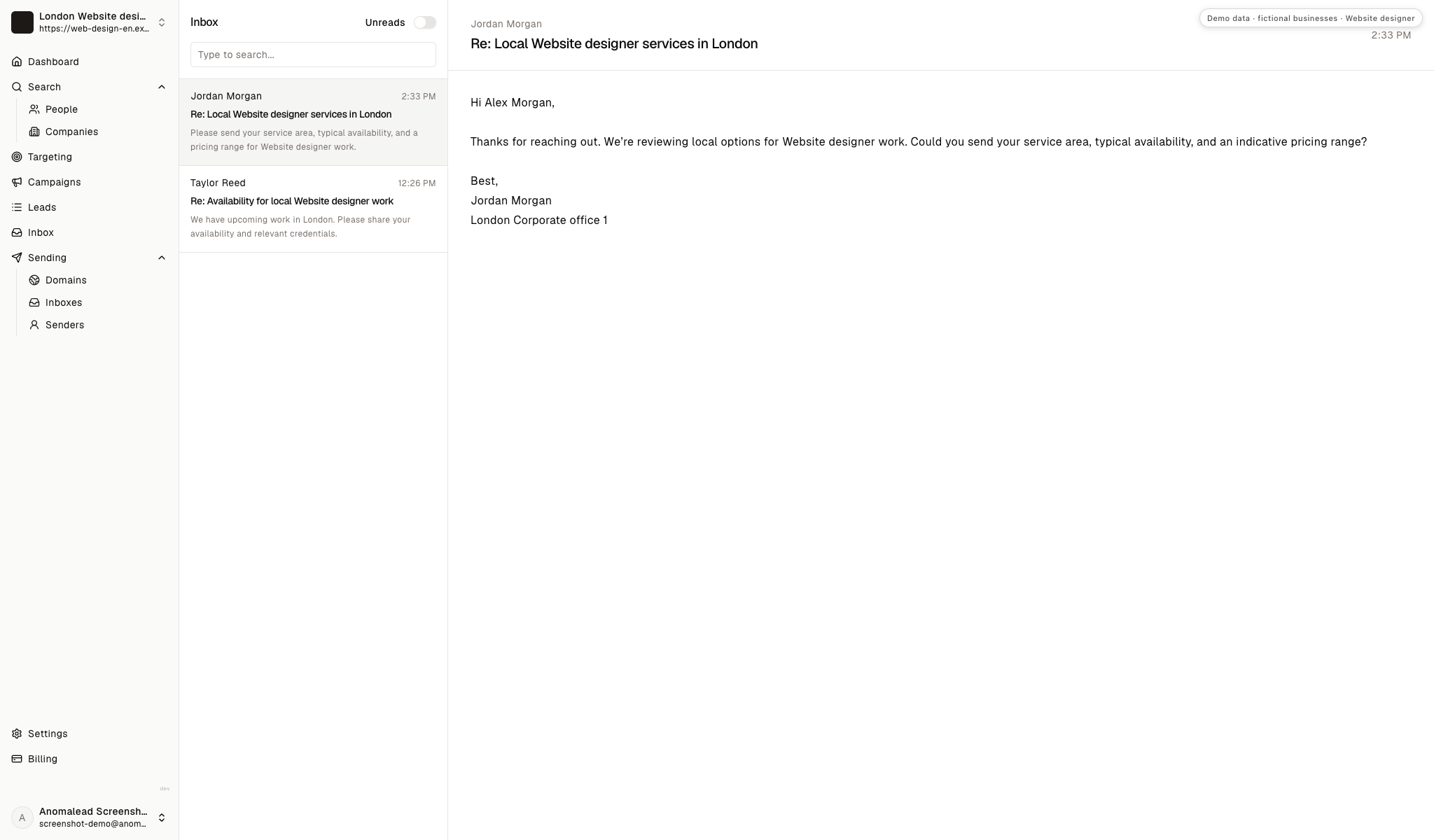
Section titled: Use replies to clarify the website projectThe inbox shows a fictional reply asking about service area, availability and pricing, plus another that mentions possible upcoming work and credentials. These seeded messages are not real inquiries; use them to practice qualifying a site project and its decision path.
Answer design inquiries without promising outcomes
Section titled: Answer design inquiries without promising outcomesAnswer the practical question first, then identify whether the business has a scoped website change. A design conversation should clarify the audience, content, platform and customer path before it turns into a proposed solution.
Jordan asks about service area, availability and price
Section titled: Jordan asks about service area, availability and priceJordan Morgan asks where the studio works, when it has capacity and what a website project might cost.
State which locations you serve and what affects scheduling. Explain that scope depends on content readiness, page structure, platform and integrations, then ask what the business wants its site to help customers do. Avoid quoting a full redesign from a general inquiry.
A short answer can set up a useful discovery step:
Thanks, Jordan. I can share our service area and how we schedule design work. Project scope depends on the content and website functions involved. Is the change connected to a new offer, a location or a specific enquiry flow?
Taylor mentions upcoming work and requests credentials
Section titled: Taylor mentions upcoming work and requests credentialsTaylor Reed says a project may be coming up and asks about availability, covered work and relevant qualifications.
Describe your design and implementation services accurately, then share credentials that apply to the work. Ask who owns the website and which business change the project supports; do not present general experience as proof of a guaranteed outcome.
Keep the reply focused on project fit:
Thanks, Taylor. I can send a short overview of our design and implementation work. Could you share what the website needs to support and who would review the content and platform decisions?
The company already has a web partner
Section titled: The company already has a web partnerOur agency handles the website, so we are not looking to replace them.
Respect the existing relationship. Ask whether the current partner owns the upcoming work or whether the business has a separate page, integration or delivery need. Continue only if the buyer sees a defined gap and wants another provider involved.
The buyer worries about losing visibility after a redesign
Section titled: The buyer worries about losing visibility after a redesignWe are concerned that changing the site could make customers stop finding us.
Do not promise that visibility will remain unchanged or improve. Explain that the team can inventory current URLs, plan relevant redirects, preserve analytics setup where possible and review launch behavior, while noting that search performance depends on factors beyond the design team’s control.
Build a prospect list around one website task
Section titled: Build a prospect list around one website taskThis week, choose a project your studio can deliver well, such as organizing a service catalogue, rebuilding a booking path or preparing pages for a new location. Write down the business signal, the person who can verify it and the first question about content, platform or approval.
Review a focused set of local companies and keep only accounts with a reason to discuss their site. For more lead generation planning ideas, separate future outreach by the website work you can actually scope, not by an unverified criticism of the prospect’s current design.
Questions about finding web design clients
Section titled: Questions about finding web design clientsWhich local businesses are good prospects for a redesign?
Section titled: Which local businesses are good prospects for a redesign?Look for a confirmed change that gives the site a new job, such as a location opening, service expansion or revised booking flow. Verify that the business has an owner for the project and wants outside help before preparing a proposal.
What should a designer ask before estimating a website project?
Section titled: What should a designer ask before estimating a website project?Clarify the audience, pages, content owners, CMS, domain and hosting access, forms, integrations and approval path. Agree how migration, testing, launch and post-project support will be handled before estimating delivery.
Should a web designer promise more leads after a redesign?
Section titled: Should a web designer promise more leads after a redesign?No. You can agree what the site should make easier and how the launch will be reviewed, but leads depend on the offer, audience, traffic and other factors outside the design work. Avoid presenting an expected result as guaranteed.
Are the companies and contacts in the screenshots real?
Section titled: Are the companies and contacts in the screenshots real?No. The operator, office records, contacts and inbox replies are fictional demo data. They are not Anomalead customers, verified design prospects or project results.
Does the ROI calculator predict design revenue or conversion results?
Section titled: Does the ROI calculator predict design revenue or conversion results?No. It organizes the deal value, meetings and close rate that you enter as planning assumptions. It does not forecast signed projects, revenue, conversion changes or project margin.