


Marketing agency lead generation works best when an agency finds a business with a defined growth question and confirms who owns the decision. A new location, service launch, or offer that is not reaching its intended audience can justify a conversation; a company appearing in a directory cannot.
Before you pitch channels, learn the target customer, the offer, the current acquisition path, the team’s follow-up capacity, and how work is approved. A useful B2B lead generation process surfaces possible accounts; a qualified discussion confirms whether the company wants agency support.
Key takeaways
- Approach a business with a specific offer or customer group to grow, not an assumption that every local company needs marketing.
- Identify whether the obstacle is reaching the right audience, converting interest, retaining customers, or following up on enquiries before proposing a channel.
- Confirm the decision-maker, access to marketing assets, approval path, and the client’s capacity to respond to new enquiries.
- Scope deliverables, reporting and media spend separately from agency fees, and avoid promising leads, revenue or return on ad spend.
Marketing agency lead generation starts with an agreed growth brief
Section titled: Marketing agency lead generation starts with an agreed growth briefPrioritize local businesses that can name the audience and offer they want to grow. The strongest first conversation is about a business objective and the work needed to support it, not a broad promise to improve marketing.
- Owner-led firms launching a service or location: An owner may need a local launch plan, customer research, campaign assets, or a way to route new enquiries to the right team. Ask what the launch must achieve and when the business will be ready to take enquiries before recommending channels.
- Service businesses relying on referrals for growth: A steady referral base can hide the fact that the company has no clear offer or follow-up process for new prospects. Find out which type of customer it wants more of, how that buyer currently finds the service, and who will respond when interest arrives.
- Local retailers or venues promoting a defined offer: A new product range, event program, or seasonal service can give an agency a focused brief. Confirm that the offer, stock or delivery capacity, target area, and approval date are settled before planning creative or media.
- Businesses with an in-house marketer and a delivery gap: A marketing lead may need outside help with a specific channel, research task, campaign build, or reporting backlog. Learn what the internal team already owns and whether the agency is expected to advise, execute, or support a handoff.
A business that needs a site rebuild may be better served by a focused web design lead generation guide; an agency engagement should stay centered on the growth plan and campaign work.
Qualify the marketing engagement before you recommend a channel
Section titled: Qualify the marketing engagement before you recommend a channelA campaign is a good fit when the client can state its audience, offer, decision path and follow-up plan. Check the operating details before you promise a launch or draft a media plan.
- Define the audience and offer. Ask which customer the business wants to reach, what problem the offer addresses, where the customer can be served, and what action should follow a campaign response. If the offer is still changing, make discovery the first scoped piece of work.
- Diagnose the actual growth obstacle. Separate low awareness from a weak enquiry path, poor sales follow-up, retention concerns or a mismatch between the offer and its audience. These problems call for different work, so do not present paid media as the answer before you understand the route from first contact to sale.
- Check assets and account access. Find out who controls the website, analytics, advertising accounts, CRM and brand files. Agree how access will be granted and removed, which systems the agency can change, and what information should stay in the client’s own accounts.
- Set scope and approvals. Name the channels, research, creative, landing pages, reporting and client tasks included in the engagement. Confirm who approves claims and materials, how revisions work, and whether media spend is separate from the agency fee.
- Make lead handling part of the brief. Define what counts as a qualified enquiry, where it is recorded, who follows up, and how the client will return useful status information. A campaign cannot fix a missed-call or unworked-lead problem by itself.
Only recommend work your team can staff and measure with the access the client is prepared to provide.
About the demo workspace
The demo operator is London Marketing agency Services. The corporate-office listings, contacts and inbox replies shown here are fictional fixture data, not Anomalead customers, confirmed agency buyers or real campaign results.
Look for a business change your agency can market
Section titled: Look for a business change your agency can marketStart in the area your team can serve and look for a public change that could create a marketing brief: a new service, a location opening, an event program, a hiring push, or a company announcement about reaching a new audience. Treat each as a reason to research, not proof that the business has budget or wants an agency.
Read the company’s own materials to understand what it sells, who it serves, and what action it asks a customer to take. Then verify your hypothesis with a decision-maker. A local lead research workflow helps you keep the signal, source and next question together instead of saving every nearby business.
Set a search area your agency can serve
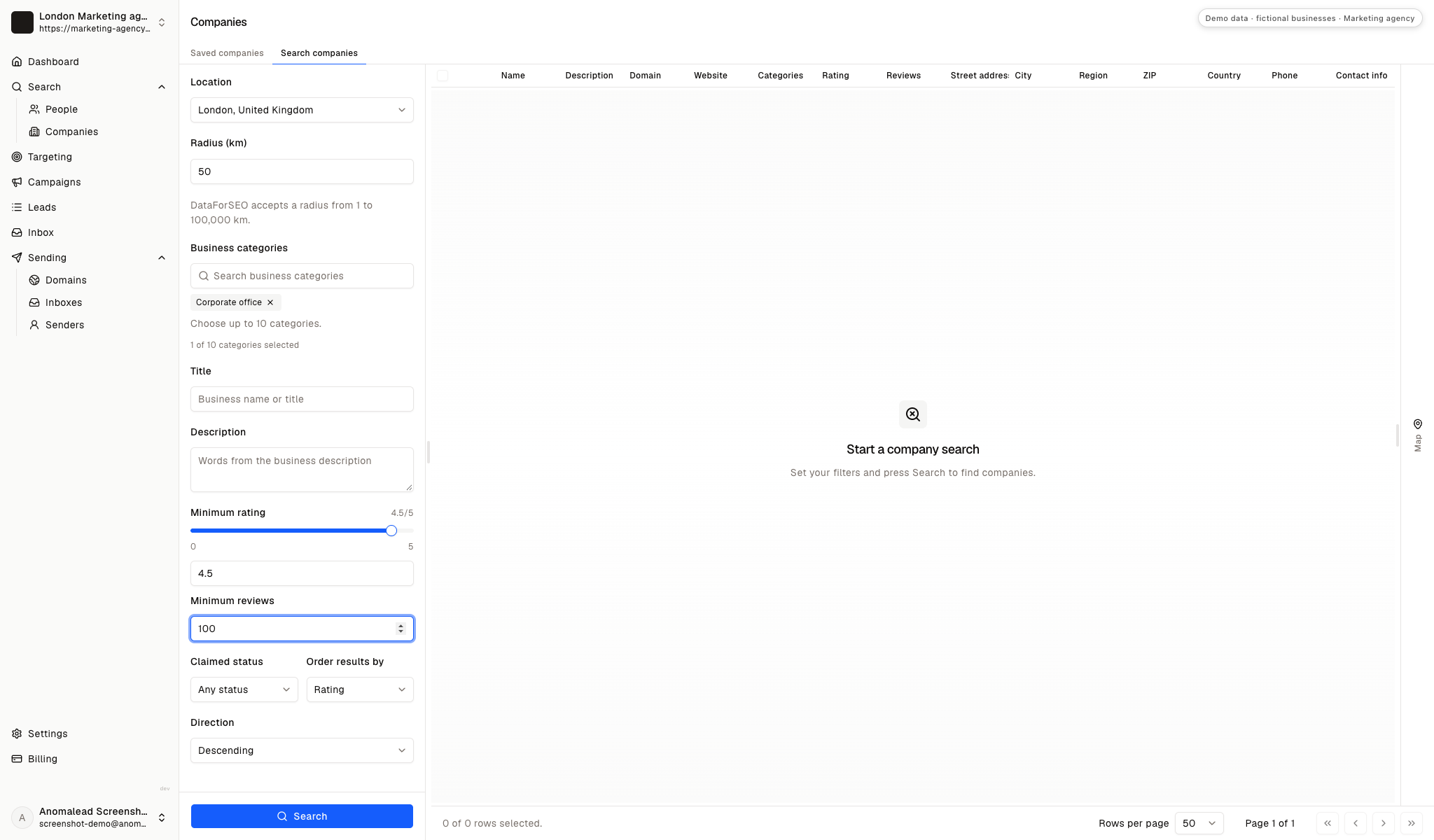
Section titled: Set a search area your agency can serveChoose an area and company category that match the markets your team understands. The search filters organize prospect research; they do not show a marketing need, campaign budget or buying intent.
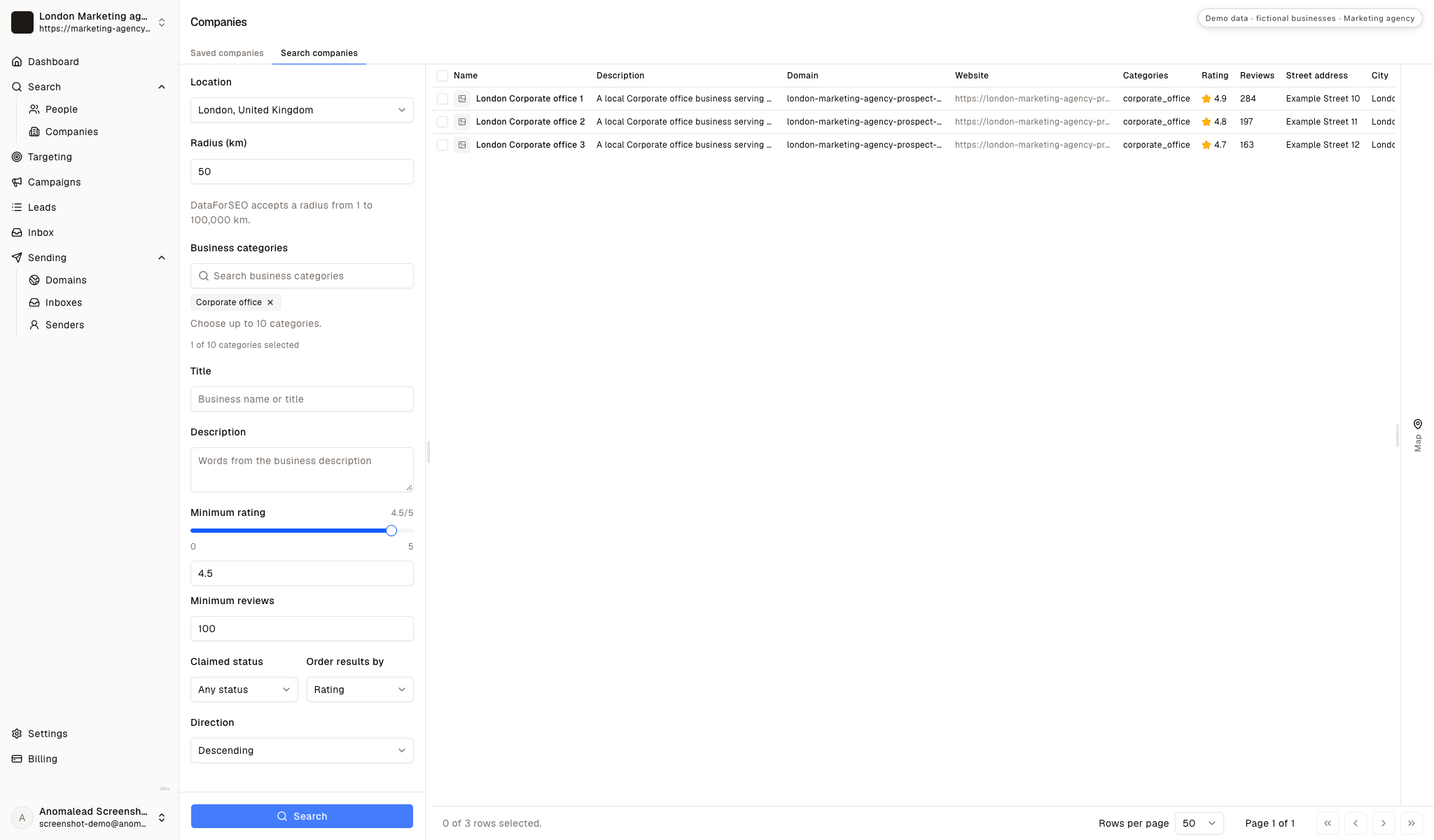
Treat the listed offices as research records
Section titled: Treat the listed offices as research recordsThe results show London Corporate office 1, 2 and 3 with generic descriptions and domains. These sample records do not reveal their marketing plans, current suppliers or ability to take on new customers.
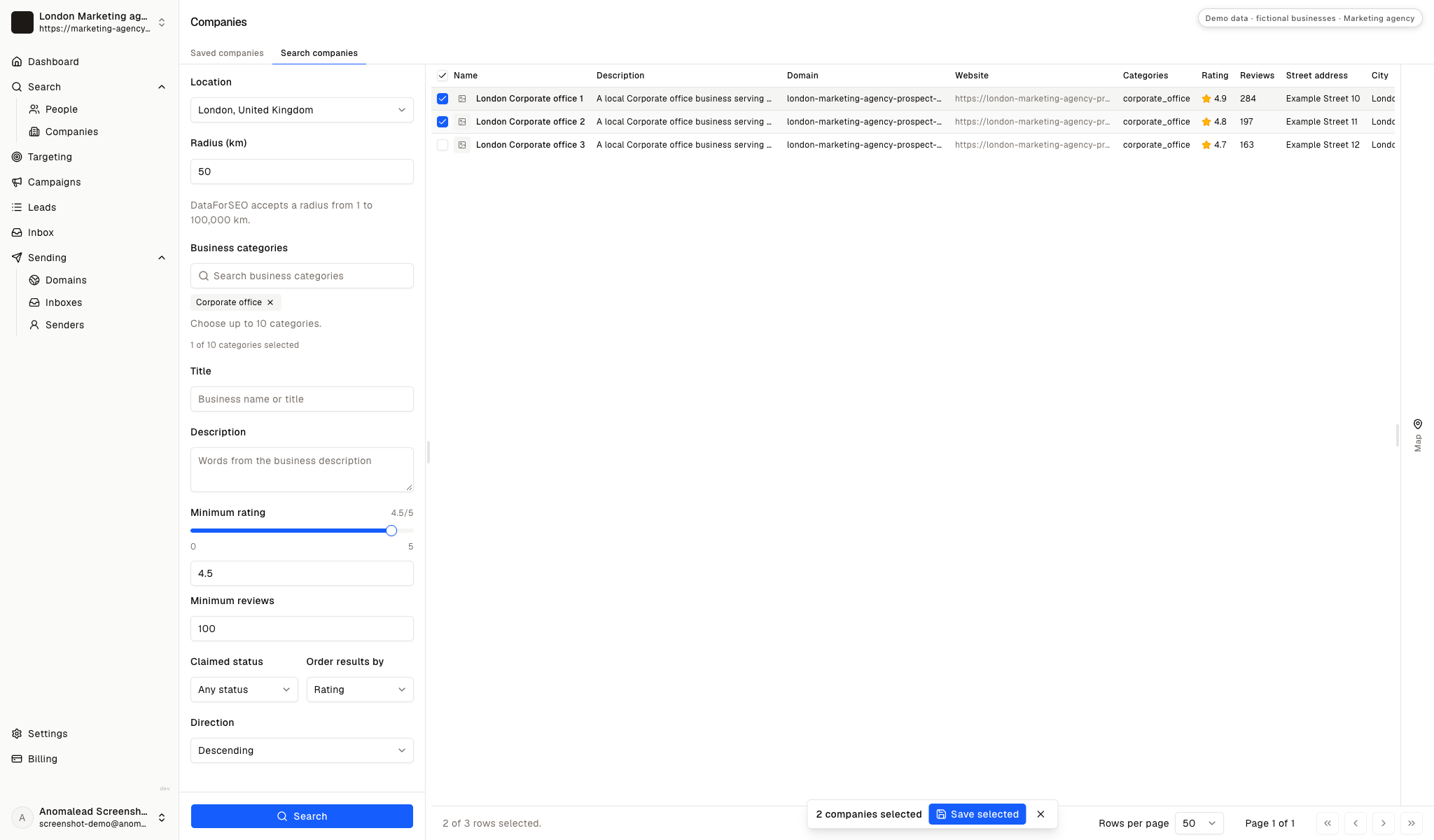
Keep only accounts with a checkable growth question
Section titled: Keep only accounts with a checkable growth questionSelecting a result moves a company into a research list. For a real prospect, record the business change you found and the question a contact can answer before you treat the account as an agency opportunity.
Find who owns the growth target, budget and approvals
Section titled: Find who owns the growth target, budget and approvalsThe owner or general manager often approves an agency relationship at a small company, while a marketing lead can explain the audience, existing channels and reporting. A sales or operations manager may know whether the team can follow up on enquiries and fulfill additional demand.
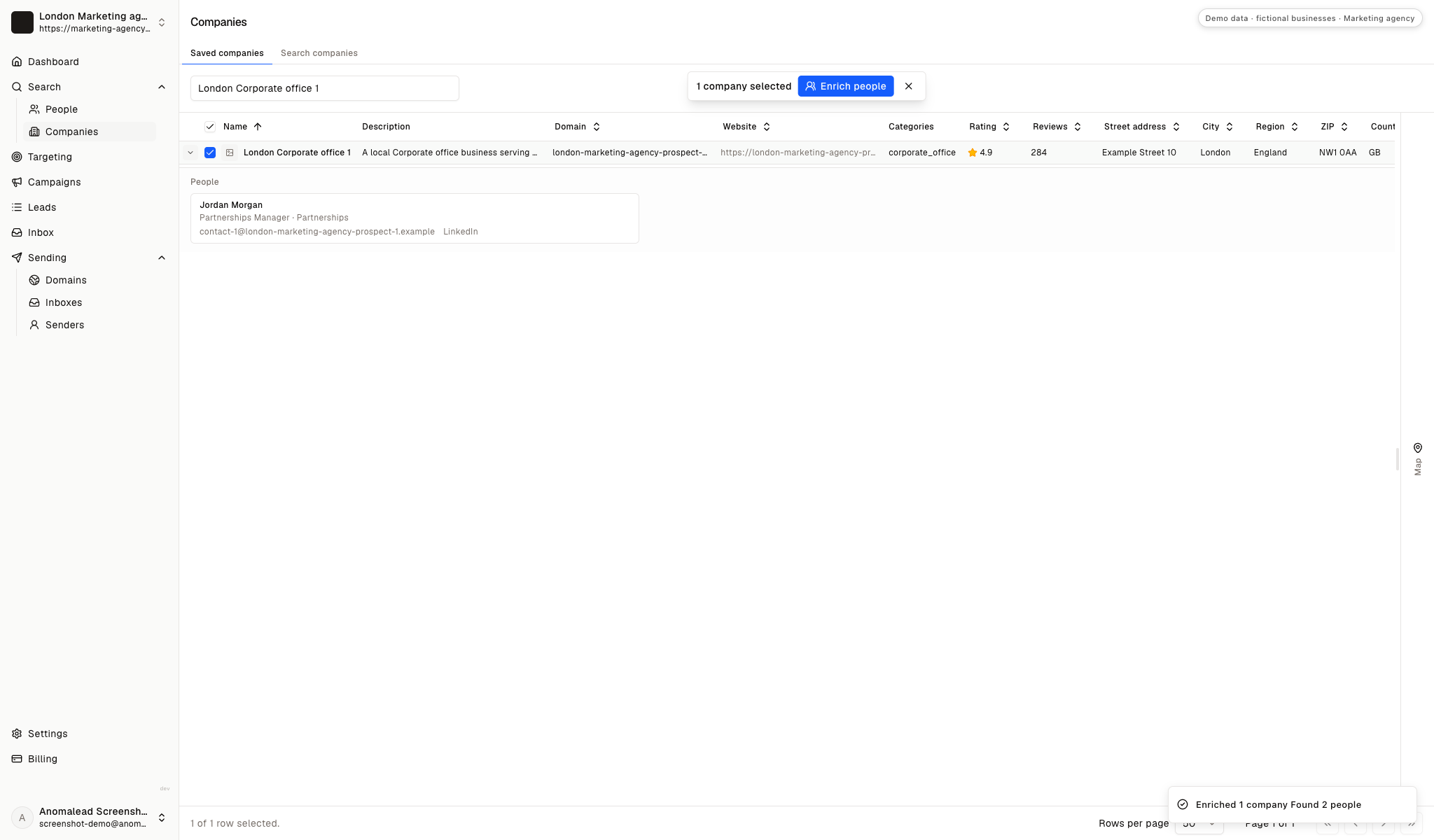
The demo enrichment panel names Jordan Morgan and Taylor Reed as Partnerships Managers. Those are fictional fixture contacts, and the title alone does not establish budget ownership or campaign authority. Verify who approves the work, who controls each account, and who can supply feedback on lead quality.
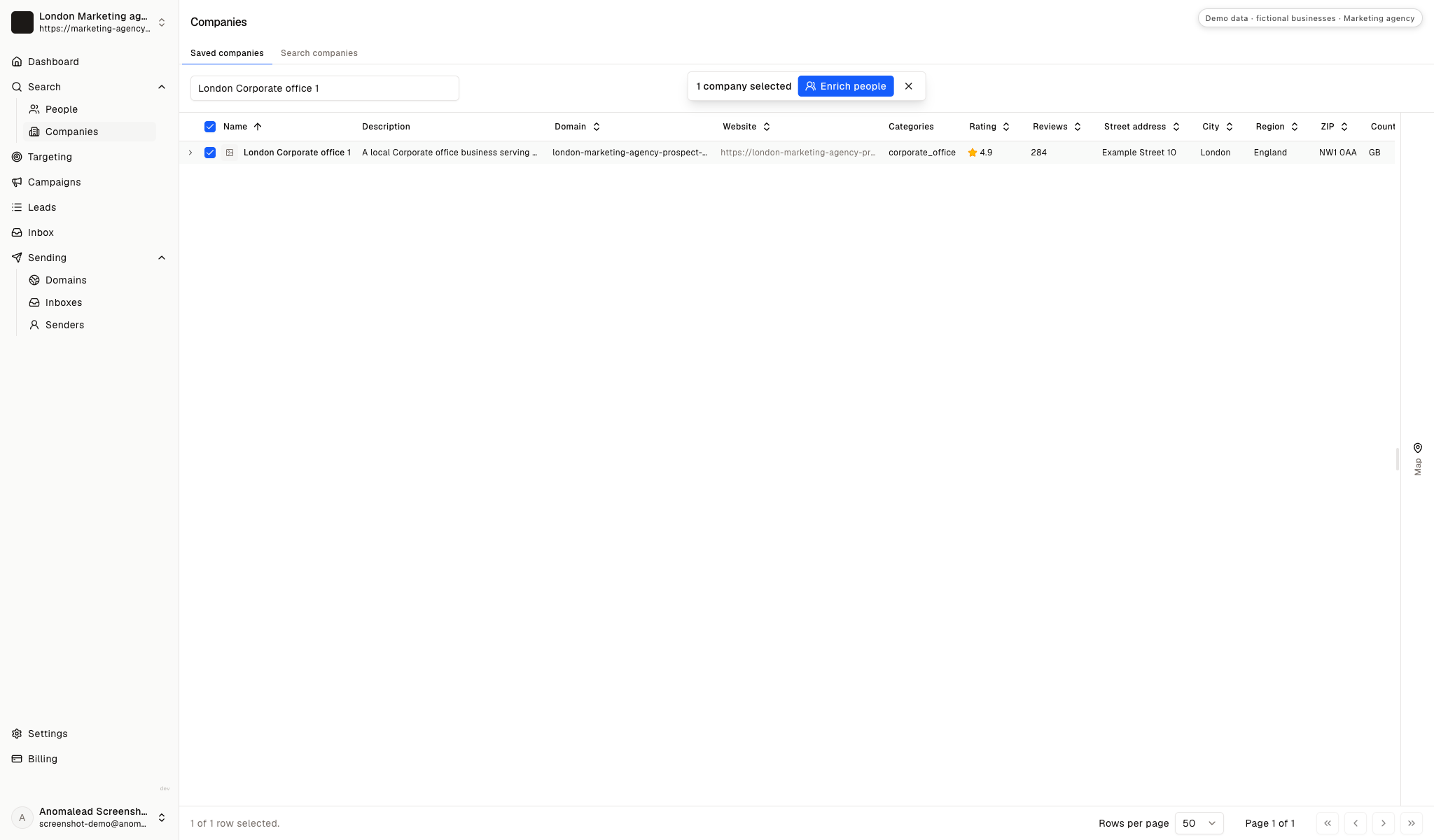
Check a company before looking for people
Section titled: Check a company before looking for peopleOne saved corporate-office result appears beside the option to enrich contacts. For agency prospecting, use this point to confirm a business trigger and decide which role could discuss a growth brief.
Treat contact titles as clues to verify
Section titled: Treat contact titles as clues to verifyThe fixture returns Jordan Morgan and Taylor Reed with partnership titles and professional details. A real agency should verify the person’s role in planning, budget, channel access or sales follow-up.
Keep the contact tied to a business question
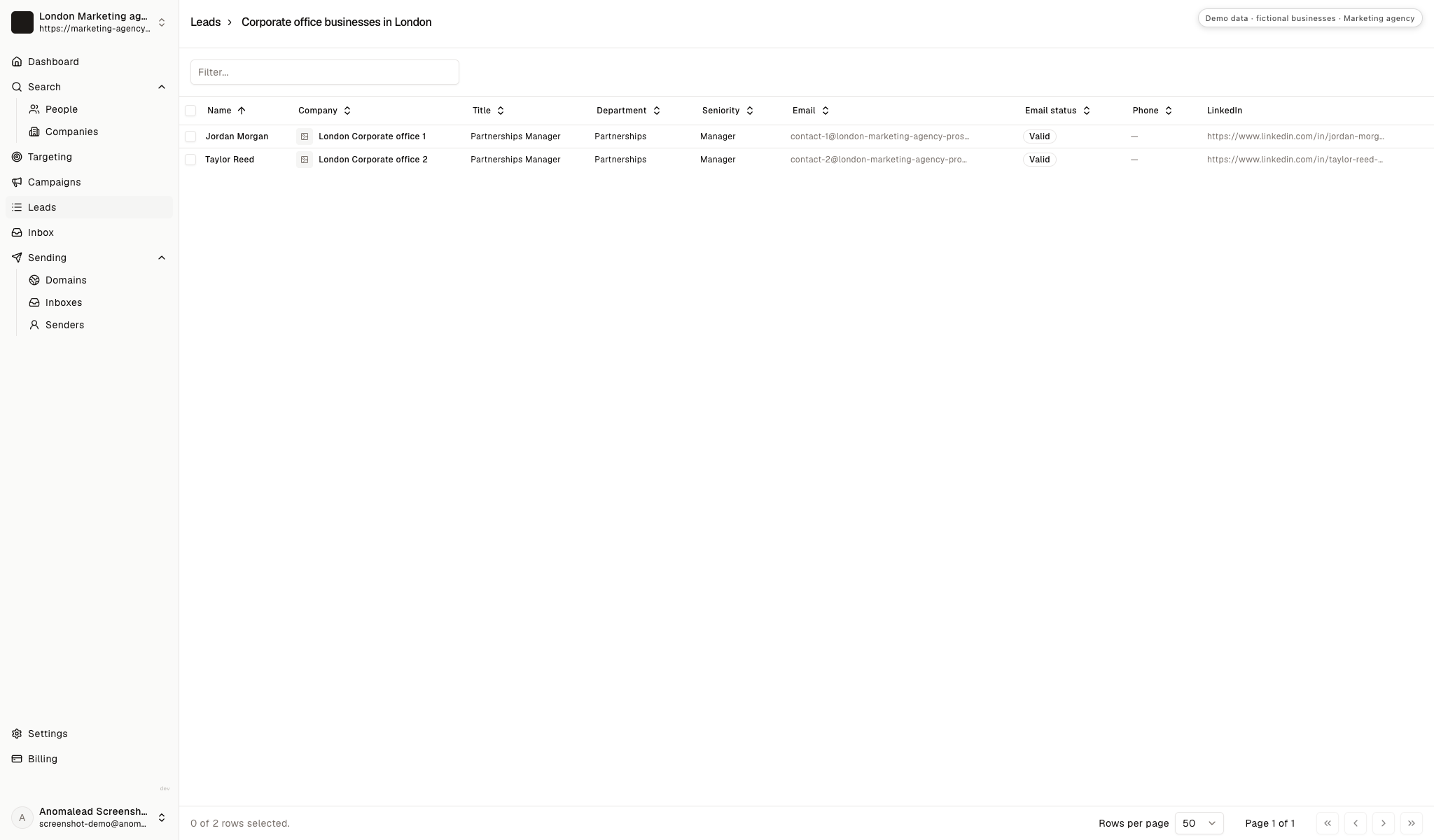
Section titled: Keep the contact tied to a business questionA curated list displays two fictional contacts, their office records and email status. Keep only the information needed to check role and fit, then write a specific first question for the person who owns the marketing decision.
Would this account support a sound agency engagement?
Section titled: Would this account support a sound agency engagement?A prospective account is worth a discovery meeting when its growth objective fits your team’s services and the business can take part in the work. Compare the likely engagement scope with your delivery capacity, the client’s readiness and the reporting they expect.
Separate agency fees from advertising spend, production costs and any third-party tools. A campaign plan also needs a client owner who can approve creative, provide account access and act on the enquiries it generates.
The calculator uses the deal value, meetings and close-rate assumptions you enter to support planning. It does not verify a prospect, forecast signed clients or predict campaign performance, agency margin or future revenue.
Do the math on one good deal
If one new customer is worth thousands, you don’t need magic. You need a few more meetings a month.
Projected monthly results
- Deals closed
- 2.0
- Projected revenue
- £10,000
- Growth plan (1 business)
- £79/mo
- ROI
- 12,558%
Conservative math on meetings you already believe you can book. One closed deal often pays for a year of Anomalead.
Before proposing a retainer or project, confirm deliverables, client responsibilities, access, approval timing and the reporting definition for a qualified enquiry.
Build a campaign around one buyer and one outcome
Section titled: Build a campaign around one buyer and one outcomeLead with the business change and the audience the company wants to reach. A first note might ask whether the owner is preparing a location launch or whether the marketing lead is reviewing a defined service offer. Do not diagnose the company’s marketing from a directory record or promise a volume of leads before access, budget and follow-up are understood.
Keep the first campaign narrow enough to personalize by buyer type and service fit. Confirm who will review the message, which claims need client approval, what happens when a prospect replies, and when the agency will report back. A cold outreach primer can help the agency make its own prospecting clear without confusing it with the client’s campaign.
Review recipients before preparing the message
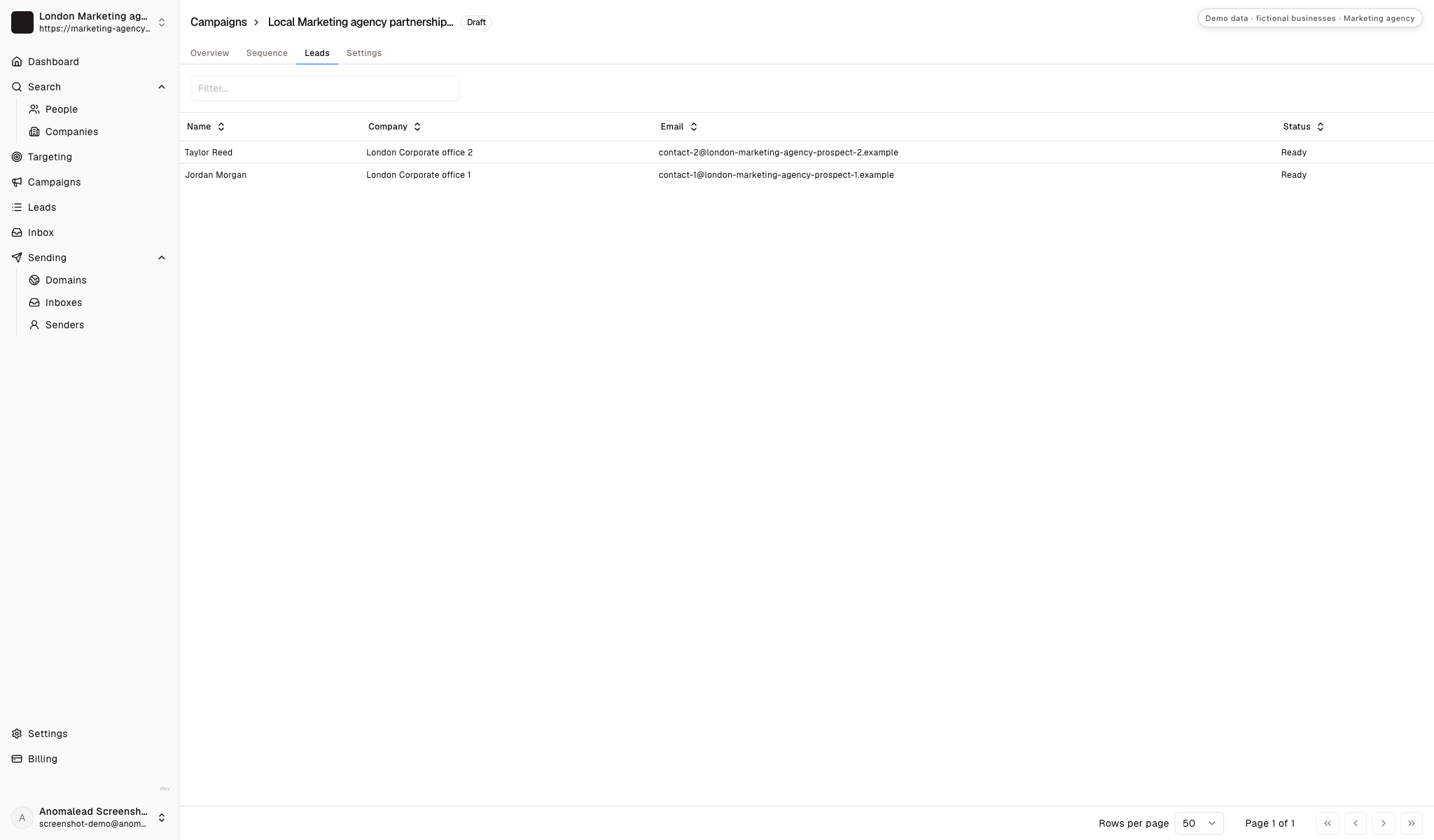
Section titled: Review recipients before preparing the messageThe draft campaign has two fictional office contacts as recipients. Before sending a real agency introduction, confirm each person’s role and tailor the message to the company’s verified growth question.
Replace generic follow-ups with useful questions
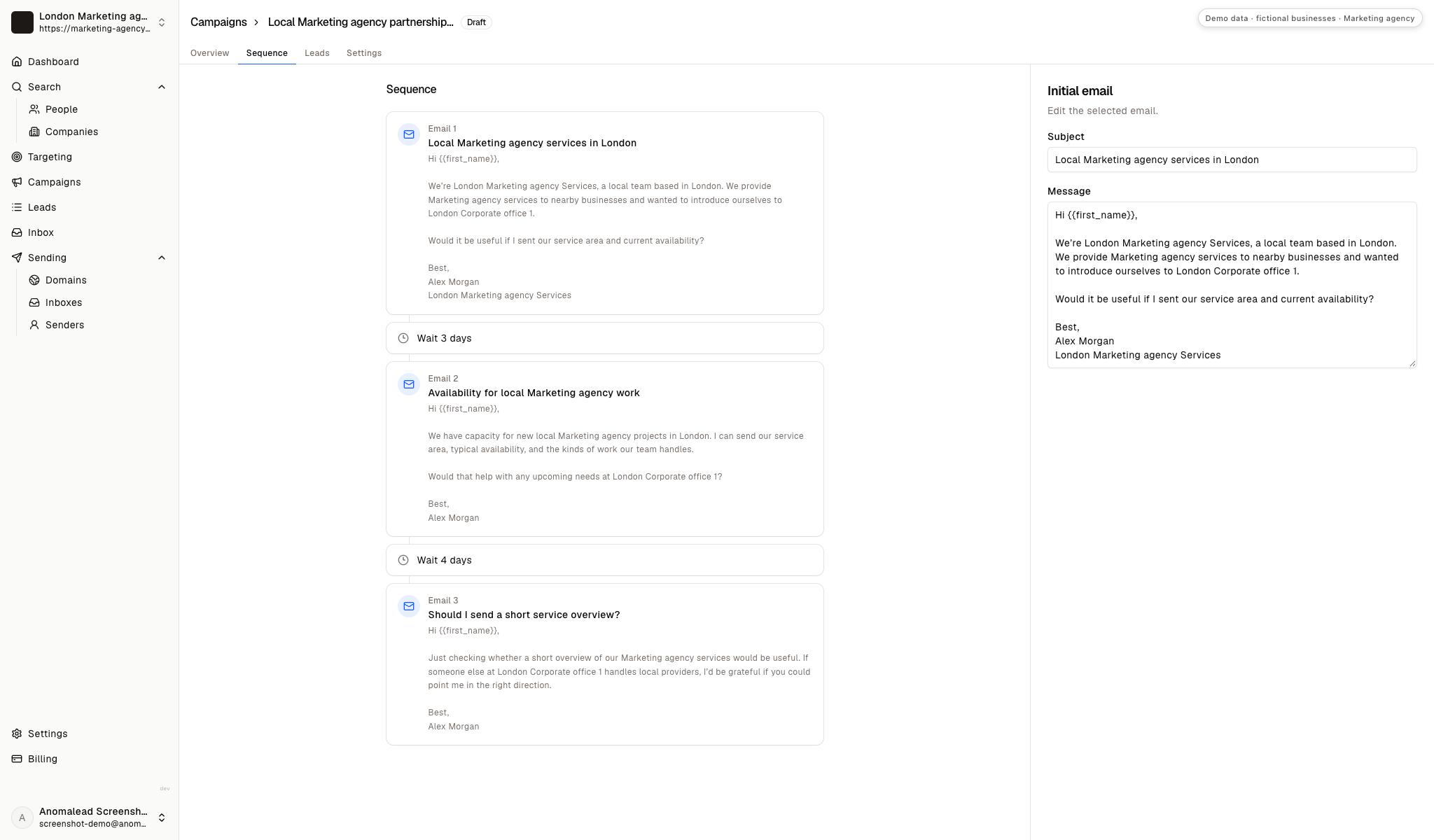
Section titled: Replace generic follow-ups with useful questionsThe sequence editor contains three draft emails with waiting steps. The seeded copy is generic, so replace it with a relevant question about the offer, audience, timing or person responsible for a marketing decision.
Open with a question about the company’s growth plan
Section titled: Open with a question about the company’s growth planUse a public business change you verified in the opening line when one is available. The fixture contains no such signal, so this example stays conditional and offers a specific launch-planning service without claiming the recipient has a problem.
First message to a local business contact
Subject: Campaign support for a new offer
Hi Jordan,
I’m Alex Morgan with London Marketing agency Services. Our agency can scope a launch campaign for one defined service, from audience and channel choices to enquiry tracking.
If your team has a new offer in preparation, we can check how customers will find it and who will handle responses. Is your team planning an offer or location launch where outside campaign support would be useful?
Best,
Alex Morgan
London Marketing agency Services
For another opening and follow-up structure, adapt these B2B cold email examples to a trigger the recipient can verify.
Treat replies as questions about scope and fit
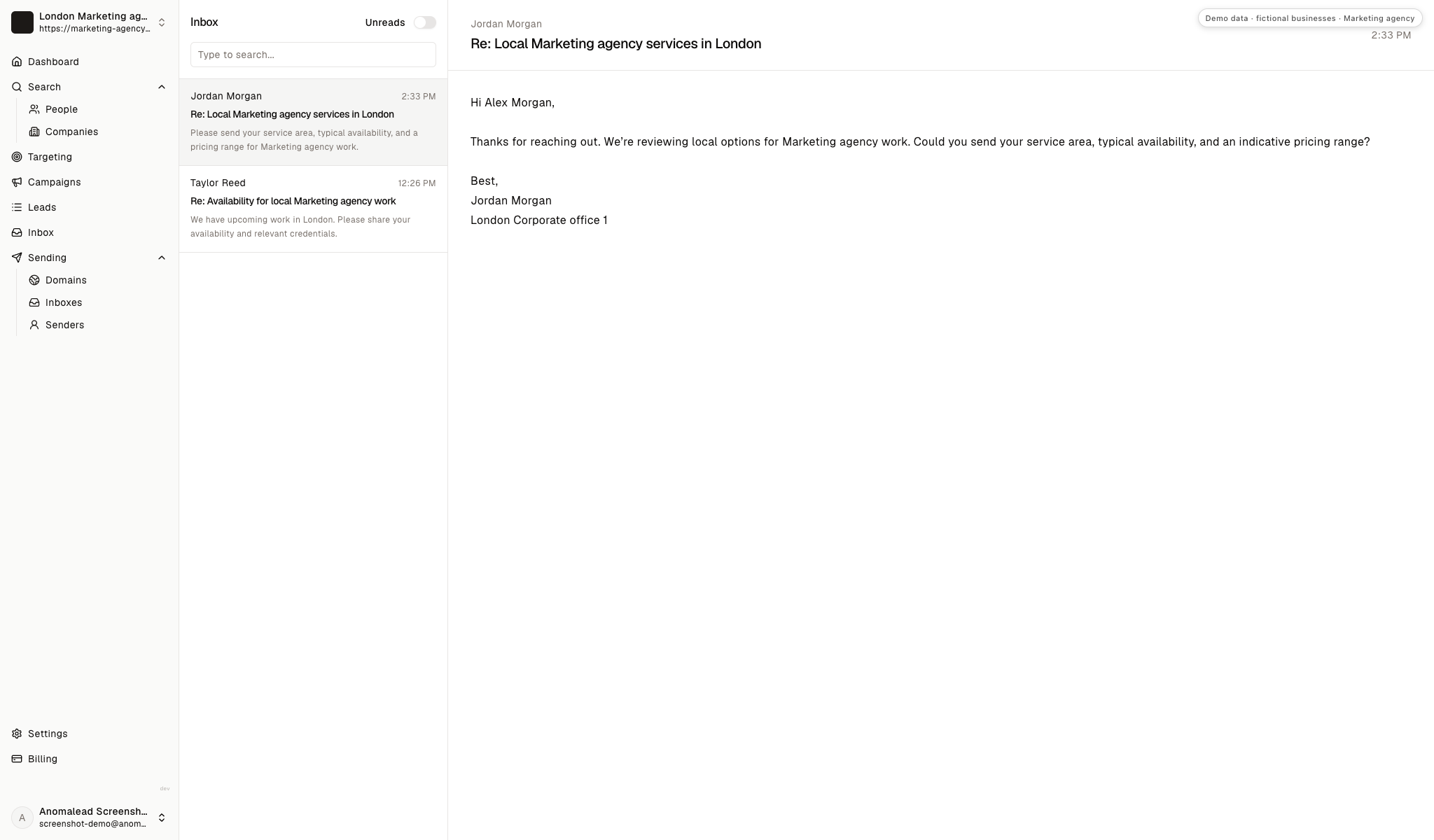
Section titled: Treat replies as questions about scope and fitThe fictional inbox replies ask about service area, availability, pricing, covered work and credentials. They are generic demo messages, not proof that the sample offices need an agency.
Answer scope and performance questions without guarantees
Section titled: Answer scope and performance questions without guaranteesRespond to the direct question first, then check whether the company has a defined audience, offer and owner for the work. Keep each reply within the services and evidence your agency can stand behind.
Jordan asks about service area, availability and price
Section titled: Jordan asks about service area, availability and priceJordan Morgan asks where the agency works, when it has capacity and what a marketing engagement might cost.
State the markets your team can serve and what affects its schedule. Explain that fees depend on the channels, deliverables, client inputs and reporting needed, while advertising spend is separate. Ask what audience or offer the company is considering before preparing a scope.
A short answer can clarify the next step:
Thanks, Jordan. I can share our service area and the kinds of work we can take on. Scope depends on the audience, channels and support your team needs. Is there a particular customer group or offer you are hoping to grow?
Taylor mentions upcoming work and asks about credentials
Section titled: Taylor mentions upcoming work and asks about credentialsTaylor Reed says a project may be coming up and asks about availability, services and relevant credentials.
Describe the strategy, creative or campaign delivery your team actually provides. Share only certifications or qualifications the agency holds and that matter for the proposed work. Ask who will approve the brief, supply account access and handle incoming enquiries.
Keep the answer tied to the work being discussed:
Thanks, Taylor. I can send a concise outline of our relevant services and current availability. What audience or business goal is the upcoming work meant to support, and who would review the plan?
The company already has an internal marketing lead
Section titled: The company already has an internal marketing leadOur marketing manager handles the work, so we are not looking to replace the team.
Respect the existing team and do not position the agency as a replacement by default. Ask whether there is a defined delivery gap, such as research, a campaign build or reporting support, and continue only if the contact sees a useful role for an outside partner.
The owner asks for a guaranteed lead or revenue result
Section titled: The owner asks for a guaranteed lead or revenue resultCan you guarantee that this campaign will bring in enough new customers?
Do not guarantee lead volume, sales, ranking or return on ad spend. Explain which assumptions the plan can test, confirm tracking and lead handling, and agree how results will be reviewed without presenting an uncertain outcome as promised.
Choose the next segment before you send more outreach
Section titled: Choose the next segment before you send more outreachThis week, choose one service your agency can deliver, one type of local buyer, and one public business change that could create a useful conversation. Write down the evidence, the person who can confirm the brief, and the first question about audience, offer or follow-up.
Review a focused list before you add recipients. Keep the campaign within your team’s real delivery capacity and use these lead generation planning ideas to keep research, outreach and sales follow-up connected.
Questions agencies ask when finding local clients
Section titled: Questions agencies ask when finding local clientsWhich local businesses should a marketing agency approach?
Section titled: Which local businesses should a marketing agency approach?Start with a company that has a clear offer, a customer group to reach and a business change that could support a scoped project. Confirm the owner or marketing lead wants outside help before preparing a channel recommendation.
What should an agency qualify before proposing paid media?
Section titled: What should an agency qualify before proposing paid media?Check the offer, audience, service area, account access, approval path and who will respond to enquiries. Define tracking and the client’s follow-up role before discussing media spend or campaign scope.
Should an agency guarantee leads or return on ad spend?
Section titled: Should an agency guarantee leads or return on ad spend?No. Results depend on the offer, audience, creative, budget, tracking and the client’s response process. Agree on the work and review measures you can control, and describe outcomes as uncertain.
Are the companies and contacts in the screenshots real?
Section titled: Are the companies and contacts in the screenshots real?No. The operator, office listings, contacts and inbox replies are fictional demo data. They are not Anomalead customers, confirmed agency prospects or campaign results.
What does the ROI calculator predict for an agency?
Section titled: What does the ROI calculator predict for an agency?It uses your own deal value, meeting and close-rate assumptions to support planning. It does not verify prospects or forecast signed clients, campaign performance, agency margin or future revenue.