

Restaurant lead generation aimed at local offices works when you solve a problem office managers already have: feeding a team for a meeting, a celebration or a client visit without chasing three suppliers. The buyer is usually an office manager, executive assistant or workplace coordinator, and the order is a catered lunch, a set-menu dinner or a private-room booking. This guide shows how to find nearby offices, qualify them, reach the person who books and answer questions about menus and prices.
Before you search, decide what your kitchen can supply to a business without disrupting service: delivered platters, boxed lunches, a private room or a buyout on a quiet night. That choice sets your radius and your pitch. If prospecting businesses is new to you, the groundwork for finding business leads is a useful start.
Key takeaways
- Restaurants win office work through the office manager, executive assistant or workplace team, because those roles book meeting lunches, client meals and team celebrations.
- Qualify each office by the days staff are really on site, the distance from your kitchen, and whether a canteen or catering contract already covers daily lunch.
- Open with one concrete format, such as labeled boxed lunches for meeting days or a set menu for a team dinner, and ask one question about how the office orders today.
- Answer a price request with your catering menu, notice period, allergen labeling and company invoicing, then offer a tasting or trial order instead of a discount.
Restaurant lead generation starts with the office staff who order food
Section titled: Restaurant lead generation starts with the office staff who order foodTarget the people who place food orders for a company, not the company in general. In most offices a small group of roles repeats the same kinds of orders every month.
- Office managers: They order lunch for meetings, onboarding days and all-hands sessions, and want one supplier who arrives on time and labels allergens. A good relationship can become a standing order for recurring team days.
- Executive assistants: They book client lunches and dinners for senior staff, often at short notice, and value a quiet table, a reservation that holds and an invoice instead of a personal card.
- Workplace or people teams: Larger employers route socials, leaving dinners and seasonal parties through these teams. They compare venues on capacity, set menus, accessibility and how easily staff dietary needs can be collected.
- Team leads with a budget: A department head planning a quarterly dinner may book directly. The order is small, but it puts your food in front of possible repeat bookers.
Keep these groups in separate campaigns, since a boxed-lunch pitch reads wrong to an assistant booking a client dinner. Hotels chase a neighboring slice of this demand through event planners, and how hotels qualify group bookings is useful if you also sell private events.
Check how an office eats before you save it
Section titled: Check how an office eats before you save itA busy office is not automatically a good account. Qualify it on how staff eat today and whether your kitchen can serve it without hurting the dining room.
- Delivery route and walking distance: Food has a short window between the pass and the plate. Check lunchtime travel, whether reception or a loading bay accepts orders, and whether a team could walk over for a sit-down meal.
- Days staff are actually in: Many offices run hybrid schedules with fixed team days, and meetings and socials cluster on those days. Ask which days are busiest before proposing a regular order.
- Existing catering: A staff canteen, a contract caterer or a corporate food platform makes a daily lunch order unlikely, though client dinners and celebrations may still be open.
- Dietary and allergen needs: Office orders nearly always include vegetarian, vegan, gluten-free and allergy requests, and sometimes halal or kosher. Pursue only offices whose needs your kitchen can meet safely.
- How the company pays suppliers: Many companies need supplier setup in their finance system, a purchase order number on each invoice or payment on account. Know whether you can invoice before pitching recurring orders.
About the demo data
The screenshots use a fictional restaurant, London Restaurant Services. London Corporate office 1, London Corporate office 2, London Corporate office 3, the contacts Jordan Morgan and Taylor Reed, and both inbox replies are demo data. They are not Anomalead customers, real offices or real campaign results.
Find offices within reach of your kitchen
Section titled: Find offices within reach of your kitchenSearch for corporate offices inside the distance your food travels well, then cut the list by hand. Anomalead runs the search, but each judgment is yours: whether a hot lunch arrives hot, whether a team could walk over and whether an office would order more than once.
Set the radius by how far food can travel
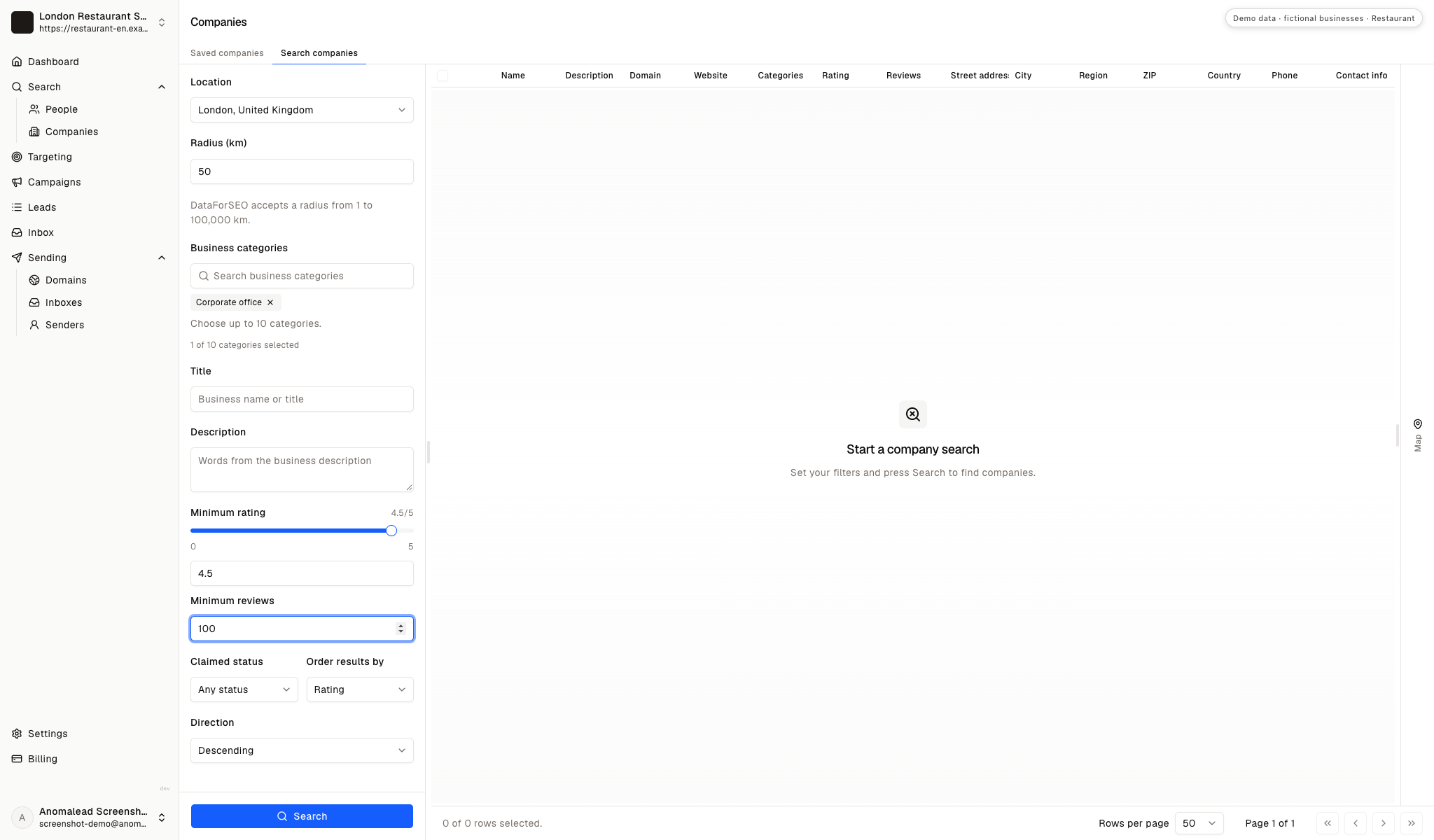
Section titled: Set the radius by how far food can travelChoose the corporate office category and a location near your restaurant. Set the radius by realistic lunchtime delivery time, or by walking distance if you sell sit-down team meals and private dining.
Start tight and widen the radius only after the nearest offices have been worked.
Read the office results with a caterer's eye
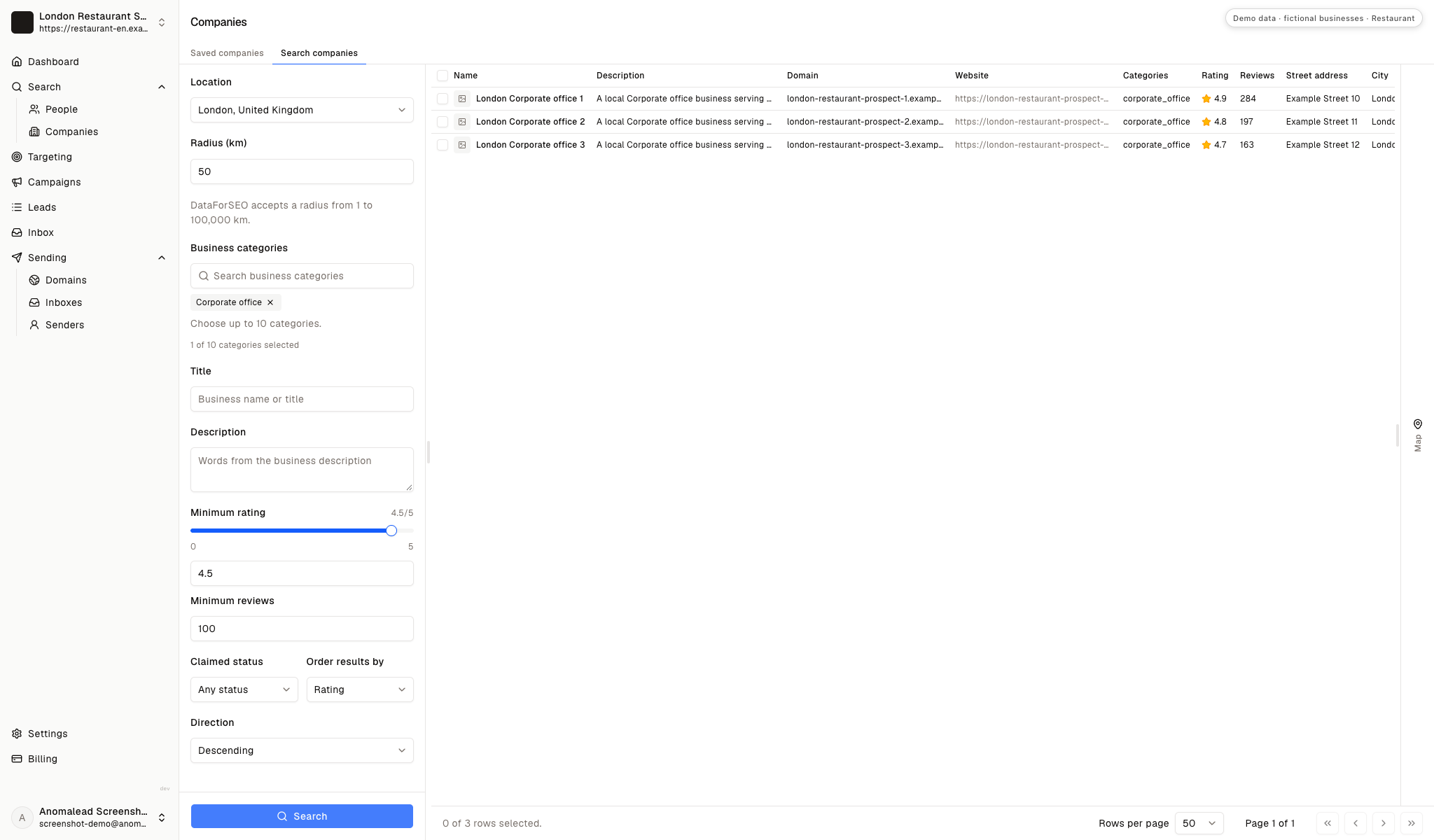
Section titled: Read the office results with a caterer's eyeThe demo returns three fictional offices with ratings, review counts and a generic one-line description. On a real list, check each website for clues: team lunches on the careers page, photos of office events, or a staff restaurant that rules out daily catering.
Keep the offices you could feed next week
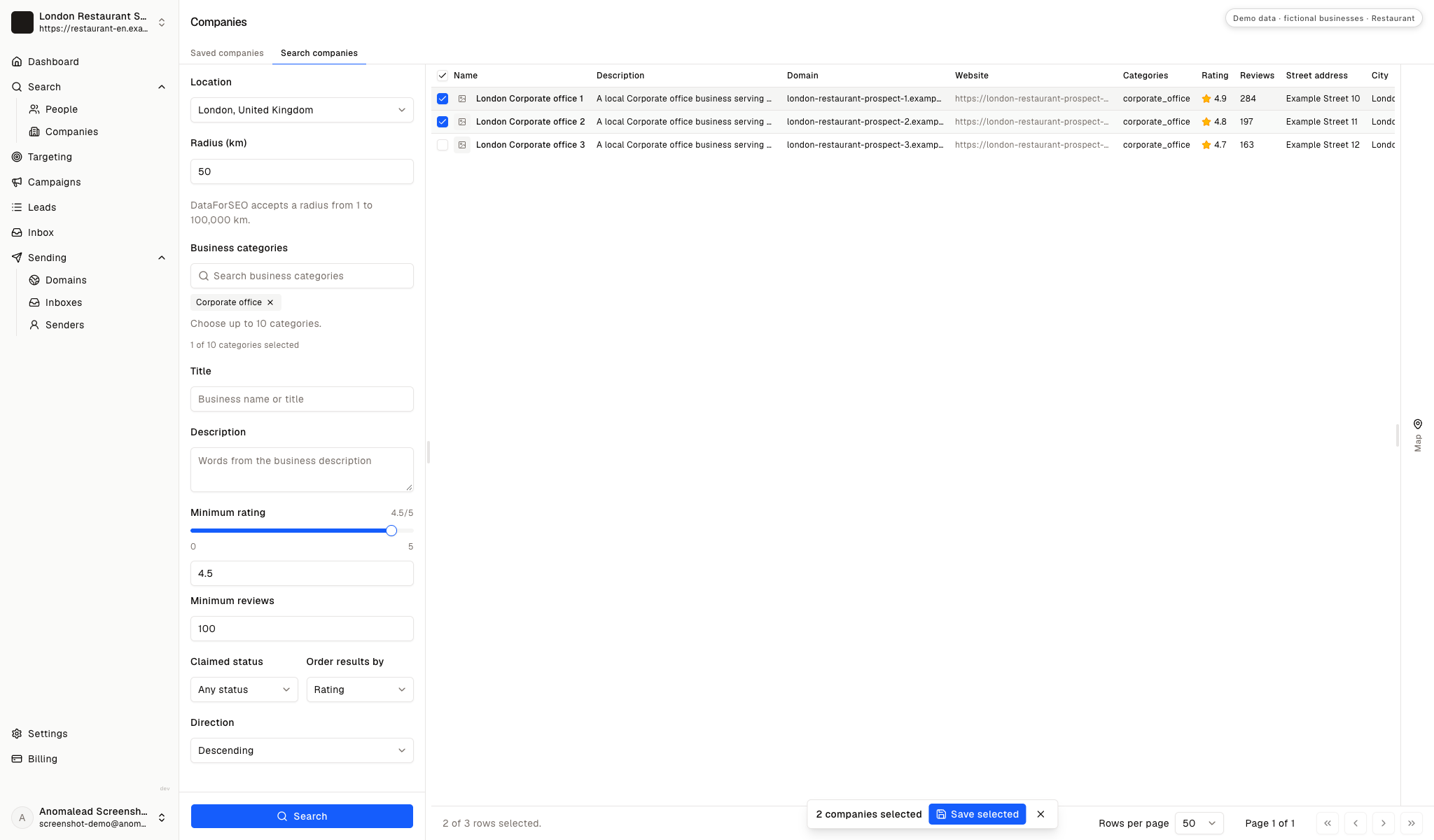
Section titled: Keep the offices you could feed next weekTwo of the three offices are selected for saving. Save an office only when you can picture a concrete first order, such as a meeting lunch, a team dinner or a client booking.
Reach the person who places the lunch order
Section titled: Reach the person who places the lunch orderThe right contact at an office is whoever places the lunch order or books the table, which is rarely a senior executive. Look for office manager, executive assistant, workplace coordinator, reception lead, or a people coordinator for social events.
A job title only hints at who orders food. If a record points outside that circle, ask briefly who handles catering instead of pitching someone who never books it.
Confirm the office before you look for names
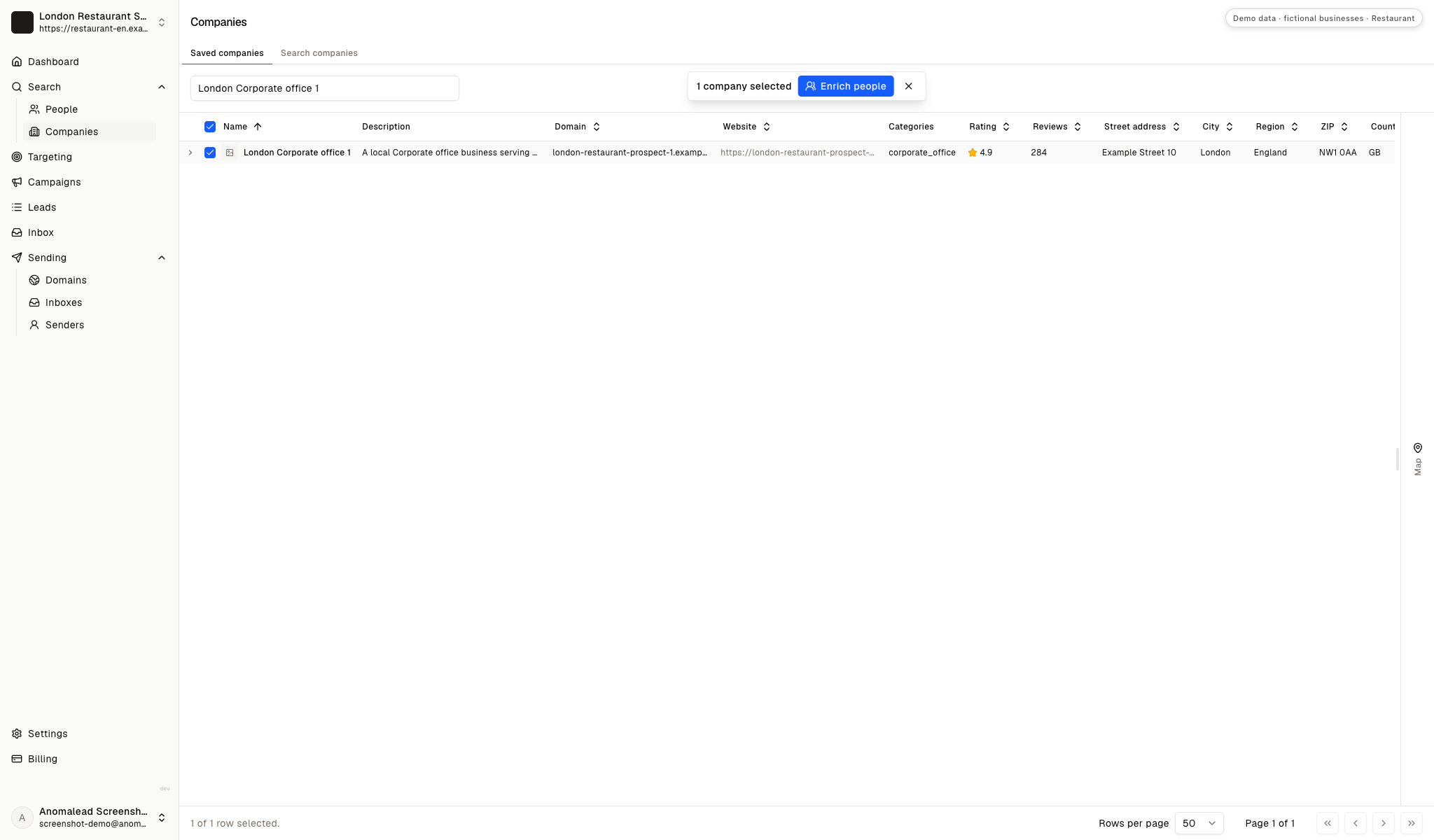
Section titled: Confirm the office before you look for namesLondon Corporate office 1 is selected in the saved-company view, with the Enrich people action ready. Confirm it sits inside your delivery area and that its website shows no in-house canteen.
Decide whether a partnerships title really books lunches
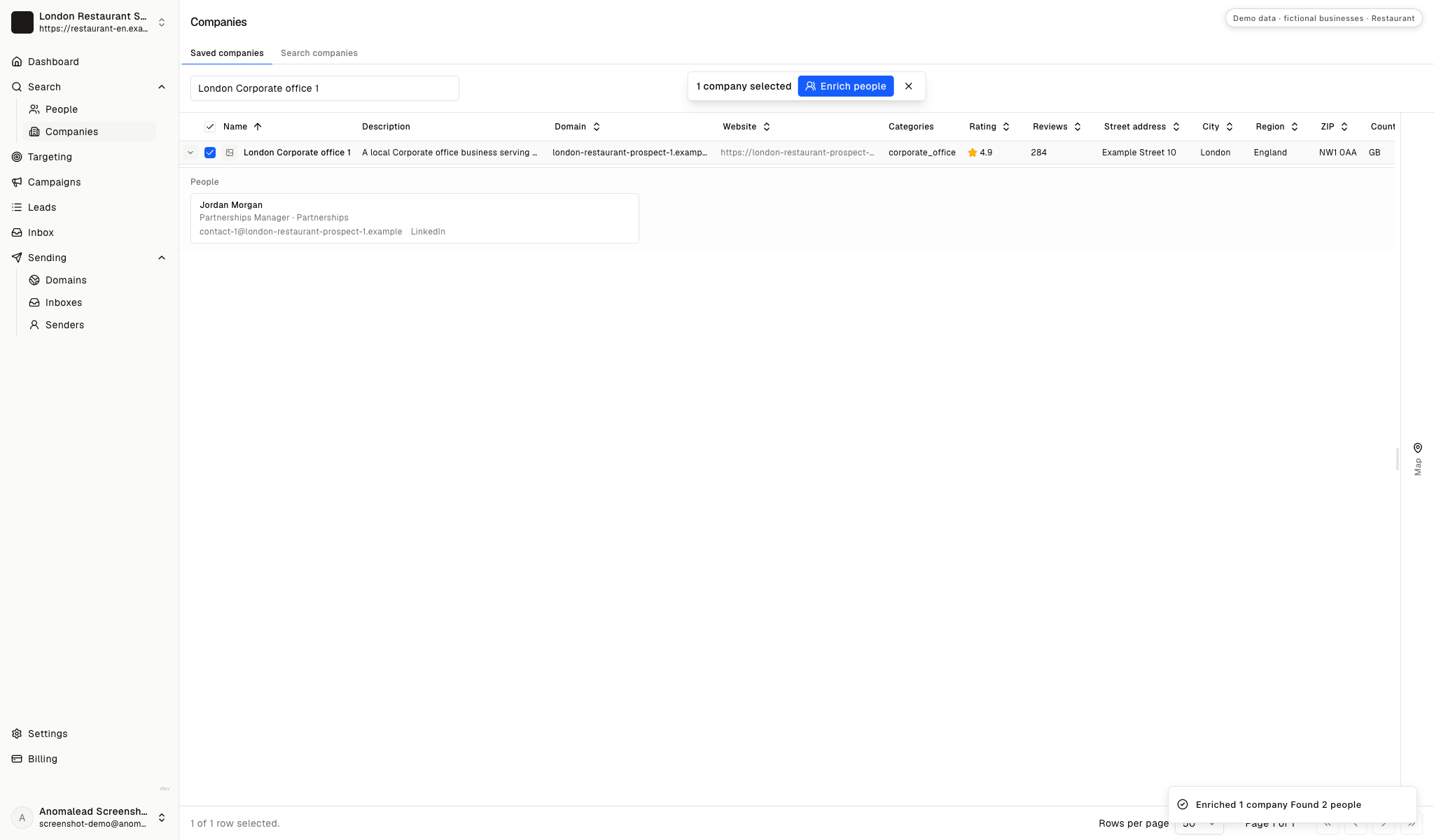
Section titled: Decide whether a partnerships title really books lunchesThe results show Jordan Morgan and Taylor Reed, both Partnerships Managers at fictional offices. That role may cover suppliers, staff perks or events, or none of them.
Keep a contact whose role plausibly touches suppliers or events, and write so they can forward the email to the office manager in one click.
Note the offer for each contact on the lead list
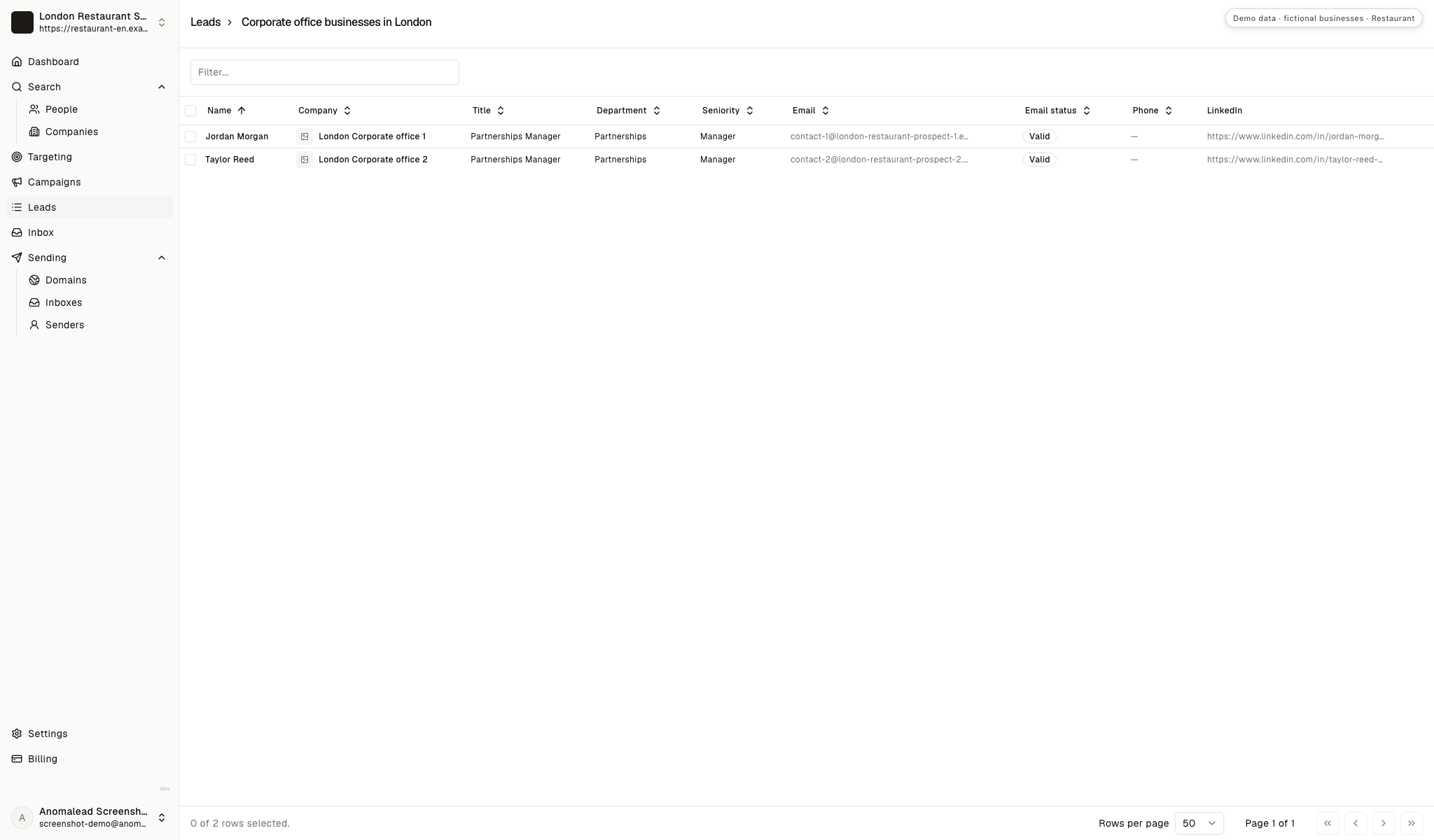
Section titled: Note the offer for each contact on the lead listThe lead list holds Jordan Morgan and Taylor Reed. Beside each record, write what you would offer: boxed lunches for meeting days, a set dinner menu or a private room for a client event. If you cannot write that note, the contact is not ready.
What is a regular office account worth to a restaurant?
Section titled: What is a regular office account worth to a restaurant?An office account can mix repeat meeting lunches, occasional team dinners, client bookings from assistants and a seasonal party that fills a quiet evening. Its value depends on order size, order frequency, your food cost on catering menus and the staff time for packing and delivery.
Use figures from your own past catering. A large order that forces you to close the dining room early or pull a cook off the line can be worth less than it looks.
Every input in the calculator, including deal value, meetings and close rate, is your own assumption. The result is a planning estimate, not a forecast, a quote or a promise of bookings.
Do the math on one good deal
If one new customer is worth thousands, you don’t need magic. You need a few more meetings a month.
Projected monthly results
- Deals closed
- 2.0
- Projected revenue
- £10,000
- Growth plan (1 business)
- £79/mo
- ROI
- 12,558%
Conservative math on meetings you already believe you can book. One closed deal often pays for a year of Anomalead.
Run it once for a recurring lunch account and once for a one-off celebration, then decide which kind of office to put first.
Give an office manager an offer they can picture
Section titled: Give an office manager an offer they can pictureThe first email should describe one format and one way it saves the office manager effort: a menu that travels well, clear allergen labels, a dependable delivery window or a room that seats the whole team. Then ask a single question. For structure and tone, writing a short cold email walks through each line.
Keep one kind of office buyer per campaign
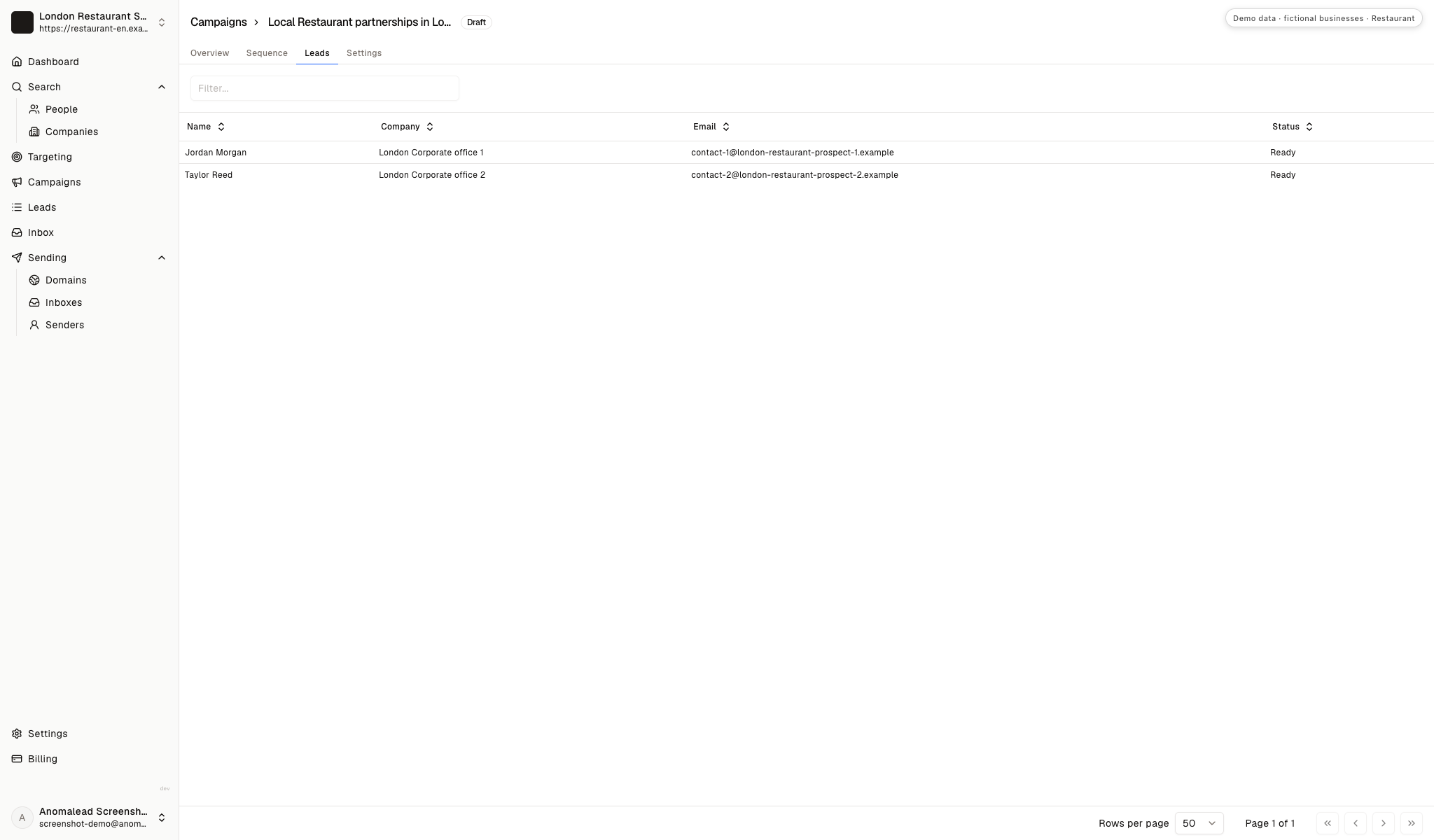
Section titled: Keep one kind of office buyer per campaignThe draft campaign has two fictional recipients. Check that both would get the same kind of offer, and split the campaign if one books client dinners while the other orders meeting lunches.
Rewrite the seeded sequence around real menus
Section titled: Rewrite the seeded sequence around real menusThe demo sequence has three emails separated by a three-day wait and a four-day wait. Its seeded copy offers generic restaurant services and a service area, which is not how an office buys food.
Give each step something new: one format first, then a sample menu or a photo of a delivered platter, then a short question about who handles catering.
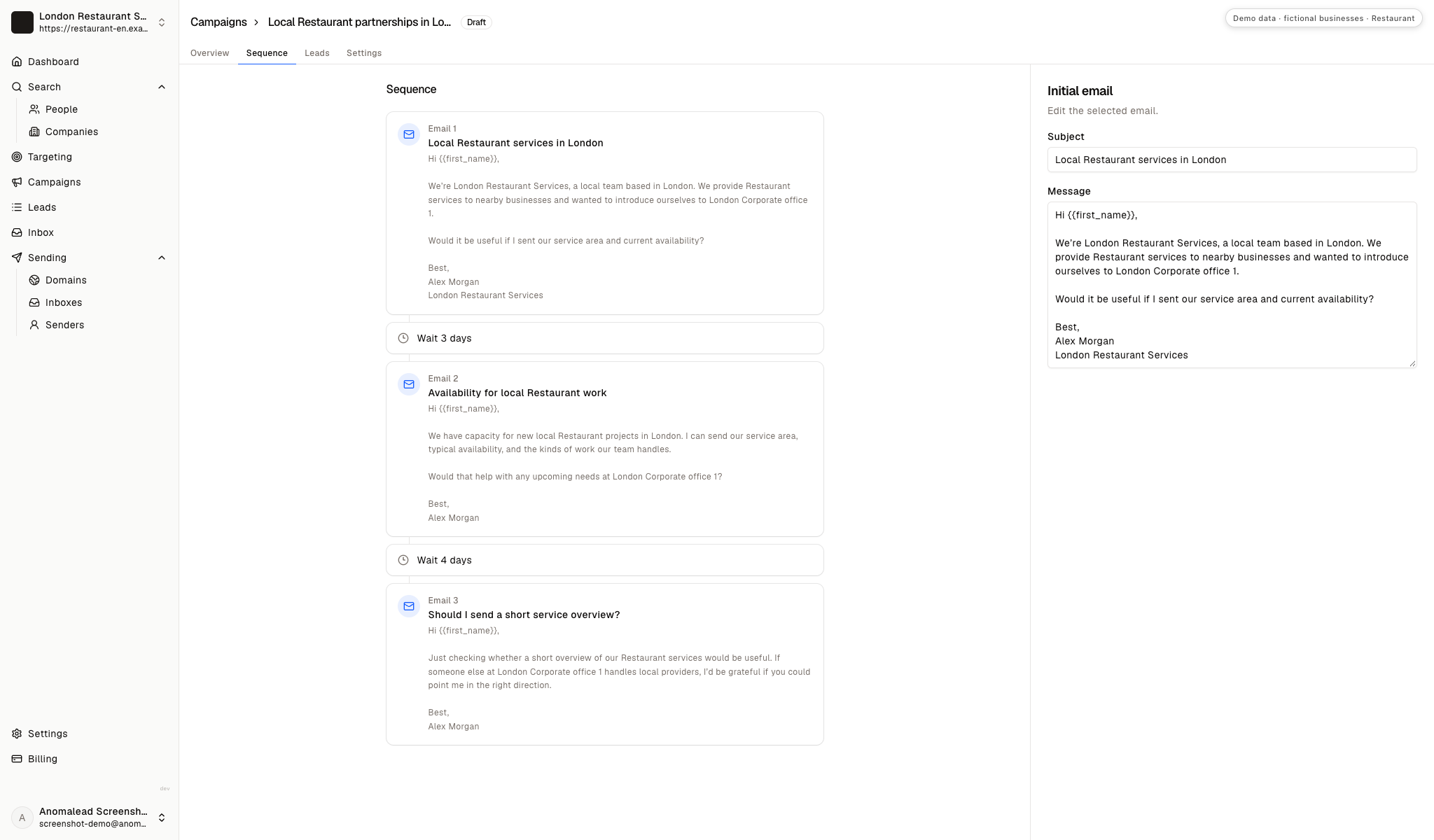
Two emails an office manager might answer
Section titled: Two emails an office manager might answerBoth drafts replace the seeded copy. Each names one format and ends with one question, so swap in the dishes and logistics your kitchen really offers.
First email about meeting-day lunches
Subject: Lunch for your team meeting days
Hi Jordan,
I'm Alex Morgan from London Restaurant Services, close to London Corporate office 1. We deliver boxed lunches for meetings and team days, each labeled with its allergens, and we invoice the company so nobody pays by card.
Who usually arranges food for meetings at your office? If it's you, I'd be glad to send our catering menu.
Best,
Alex Morgan
London Restaurant Services
First email about a team dinner
Subject: A private room for your next team dinner
Hi Taylor,
I'm Alex Morgan, and I look after group bookings at London Restaurant Services. Our private room suits leaving dinners and end-of-year parties, with a set menu that covers vegetarian, vegan and common allergy requests.
Is anything like that coming up at London Corporate office 2 in the next few months?
Best regards,
Alex Morgan
Keep subject lines this plain; more patterns are collected in subject lines office buyers open. Make only claims that are true for your restaurant.
Read what the offices asked for
Section titled: Read what the offices asked forThe demo inbox shows two fictional replies. Jordan Morgan asks for a service area, typical availability and an indicative price range, and Taylor Reed mentions an upcoming project and asks about scope and credentials.
For a restaurant, those questions mean delivery radius, notice period, a priced sample menu, and food safety and insurance documents.
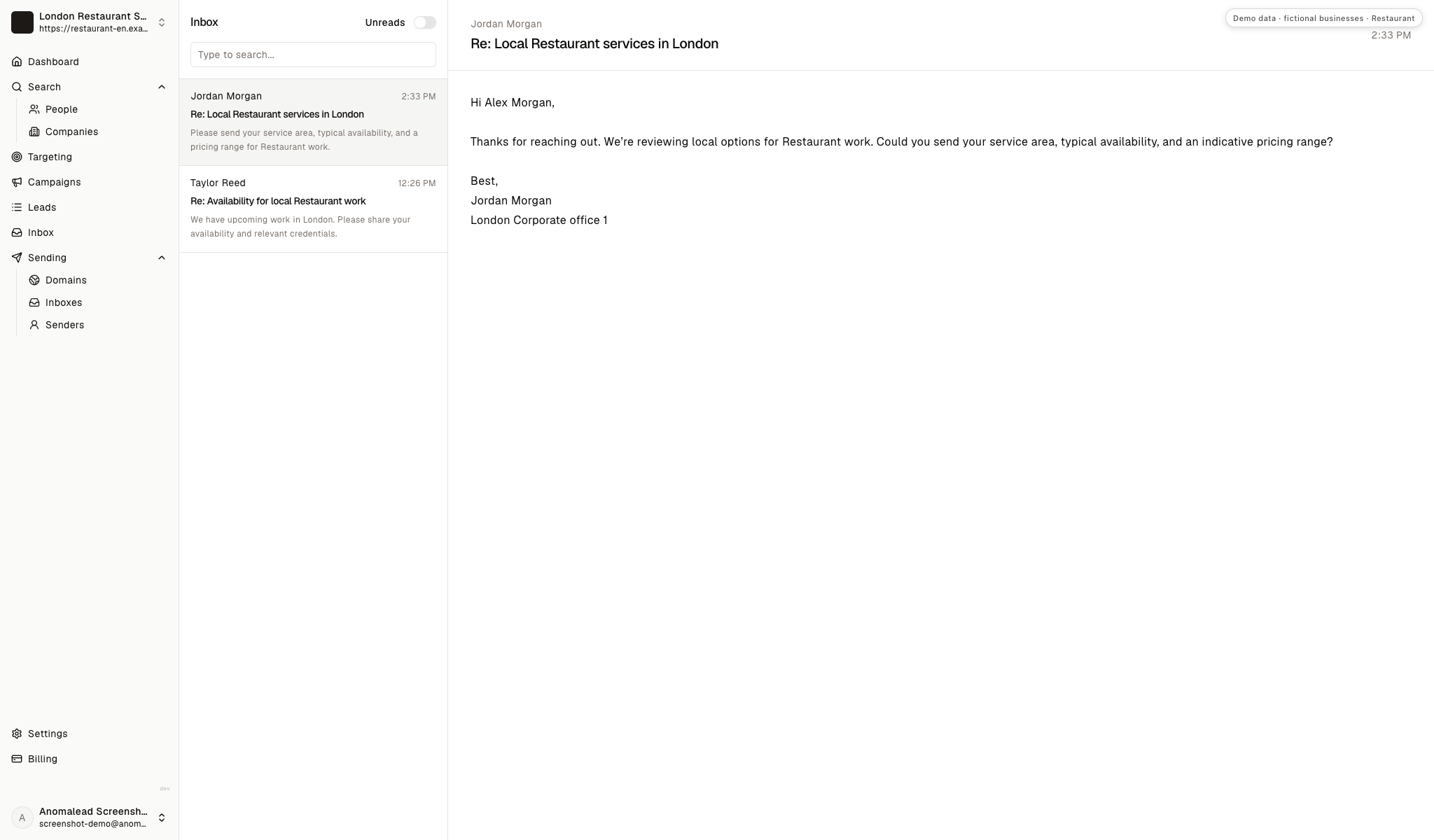
Answering office managers who reply about catering
Section titled: Answering office managers who reply about cateringAn office reply is usually a request for something the contact can forward. Send a menu, the practical details and one question that moves toward a first order or a tasting.
Jordan Morgan asks for service area, availability and prices
Section titled: Jordan Morgan asks for service area, availability and pricesThanks for getting in touch. We're comparing a few local options. Could you share where you deliver, how soon you can usually take an order and a rough price range?
Send your catering menu with prices per person or per platter, where you deliver at lunchtime, how much notice you need and when final numbers can change. Then ask what the first occasion is, because a weekly meeting lunch and a one-off celebration need different menus.
Alex Morgan could reply:
Thanks, Jordan. Our catering menu is attached with prices per person and per platter. We deliver to the streets around your office at lunchtime and need orders the day before, with final numbers that morning. What would the first order be for: a regular meeting, a team day or a one-off event?
Taylor Reed asks about an upcoming project and credentials
Section titled: Taylor Reed asks about an upcoming project and credentialsSomething may be coming up for us soon. Could you tell us when you're free, what your team can take on and which licenses or credentials you hold?
For a restaurant, credentials usually mean your latest food hygiene or safety inspection result, your allergen information and liability insurance if the supplier process asks for it. Requirements differ by location, so never claim a certification you don't hold.
Ask about the occasion, the head count and the date so you can match a menu or a room.
A reply that draws out the event details:
Thanks, Taylor. I've attached our latest food safety inspection result, our allergen guide and our insurance certificate. We deliver lunches to offices and host team dinners in our private room. What is the occasion, roughly how many people, and do you have a date in mind?
The office already has a canteen or a catering platform
Section titled: The office already has a canteen or a catering platformWe order through a corporate catering platform and our building has a staff canteen, so we're covered for now.
Don't argue with a daily arrangement you cannot replace. A canteen rarely covers client dinners or the end-of-year party, and some platforms let an office add a restaurant it likes.
A reply that finds the gap:
That makes sense for everyday lunches. Would it help if I sent our group set menus, so you have them ready for the next client dinner or team celebration?
Finance sets a fixed amount per person
Section titled: Finance sets a fixed amount per personOur finance team sets a fixed amount per person for team events, and most restaurants we've tried go over it.
Ask for the figure and build a menu that meets it rather than discounting your standard one. A shorter set menu, sharing platters or lunch instead of dinner can fit the budget, and written terms for drinks, service charge and deposit keep the invoice in line with what finance approved.
Choose the next offices by what actually got booked
Section titled: Choose the next offices by what actually got bookedLog every reply by role, occasion and outcome. Build the next list around the pattern that led to a tasting or a first order, such as offices within walking distance or companies with regular team days.
Deliver the first order well and ask for a repeat date while the event is fresh. Cold email is only one channel, and local marketing strategies beyond cold email cover referrals and more. This week, pick ten offices inside your delivery radius and write one sentence for each about the order you would propose.
Questions restaurant owners ask about office catering leads
Section titled: Questions restaurant owners ask about office catering leadsWho should a restaurant contact first at a local office?
Section titled: Who should a restaurant contact first at a local office?Start with the office manager or an executive assistant, because they place most food orders and book tables for client meals. At larger companies the people or workplace team often decides on parties. If your first contact does not book food, ask who does.
Should a restaurant offer a discount to win its first office order?
Section titled: Should a restaurant offer a discount to win its first office order?Usually not, because a discount sets the price for every repeat order. Offer a tasting box, a sample platter for a meeting or a set menu that fits their budget, so the office judges your food rather than your price.
When do offices book end-of-year parties and team events?
Section titled: When do offices book end-of-year parties and team events?Seasonal parties are often booked well ahead, while meeting lunches are ordered days or hours in advance. Contact offices about celebrations early in the season and pitch regular lunches any time. Ask each office how far ahead it plans.
Are the offices, contacts and replies in the screenshots real?
Section titled: Are the offices, contacts and replies in the screenshots real?No. London Restaurant Services, the three London corporate offices, Jordan Morgan, Taylor Reed and both replies are fictional demo data. None of them is an Anomalead customer, and nothing shown is a real campaign outcome.
What does the ROI calculator tell a restaurant, and what can it not predict?
Section titled: What does the ROI calculator tell a restaurant, and what can it not predict?It combines the deal value, meeting count and close rate you enter into a rough revenue estimate. It knows nothing about your food cost, delivery time or kitchen capacity, and it cannot forecast bookings. Use it to compare account types.