


Hotel lead generation works when event planners can tell whether your property fits the group they are organizing, from the guest-room block to the meeting or event space. Start with local planners who book groups, corporate meetings, association gatherings or social events, then qualify dates, room needs and venue operations before discussing terms. For a general process, read B2B lead generation basics and build your prospect list around one event type.
A planner is coordinating more than a room night. They may need a block with clear release and cancellation terms, a workable meeting layout, food-and-beverage options, AV support, a site visit and a reliable handoff between sales and hotel operations. A focused introduction explains how your team evaluates fit without inventing availability, rates or event outcomes.
Key takeaways
- Target event planners who book group stays or meeting space that your property can actually host.
- Qualify event dates, room types, block terms, meeting layout, catering, AV and decision timing before preparing a proposal.
- Use a site visit to review guest rooms, event flow, loading and service points with the planner and the hotel teams involved.
- Confirm who owns the contract, room-block changes, event order and operational handoff before treating an inquiry as booked business.
Which event planners are worth a hotel sales conversation?
Section titled: Which event planners are worth a hotel sales conversation?Start with planners whose programs match your guest-room inventory, function space and operating strengths. A useful prospect can describe the event format, the booking owner and how hotel options enter the client’s review.
- Corporate event planners: They coordinate meetings, training sessions and off-sites that may combine guestrooms, meeting rooms and food service. Ask whether the hotel is being considered for a single event or a repeat program, and who approves the venue.
- Independent event agencies: Agencies may source hotels for several clients and need a concise way to compare room blocks, function space, AV and catering. Learn which event types they handle and how they arrange site visits and client approvals.
- Association and conference coordinators: They often balance room nights, breakout rooms, registration flow and attendee arrival. Clarify the expected pattern of stays, schedule shape, accessible routes and what the association needs to sign off on.
- Wedding and social-event planners: They may need a guest-room block alongside a reception or meeting space. Ask about guest-room preferences, event-room setup, food service, outside vendors and the handoff between planner and hotel teams.
Use a clear first-contact email to find the planner who owns hotel selection, then confirm who approves the contract and block terms.
Qualify the event before you quote rooms or space
Section titled: Qualify the event before you quote rooms or spaceA hotel proposal is useful only when the event’s date window, guest-room pattern and venue requirements are clear enough to check. Ask what is known, mark open decisions and verify current inventory before suggesting rates or promising space.
- Dates and guest-room block: Clarify event dates, arrival and departure pattern, room types and how the planner expects the block to release. Review cutoff, pickup, cancellation and any attrition language with the person authorized to approve the hotel contract.
- Meeting layout and event flow: Ask about the agenda, room sets, breakout needs, registration, guest movement and service access. Compare the request with the property’s function-room plans, published capacity, accessible routes and setup limitations.
- Food, beverage and AV: Discuss meal periods, service style, dietary requests, package boundaries and any minimums without inventing a quote. Confirm whether AV is in-house or supplied by a partner, what power and connection needs must be reviewed, and who supports the room during the program.
- Site visit and approvals: Offer a visit that shows the likely guest-room type, meeting room, arrival path, loading point and service areas. Identify who attends, what they need to inspect and which client or procurement approvals follow before a proposal becomes a contract.
- Contract and operations handoff: Confirm who signs, how changes are recorded and which hotel lead owns the booking after signature. Align sales, front desk, banquets, catering and AV on the event order, guest-block notes, arrival details and escalation contact.
About the demo hotels, planners and replies
London Hotel Services, London Event planner 1, London Event planner 2 and London Event planner 3, the contacts and inbox replies are fictional demo data. They are not Anomalead customers or real hotel bookings. The seeded company descriptions and messages are generic interface examples, not evidence of event demand or planner fit.
Hotel lead generation begins with planners whose events fit your property
Section titled: Hotel lead generation begins with planners whose events fit your propertySearch in the markets where your sales and operations teams can host a site visit and support an event. Decide whether the campaign is for room blocks, meetings, association programs or social events, then review planner companies for relevant public portfolios and event formats.
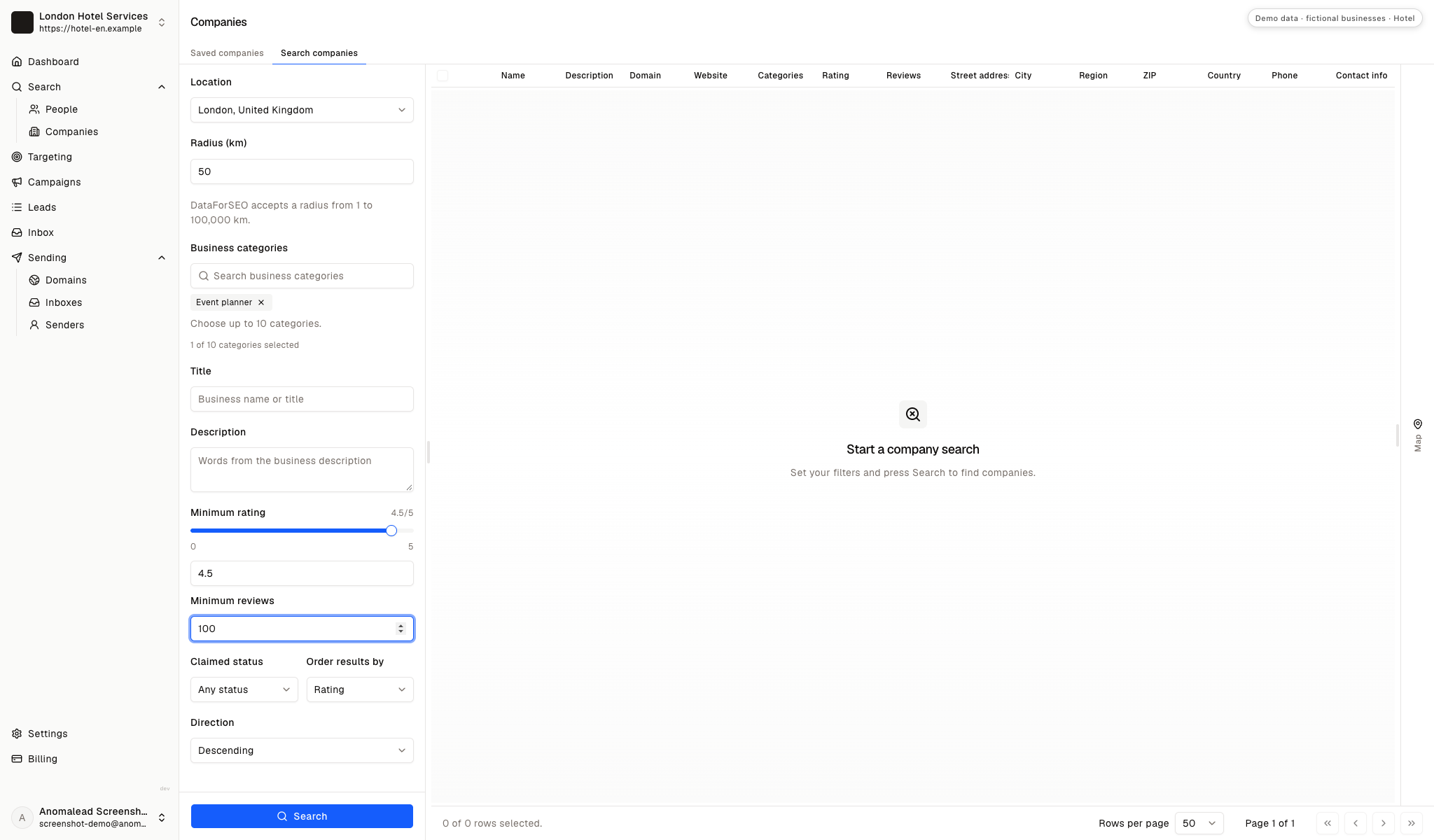
The search screen has location, radius, company category and rating filters. The three fictional event-planner listings and review details are generic demo data; they do not show a planned booking, client roster or hotel preference.
Choose an event-planner market your team can serve
Section titled: Choose an event-planner market your team can serveSet the location and radius around properties where your sales team can arrange visits and hotel operations can support the program. Select event planners as the prospect category, then keep the search focused on a realistic service market.
Review the generic event-planner listings
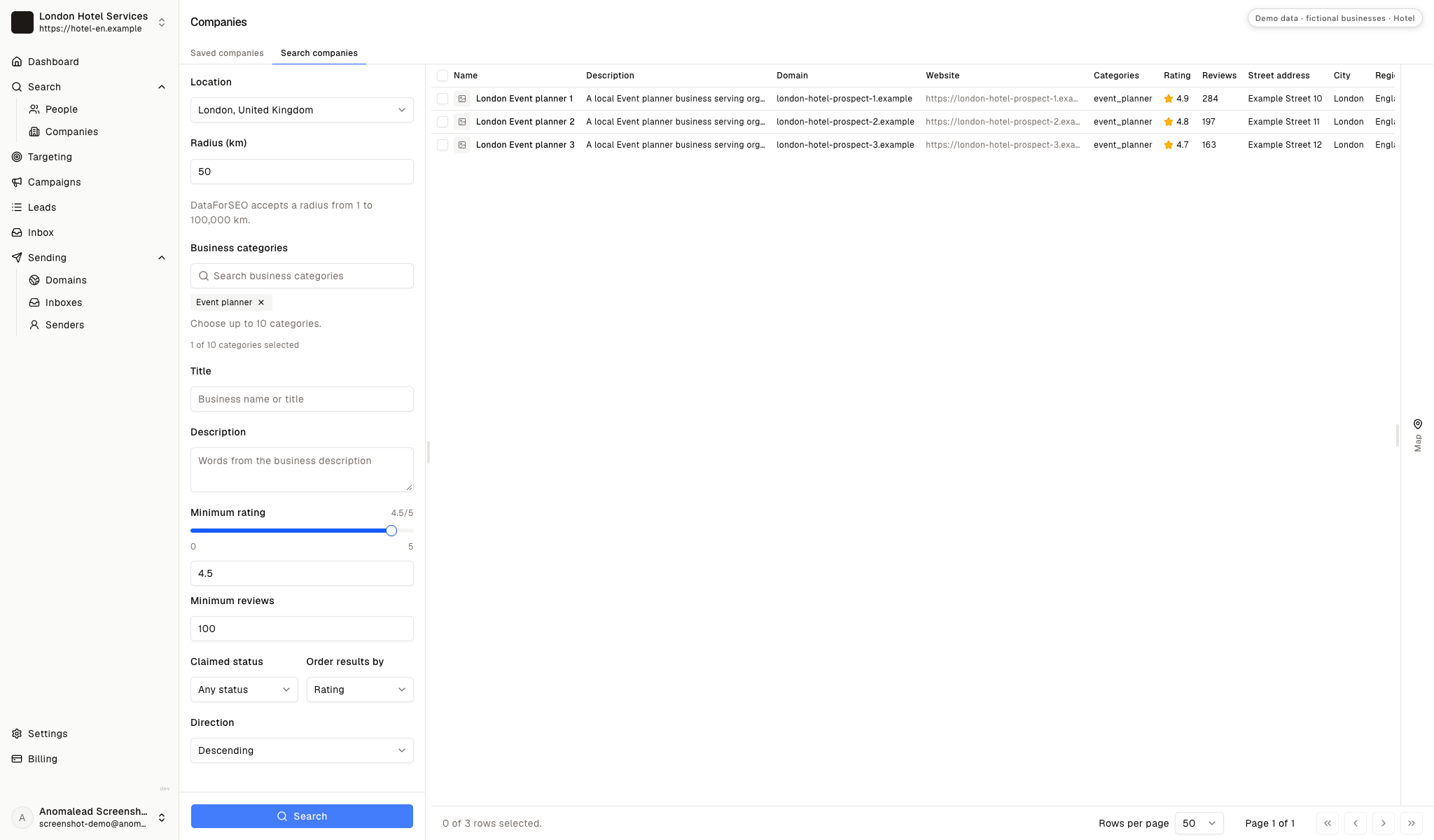
Section titled: Review the generic event-planner listingsThe results screen lists three fictional event-planning companies with ratings and review counts. Those fields are sample interface data and do not identify event type, booking authority or a need for hotel rooms.
Save planners whose programs match your hotel
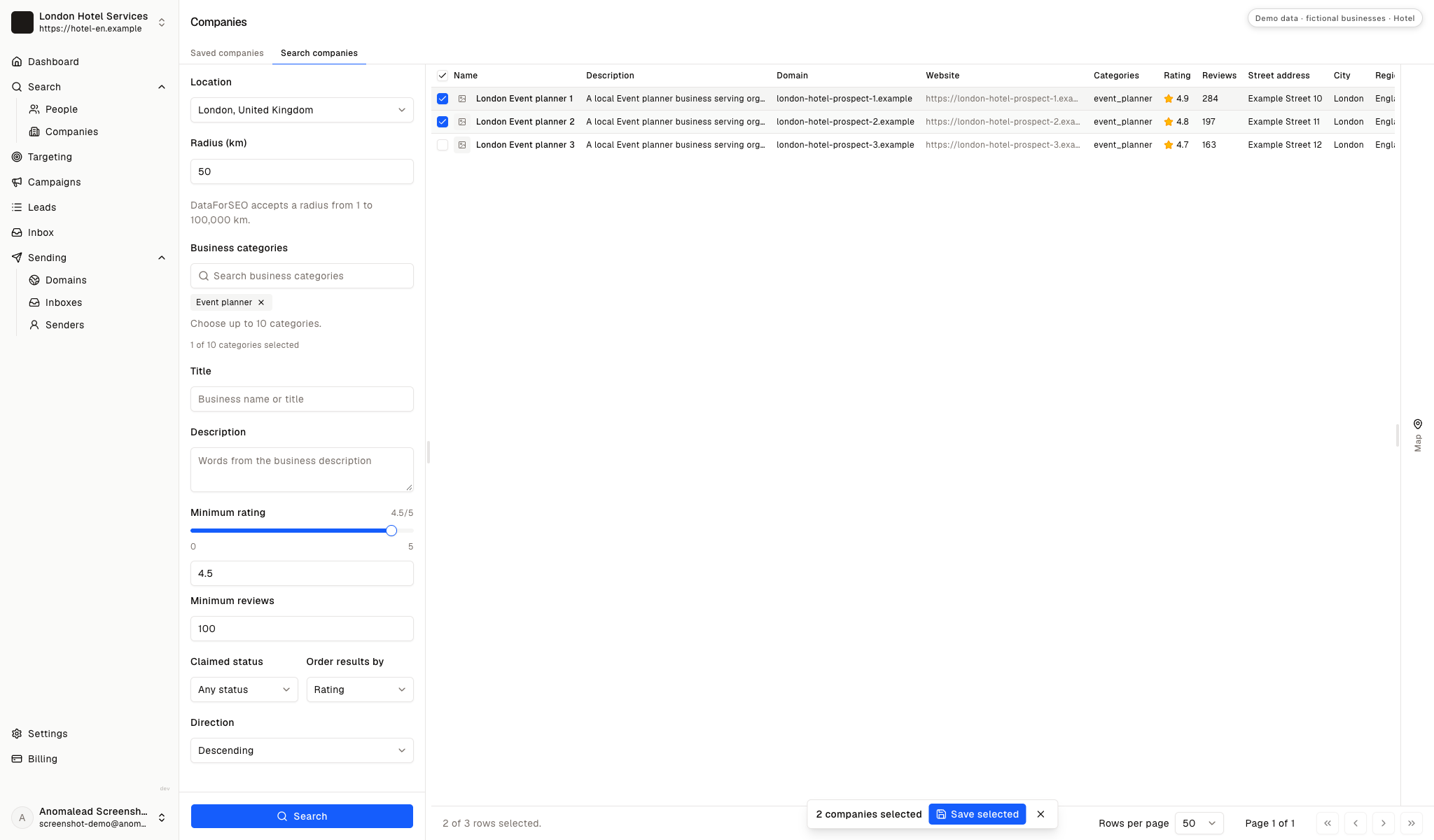
Section titled: Save planners whose programs match your hotelThe demo selects two of three fictional planner records and saves them. Keep prospects whose public event work could fit your room inventory, meeting space and service model.
Research who owns venue selection and group contracting
Section titled: Research who owns venue selection and group contractingAn event agency may research venues while a corporate organizer or client signs the hotel agreement. Find who gathers options, who leads a site visit, who approves room-block terms and who handles event production before choosing a recipient.
Contact enrichment identifies professional roles, not event dates, guest counts or booking intent. Use public business context for prospecting; do not add attendee names, travel details or private event documents to a marketing list.
Check the planner company before enriching contacts
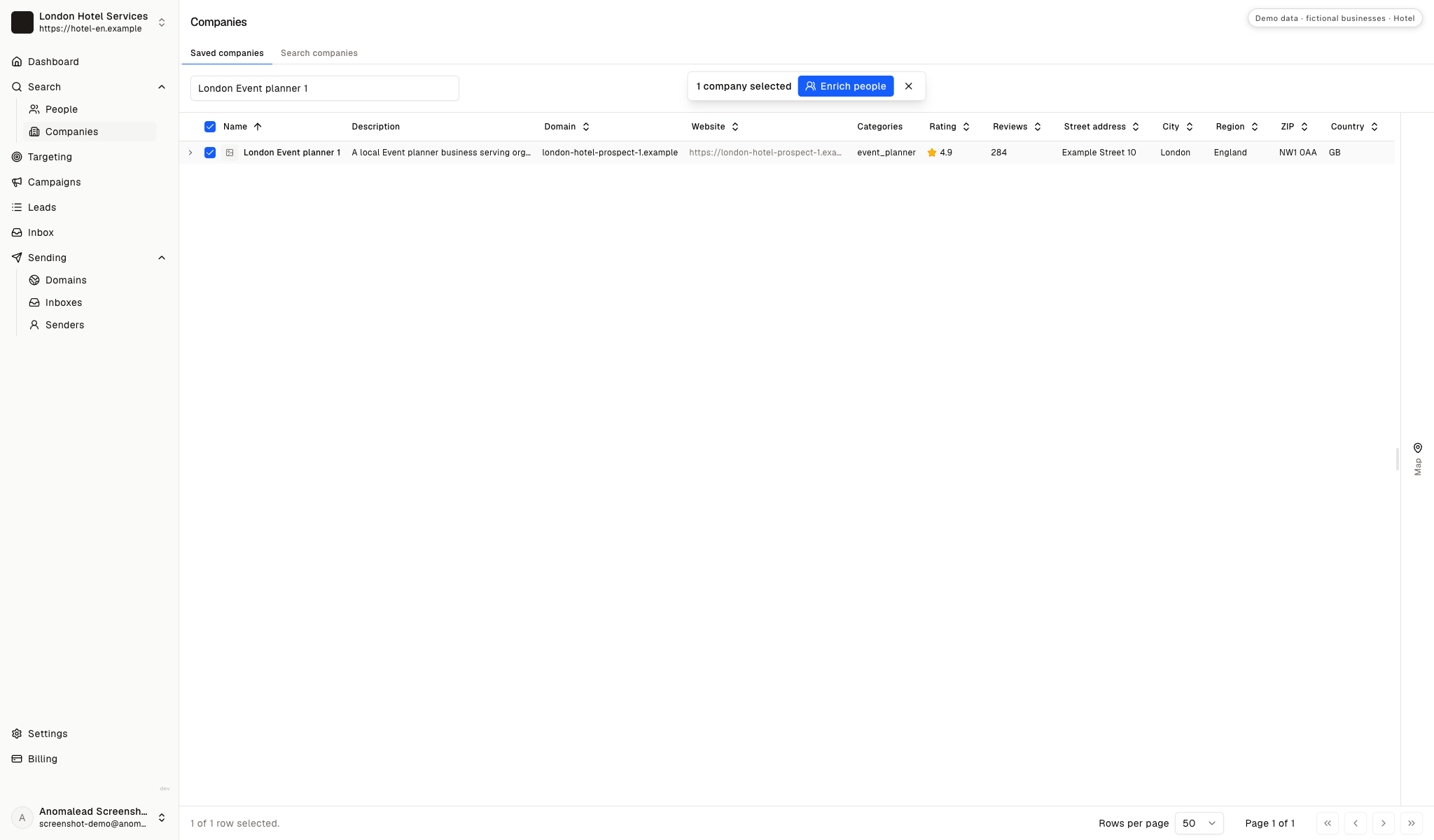
Section titled: Check the planner company before enriching contactsReview each saved organization and its event portfolio before looking for individuals. Contact enrichment is most useful after you can explain why the hotel may fit the planner’s work.
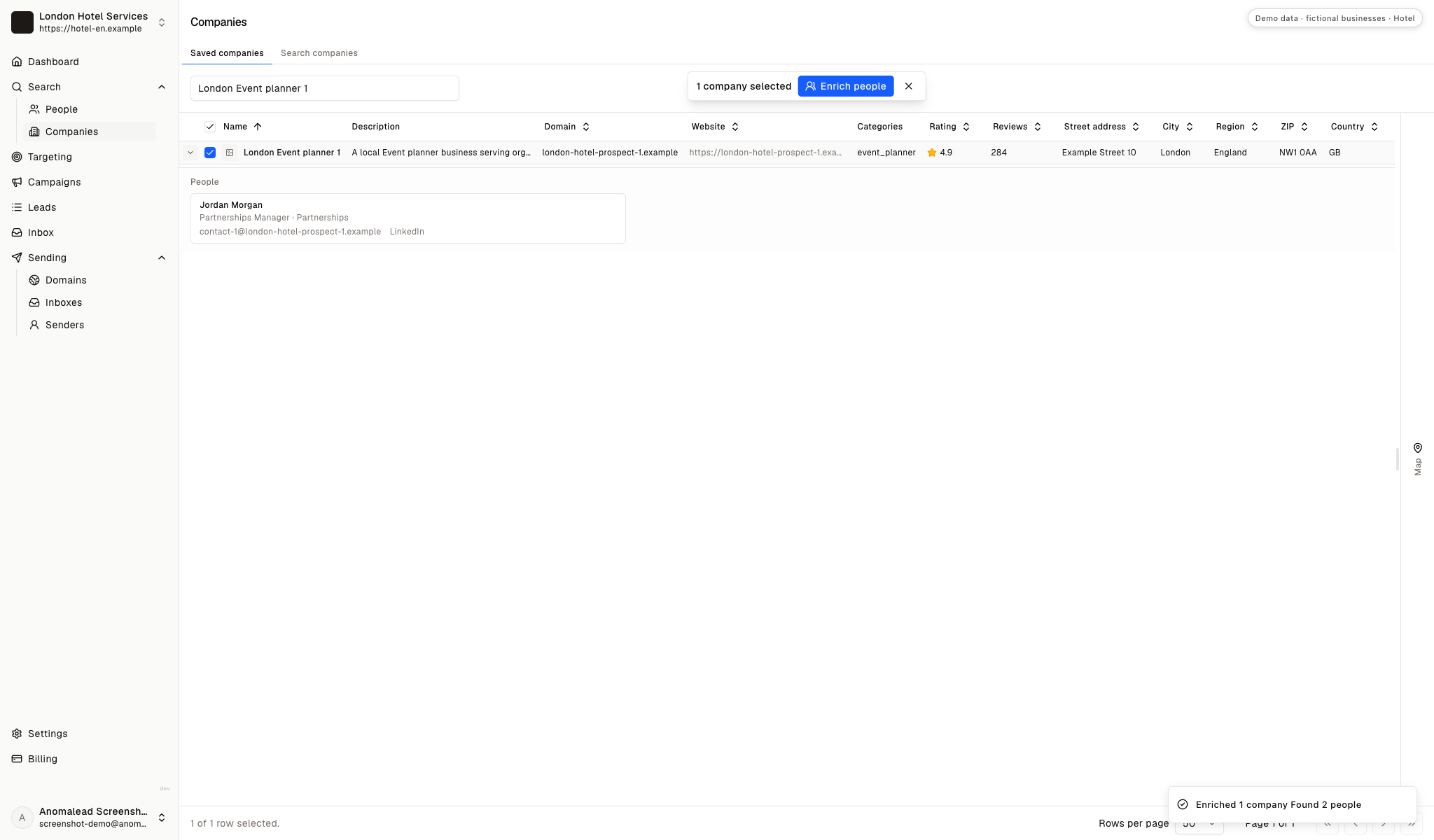
Find who selects the hotel for a program
Section titled: Find who selects the hotel for a programThe demo shows two fictional partnerships contacts, Jordan Morgan and Taylor Reed. A planner’s team may separate client approval, venue research, room blocks and event production among different people.
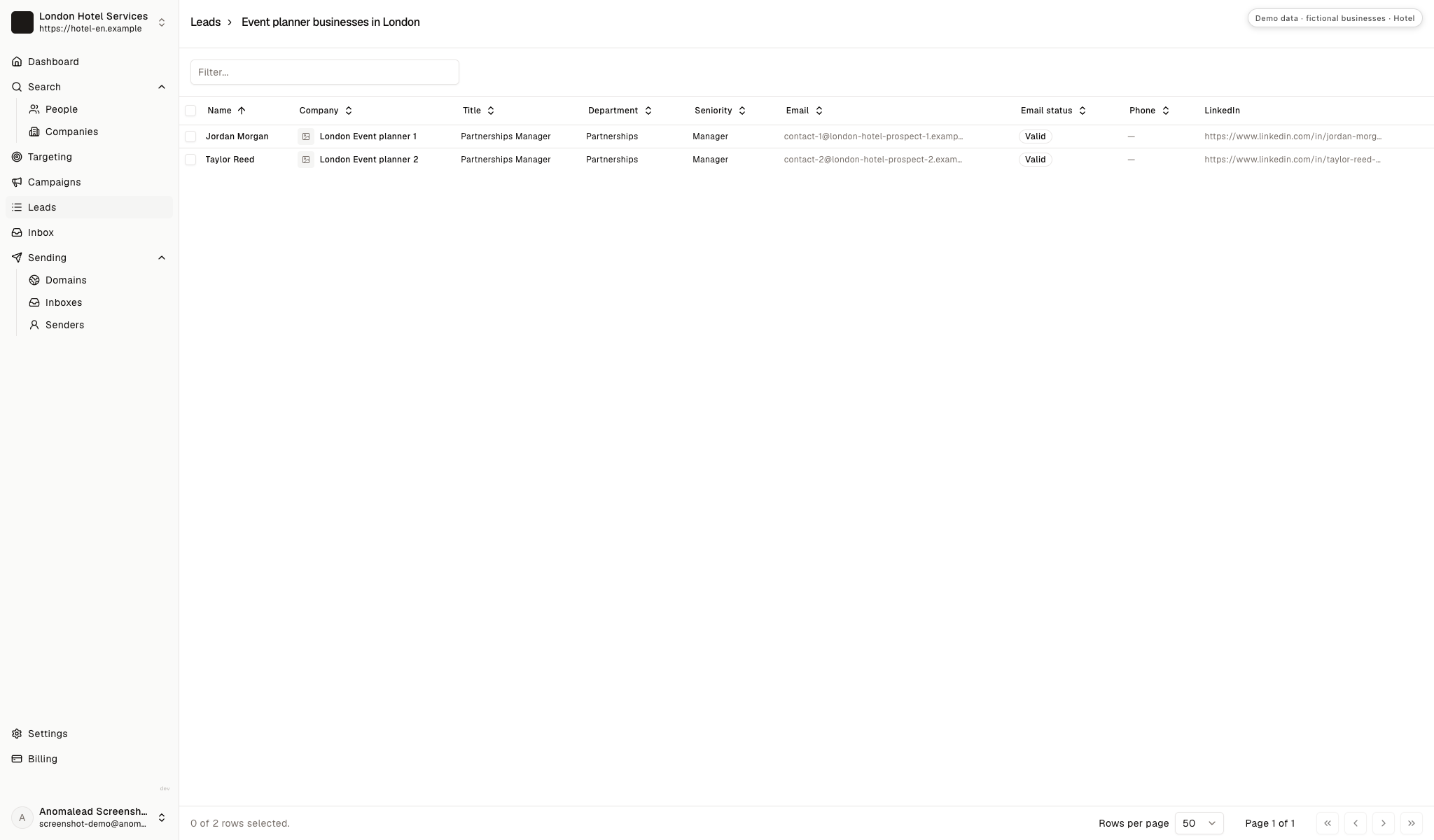
Keep the outreach list tied to event-planning roles
Section titled: Keep the outreach list tied to event-planning rolesThe saved lead list contains two professional contacts for campaign review. Record work context that helps tailor a hotel conversation, such as planner role or public event focus, rather than private attendee details.
Assess the work behind an event-planner relationship
Section titled: Assess the work behind an event-planner relationshipA planner relationship can require venue research, room-block checks, menu and AV coordination, site visits and an operations handoff before an event is contracted. Compare that effort with the sales and event capacity the property can actually provide.
Repeat business may depend on fit across several event requirements, not only room demand. Consider whether the hotel can support the expected date pattern, space layout and service commitments before treating a planner as a valuable account.
Enter your own assumptions about outreach, site visits and a possible group booking. The calculator relates those inputs; it does not predict room pickup, signed contracts, event attendance, revenue or conversion.
Do the math on one good deal
If one new customer is worth thousands, you don’t need magic. You need a few more meetings a month.
Projected monthly results
- Deals closed
- 2.0
- Projected revenue
- £10,000
- Growth plan (1 business)
- £79/mo
- ROI
- 12,558%
Conservative math on meetings you already believe you can book. One closed deal often pays for a year of Anomalead.
Include proposal work, site visits, menu and AV review, room-block administration and event handover in your estimate of sales effort.
Open with a venue-fit conversation, not a generic room offer
Section titled: Open with a venue-fit conversation, not a generic room offerA useful hotel introduction names the group or meeting format your property can support and offers to check the actual requirements. Explain which room types, function layouts, food service or AV you can discuss, while avoiding unverified availability or rate claims.
Ask for the right next step, such as a short call to understand the event brief or permission to share a venue overview. Before proposing terms, confirm date flexibility, room pattern, decision owner and who needs to join a site visit.
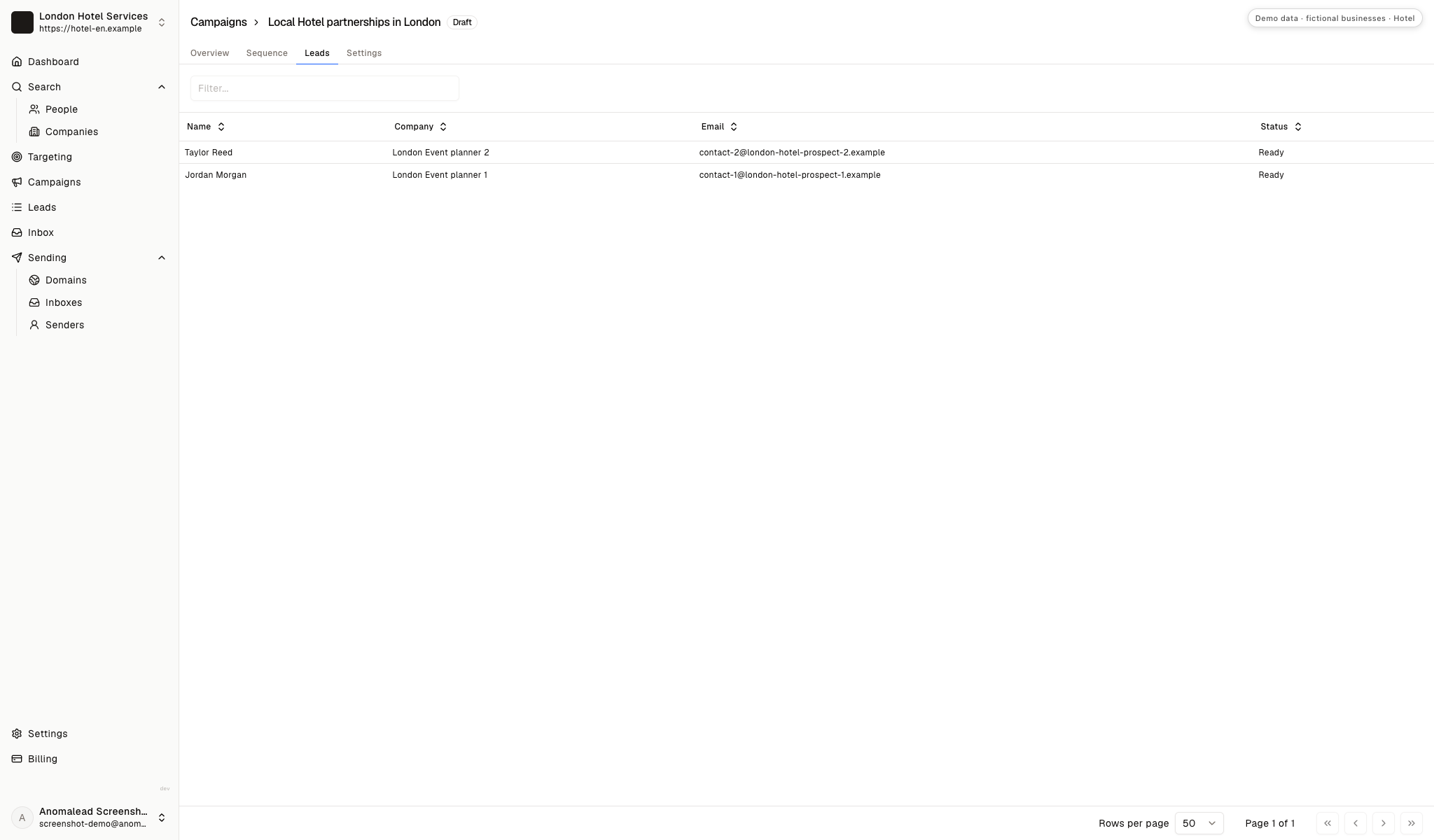
Choose recipients who can review a hotel fit
Section titled: Choose recipients who can review a hotel fitThe draft campaign shows two selected contacts. Confirm they work on venue sourcing or can direct you to the person who owns hotel selection and contracting.
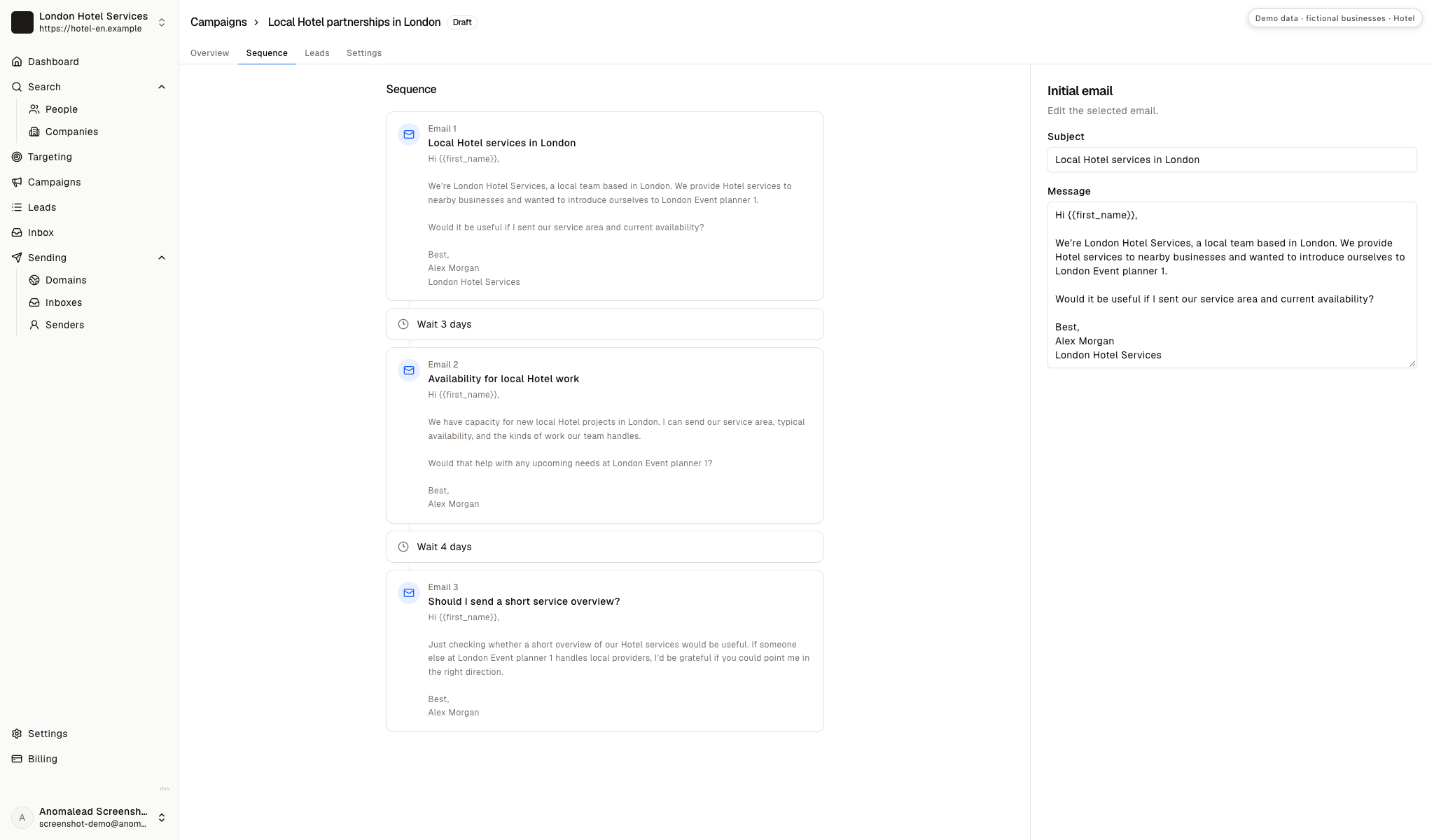
Review the group-sales email sequence before launch
Section titled: Review the group-sales email sequence before launchThe editor shows three emails with a three-day wait and a four-day wait. Check that the first note offers a relevant venue discussion and later messages add useful detail without repeating the same pitch.
Write to the planner about one event-fit question
Section titled: Write to the planner about one event-fit questionJordan Morgan and Taylor Reed are fictional demo contacts. Replace details with your current room inventory, event facilities, service area and terms approved by your hotel.
First note about a room block and meeting venue
Subject: A local hotel option for your group program
Hi Jordan,
I’m Alex Morgan with London Hotel Services. We work with event planners on group room blocks and meeting-space fit, including room layouts, food service and AV coordination. We confirm dates, room types and event requirements before discussing availability or terms.
Would a short overview of our group and meeting options help with an upcoming venue review?
Best, Alex Morgan, London Hotel Services
Follow-up about a site visit
Subject: Re: A local hotel option for your group program
Hi Taylor,
I’m following up with a practical way to check whether the property fits a planned program. A site visit can review guest-room types, meeting-room layout, arrival flow, catering, AV and the sales-to-operations handoff. Any room block or event terms would be confirmed by the hotel team.
Who coordinates venue visits and hotel contracting for your upcoming events?
Best, Alex Morgan
Use B2B cold email examples as a structure, then name the event format and ask one clear question.
Use the planner’s reply to qualify the event
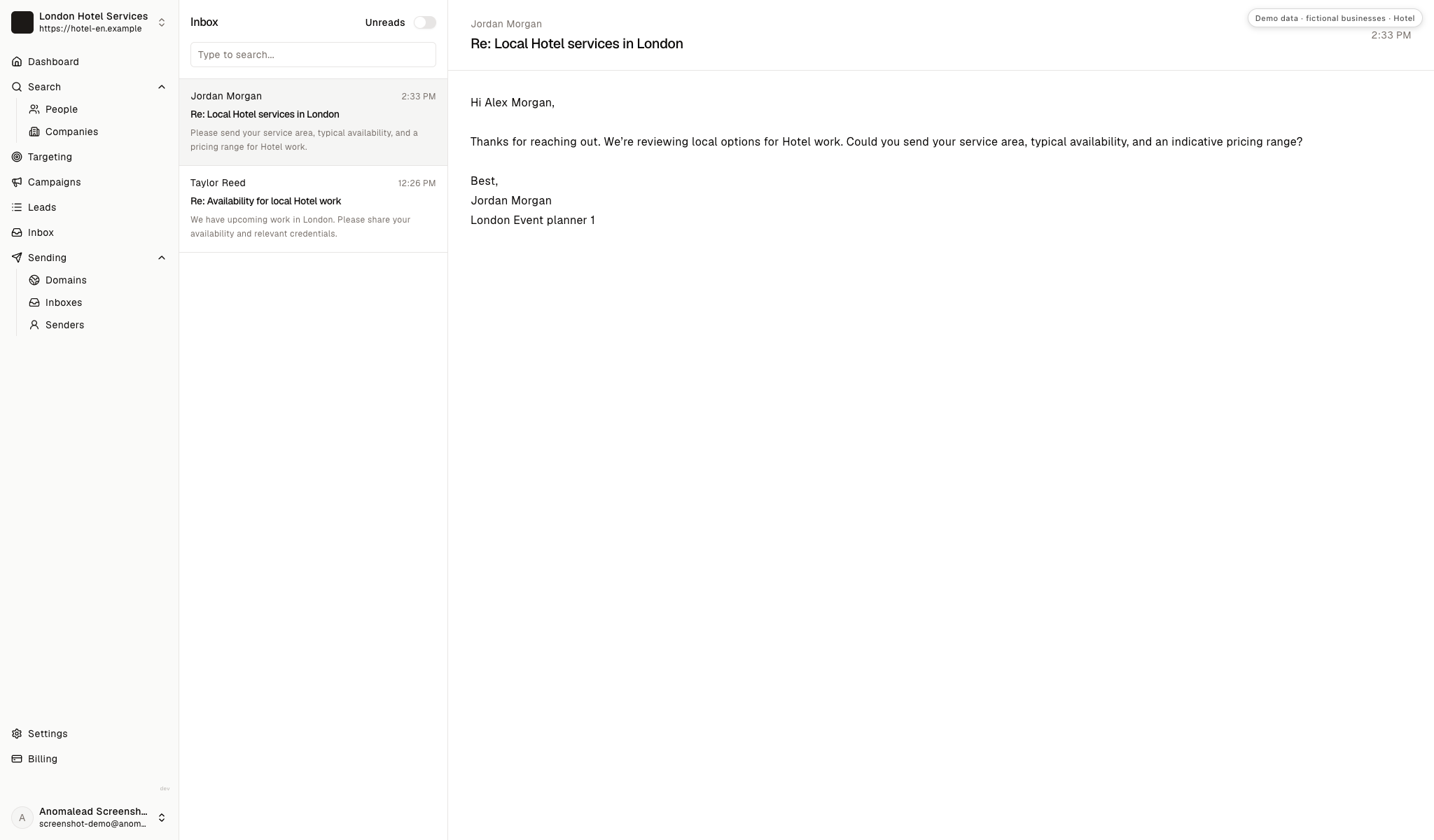
Section titled: Use the planner’s reply to qualify the eventThe fictional inbox contains replies from Jordan Morgan and Taylor Reed. One asks for service area, availability and an indicative price range; the other mentions upcoming work and asks about availability and relevant credentials.
How to respond when an event planner replies
Section titled: How to respond when an event planner repliesAnswer the planner’s request before proposing a visit. Be precise about what the hotel can verify now, what depends on the event brief and who can approve room-block or venue terms.
Jordan asks for service area, availability and a price range
Section titled: Jordan asks for service area, availability and a price range“Please send your service area, typical availability and an indicative price range for hotel work.”
Share the locations and property types your sales team can serve, then explain that availability and pricing depend on dates, room mix, event space and service requirements. Do not quote a rate without checking the hotel’s current inventory and approved terms. Ask for the general event window and format.
Keep the next step tied to the event brief:
“Thanks, Jordan. I can send our current property and event overview. Room and venue availability depend on dates, room types, setup and service needs, so our team would check those before confirming terms. What type of program and date window are you planning?”
Taylor mentions upcoming work and asks for availability and credentials
Section titled: Taylor mentions upcoming work and asks for availability and credentials“We may have an upcoming event. Please share availability and relevant credentials.”
Send current property information and any relevant venue, accessibility, food-service or AV details that your team can substantiate. Ask what event format is being considered and whether a site visit or client review comes first. Do not promise dates, capacity or services before internal confirmation.
Confirm the planning details before holding space:
“Thanks, Taylor. I can share current venue information and the services our hotel team supports. Could you outline the event format and date window? Once we know the room pattern and meeting needs, we can check availability and arrange the right site visit.”
The planner asks for a room block with release or cancellation terms
Section titled: The planner asks for a room block with release or cancellation terms“Can you hold a group block and explain the cutoff and cancellation terms?”
Use the hotel’s approved contract language and confirm which person may authorize a hold. Clarify room types, arrival pattern, cutoff, release, cancellation and any attrition terms in writing. Do not treat a preliminary availability check as a contracted block.
Keep terms with the authorized hotel contact:
“We can review a group block once dates and room types are clear. Our authorized sales contact can provide the current cutoff, release and cancellation terms for the proposed block. Which arrival and departure pattern should we check?”
The event requires catering and AV the planner has not scoped
Section titled: The event requires catering and AV the planner has not scoped“We need catering and AV, but the program details are still being worked out.”
Ask for the agenda shape, service periods, room setup, equipment needs and whether outside suppliers are permitted. Route technical and menu questions to the hotel teams responsible, and label unconfirmed items as options rather than promises.
Move from a broad request to a site review:
“We can check catering and AV fit once the agenda and room setup are clearer. Who is coordinating the program brief, and would a site visit help your team review the space and service points?”
Choose one event-planner segment for the next outreach list
Section titled: Choose one event-planner segment for the next outreach listPick a program type your hotel can serve, such as local meetings with a room block or an association event that needs breakout space. Use focused lead-generation planning to organize planners by event type, decision role and likely site-visit needs.
For every conversation, record the event window, room pattern, space and service questions, contract owner and next approval step. Send a specific first note, then check inventory and operations before discussing terms. A well-qualified planner conversation begins with fit, not a promised booking.
Questions about hotel partnerships with event planners
Section titled: Questions about hotel partnerships with event plannersWhich event planners should a hotel contact first?
Section titled: Which event planners should a hotel contact first?Start with planners whose group stays or meeting formats match the property’s room inventory, function space and service model. Research their public event focus, then confirm who selects the hotel and who approves terms.
What details should a hotel qualify before offering a room block?
Section titled: What details should a hotel qualify before offering a room block?Confirm dates, room types, arrival pattern, cutoff and release expectations, plus the authorized contact for contract terms. Check current inventory before offering a hold, rate or commitment.
What should a hotel site visit cover for a group event?
Section titled: What should a hotel site visit cover for a group event?Show the likely guest-room type, meeting layout, arrival flow, accessible routes, loading and service areas. Include the relevant catering, AV and operations contacts so the planner can assess how the program would run.
Are the hotels and event-planner replies in the screenshots real?
Section titled: Are the hotels and event-planner replies in the screenshots real?No. London Hotel Services, the event-planner companies, contacts and inbox replies are fictional demo data. The generic listings and messages do not show real hotel customers, event demand or bookings.
Does the ROI calculator predict room pickup or event revenue?
Section titled: Does the ROI calculator predict room pickup or event revenue?No. It relates the assumptions you enter about outreach and a possible group account. It does not predict room pickup, signed contracts, attendance, revenue or conversion.