


Personal injury lawyer lead generation works best when it helps someone find independent advice without steering their decision. Local business owners may be willing to make a neutral resource available to workers or customers, but they are not a source of case details and should not be asked to recommend counsel.
This guide shows how an injury practice can identify suitable community businesses, make a careful first approach and keep any follow-up separate from a person’s claim. The overview of B2B lead generation explains the general process. Before contacting anyone, review the professional-conduct, advertising, referral and privacy rules that apply to your practice and the audience.
Key takeaways
- Approach local businesses only when they can share general, optional information without endorsing a lawyer or directing a specific person.
- Screen a business for conflicts before discussing an incident, and never ask an employer or partner to pass along someone’s name, records or injury story.
- Offer a public resource or voluntary educational session that leaves every person free to choose their own adviser.
- Use verified details about your practice and consultation process; do not promise a result, quote an unsupported fee or invite sensitive facts by email.
Which local businesses can support an independent consultation path?
Section titled: Which local businesses can support an independent consultation path?The right business is a host for neutral information, not a gatekeeper to an injured person. Start with organizations that can make a general resource visible while leaving workers and customers in control of whether they seek advice.
- Employers with an employee information channel: A people or workplace lead may be able to share a public guide after an incident or safety meeting. The firm should not ask the employer to identify an injured worker, describe an event or recommend a particular lawyer.
- Local business and trade associations: An association can distribute general information to members or host an optional session about finding independent legal advice after an injury. Its role stays educational; it does not qualify claims, select counsel or send names to the firm.
- Community businesses with public-facing staff: A venue or service business may want a clear resource for customers who ask where to find help after an accident. Approach only where the owner is comfortable sharing neutral information and the business is not involved in a potential claim.
A partnership is not a fit when the business wants to screen claimants, control which lawyer they see or exchange introductions for a benefit.
Qualify a business partner before asking for a conversation
Section titled: Qualify a business partner before asking for a conversation- Check for an adverse interest: Identify the business and any related entities before discussing an incident. If the organization could be a defendant, insurer, witness or other opposing party, stop and use the firm’s conflict process before seeking facts.
- Keep the route voluntary: Confirm the business can share a public resource without endorsing the firm, selecting counsel or pressuring an employee or customer. The person seeking advice must remain free to choose another source.
- Protect people’s information: Do not request names, medical information, accident reports, contact lists or details from an employer or host. Let an interested person use the firm’s approved intake channel directly, subject to its privacy process.
- Define an educational offer: Choose a format the practice can deliver, such as a general information sheet or an optional talk about how to find independent advice. Keep it separate from claim evaluation and do not promise legal conclusions in a public session.
About the demo data
The screenshots come from a demo workspace. London Personal injury lawyer Services, the London Corporate office companies, Jordan Morgan and Taylor Reed, and their replies are fictional examples. They are not Anomalead customers and the screens do not show real campaign outcomes or injury enquiries.
Personal injury lawyer lead generation starts with a voluntary information route
Section titled: Personal injury lawyer lead generation starts with a voluntary information routeA useful search finds community businesses that can host neutral information, not people or incidents to pursue. Set the service area around where the practice can genuinely consult, then look for employers, member organizations or public-facing businesses with a suitable education channel.
Choose a service area and a business category
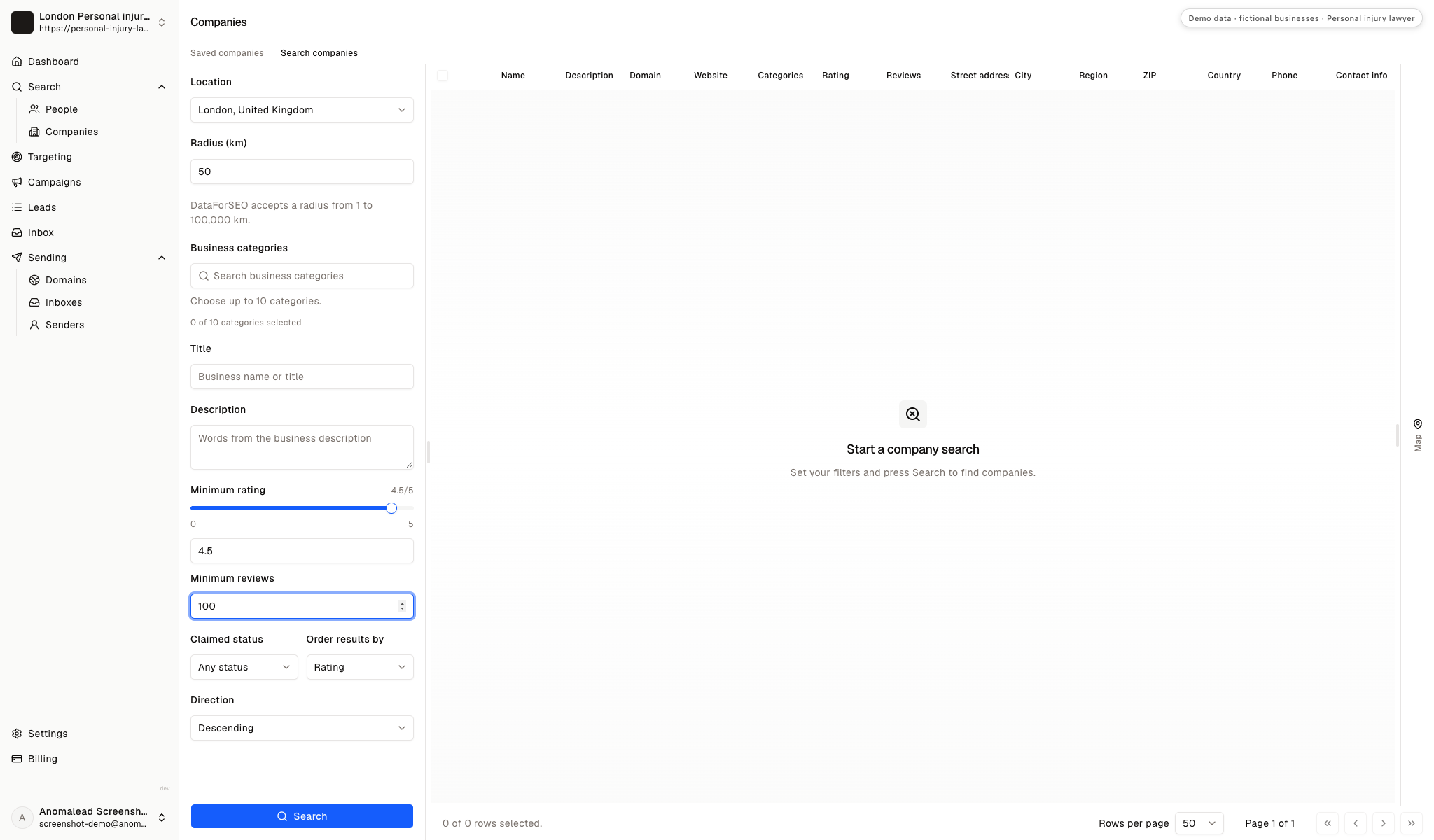
Section titled: Choose a service area and a business categoryThe demo search is set to London, a 50 km radius, Corporate office, a minimum rating and a minimum review count. Treat those filters as example settings. In a real search, choose a practical area and business categories that could host neutral public information.
Review the companies before saving them
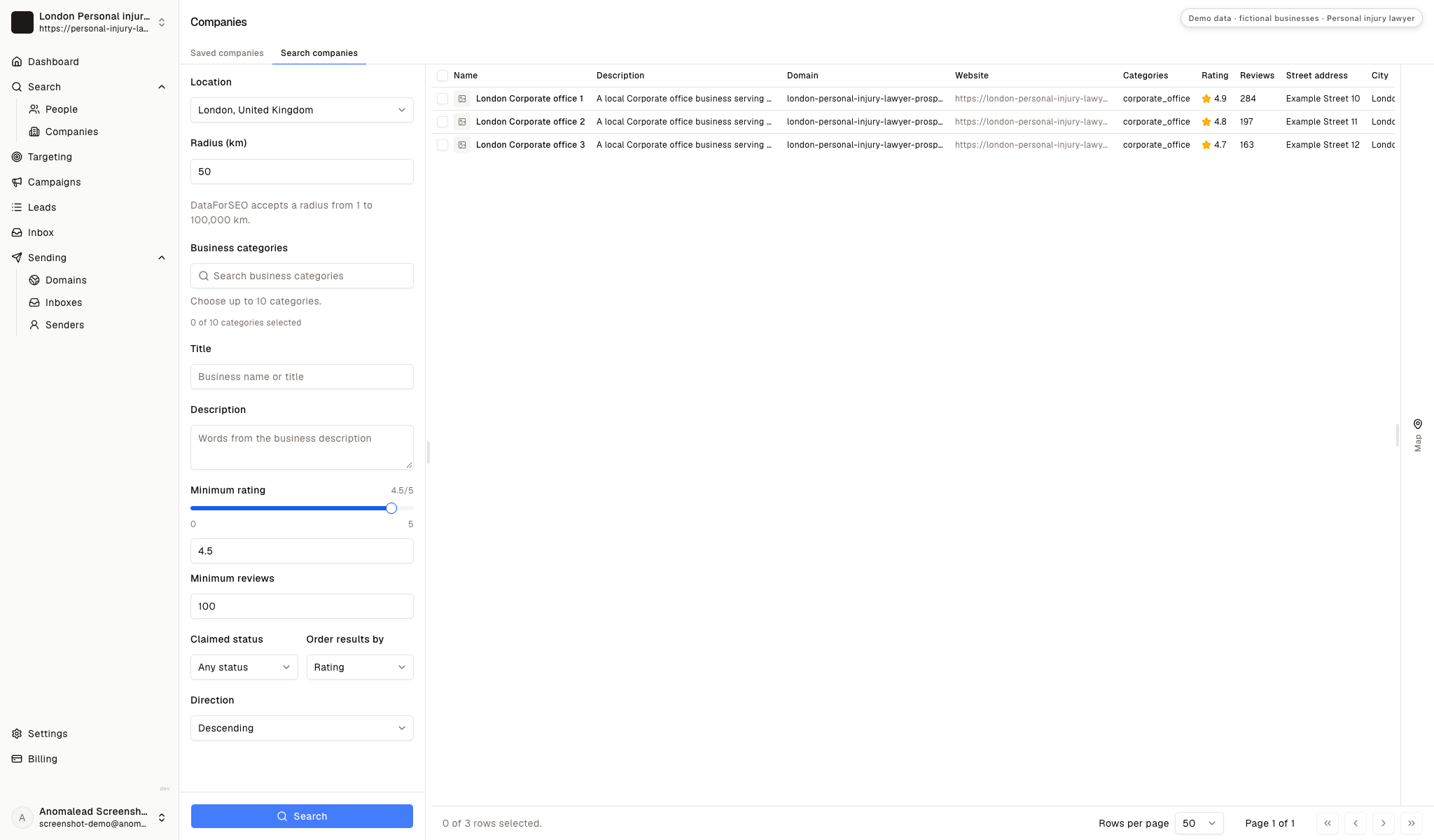
Section titled: Review the companies before saving themThe table shows three fictional corporate offices with example domains, descriptions, ratings and review counts. A listing says nothing about an injury or legal need. Check whether the organization has an appropriate public information channel and screen for conflicts before keeping it.
Save only businesses that fit the outreach purpose
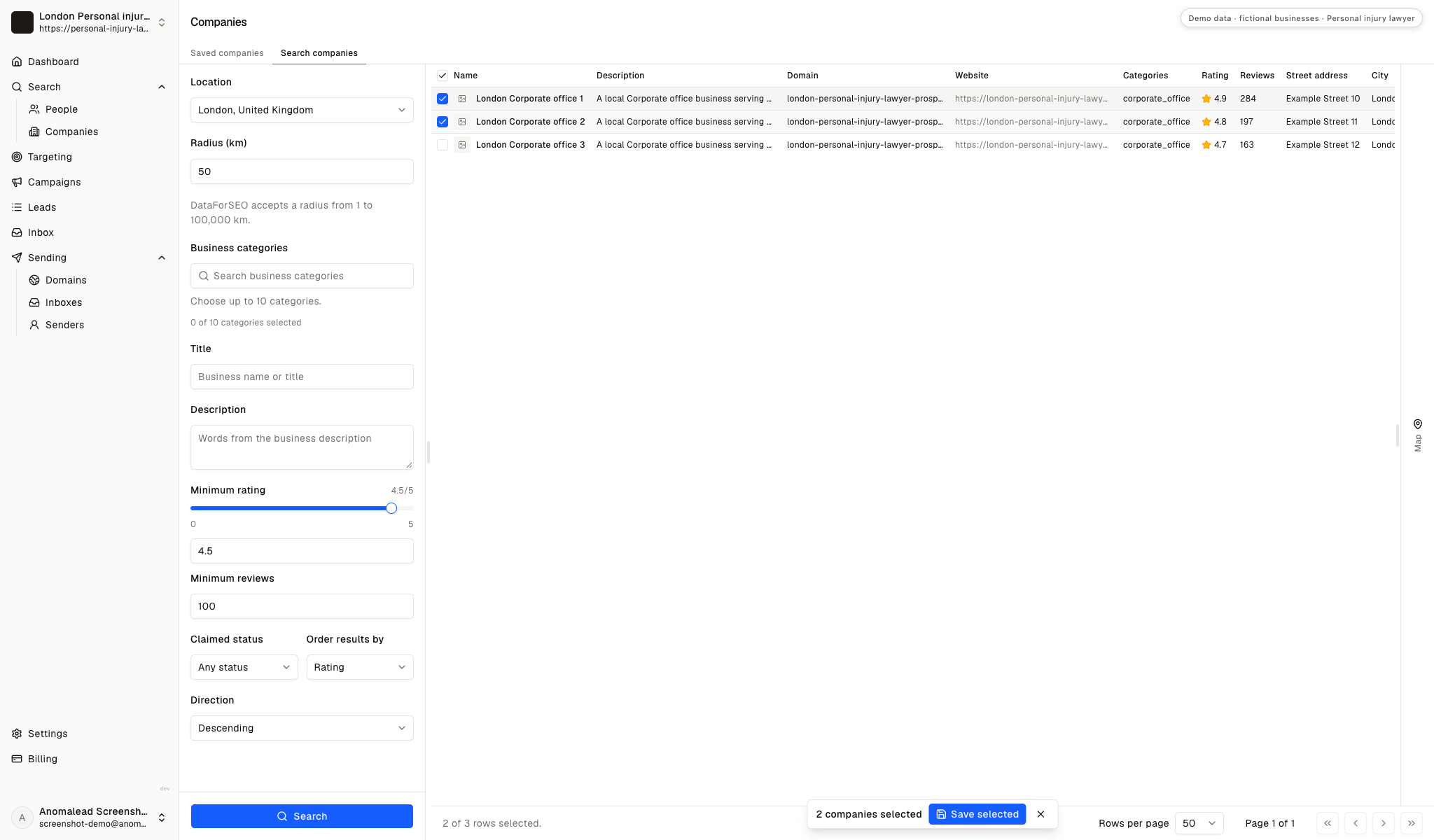
Section titled: Save only businesses that fit the outreach purposeThe demo has two of the three companies selected. Keep a company only if it can share general information voluntarily and passes the firm’s conflict review. Do not save a business because an employee or customer may have been injured there.
Find the person who manages public information
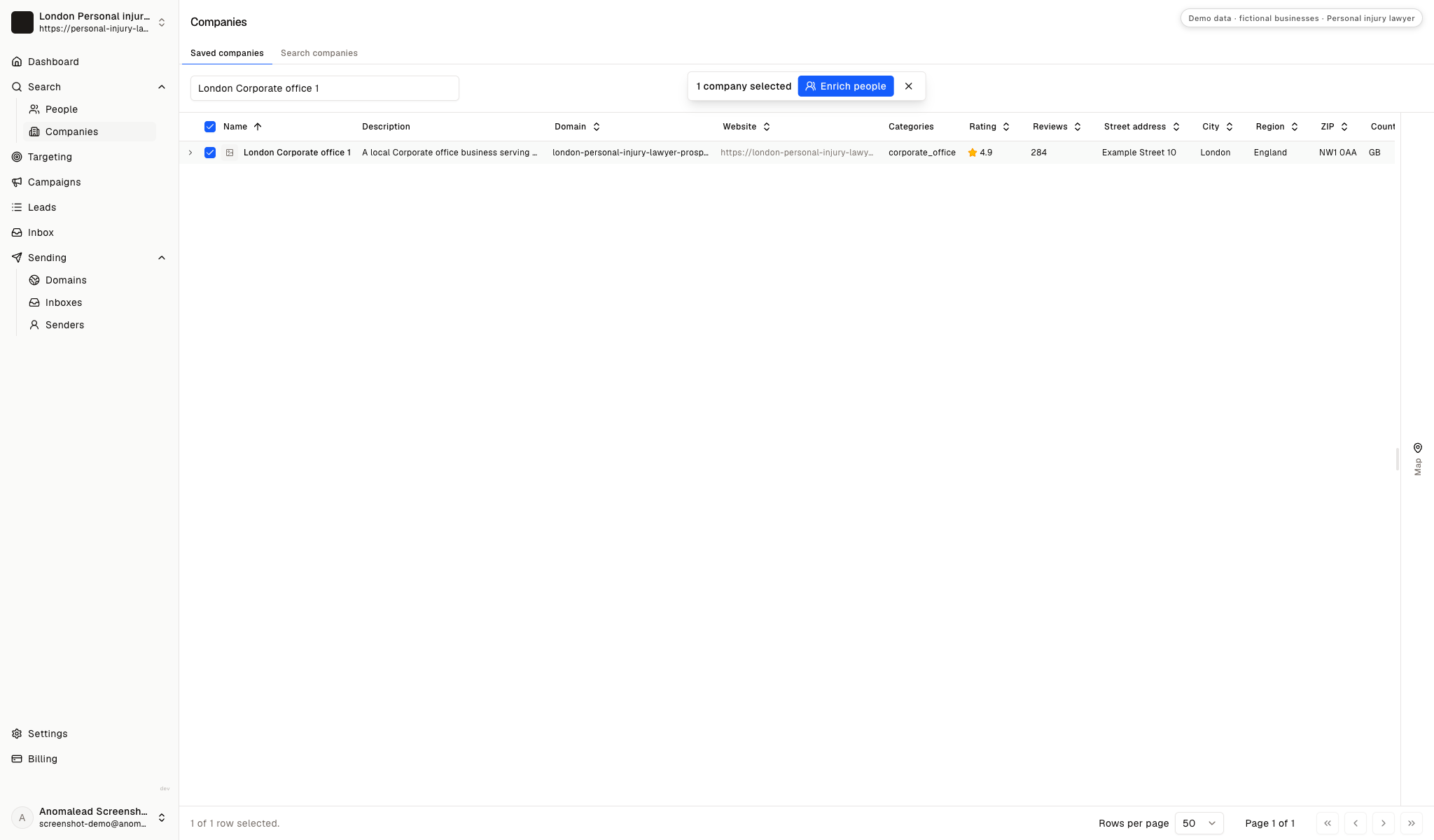
Section titled: Find the person who manages public informationA business owner, people lead or association coordinator may control a newsletter, staff resource page or event schedule. Ask about that channel, not about who has been injured. Contact enrichment can suggest a role, but it does not establish authority to share information or make an endorsement.
Review the business before looking up contacts
Section titled: Review the business before looking up contactsWrite down why this organization could host a neutral resource and where it would appear. If the only reason to contact it is a possible claim, remove it from the list and follow the firm’s intake and conflict procedures instead.
Confirm who manages the relevant channel
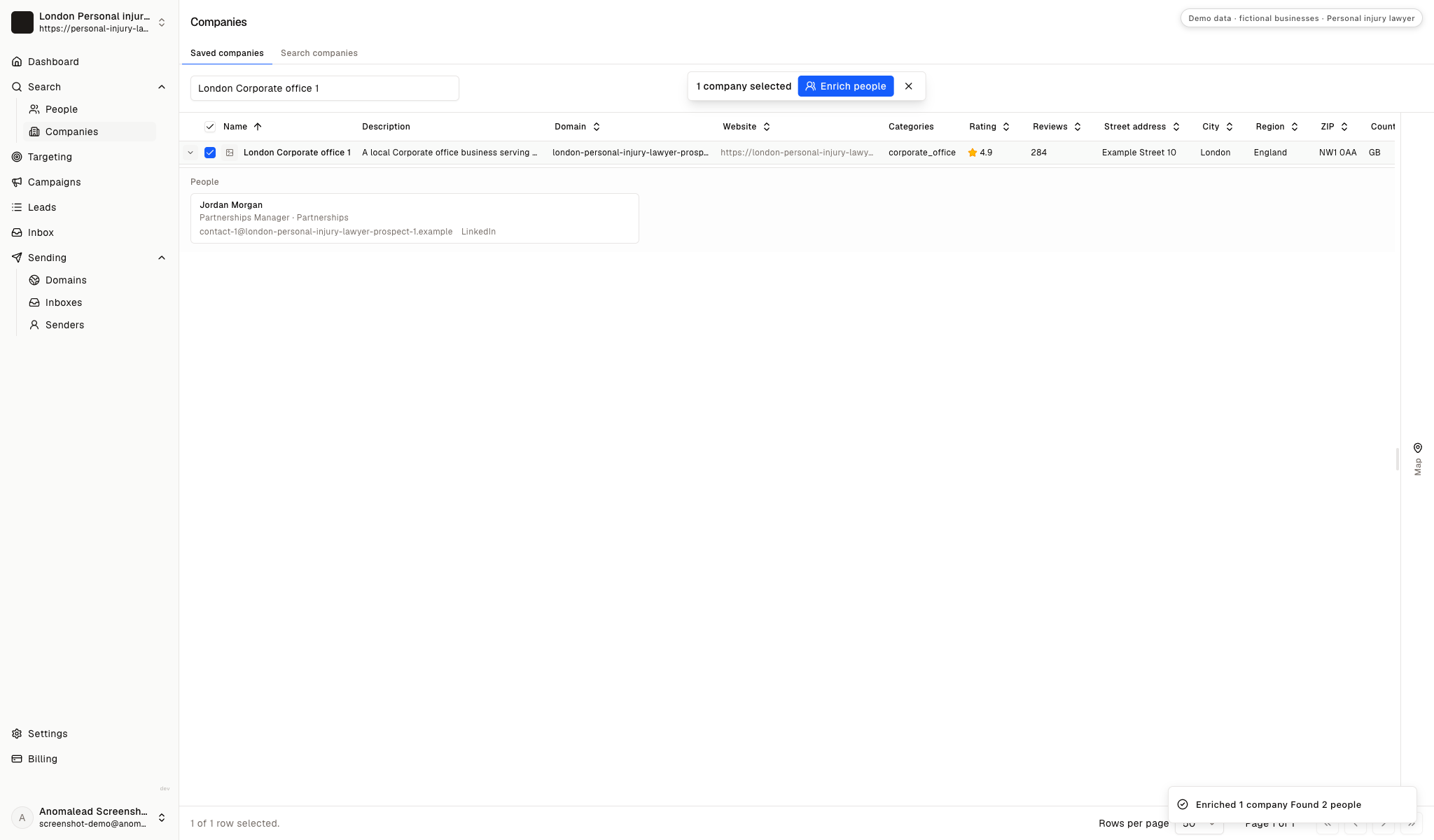
Section titled: Confirm who manages the relevant channelThe demo finds Jordan Morgan, a Partnerships Manager, with a work email and LinkedIn link. That title may indicate someone who coordinates external information, but it does not show whether Jordan can approve legal content or speak for an injured person. Ask only about the business’s publication process.
Check the contact list before any message
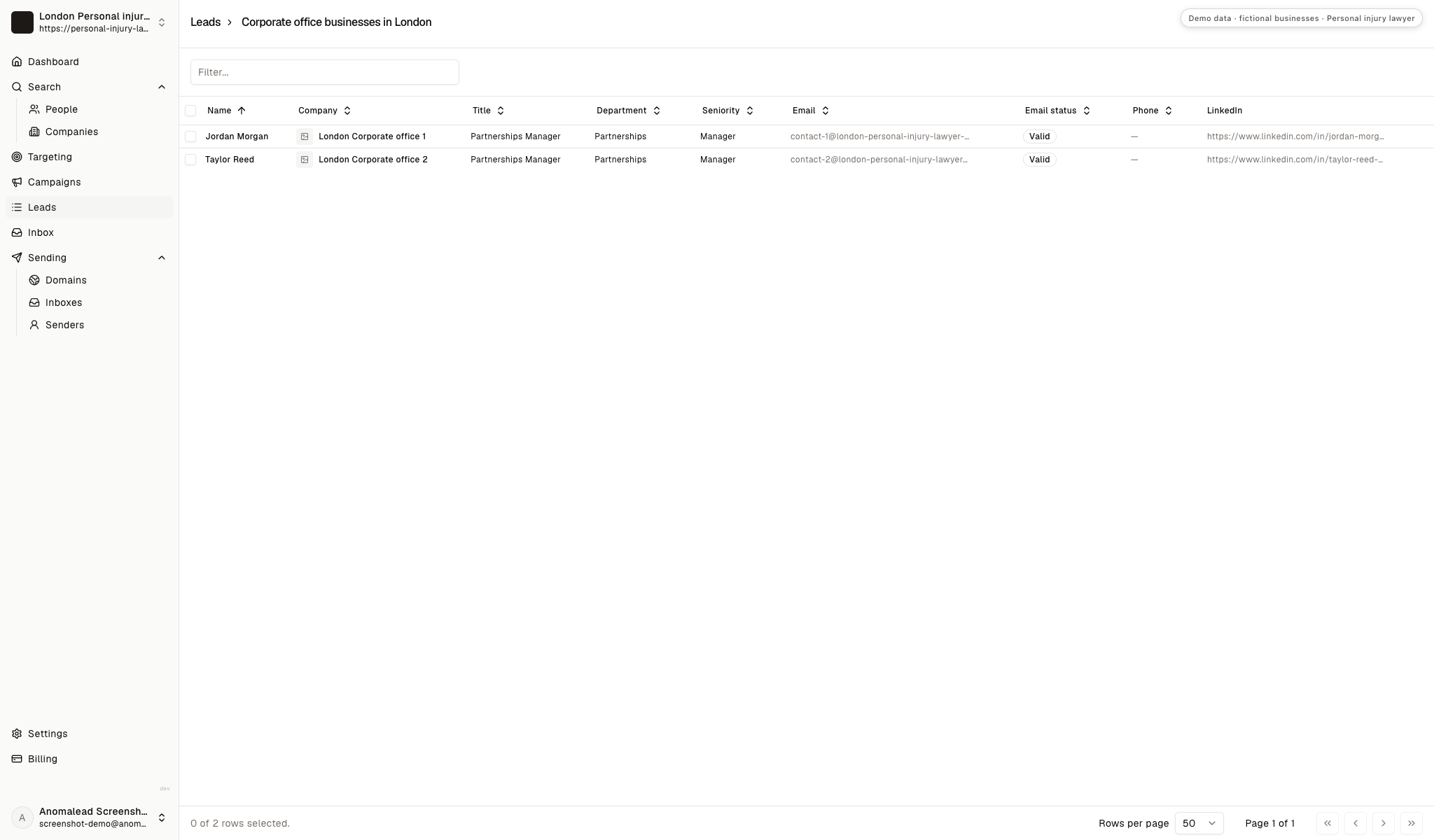
Section titled: Check the contact list before any messageThe demo list contains Jordan Morgan and Taylor Reed, both Partnerships Managers at separate companies with valid email status. Confirm each business, the contact’s role and the conflict review before outreach. The list is not a list of injured people or potential claimants.
What can an appropriate business relationship be worth to an injury practice?
Section titled: What can an appropriate business relationship be worth to an injury practice?A business relationship may create a place for general public information, but it does not guarantee consultations or cases. Estimate value from the work your practice can actually accept, the time needed to maintain the relationship and your own experience with lawful, voluntary enquiries.
Every input is an assumption you provide. The calculator contains no legal-fee benchmarks, expected case values or forecast of clients or outcomes.
Do the math on one good deal
If one new customer is worth thousands, you don’t need magic. You need a few more meetings a month.
Projected monthly results
- Deals closed
- 2.0
- Projected revenue
- £10,000
- Growth plan (1 business)
- £79/mo
- ROI
- 12,558%
Conservative math on meetings you already believe you can book. One closed deal often pays for a year of Anomalead.
If the estimate depends on businesses sending people or case details directly, redesign the arrangement around public information and individual choice.
Prepare an outreach message that protects independence
Section titled: Prepare an outreach message that protects independenceIdentify the practice, explain the general resource and make clear that the business does not endorse the firm or share individual details. Check the advertising and referral rules that govern your practice before proposing a partnership. The guide to writing a cold email covers the message structure, but the permission and ethics review must be specific to legal services.
Choose business contacts for a narrow purpose
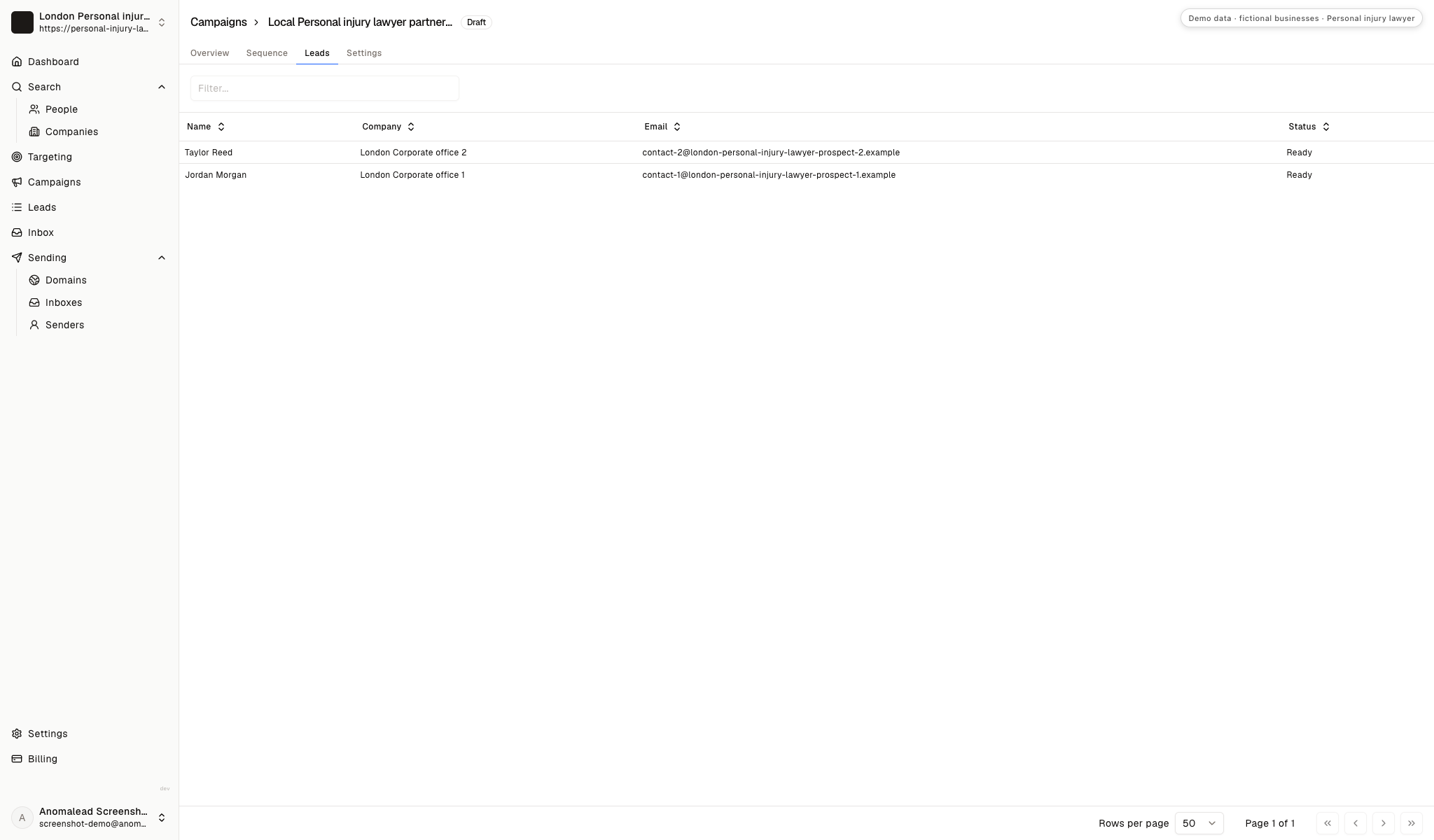
Section titled: Choose business contacts for a narrow purposeTwo contacts are marked ready in the demo campaign. A real campaign should include only people who manage a suitable public channel, with a single request such as permission to share a general resource. Do not mix this outreach with individual claim intake.
Replace the generic follow-up with a respectful sequence
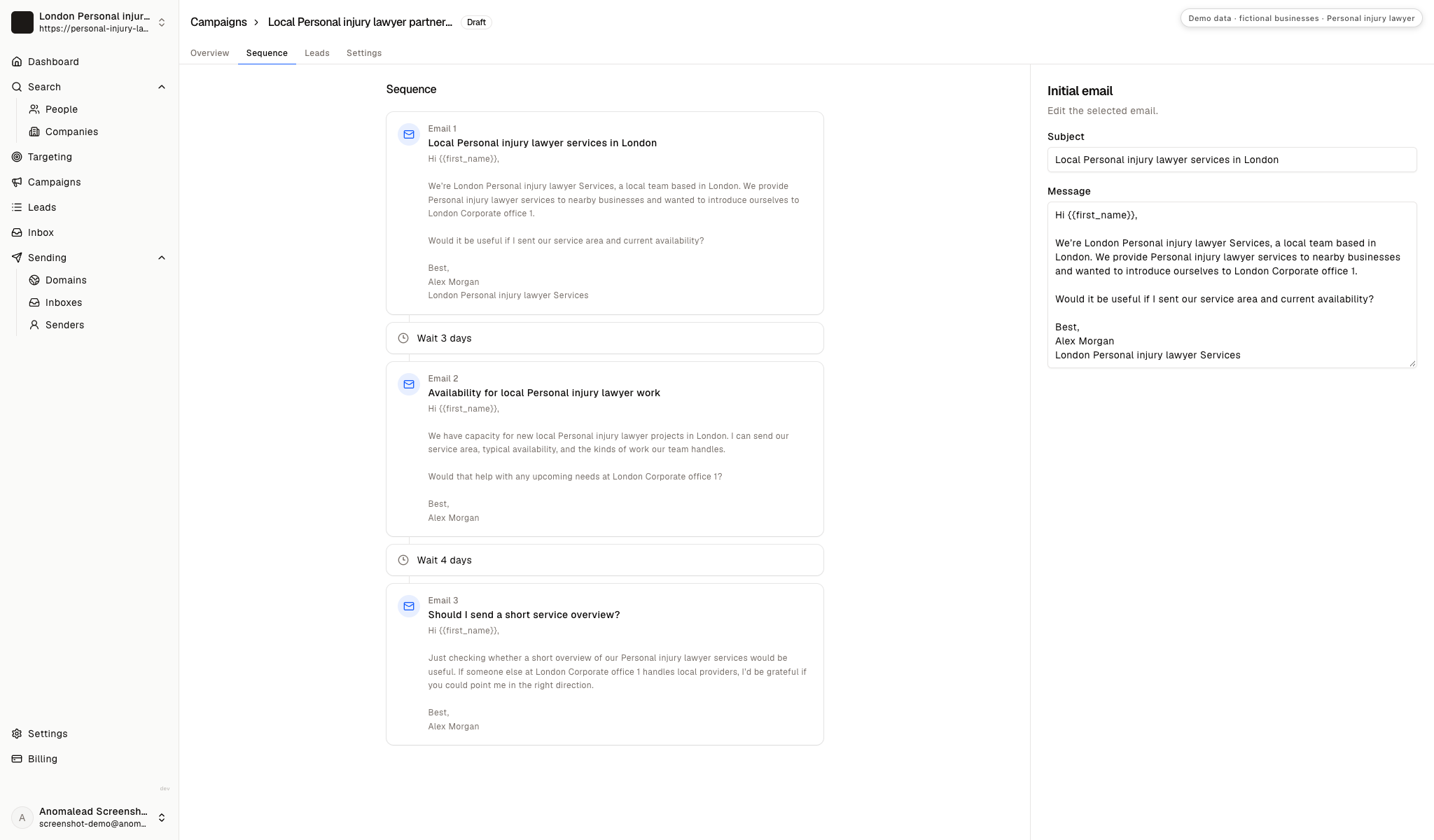
Section titled: Replace the generic follow-up with a respectful sequenceThe demo sequence has three emails with waits of three and four days. Its seeded copy offers service area and availability. For this partnership, explain the public resource, who controls whether it is shared and how a person can contact the practice independently.
Use one concise follow-up if appropriate under your rules, then stop when the business declines or does not want further contact. Repeated nudges can make a sensitive legal introduction feel pressured.
A careful first email to a local business
Section titled: A careful first email to a local businessThis sample asks about an optional public resource, not a claimant introduction. Adjust the description to materials your practice has approved and can keep current.
First email to a business owner
Subject: A neutral resource for people seeking injury advice
Hello Jordan,
I’m Alex Morgan at London Personal injury lawyer Services. We help people who are considering independent advice after an injury understand how to contact a legal practice.
We have a short general resource that your team could make available through a staff or community information channel, if that fits your policies. Your business would not need to recommend us, identify anyone or pass along an incident.
Would you be the right person to ask about sharing an optional resource?
Regards,
Alex Morgan, London Personal injury lawyer Services
The email does not request a referral, personal information or an account of an injury. For structure and subject options, see these B2B cold email examples and cold email subject line ideas.
Read business replies without treating them as claimant leads
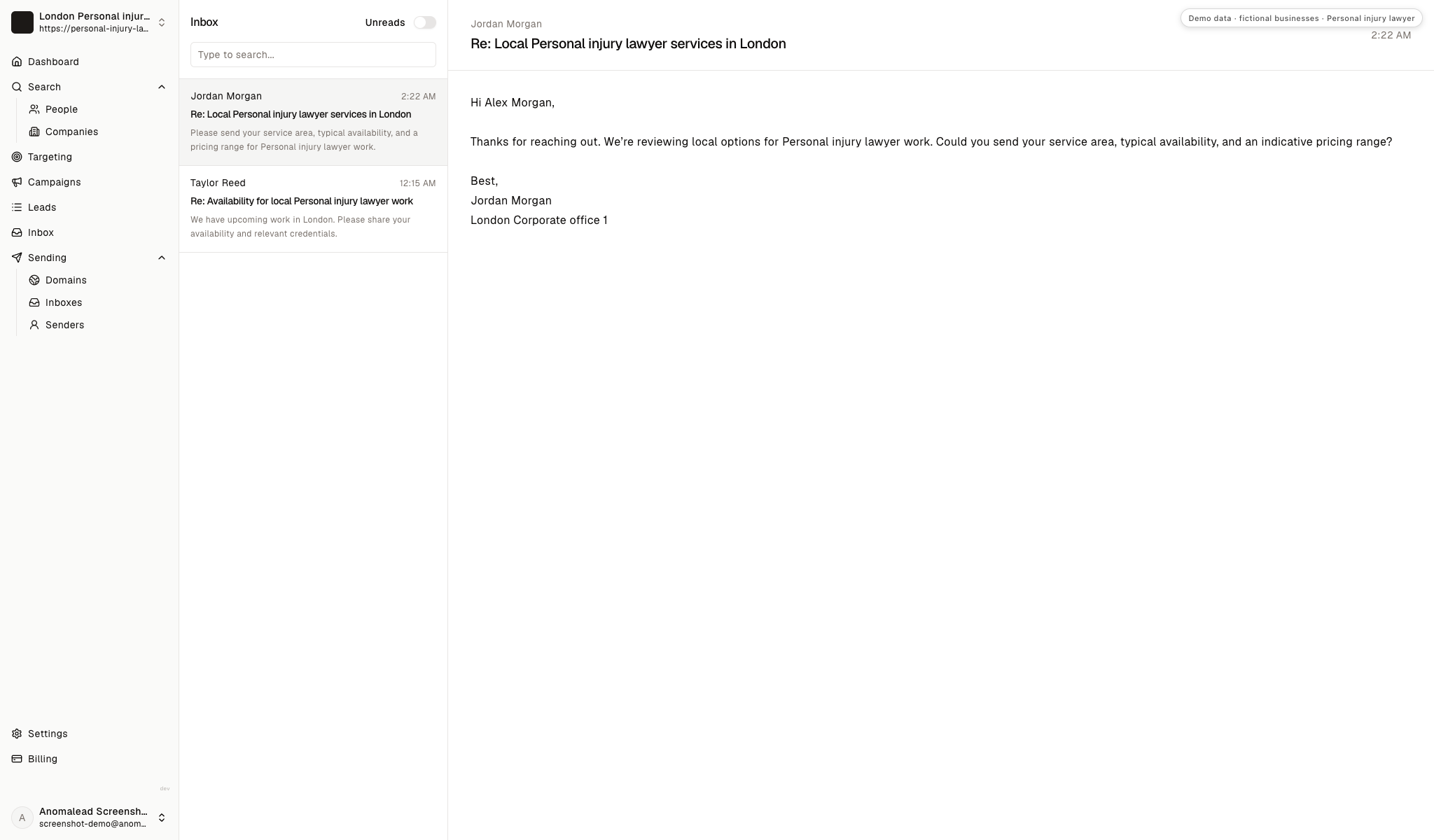
Section titled: Read business replies without treating them as claimant leadsJordan Morgan asks for service area, usual availability and an indicative price range. Taylor Reed mentions possible upcoming work and asks about scope and credentials. These are fictional replies to a generic sequence. Answer only in terms approved for your practice, and keep all personal injury facts in a separate, screened intake process.
Respond to business questions without taking case details
Section titled: Respond to business questions without taking case detailsAnswer the business question while keeping its role separate from a person’s legal consultation. Do not invite names or incident facts into the partnership thread; use the firm’s approved process if someone independently asks for representation.
The business asks about coverage, availability and fees
Section titled: The business asks about coverage, availability and feesPlease send your service area, typical availability and an indicative pricing range for personal injury work.
Explain where the practice consults and how a person can ask about availability through the approved intake route. Do not quote a fee without context or make a general statement that applies to every matter.
A business contact is not a substitute for speaking with the person seeking advice. Keep any fee discussion and engagement decision between the practice and that person, subject to the rules that apply.
A response that keeps the route independent:
Thanks, Jordan. Our practice serves people seeking injury advice in the areas listed in our public information. Anyone considering a consultation can contact our intake team directly to ask about timing and the terms that apply to their circumstances.
We do not ask businesses to collect names or share incident details. If you are comfortable making a general resource available, I can send the approved version for your review.
The business asks for qualifications before sharing information
Section titled: The business asks for qualifications before sharing informationWe may have an upcoming need. Please share your availability, relevant experience and credentials.
Provide accurate, current details about the practice and the lawyers who handle enquiries. Avoid claims about success rates, likely compensation or guaranteed outcomes. Ask the business to review the material for fit with its own policies.
A response focused on verifiable practice information:
Thanks, Taylor. I can send a short profile with our practice areas, lawyer qualifications and the public consultation route. It will not describe results or predict what someone’s matter may be worth. Please review it against your organization’s information-sharing policy before deciding whether to publish it.
The business does not endorse lawyers or share employee details
Section titled: The business does not endorse lawyers or share employee detailsWe cannot recommend a law firm or send you information about employees.
Respect the boundary without asking for an exception. A neutral, public resource may still be possible if the organization chooses to host it and local rules permit; otherwise thank them and close the conversation.
A reply that accepts the organization’s limit:
Understood. We are not asking for an endorsement or any employee information. If your policy allows a general resource that people can choose to access themselves, I can send it for review. If not, I will close this request.
A contact starts describing a specific injury or incident
Section titled: A contact starts describing a specific injury or incidentOne of our staff members was hurt at a site last week. Can you tell us whether the company is responsible?
Do not assess fault or take a statement in the business-partnership thread. Stop the discussion of facts, identify the organizations only as needed for a conflict check, and use the practice’s private intake process if an individual independently seeks advice. Do not promise representation.
Review the partnership before reaching more businesses
Section titled: Review the partnership before reaching more businessesLook at whether a business was comfortable with a neutral information resource, who controls its publication channel and what concerns it raised. A refusal to endorse the firm is not an objection to overcome; it is a boundary to respect.
This week, choose one business group, screen a small set for conflicts and identify a single public channel that could host optional information. Prepare a current resource that lets a person contact the practice independently. For a different provider perspective, see the guide to medical clinic lead generation.
Questions about personal injury lawyer lead generation
Section titled: Questions about personal injury lawyer lead generationCan an injury law firm partner with a local employer?
Section titled: Can an injury law firm partner with a local employer?Possibly, if the arrangement is permitted by the rules that apply to the practice and the employer’s policies. Keep it educational and optional, do not buy referrals or seek employee details, and preserve each person’s freedom to choose counsel.
Should a business introduce an injured person directly to the firm?
Section titled: Should a business introduce an injured person directly to the firm?The guide does not ask for direct introductions or identifying information. A business may choose to make approved public information available, while anyone seeking advice contacts the practice through its own intake process.
What should the firm do if a business describes an incident?
Section titled: What should the firm do if a business describes an incident?Do not offer an opinion or collect a detailed account in the partnership thread. Check for conflicts using the minimum information needed, then follow the practice’s private intake process if an individual independently wants to discuss representation.
Are the companies and replies in the screenshots real?
Section titled: Are the companies and replies in the screenshots real?No. London Personal injury lawyer Services, the London Corporate office companies, Jordan Morgan, Taylor Reed and their replies are fictional demo data. They are not Anomalead customers and do not show real enquiries.
Does the calculator predict cases or compensation?
Section titled: Does the calculator predict cases or compensation?No. It only combines assumptions entered by the user. It does not predict consultations, retained clients, case outcomes or compensation.