


Landscaping lead generation works best when a grounds-care company approaches property managers who need reliable maintenance across several sites. The buyer is comparing more than a mowing crew: they need a defined scope, workable access, seasonal scheduling and clear ownership of green waste.
Start with the services your team can deliver repeatedly, then qualify the buildings and the person who coordinates contractors. The overview of B2B lead generation basics explains how to turn a list of organizations into a focused set of buying conversations.
Key takeaways
- Target property managers who oversee multiple grounds-care sites and can review a recurring maintenance agreement.
- Qualify each account by site layout, service scope, access rules, waste handling and the seasonal capacity your crew can commit.
- Ask who owns grounds contracts, then tailor the first note to a real property need such as turf upkeep, bed care or a seasonal cleanup.
- Price a site only after you understand its grounds, visit expectations, access and exclusions; do not estimate a portfolio from its company name.
Landscaping lead generation for recurring grounds contracts
Section titled: Landscaping lead generation for recurring grounds contractsPrioritize managers responsible for several maintained properties and a clear vendor process. Recurring work is a stronger fit when the manager can coordinate site access and review the service scope across the portfolio.
- Residential portfolio managers: They oversee shared lawns, planted beds, paths and common areas where residents notice missed visits quickly. Ask how the manager plans service around tenant access, quiet hours and communications about work on site.
- Commercial property operations teams: They may coordinate grounds for offices, retail sites or mixed-use buildings. Their questions often turn on presentation standards, access for equipment, safe pedestrian routes and whether the contractor can document completed visits.
- Managing agents with multi-site portfolios: A managing agent may coordinate contractors for owners across several properties, but budget approval can sit with a separate asset manager or board. Find out who scopes the work, who approves the supplier and whether the agent can introduce both.
Keep maintenance contracts separate from one-off redesign projects. A manager arranging routine turf, pruning and bed care needs a different conversation from an owner planning a new landscape installation. The property management lead generation guide covers the buyer workflow from the manager’s side.
Qualify the grounds before you look up contacts
Section titled: Qualify the grounds before you look up contactsA landscaping account is qualified when the properties, requested work and service calendar fit the crew you can actually deploy. Review the operating details before spending time on contact research.
- Grounds included in the contract: Separate turf mowing and edging from shrub pruning, seasonal planting, weed control, irrigation checks and litter or leaf removal. Ask which tasks are included in the regular visit and which are quoted as a separate project.
- Site layout and access: Check the size and slope of the grounds, gate widths, equipment storage, water points and the route from a loading area to the work zone. For occupied properties, learn how crews receive entry instructions and how residents are notified about noisy or obstructive work.
- Plant and turf responsibilities: Confirm whether the manager expects routine care or diagnosis and replacement of failing plants. Turf damage, drainage issues and irrigation faults can sit outside a maintenance crew’s scope, so agree how these findings are reported and who authorizes extra work.
- Seasonal workload and visit plan: Ask how the manager handles changing growth, pruning windows, leaf clearance and seasonal planting. A calendar should leave room for weather shifts and access limits instead of promising the same task mix on every visit.
- Green waste and supplier requirements: Clarify whether clippings and prunings stay on site, go to a designated collection point or must be removed by the contractor. Be ready to share relevant insurance, site-safety documents and any qualifications required for services you offer, including treatment work where applicable.
About the demo workspace
The screenshots use the fictional operator London Landscaper Services. London Property management company 1, London Property management company 2, London Property management company 3, Jordan Morgan, Taylor Reed and both replies are invented demo data, not Anomalead customers or real campaign results.
Build a local list around the properties you can maintain
Section titled: Build a local list around the properties you can maintainChoose the property-management category and define a service area your crews can reach with the equipment and time available. A map radius does not account for travel between sites, loading access, disposal arrangements or the seasonal work already on the schedule.
Review company descriptions for managed residential or commercial properties, then check whether grounds maintenance is handled in-house or by vendors. The guide to finding leads for a small business can help structure the search, but each landscaping account still needs a site-level fit check.
Set a search area your crews can cover
Section titled: Set a search area your crews can coverSelect property management companies and set a location and radius that fit your regular routes. The filters identify possible buyers; they do not show site layout, travel conditions or whether the manager outsources landscaping.
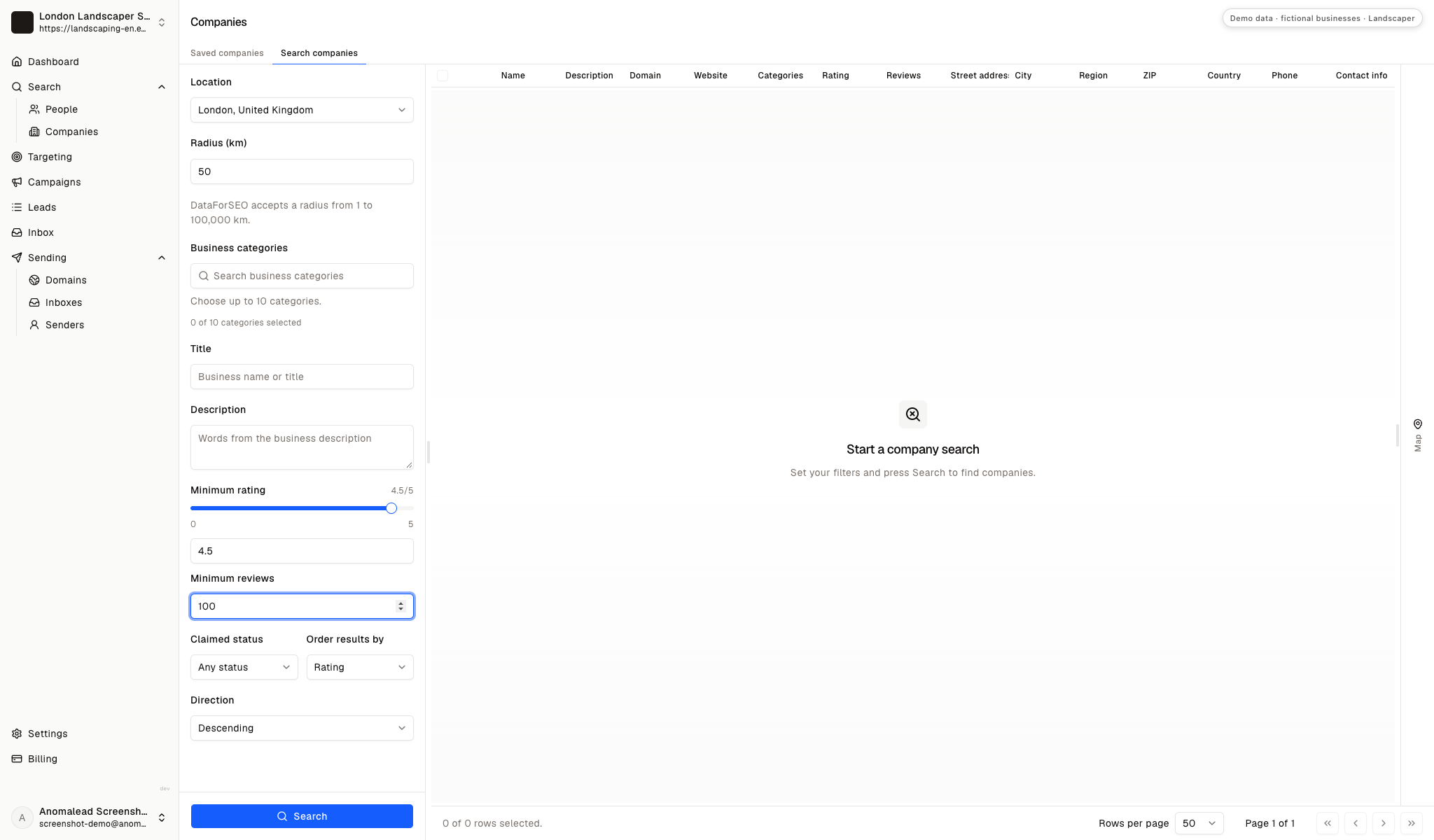
Check the property companies in the results
Section titled: Check the property companies in the resultsThe results show three fictional property-management companies with ratings and review counts. Those directory details do not reveal whether the firms manage landscaped grounds or are reviewing a supplier.
Read each public profile for portfolio clues and check for a practical reason to discuss recurring grounds care.
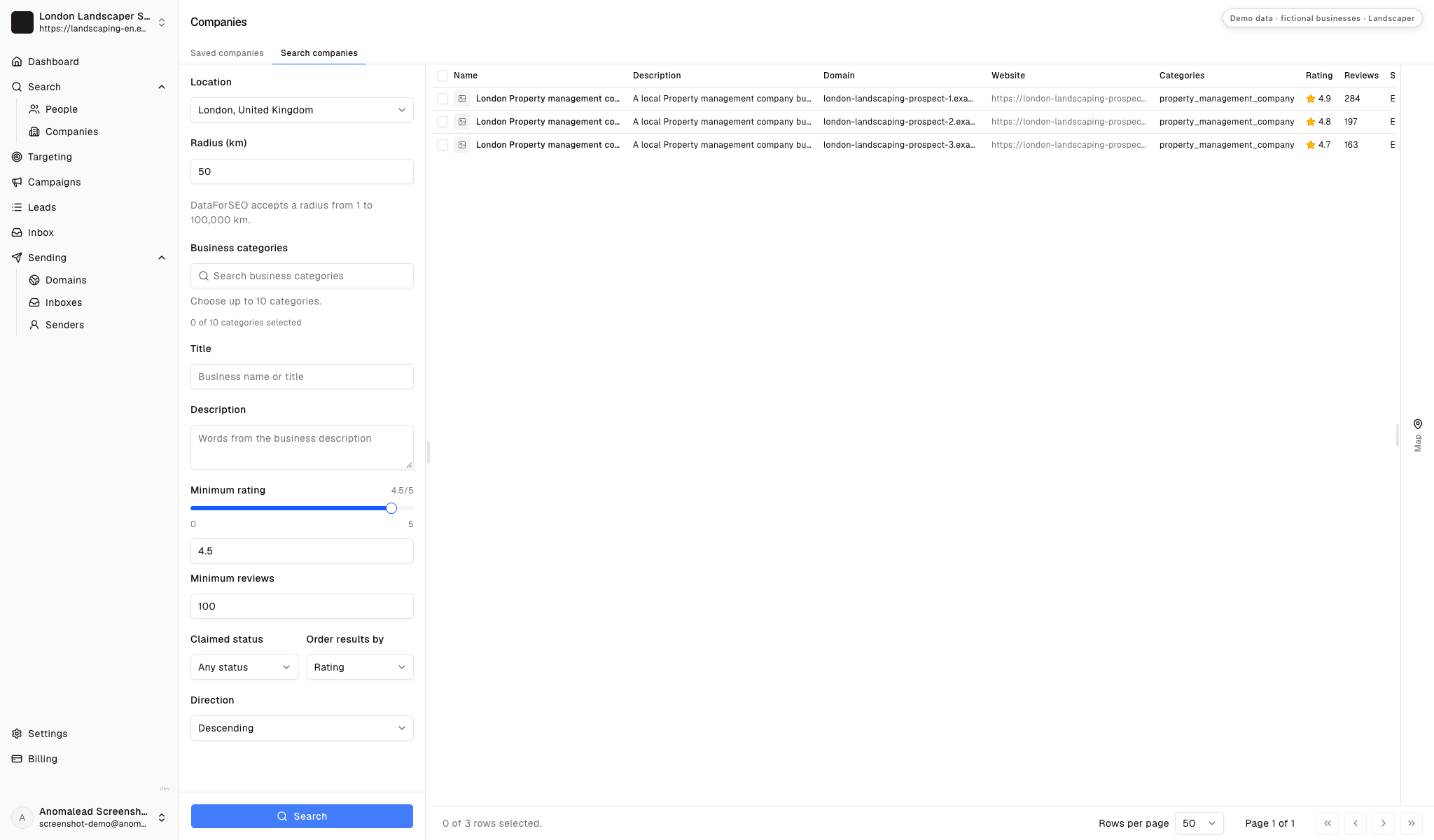
Save only companies with a plausible service fit
Section titled: Save only companies with a plausible service fitTwo of the three fictional companies are selected for saving. This is a shortlist decision, not proof that either needs landscaping work. Keep accounts whose properties and service area you can verify, and leave uncertain matches out.
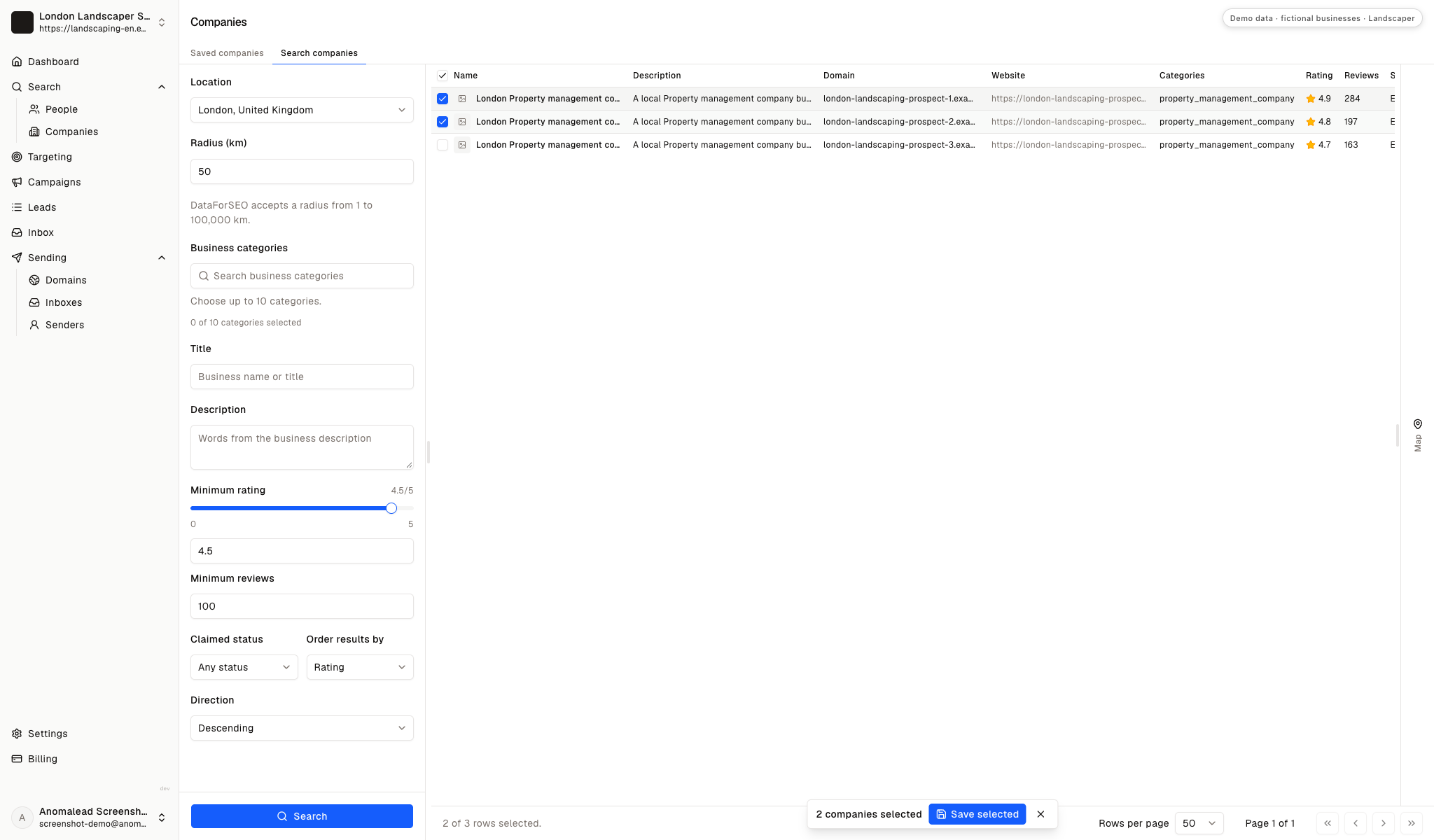
Find who coordinates grounds-care contractors
Section titled: Find who coordinates grounds-care contractorsLook for the person who scopes external maintenance and coordinates access across the portfolio. A property manager may collect requirements, while procurement, an asset manager or a board approves the agreement.
The demo contacts have the title Partnerships Manager, which may not mean they choose landscaping contractors. Verify the role and ask for an introduction if someone else owns grounds maintenance.
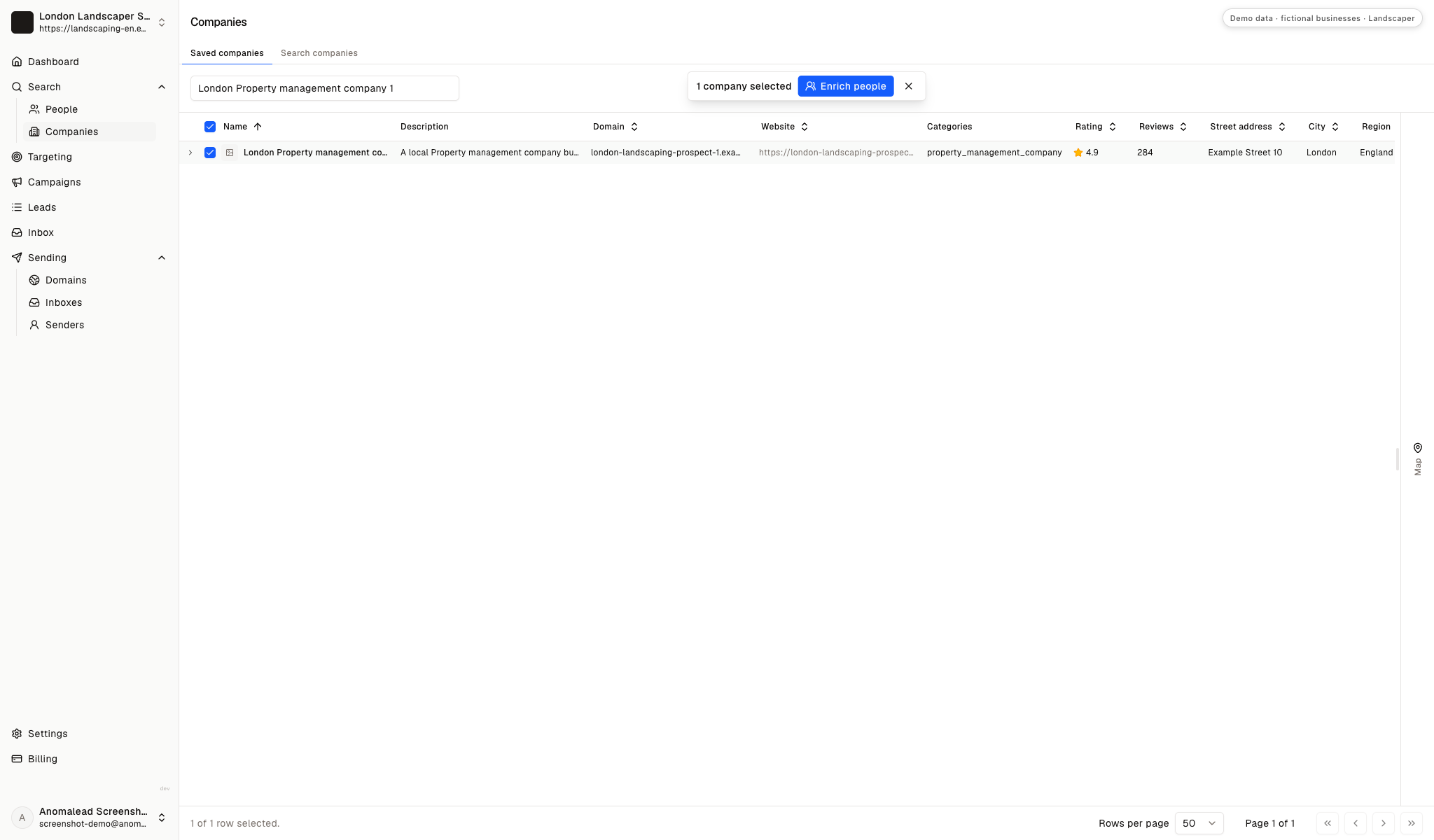
Review one saved company before enrichment
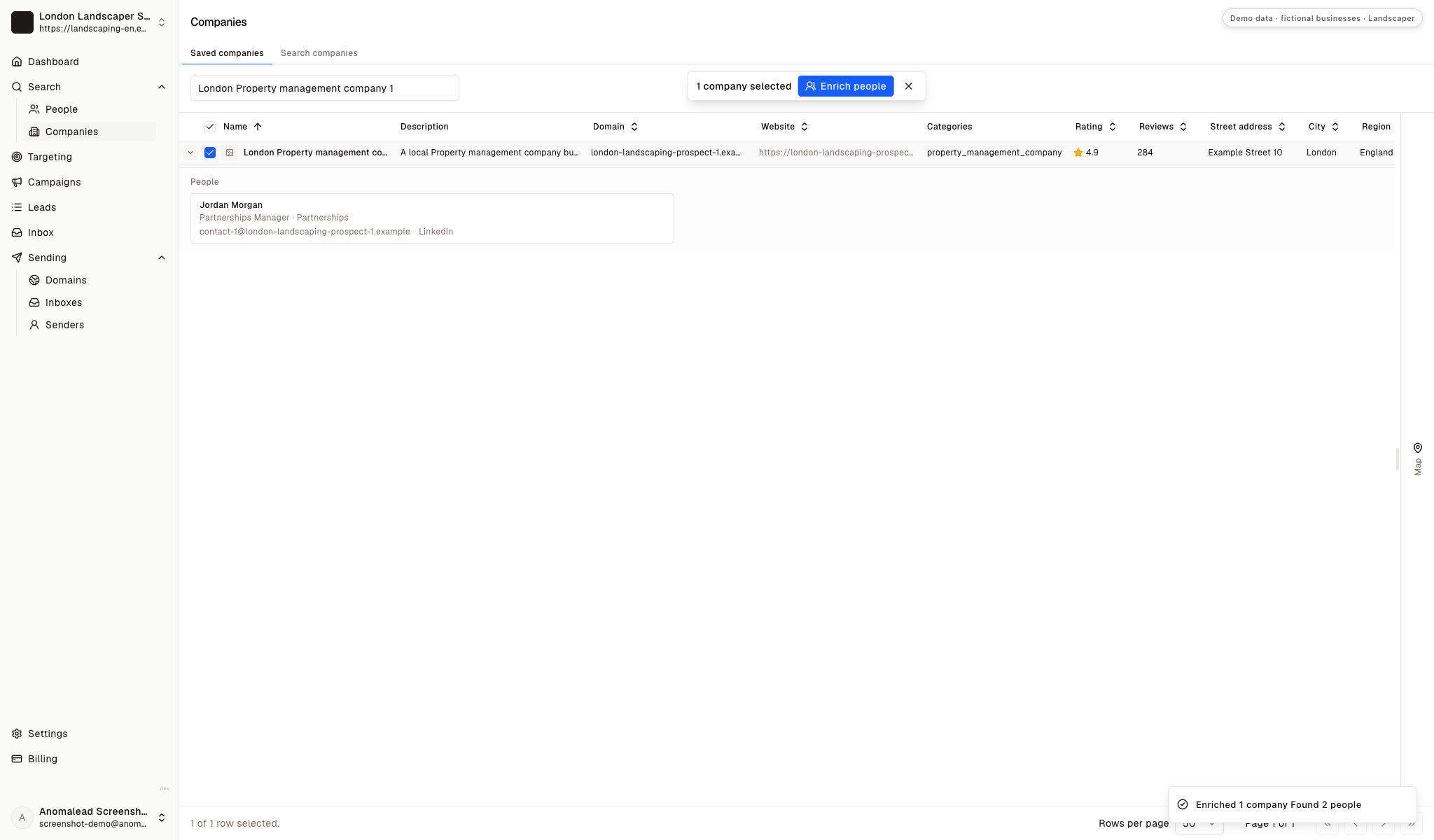
Section titled: Review one saved company before enrichmentLondon Property management company 1 is selected in the saved-company view, with the Enrich people action available. Check the company’s service area and likely property mix before looking for names.
Check which contact handles property partnerships
Section titled: Check which contact handles property partnershipsThe enriched results list Jordan Morgan and Taylor Reed as Partnerships Managers at fictional firms. Confirm whether either person works with landscaping suppliers or can route the question to property operations.
Do not assume the listed title controls a grounds contract. A maintenance coordinator or managing agent may be the better first contact.
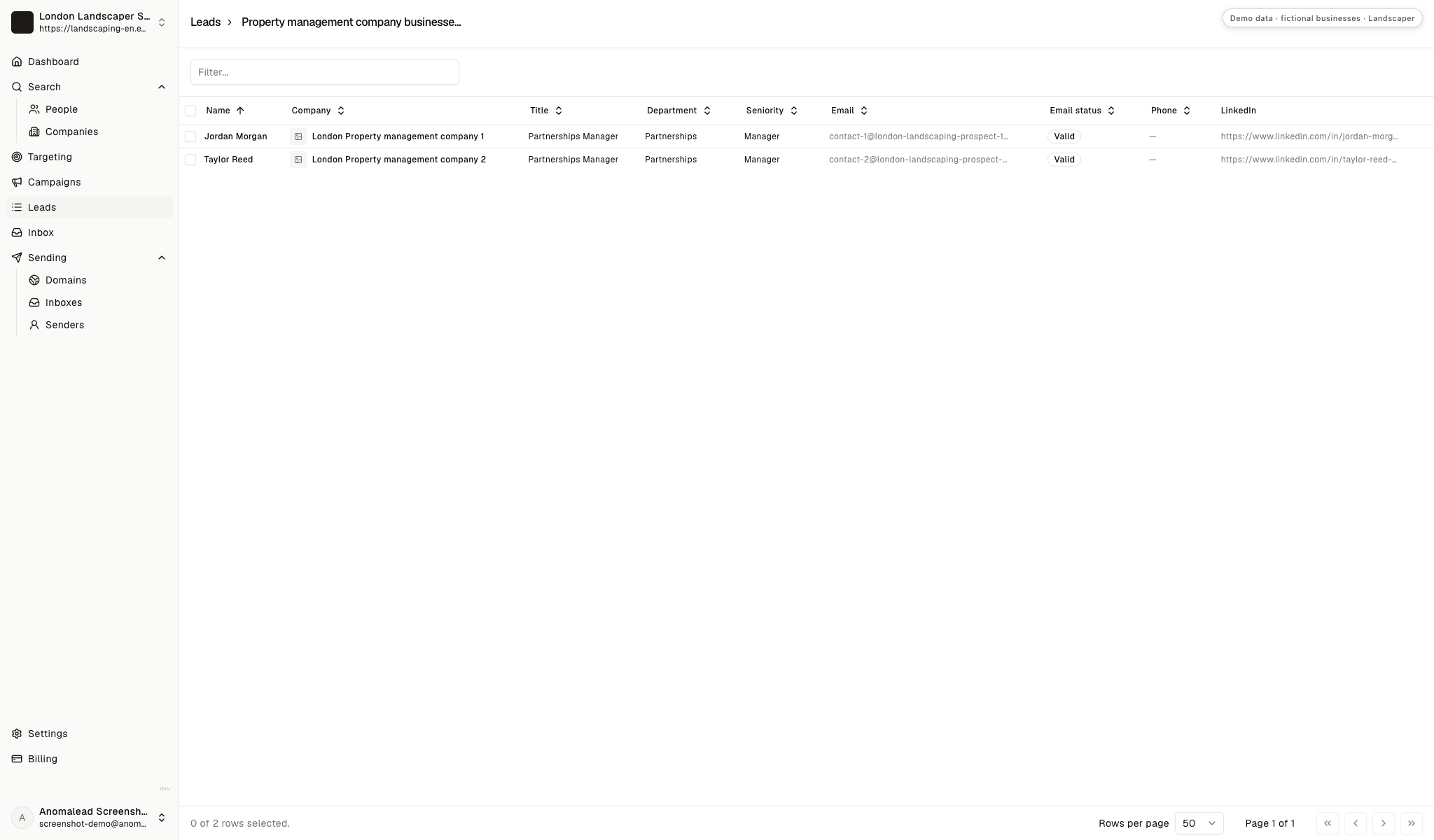
Review the two contacts before outreach
Section titled: Review the two contacts before outreachThe lead list contains Jordan Morgan and Taylor Reed at separate property-management companies. Check each person’s role and company so a seasonal grounds message goes to someone who can direct it.
Could a managed portfolio support recurring grounds care?
Section titled: Could a managed portfolio support recurring grounds care?A property-management agreement may cover routine visits across shared lawns, planted beds, paths and seasonal cleanup. Its value depends on the area maintained, task mix, access arrangements, green-waste handling and the time between properties.
Use your own completed and declined work to set assumptions. A portfolio with scattered sites or frequent one-off enhancements can take more crew time than its recurring scope suggests.
The calculator uses the contract value, meetings and close-rate assumptions you enter. It is a planning aid, not a quote, forecast or promise of work.
Do the math on one good deal
If one new customer is worth thousands, you don’t need magic. You need a few more meetings a month.
Projected monthly results
- Deals closed
- 2.0
- Projected revenue
- £10,000
- Growth plan (1 business)
- £79/mo
- ROI
- 12,558%
Conservative math on meetings you already believe you can book. One closed deal often pays for a year of Anomalead.
Use assumptions that reflect the route and maintenance scope you would actually accept before deciding whether to arrange a site walk.
Write to the manager about grounds they oversee
Section titled: Write to the manager about grounds they overseeConnect your first note to a real management task: agreeing a visit calendar, separating routine care from enhancement work, arranging access or deciding who removes green waste. Keep the offer specific, and use this cold email writing guide to shape a brief, clear question.
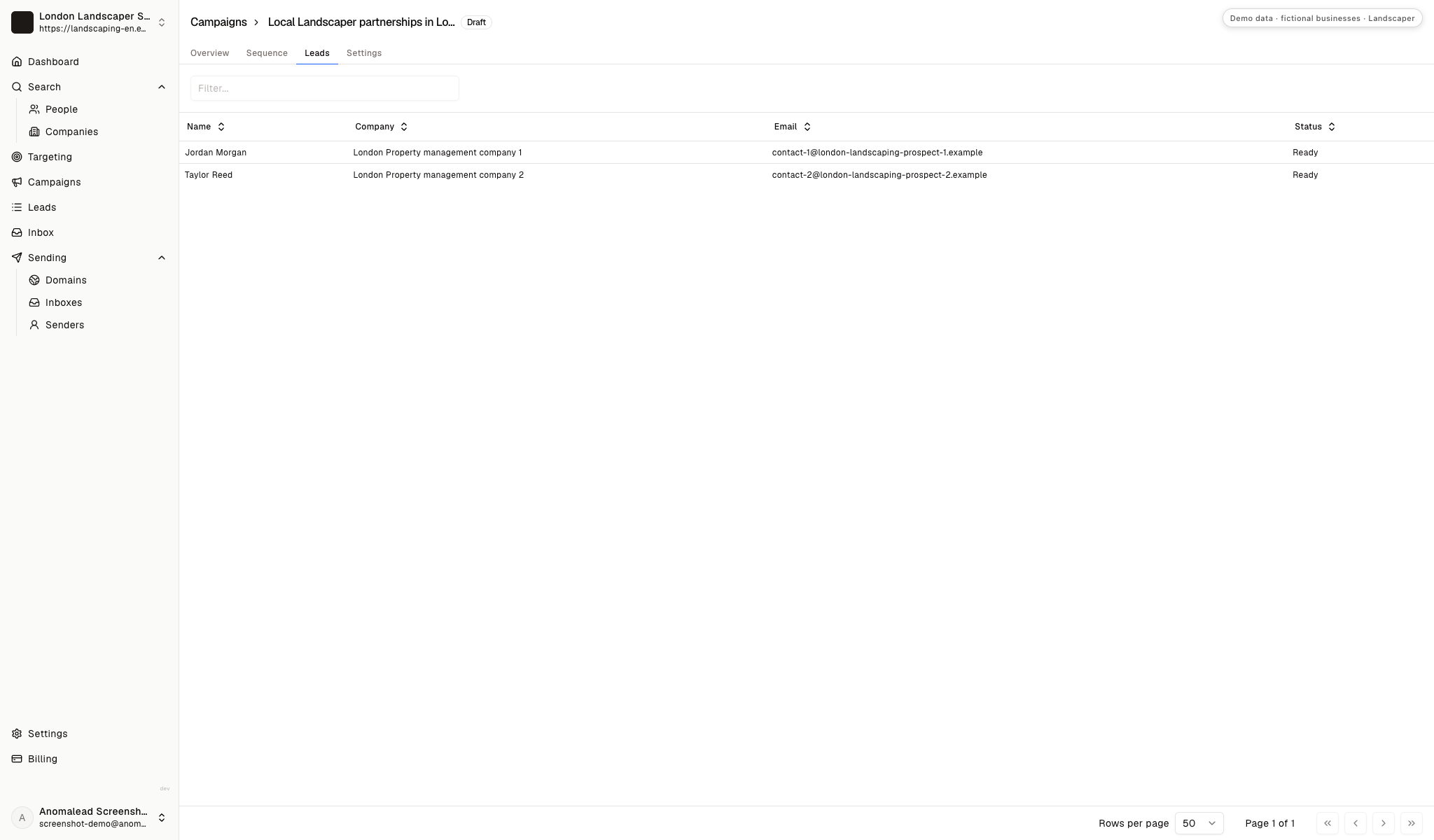
Keep campaign recipients on one buyer theme
Section titled: Keep campaign recipients on one buyer themeThe draft campaign contains two fictional recipients. Check that both have a plausible link to property grounds or can refer you to the person who manages outside contractors.
If the contacts have different responsibilities, split the campaign and write to each role’s grounds-care concerns.
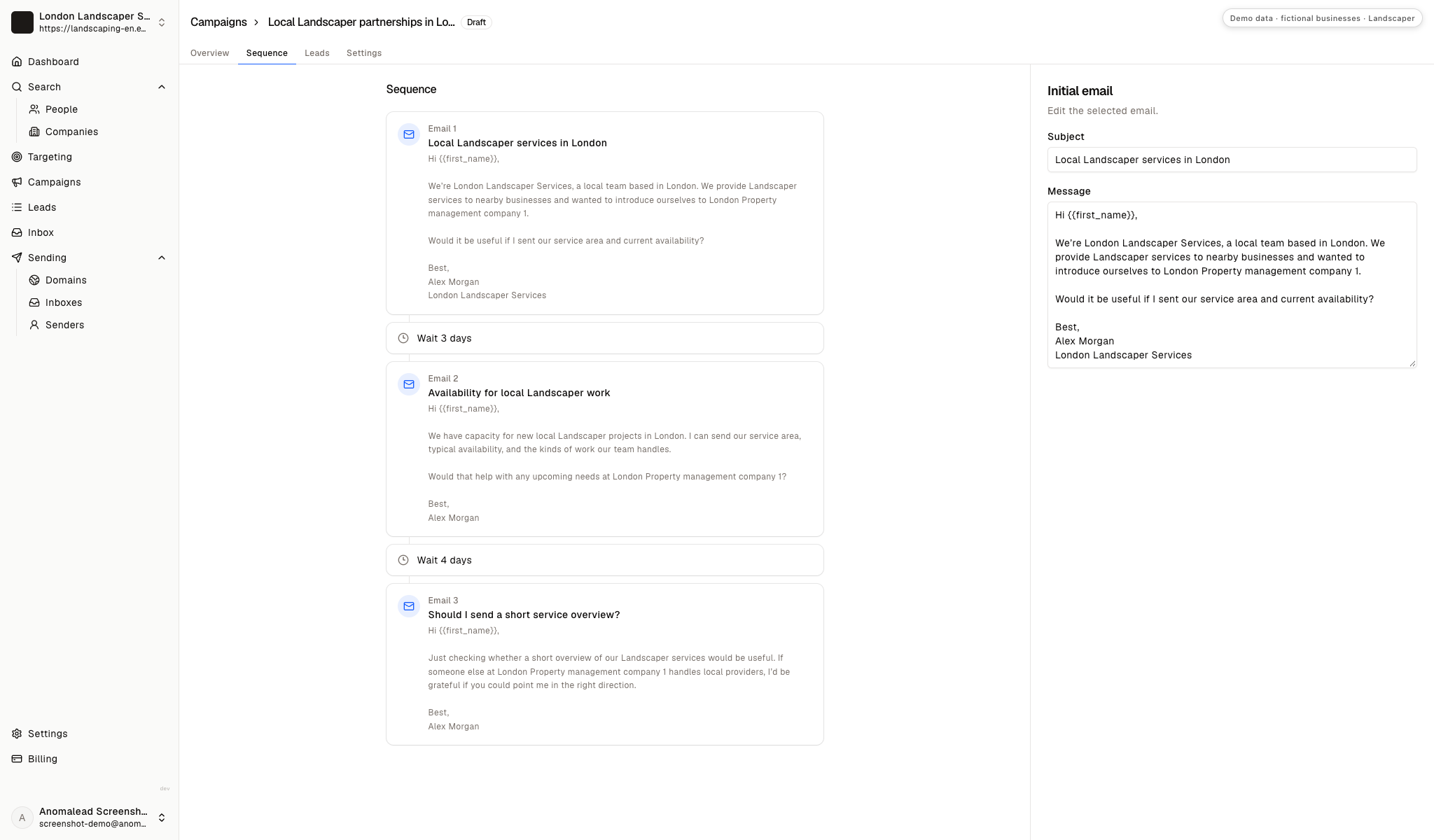
Make each follow-up useful to a grounds buyer
Section titled: Make each follow-up useful to a grounds buyerThe demo sequence shows three emails with a three-day wait and then a four-day wait. Its seeded copy is generic, so replace it with a grounds-care detail that helps a manager judge fit.
A later message could clarify how you scope turf and beds, coordinate tenant notices or handle cuttings. Mention qualifications and seasonal availability only when your team can confirm them.
Example emails for property managers
Section titled: Example emails for property managersThese notes focus on recurring grounds work rather than a large redesign. Replace each detail with a service your team actually provides and do not imply you have visited a site.
Opening note about recurring grounds care
Subject: Grounds maintenance for your managed properties
Hi Jordan,
I’m Alex Morgan with London Landscaper Services. We help property teams plan recurring care for lawns, planted beds and shared outdoor areas, with visit notes for the site contact.
Would a short outline of our service area and grounds scope help London Property management company 1 review its maintenance options?
Best,
Alex Morgan
Opening note about seasonal planning
Subject: Planning seasonal grounds work
Hi Taylor,
For managed sites, the grounds plan often needs to separate regular mowing and bed care from seasonal planting or larger improvements. London Landscaper Services can share the work our crew covers and how we coordinate site access.
Does London Property management company 2 review recurring grounds contracts before its next service season?
Best,
Alex Morgan
Use only the version that matches your actual service process, and remove any promise your team cannot keep. These B2B cold email examples can help you draft a distinct follow-up.
Read the manager’s questions in the inbox
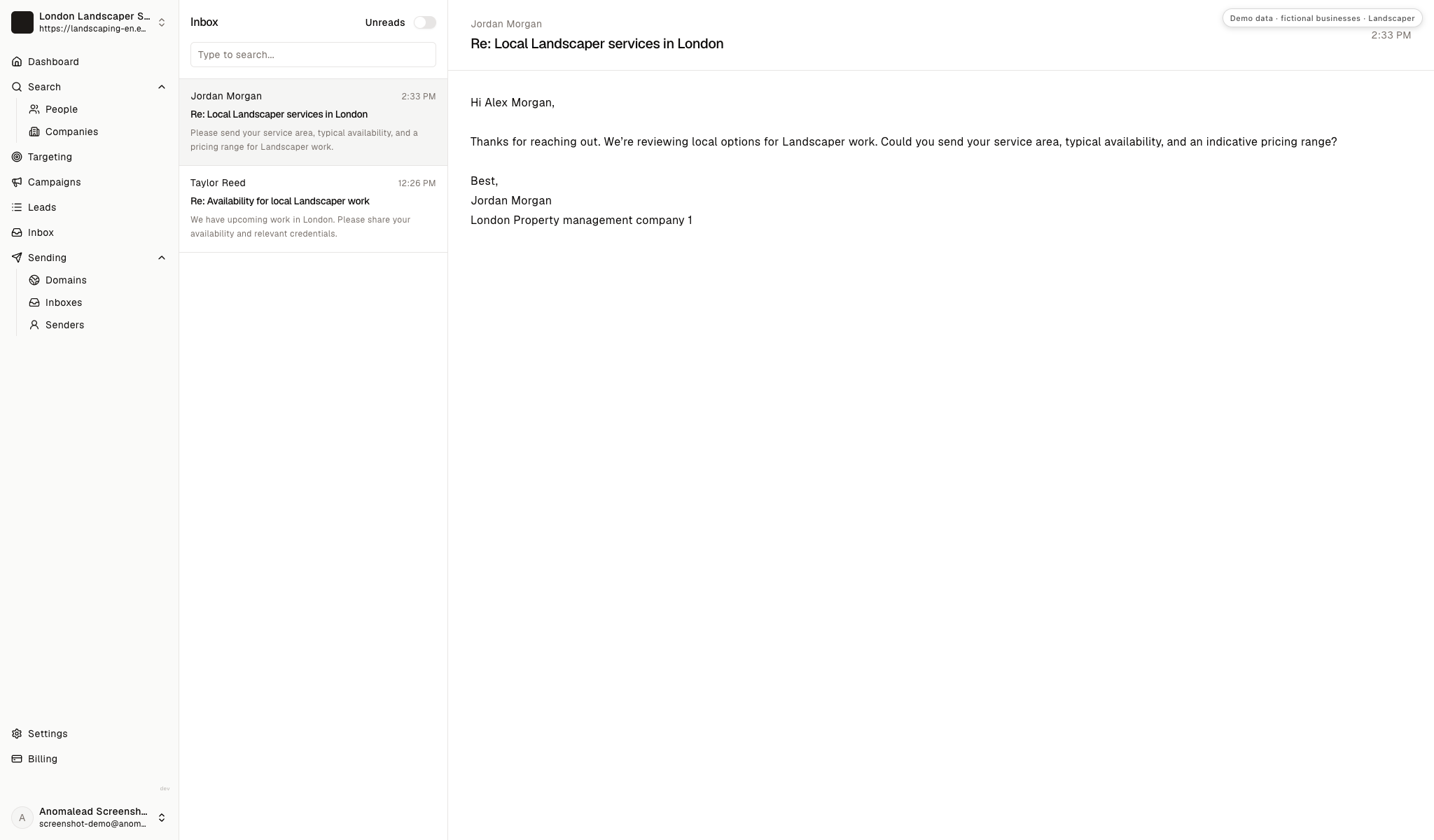
Section titled: Read the manager’s questions in the inboxThe demo inbox contains two fictional replies. Jordan Morgan asks for the service area, typical availability and a pricing range; Taylor Reed asks about an upcoming project, availability and relevant credentials.
Answer grounds-care questions with scope and timing
Section titled: Answer grounds-care questions with scope and timingA manager’s reply is a chance to clarify site conditions, not a reason to guess at a contract price. Answer the question directly, then ask for the property detail needed to judge workload and access.
Jordan asks about service area, availability and pricing
Section titled: Jordan asks about service area, availability and pricingCould you send your service area, typical availability, and an indicative pricing range for Landscaper work?
State the areas and seasonal capacity your crew can support. Do not price a portfolio until you know the grounds, visit pattern and who removes green waste.
Ask whether the request is for routine mowing and bed care or also planting and enhancements. A site walk or existing schedule can clarify the estimate.
A measured reply from Alex Morgan could say:
Thanks, Jordan. I can confirm coverage and capacity once I understand the sites and visit plan. Is the request for routine lawn and bed care, or should seasonal planting and waste removal be included? I can then share a suitable scope.
Taylor asks about an upcoming project and credentials
Section titled: Taylor asks about an upcoming project and credentialsWe are reviewing a grounds-care project near London. Which property types do you service, what recurring tasks can you include, and how do you coordinate access and green-waste removal?
Confirm the work types your crew accepts and share relevant insurance or site-safety documents. If treatment work is involved, verify your team meets the client’s qualification requirements.
Ask for the site, scope and access process. A site walk can reveal storage, water access and waste rules.
A clear reply can move the review forward:
Thanks, Taylor. I’ve attached the documents relevant to our grounds-care work. Could you share the address, requested tasks and access arrangements so I can confirm availability and whether a site walk would help?
The manager has an incumbent grounds contractor
Section titled: The manager has an incumbent grounds contractorWe already have a contractor for the grounds and are not reviewing the agreement right now.
Respect the current arrangement. Ask when the contract is reviewed or whether they keep backup for seasonal cleanups or another site. Do not push for a change before the buyer is ready.
A courteous answer keeps the timing clear:
Thanks for letting me know. I won’t ask you to change a working arrangement. If you use backup help for seasonal work or another site, I can share our scope and coverage. Otherwise, when should I check in before your next review?
The buyer wants a quote before sharing site details
Section titled: The buyer wants a quote before sharing site detailsCan you send a price for maintaining our properties?
Explain that a useful quote depends on the grounds, visit pattern, access and waste plan. Ask for a site list or walk-through, and separate routine maintenance from optional improvements.
Choose the next properties by fit, not volume
Section titled: Choose the next properties by fit, not volumeRecord which manager replied, what grounds work they need and whether the sites match your routes and crew capacity. Use that signal to refine the next list around a clear contract type, such as recurring turf care or a seasonal cleanup plan.
Keep the next batch small enough to research each site and respond promptly. A contractor who can explain access, scope and disposal is easier to evaluate than a generic grounds offer. For another property-services angle, see the commercial cleaning lead generation guide.
Landscaping contract questions property managers ask
Section titled: Landscaping contract questions property managers askWho usually chooses a landscaping contractor for a managed property?
Section titled: Who usually chooses a landscaping contractor for a managed property?A property manager often scopes the need and coordinates access, while an owner, asset manager or board may approve the contract. Ask who defines the grounds schedule and who signs off on the supplier before sending a formal proposal.
What should a landscaping company qualify before quoting a portfolio?
Section titled: What should a landscaping company qualify before quoting a portfolio?Confirm the sites, grounds included, visit expectations, access rules and green-waste plan. Separate routine mowing and bed care from planting, irrigation repairs or other enhancements so the manager can compare like-for-like proposals.
How can a small landscaping crew compete for recurring property work?
Section titled: How can a small landscaping crew compete for recurring property work?Choose a service area and portfolio size the crew can maintain consistently. Be specific about included tasks, seasonal adjustments, access coordination and how the manager receives completion notes.
Are the property companies and replies shown in the screenshots real?
Section titled: Are the property companies and replies shown in the screenshots real?No. London Landscaper Services, the property-management firms, Jordan Morgan, Taylor Reed and both messages were invented for this example. They do not describe actual landscaping enquiries or customer relationships.
Does the ROI calculator predict landscaping contract revenue?
Section titled: Does the ROI calculator predict landscaping contract revenue?No. It combines the contract value, meeting count and close rate you enter. Use the output to explore your own planning assumptions, not as a quote, forecast or guarantee.