


For a local hauler, junk removal lead generation works best when property managers need an authorized clear-out between tenants or before a site project. The goal is to earn repeat work by making item removal predictable for the manager, not by promising to take anything left in a unit.
A strong B2B offer explains what you accept, how you estimate volume, what access details you need and which disposal records you can provide. Start with B2B lead generation basics, then build a short list of property teams whose unit turnover work matches your service area and capacity.
Key takeaways
- Prioritize property managers who coordinate recurring unit turnovers, common-area clear-outs or approved removal before a repair project.
- Ask for authorized item lists, current photos, estimated volume, building access rules and the required completion window before quoting.
- State accepted materials, exclusions, crew capacity and any disposal confirmation you actually provide so the manager can plan the handoff.
- Separate junk removal from cleaning, moving and restoration by describing the material you remove and the point where another trade takes over.
Which property teams buy repeat clear-out work?
Section titled: Which property teams buy repeat clear-out work?Find the person who schedules work between tenancies or project phases, then confirm who approves the vendor and item list.
- Portfolio property managers: They can need one process for approved bulky-item removal across several sites. Ask how each job is authorized and whether vendors are selected centrally.
- On-site property or building managers: They know a building's loading route, lift rules and access contact. A regional manager may still approve the vendor or material list.
- Turnover and maintenance coordinators: They schedule clear-outs around repairs, inspections or a new tenancy. A missed collection can block the next contractor, so timely updates matter.
- Asset managers or owner representatives: They may review larger clear-outs or unusual disposal needs. Approach through the property manager who knows the site and its operations.
Removing contents differs from cleaning surfaces. See the commercial cleaning guide for that adjacent service.
Qualify the site before promising a collection
Section titled: Qualify the site before promising a collectionQualify authorization, access and materials before quoting. A vague request to empty a unit can hide a different vehicle, crew or disposal requirement.
- Written authority and item boundaries: Ask who approves removal and how cleared items are identified. An empty-looking unit is not permission to discard possessions that may still belong to someone.
- Photos, volume and material mix: Request current photos, an item list and rough volume. Note bulky furniture, appliances, bagged debris and disassembly; visit when pictures do not show the load or route.
- Access and loading route: Confirm floor, lift size and booking, stairs, carry distance, loading hours, vehicle limits and site contact. A shared hallway may need protection that a ground-level loading door does not.
- Accepted items and restricted materials: List what you accept, what needs separate handling and what you cannot take. Check local rules for restricted materials instead of making a broad promise about hazardous waste.
- Schedule, handoff and records: Agree on the ready-by deadline, arrival window, site contact and completion update. Explain any reuse, donation or disposal records you offer without promising a destination before inspection.
Use this lead qualification approach to screen for the job details that affect whether your crew can deliver, rather than saving every property account in the search area.
About the demo screenshots
The fictional operator in the demo is London Garbage collection service Services. London Property management company 1, London Property management company 2, London Property management company 3, contacts Jordan Morgan and Taylor Reed, and the replies are seeded examples. They are not Anomalead customers and do not show real campaign results; the generic records illustrate the screens, while the guide provides the practical junk-removal advice.
Find property managers inside your dispatch area
Section titled: Find property managers inside your dispatch areaSearch for property-management companies your crews can reach with the right vehicle and disposal options. Check whether a prospect manages buildings where you can load and remove materials you accept.
A radius will not show lift access, loading hours or vendor rules. Use results to choose accounts for research, then verify those details before proposing a collection.
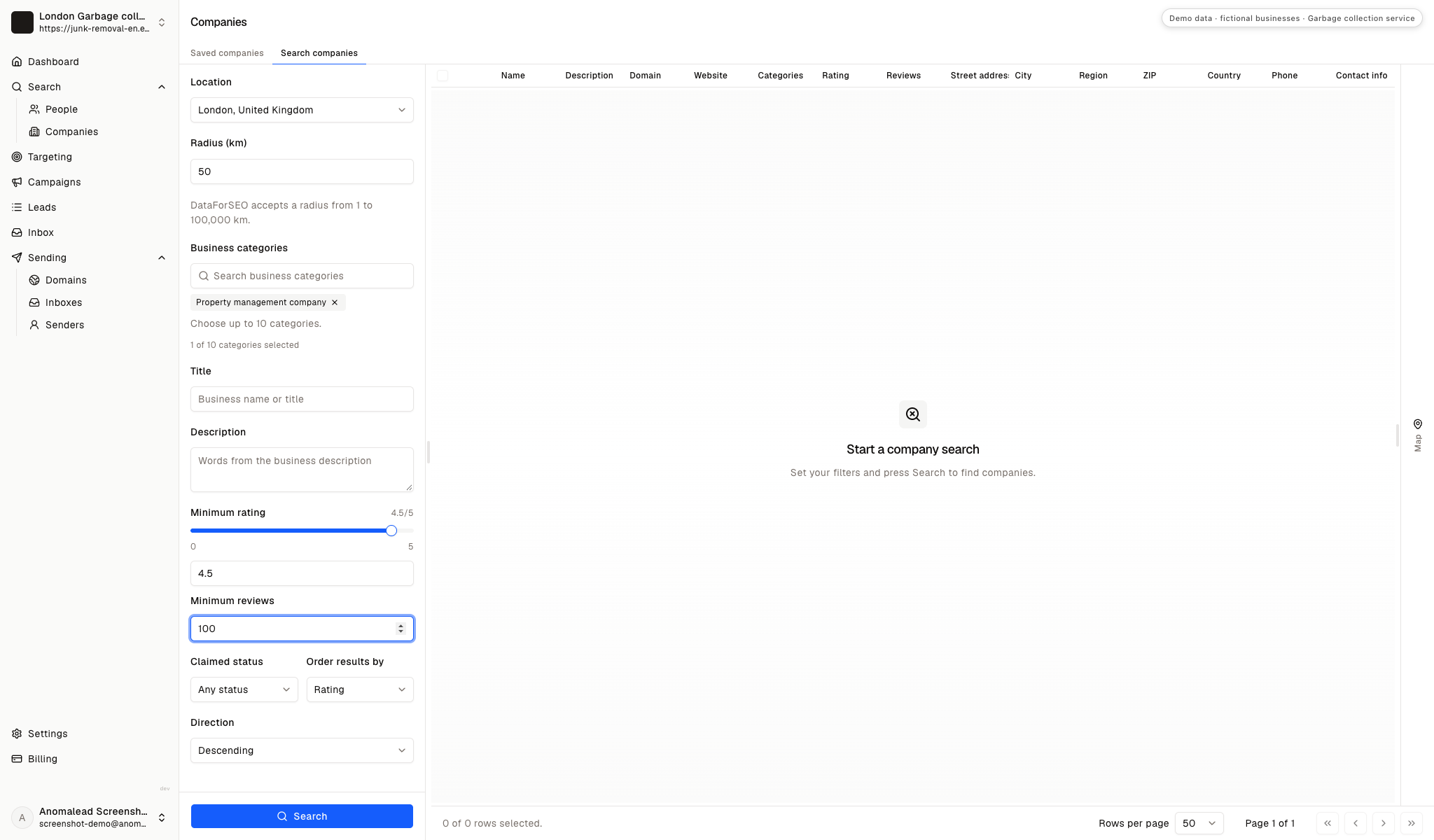
Choose property management and a workable search area
Section titled: Choose property management and a workable search areaThe form shows location, radius and rating filters for property-management prospects. Choose an area your dispatch and disposal routes can support.
Ratings help sort research, but do not show clear-out frequency or who can approve removal.
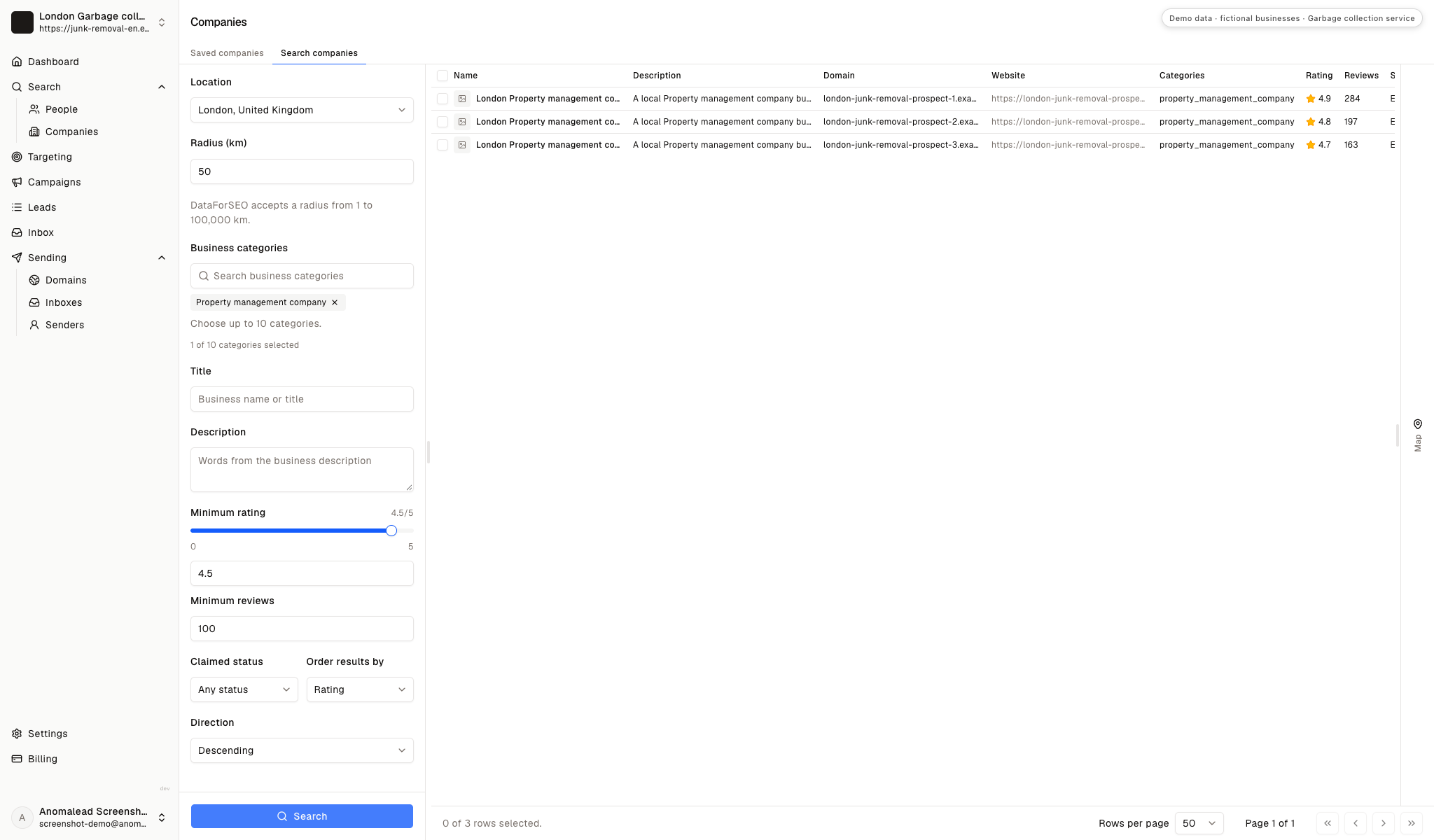
Review the property-company records
Section titled: Review the property-company recordsThe screen lists three fictional property managers with domains, ratings and review counts. Those details do not show turnover volume, so verify each firm's portfolio and service area.
Keep accounts where a contact can explain how clear-outs are approved and scheduled.
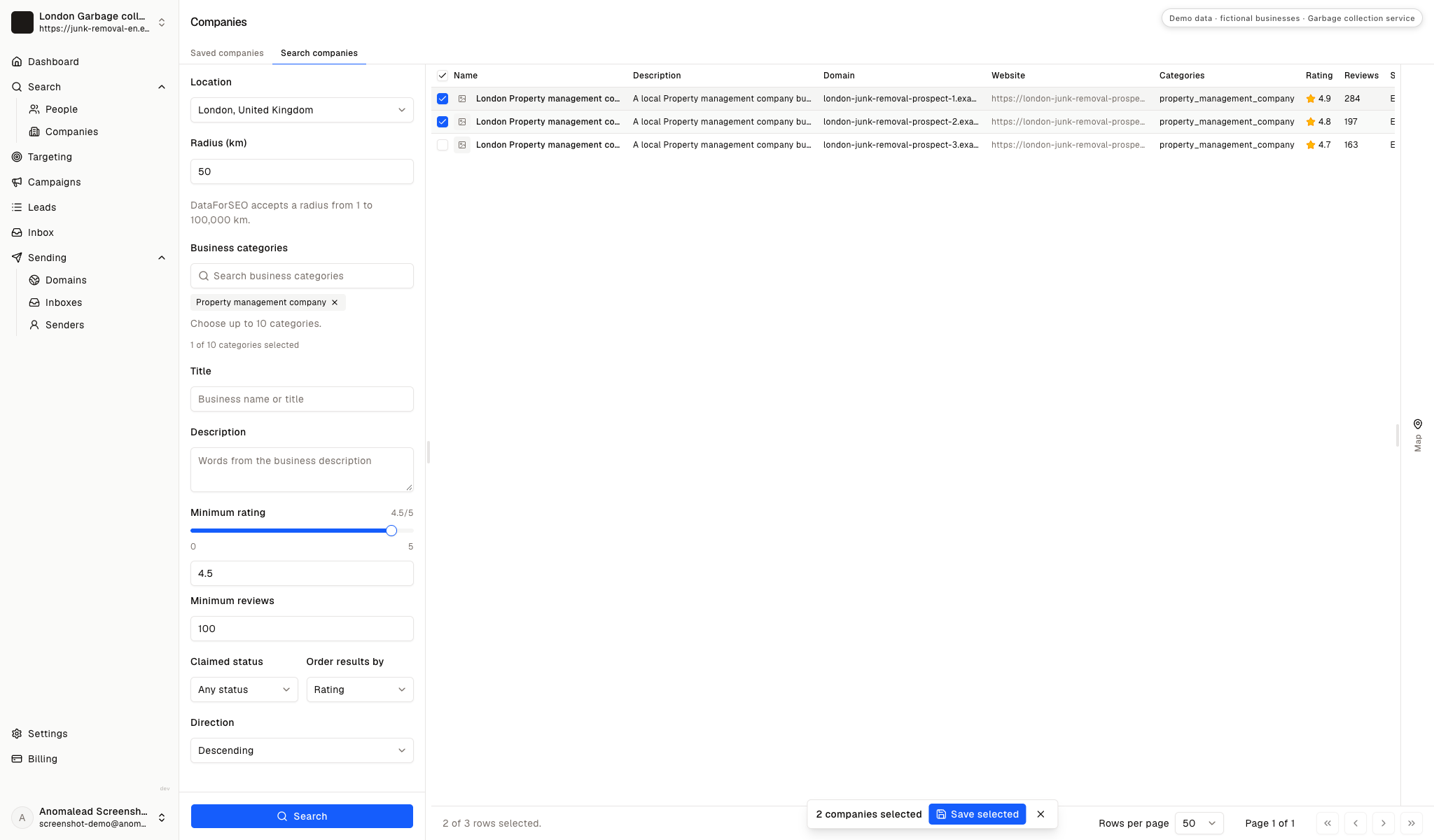
Save only accounts with a clear service fit
Section titled: Save only accounts with a clear service fitTwo of three demo results are selected. In your list, keep accounts that overlap your routes and match your accepted work.
Leave out a weak fit until you verify the buildings or approval process.
Find who can approve a site clear-out
Section titled: Find who can approve a site clear-outContact the property manager or maintenance lead who can confirm item scope and authorization. A portfolio manager may onboard vendors while an on-site manager handles keys, lift access and loading.
Verify an enriched contact's role. Ask about the clear-out process without implying a tenant has left or contents are approved for removal.
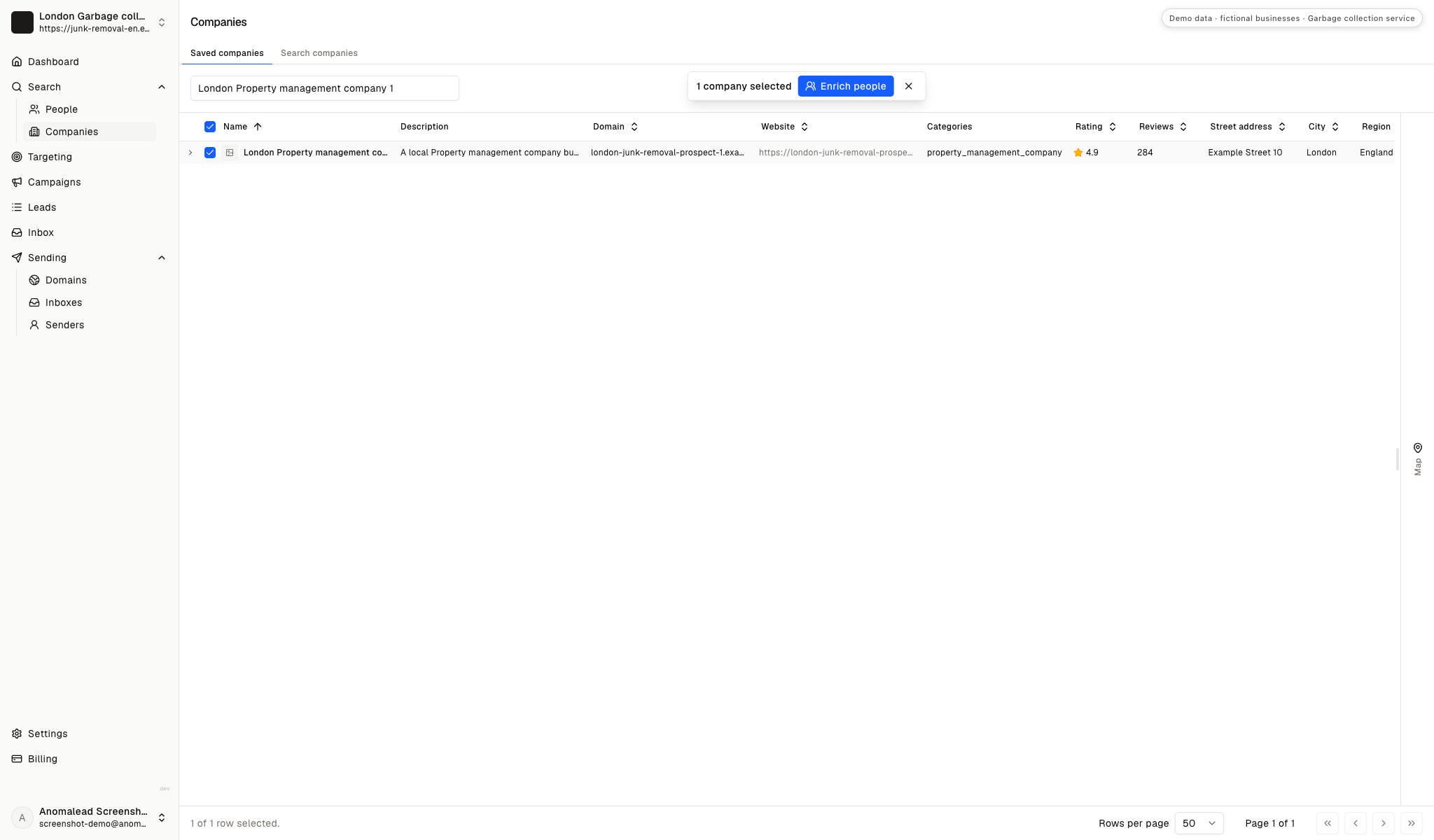
Review the saved account before enrichment
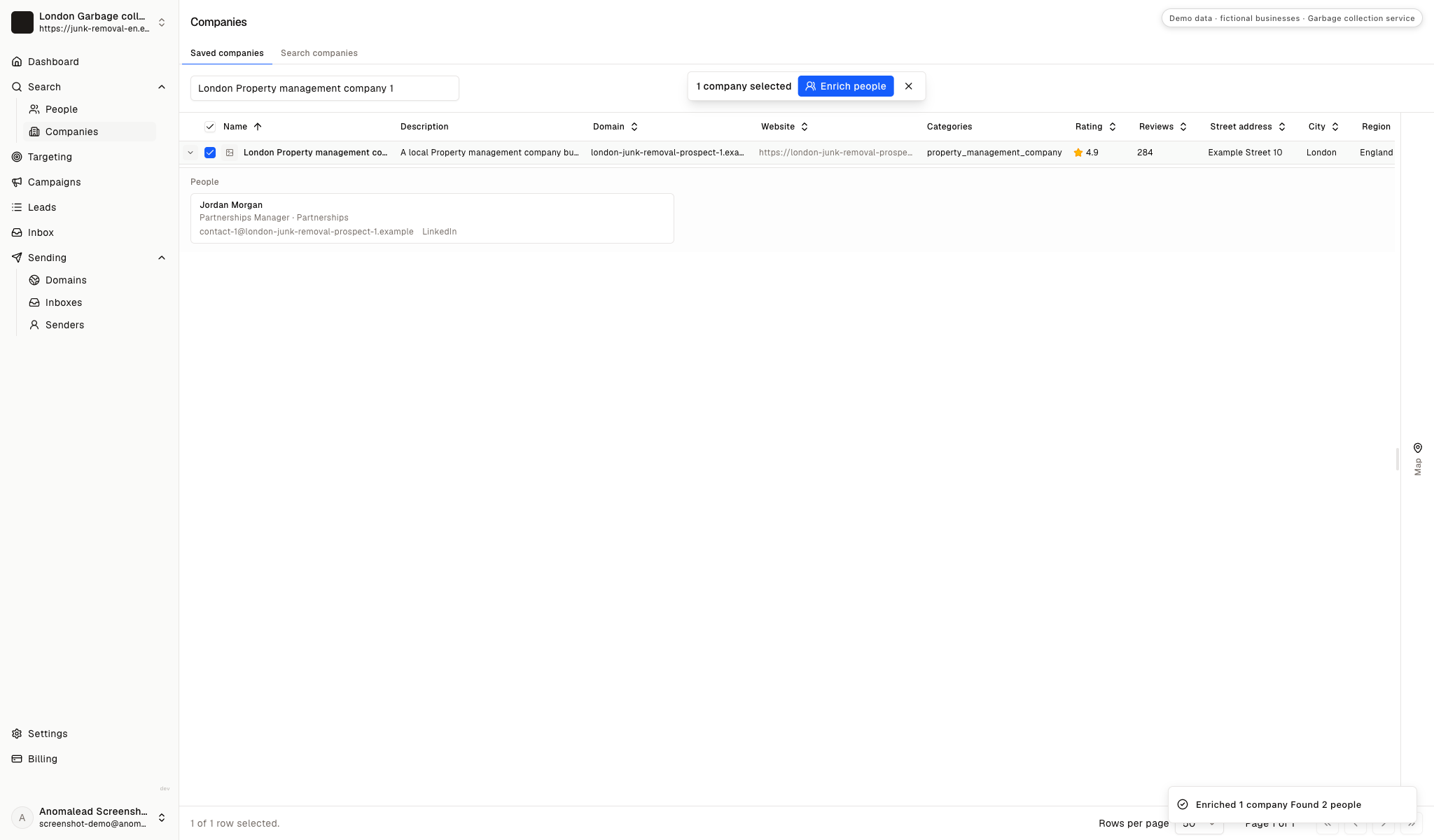
Section titled: Review the saved account before enrichmentThe shortlist screen shows one saved fictional property manager selected, with an Enrich people action available. Use this step to remove irrelevant accounts before looking for names, so contact research stays focused on plausible buyers.
Check contact roles before writing
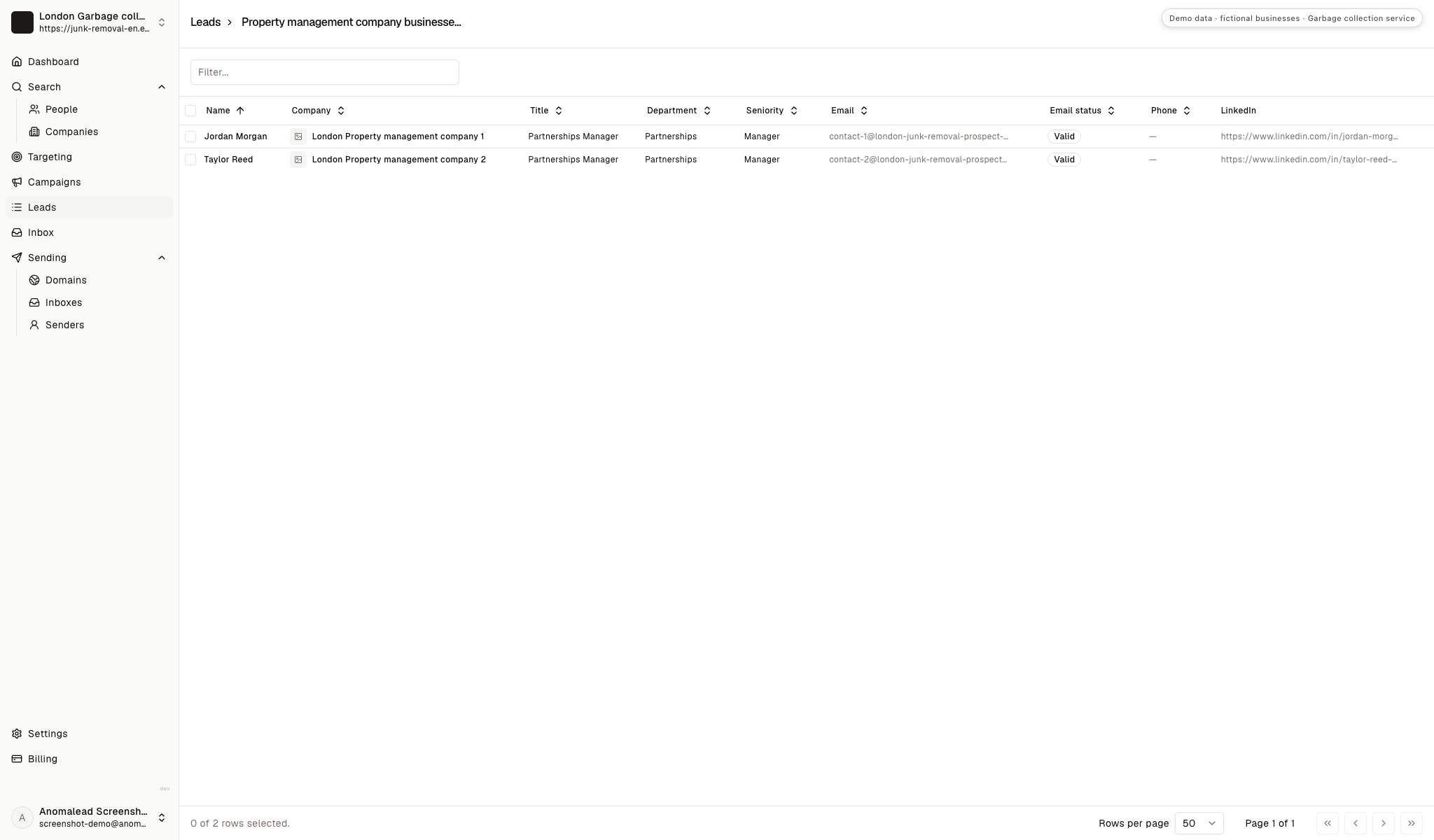
Section titled: Check contact roles before writingThe fixture presents Jordan Morgan and Taylor Reed as Partnerships Managers with work email and LinkedIn fields. They are fictional contacts, and their title does not confirm who can approve a removal at a particular building.
Check whether a partnerships contact routes vendor introductions or whether a maintenance manager owns day-to-day clear-outs. Send one useful note to the person closest to the decision.
Keep only contacts tied to the right accounts
Section titled: Keep only contacts tied to the right accountsThe curated list contains two fictional contacts, one at London Property management company 1 and one at London Property management company 2. Check the account and email status before adding a person to a campaign.
Do not treat a saved contact as permission to remove contents from a property. A work order or other site authorization still needs to come from the responsible manager.
Estimate what a property account is worth
Section titled: Estimate what a property account is worthScheduled unit clear-outs and project jobs differ in volume, access and disposal needs. Estimate contribution from completed work after vehicle time, crew hours, sorting and quoting effort.
A recurring account is useful only when jobs fit your routes, accepted materials and crew availability. Include time spent coordinating access and recording completion.
The calculator uses the deal value, meeting volume and close rate you provide as planning assumptions. It does not predict property turnover, load size, disposal cost, repeat work or guaranteed revenue.
Do the math on one good deal
If one new customer is worth thousands, you don’t need magic. You need a few more meetings a month.
Projected monthly results
- Deals closed
- 2.0
- Projected revenue
- £10,000
- Growth plan (1 business)
- £79/mo
- ROI
- 12,558%
Conservative math on meetings you already believe you can book. One closed deal often pays for a year of Anomalead.
If an account looks attractive only when every clear-out is easy to access and fully recyclable, revise the assumptions to reflect the jobs you actually accept.
Junk removal lead generation starts with a scoped offer
Section titled: Junk removal lead generation starts with a scoped offerTell the manager your coverage, the photos or list you need, accepted materials and how you confirm access. Do not offer rapid service unless your dispatch team can support it.
Ask whether the contact handles unit clear-outs. A cold email framework can keep the note focused on one operational question.
Check recipients in the campaign draft
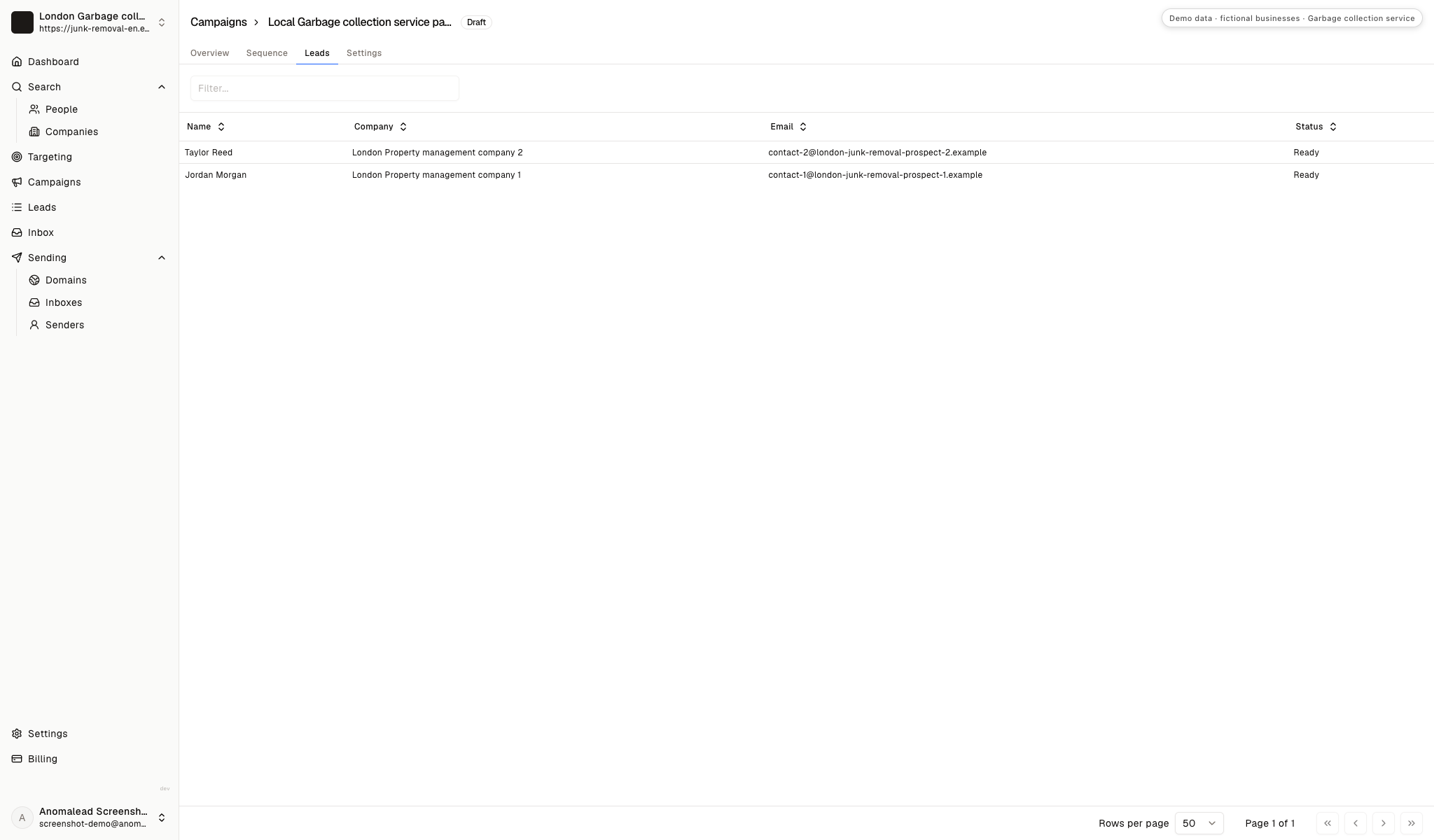
Section titled: Check recipients in the campaign draftThe draft shows two property-management recipients. Check that the offer fits both and that each contact has a role in vendor introductions or site operations.
Use separate messages when maintenance and procurement have different approval roles.
Review the follow-up sequence before sending
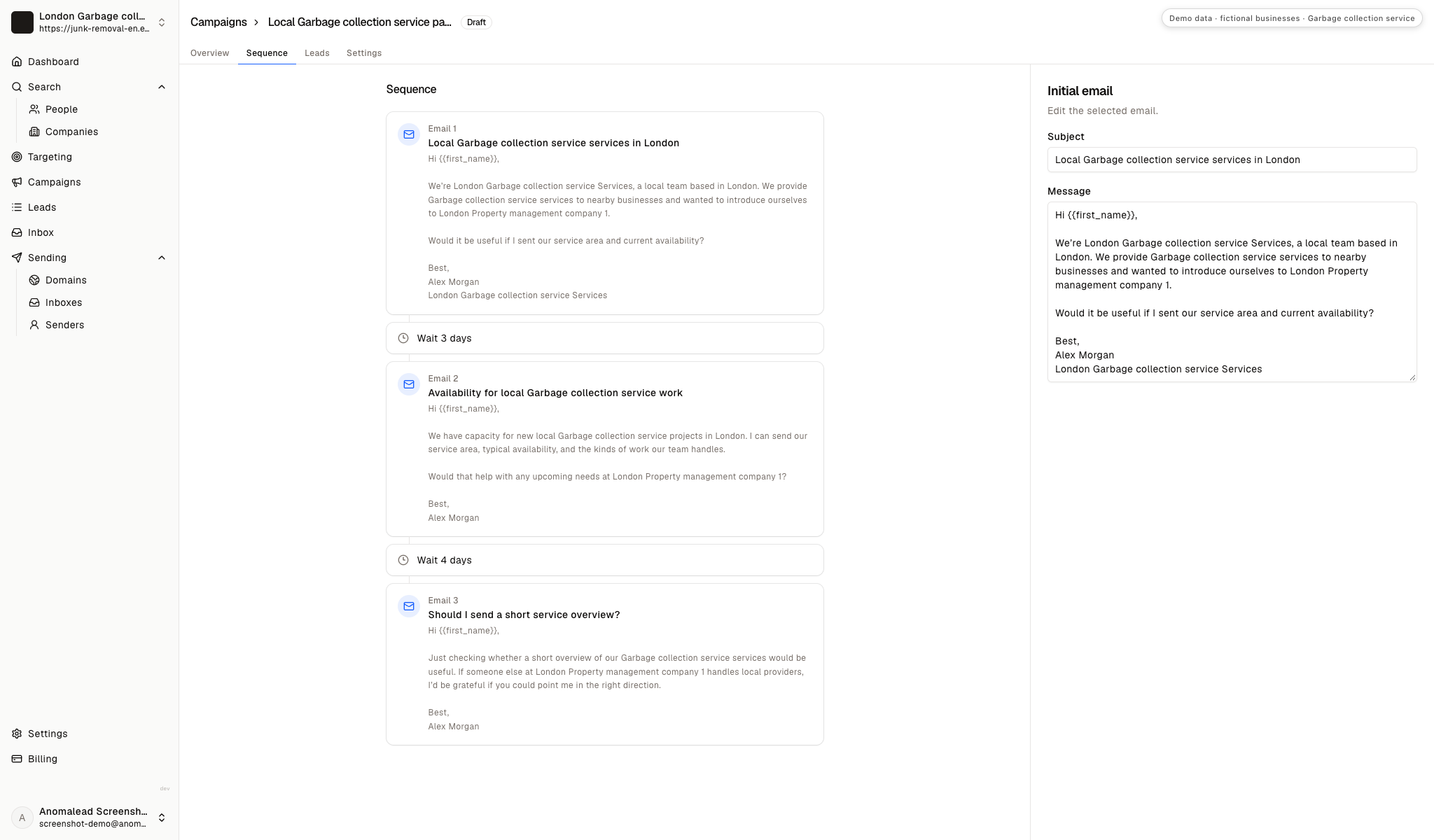
Section titled: Review the follow-up sequence before sendingThe fixture shows three generic emails with a three-day wait and then a four-day wait. Replace its copy with your true removal scope, accepted items and quote process.
A follow-up can explain how to share photos or arrange a visit. Stop when the manager declines.
Offer a clear way to scope the next unit
Section titled: Offer a clear way to scope the next unitThe fixture sender is Alex Morgan at London Garbage collection service Services. The example below replaces the generic demo email with a property-specific offer; adjust the accepted materials and service claims to match your actual operation.
Introduction to Jordan Morgan
Subject: A clear-out process for your managed units
Hi Jordan,
I’m Alex Morgan from London Garbage collection service Services. We help property teams plan approved furniture and contents removal between tenancies, with the collection route and item scope checked before the crew arrives.
If unit clear-outs fall within your role, I can send our coverage, accepted-item list and the photos we need to prepare a quote. Would that be useful for your team?
Best,
Alex Morgan
London Garbage collection service Services
Follow-up to Taylor Reed
Subject: Photos and access details for a removal quote
Hi Taylor,
For a property clear-out, the load and access route both shape the crew plan. Current photos, an item list and details such as lift access or loading hours help us decide whether a site visit is needed before quoting.
Would a short job-scoping checklist help when your team schedules a unit turnover?
Best,
Alex Morgan
Keep the request easy to answer and avoid claiming a particular disposal destination or turnaround time unless it is confirmed for the job. You can adapt these B2B email examples while keeping the operational details specific.
Separate a quote request from a booking
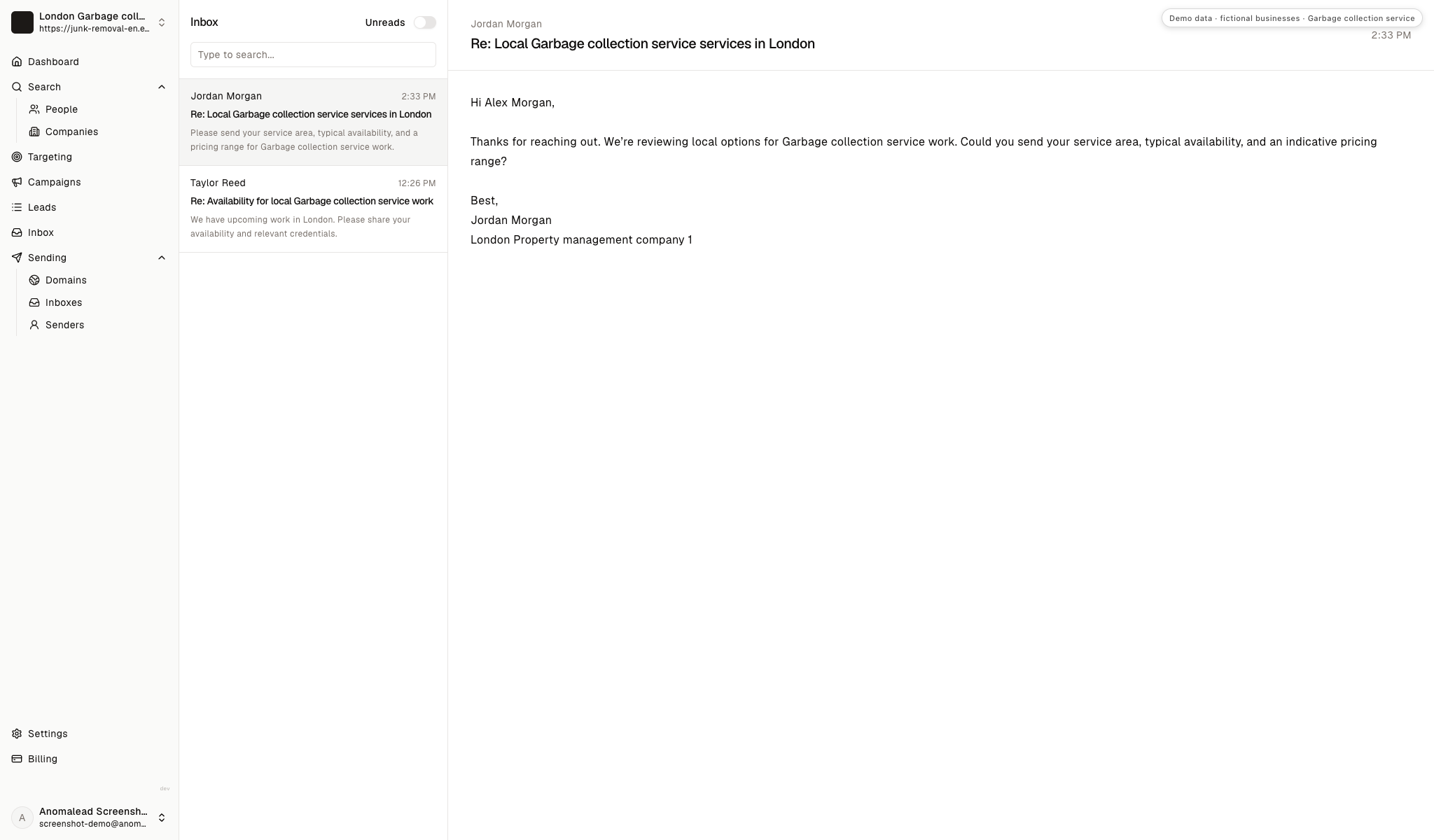
Section titled: Separate a quote request from a bookingThe fictional inbox shows Jordan Morgan asking about service area, availability and a pricing range. Taylor Reed asks whether upcoming work fits your schedule, which services you cover and what credentials you can share.
These are generic seeded replies rather than real customer feedback. Respond with your current facts, then collect the site details needed to scope a clear-out.
Answer clear-out enquiries with the missing details
Section titled: Answer clear-out enquiries with the missing detailsA reply about availability or price is an opening to scope the site, not confirmation of a work order. Answer what you know, name what still needs checking and ask for only the details that let you assess fit.
Jordan Morgan asks for service coverage, availability and pricing
Section titled: Jordan Morgan asks for service coverage, availability and pricingParaphrase of the first fictional fixture reply: Jordan Morgan at London Property management company 1 is reviewing local removal options and asks what area you serve, when crews might be available and how a manager can estimate a job's cost.
Send your current coverage and the next realistic scheduling window. Explain whether a quote starts with photos, a site visit or both, and which details affect the estimate, such as volume, heavy items, stairs and loading distance.
Do not give a firm price for an unseen load or reserve a crew from an approximate turnover date. Offer the manager a clear checklist for getting the unit assessed.
A reply that sets up a proper scope review:
Thanks, Jordan. I can share our current coverage and scheduling window. We assess a load from an item list and clear photos, and arrange a site visit when the contents or access are hard to judge. Could you send the approved item list and a few current photos for the next unit?
Best,
Alex Morgan
London Garbage collection service Services
Taylor Reed asks whether you can handle upcoming work
Section titled: Taylor Reed asks whether you can handle upcoming workParaphrase of the second fictional fixture reply: Taylor Reed at London Property management company 2 mentions a possible job and requests your availability, the types of removal you handle and relevant credentials.
Share the work you accept and the documents your business can actually provide. Ask about the likely load, access and required completion window before confirming a vehicle or crew.
If the request includes materials outside your scope, identify that boundary early and let the manager decide whether to split the work with another provider.
A practical answer leaves capacity unpromised until checked:
Thanks, Taylor. I can send our accepted-item list and current service documents. We check the load, access route and requested handoff time before confirming crew availability. Would you share the material types and target unit-ready date so I can tell you whether it fits our service?
Best,
Alex Morgan
The manager says a site already uses another hauler
Section titled: The manager says a site already uses another haulerWe already have a contractor who handles our unit clear-outs.
Respect the existing arrangement. Ask whether the manager ever needs backup for overflow, a different service area or a material type the current provider does not accept, but do not undermine the incumbent.
If the manager is not looking for another option, close politely and record the preference rather than continuing automated follow-ups.
A low-pressure reply can leave room for a future fit:
That makes sense. If you ever need a backup for a load outside your current provider's scope or coverage, I can share our details for review. Thanks for letting me know.
Best,
Alex Morgan
The request includes materials you may not be able to accept
Section titled: The request includes materials you may not be able to acceptThere are paint containers and other items mixed in with the furniture. Can your crew take everything?
Do not agree to remove unknown or restricted materials just to keep the job. Ask for clear photos and an item description, then check your company's accepted-material policy and the applicable local handling requirements before confirming the scope.
Turn the first account into a repeatable process
Section titled: Turn the first account into a repeatable processChoose one property-manager segment and prepare a job-scoping sheet that covers authorization, photos, item boundaries, access, loading, timing and completion records. Contact a small group of relevant firms and ask how they request a clear-out before sending a broad service pitch.
Track which introductions lead to authorized site reviews, suitable quotes and completed work. Share a current service window with the manager, document exclusions clearly and keep a client-ready option open when a cleaner or mover handles the next stage. The moving company lead generation guide explains a related property workflow with a different job scope.
Junk removal lead generation questions
Section titled: Junk removal lead generation questionsWhich property-management contact should a junk hauler approach?
Section titled: Which property-management contact should a junk hauler approach?Start with the property manager, turnover coordinator or maintenance lead who can explain how a clear-out is requested and approved. Confirm whether a regional manager or owner representative also needs to authorize the vendor or item list.
What information helps quote a unit clear-out?
Section titled: What information helps quote a unit clear-out?Ask for an approved item list, current photos, estimated volume, material types and the access route. Floor level, lift or loading rules, carry distance and the unit-ready deadline can change the crew plan, so arrange a site visit when remote details are not enough.
How should a hauler handle restricted or mixed materials?
Section titled: How should a hauler handle restricted or mixed materials?State what your business accepts and set aside anything that needs separate review. Check your operating policy and local handling requirements before agreeing to collect regulated, hazardous or unidentified material.
Are the businesses and replies in the screenshots real?
Section titled: Are the businesses and replies in the screenshots real?No. London Garbage collection service Services, the three London Property management company records, Jordan Morgan, Taylor Reed and the replies were generated for this demo. They illustrate interface content only and provide no evidence of customer status, outreach delivery or results.
Does the ROI calculator predict revenue from property managers?
Section titled: Does the ROI calculator predict revenue from property managers?No. It uses the planning assumptions you enter to help compare possible deal value and outreach effort. It does not predict job volume, load size, disposal costs, bookings or revenue.