


Janitorial lead generation works when a cleaning operator targets facility managers who need dependable routines across occupied buildings. The strongest prospect is not simply a nearby company; it is a site whose operating hours, room mix, access rules and service expectations match the crew you can staff.
This guide follows that buying path from a local search to a scoped conversation. It focuses on recurring day-to-day service, such as washroom rounds, lobby upkeep, waste handling and shift handovers, rather than one-off specialty work. If you are building a business-to-business pipeline for the first time, start with these B2B lead generation basics, then use the checks here to make your shortlist useful.
Key takeaways
- Target facility managers responsible for occupied sites, because they see whether routine cleaning coverage matches how a building is used.
- Qualify each account by shift, task schedule, washroom supply duties, access procedure and service reporting before you look up contacts.
- Describe the daily scope you can staff and ask one question about the buyer’s current coverage or review timing.
- Answer requests for availability or pricing by clarifying areas, frequency and consumables before sending a proposal.
Which facility buyers oversee janitorial coverage?
Section titled: Which facility buyers oversee janitorial coverage?Begin with the person accountable for the building’s routine service, then map who controls the supplier decision. Janitorial contracts work best when the operational contact and the person who approves scope can both see how the schedule will run.
- Facilities managers: They coordinate cleaning with opening hours, tenant activity, repairs and safety procedures. Ask about service windows, busy areas and how a missed task is reported; those details reveal whether your staffing model fits the site.
- Building or site managers: They often manage day-to-day access and notice recurring problems in entrances, lifts, shared kitchens and washrooms. They can explain the practical routine and may introduce the facilities lead who owns the contract.
- Regional facilities or procurement leads: A central team may set supplier requirements across several locations. Confirm whether local managers can recommend a provider or whether onboarding, insurance documents and pricing proposals must go through a central review.
Keep these roles in separate campaign groups. A site manager needs confidence in daily delivery, while a central buyer may first ask about onboarding, scope consistency and documentation.
Qualify the service before enriching contacts
Section titled: Qualify the service before enriching contactsA company record cannot tell you whether a cleaning contract is deliverable. Check the operating details below before you spend time finding a name.
- Shift and visit windows: Find out whether work happens before opening, during occupied hours or after staff leave. Confirm that your team can cover the requested handover and travel pattern without promising a rota you cannot staff.
- Rooms and traffic patterns: Separate public-facing zones from controlled work areas. Entrances, lifts, washrooms and shared kitchens may need different task instructions from offices or back-of-house rooms, so a broad building label is not enough for a sound quote.
- Consumables and waste duties: Clarify who buys washroom paper, soap and other supplies, where stock is kept, and whether the cleaner records a refill or only flags a low shelf. Put waste removal and recycling handling in the written scope as well.
- Keys, badges and alarm handover: Ask how staff sign in, receive access, lock up and report a problem. A buyer may require a named key holder, a badge return process or restricted-room instructions; discuss the procedure without putting sensitive access details in an email campaign.
- Inspection and relief cover: Learn how the site checks completed work and wants missed tasks corrected. Be ready to describe your actual supervisor checks, issue log and staff-cover plan, and identify any client onboarding credentials you really hold.
About the seeded demo
London Janitorial service Services is a fictional operator in the seeded workspace. London Property management company 1, London Property management company 2, London Property management company 3, Jordan Morgan, Taylor Reed and every inbox reply are fictional demo records, not Anomalead customers or real campaign outcomes.
Build a local shortlist around routine coverage
Section titled: Build a local shortlist around routine coverageA useful search starts with the buildings your team can cover consistently. Choose a service area from actual crew travel and shift availability, then search for property management organizations as a route to facilities contacts. The results are leads to inspect, not proof that a site is buying. For a broader approach to finding clients, see ways to get business leads.
Set the search to your workable territory
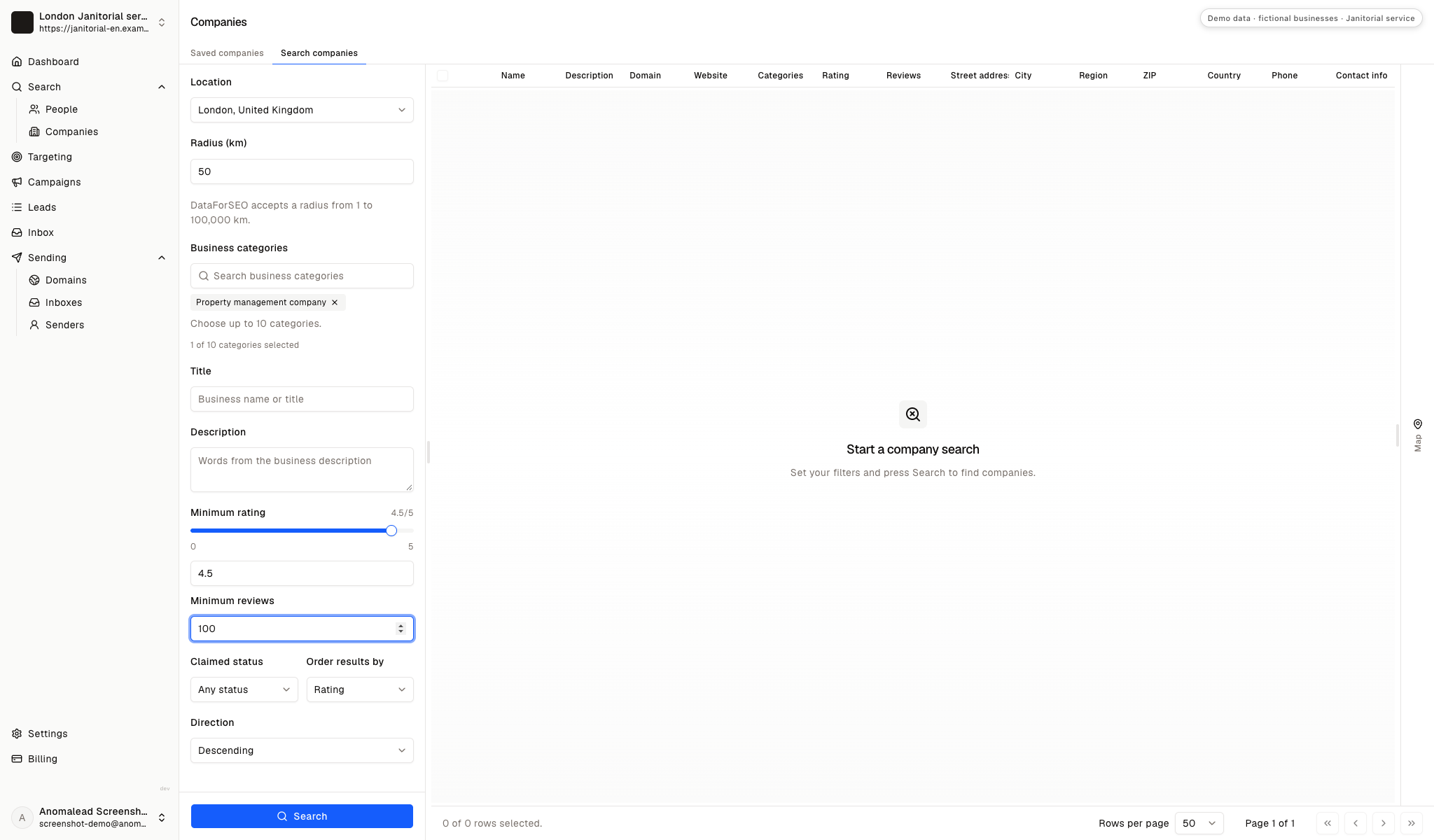
Section titled: Set the search to your workable territorySet a location and radius your supervisors and cleaning staff can reach around the required service windows. The form also shows the selected company category and rating filters; use them to shape discovery, then verify the organization’s building portfolio before adding it.
Inspect the companies returned by search
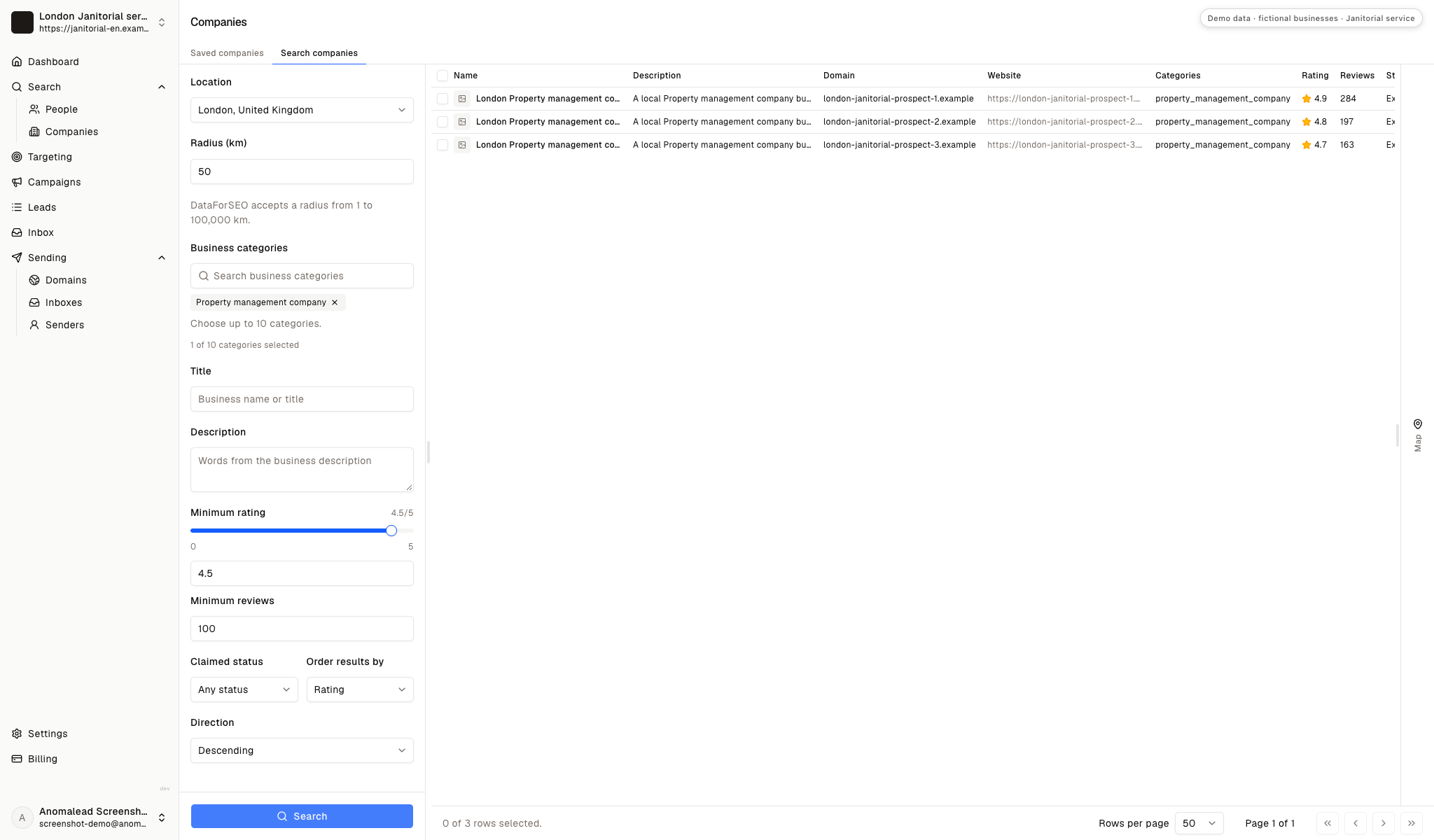
Section titled: Inspect the companies returned by searchThe seeded results show three fictional property management companies with generic descriptions, domains, ratings and review counts. Those fields do not establish that any facility needs a cleaner. Check each organization’s managed sites and identify a plausible facilities contact before treating it as a prospect.
Save only the accounts worth researching
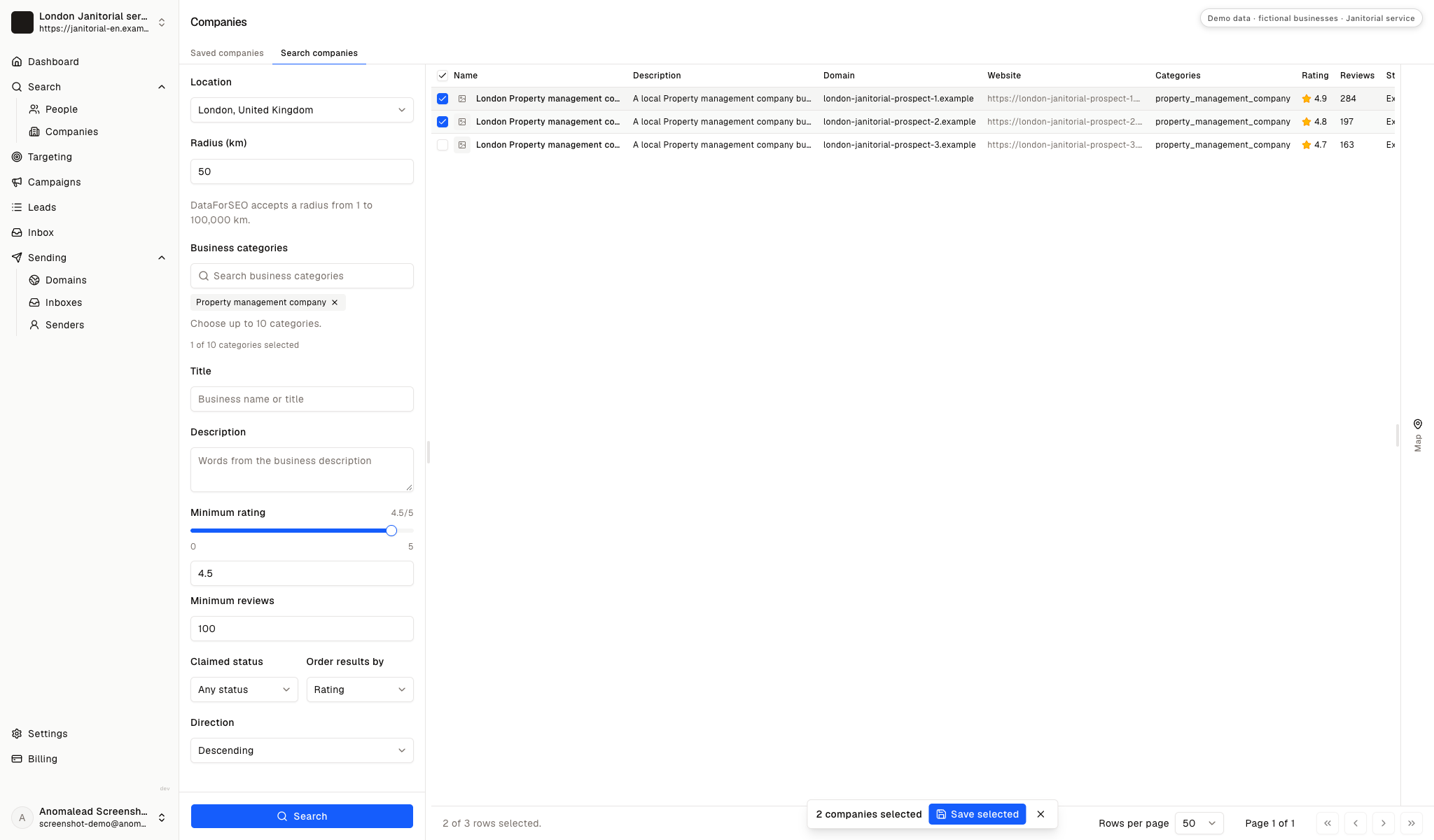
Section titled: Save only the accounts worth researchingThe demo selects and saves two of the three displayed companies. In your own search, keep a record only when its likely locations, access conditions and service hours could fit your operating plan; leave weak matches out rather than padding a campaign.
Find who schedules service at each building
Section titled: Find who schedules service at each buildingContact enrichment is more useful after you know why an account belongs on the list. Facilities managers often own the cleaning routine, but an organization may route contracts through property operations or procurement. Check role descriptions and ask for a referral when the visible contact does not appear to own site services.
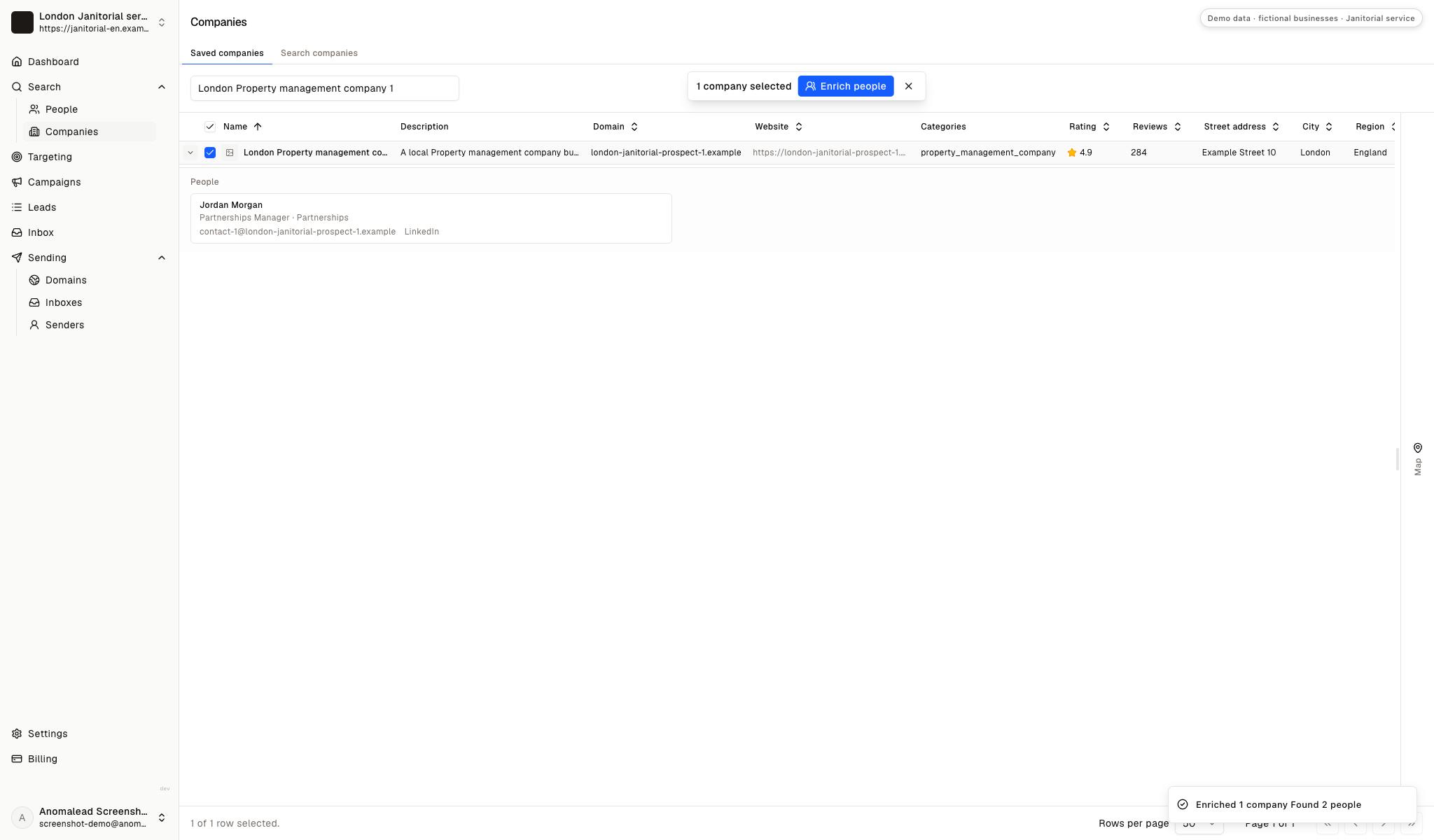
Recheck the saved company before enrichment
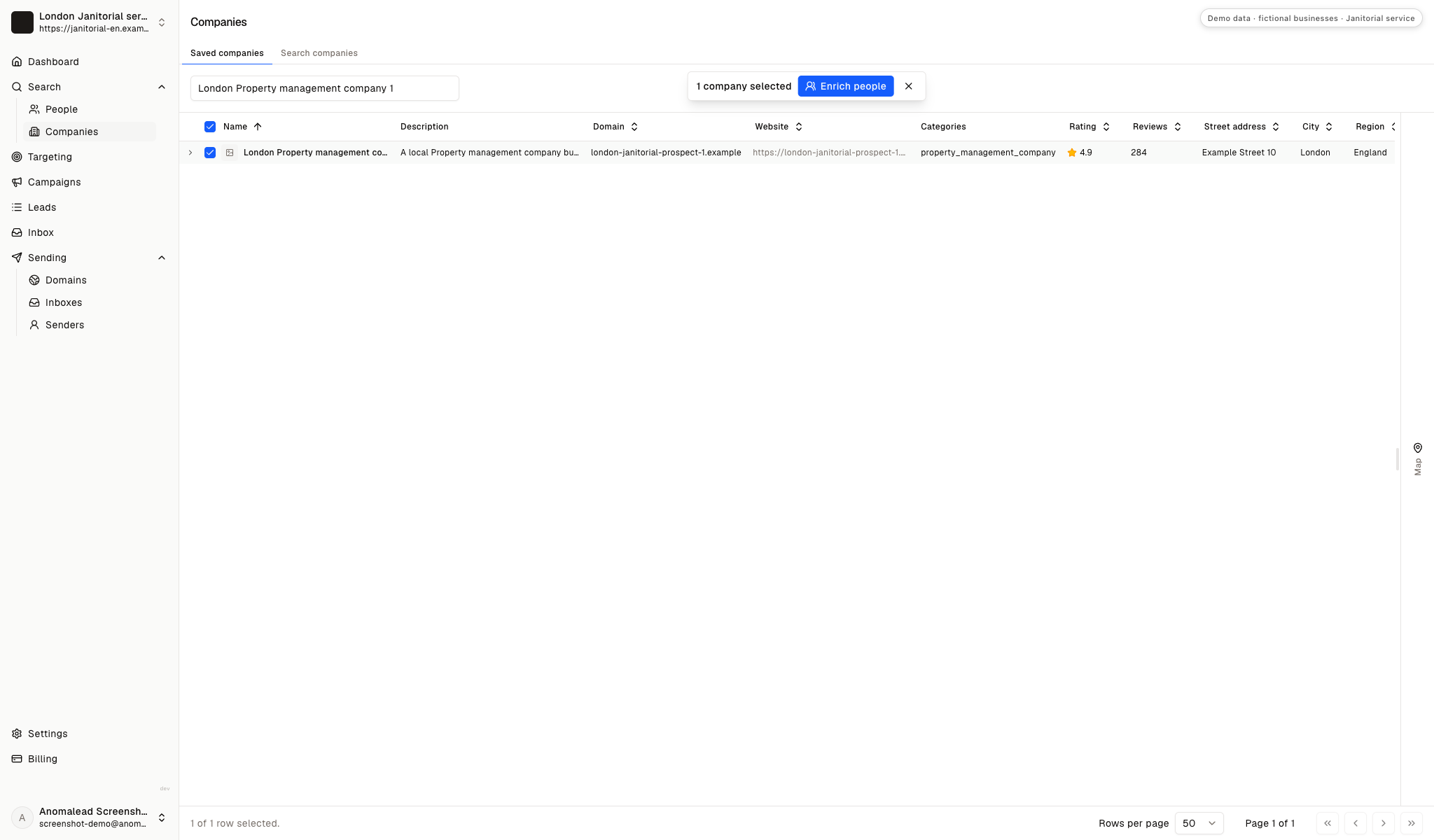
Section titled: Recheck the saved company before enrichmentOne saved company is selected in the shortlist and the Enrich people action is available. Use this pause to revisit the company’s likely sites and remove it if the account would require shifts, travel or building access your team cannot support.
Check whether the surfaced contacts own the work
Section titled: Check whether the surfaced contacts own the workThe fixture presents Jordan Morgan and Taylor Reed, both labeled Partnerships Manager, with contact details. Treat those titles as demo data rather than evidence that either person runs facilities. A relevant name is a starting point: verify responsibilities and ask who coordinates cleaning contracts when the role is unclear.
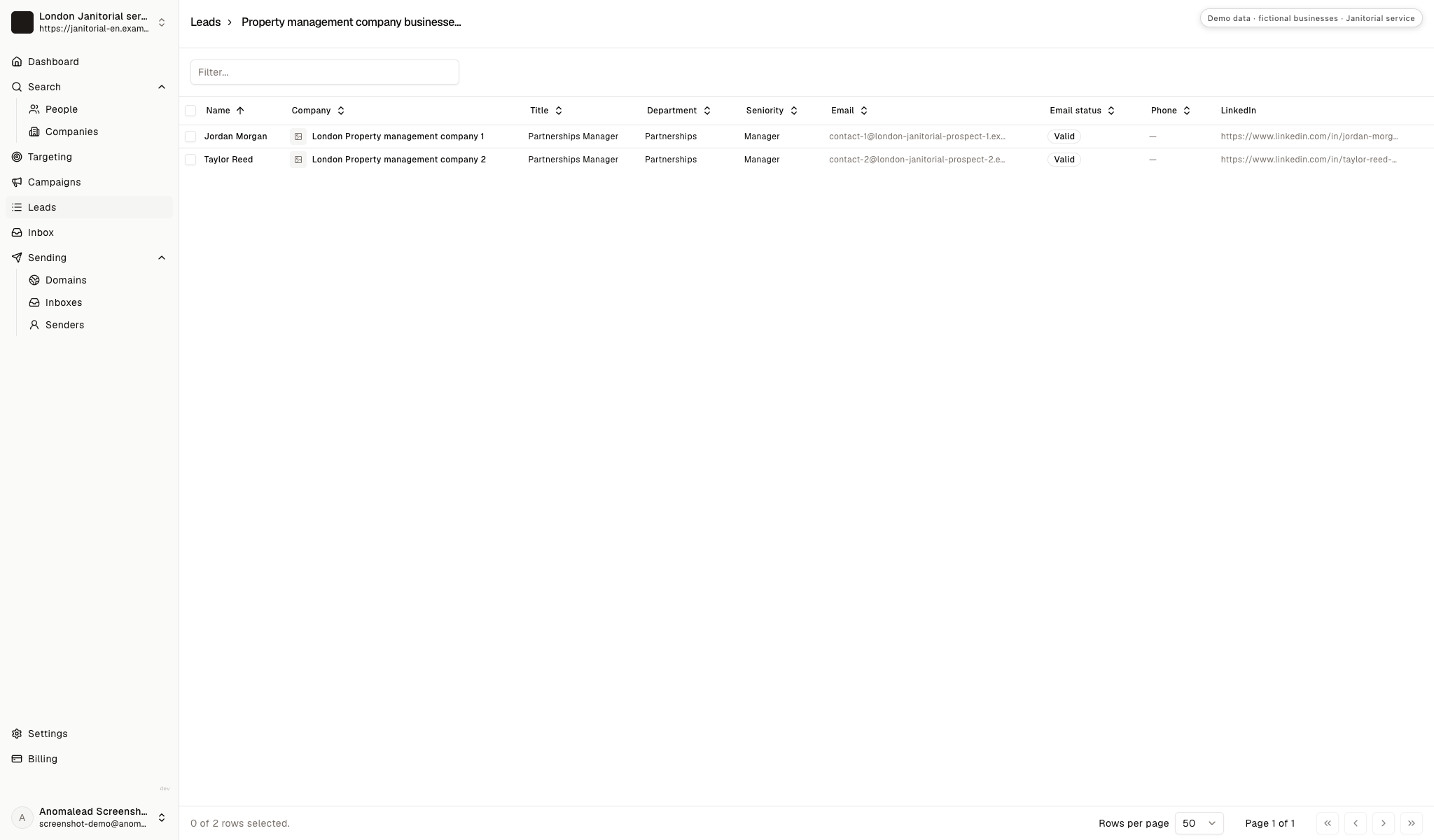
Review the send list one recipient at a time
Section titled: Review the send list one recipient at a timeThe example lead list contains two contacts with email status shown. In a live list, compare each person’s role with the account notes and keep only recipients for whom the same service conversation makes sense.
Would a recurring janitorial account fit your operation?
Section titled: Would a recurring janitorial account fit your operation?A recurring facility contract can occupy staff time across shifts and buildings, so its value depends on both the agreed scope and the labor your team must schedule. Consider the inspection and supervision work as well as the cleaning hours when deciding whether an account is worth pursuing.
Use figures from your own signed work and current operating plan, then compare the result with your crew capacity.
The calculator uses values you supply as planning assumptions. It does not know your staffing costs, travel, supply responsibilities, service deductions or whether a prospect will award a contract.
Do the math on one good deal
If one new customer is worth thousands, you don’t need magic. You need a few more meetings a month.
Projected monthly results
- Deals closed
- 2.0
- Projected revenue
- £10,000
- Growth plan (1 business)
- £79/mo
- ROI
- 12,558%
Conservative math on meetings you already believe you can book. One closed deal often pays for a year of Anomalead.
If the account only looks attractive when you ignore relief cover or supervision, revise the scope discussion before expanding outreach.
Janitorial lead generation needs a useful first message
Section titled: Janitorial lead generation needs a useful first messageA facility manager is more likely to engage with a clear service question than a broad claim about being local. Name the routine work you take on, make your coverage easy to assess and ask whether the recipient reviews cleaning schedules. The general advice in writing a useful cold email can help with structure, while the details below make the message fit this service.
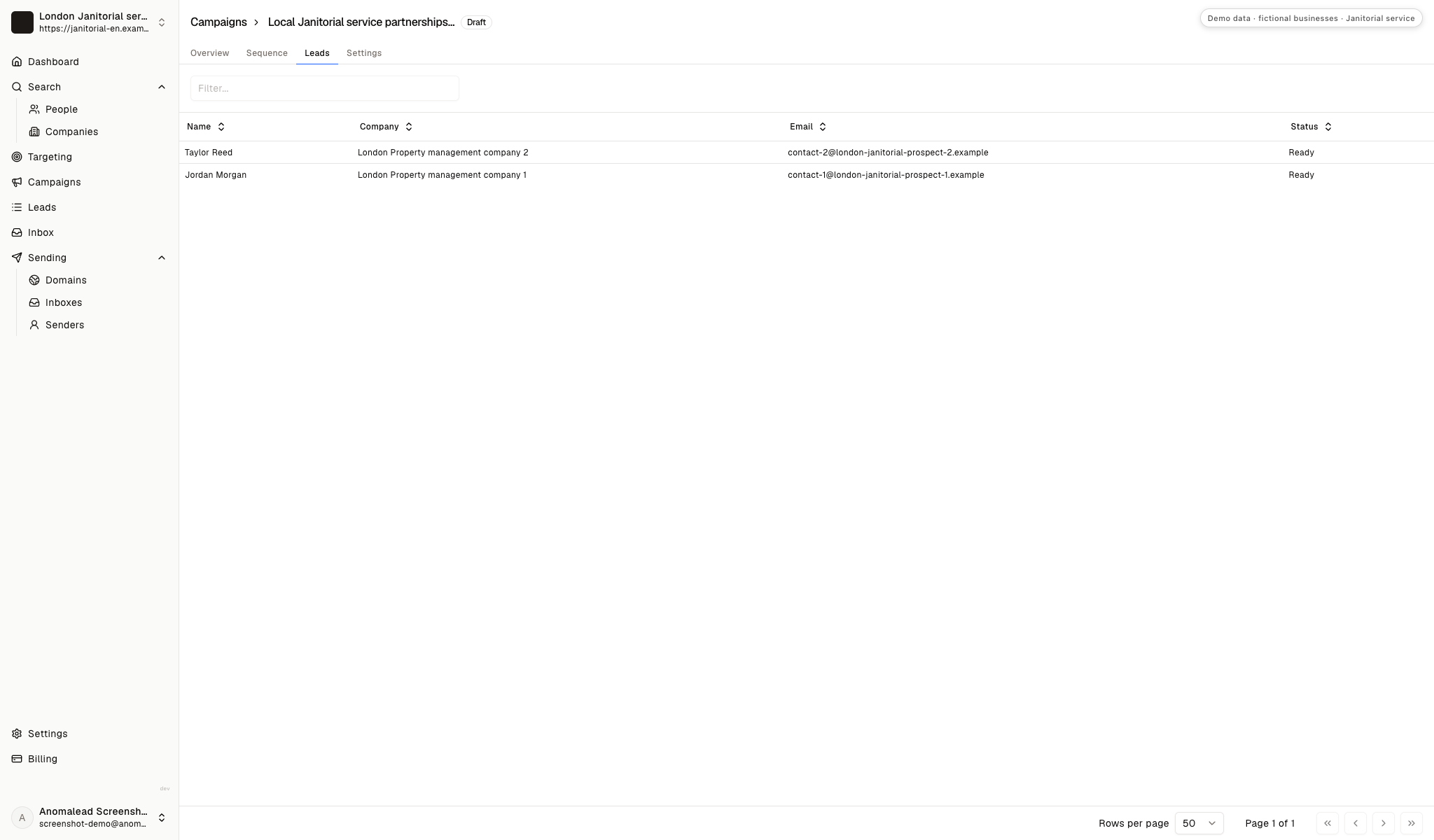
Keep the draft campaign tied to one buyer
Section titled: Keep the draft campaign tied to one buyerThe draft campaign has two recipients. Before sending, confirm each person belongs to the same buyer group and would recognize the reason for the message. Separate a facilities operations conversation from one intended for a central procurement contact.
Check each follow-up for a new reason to reply
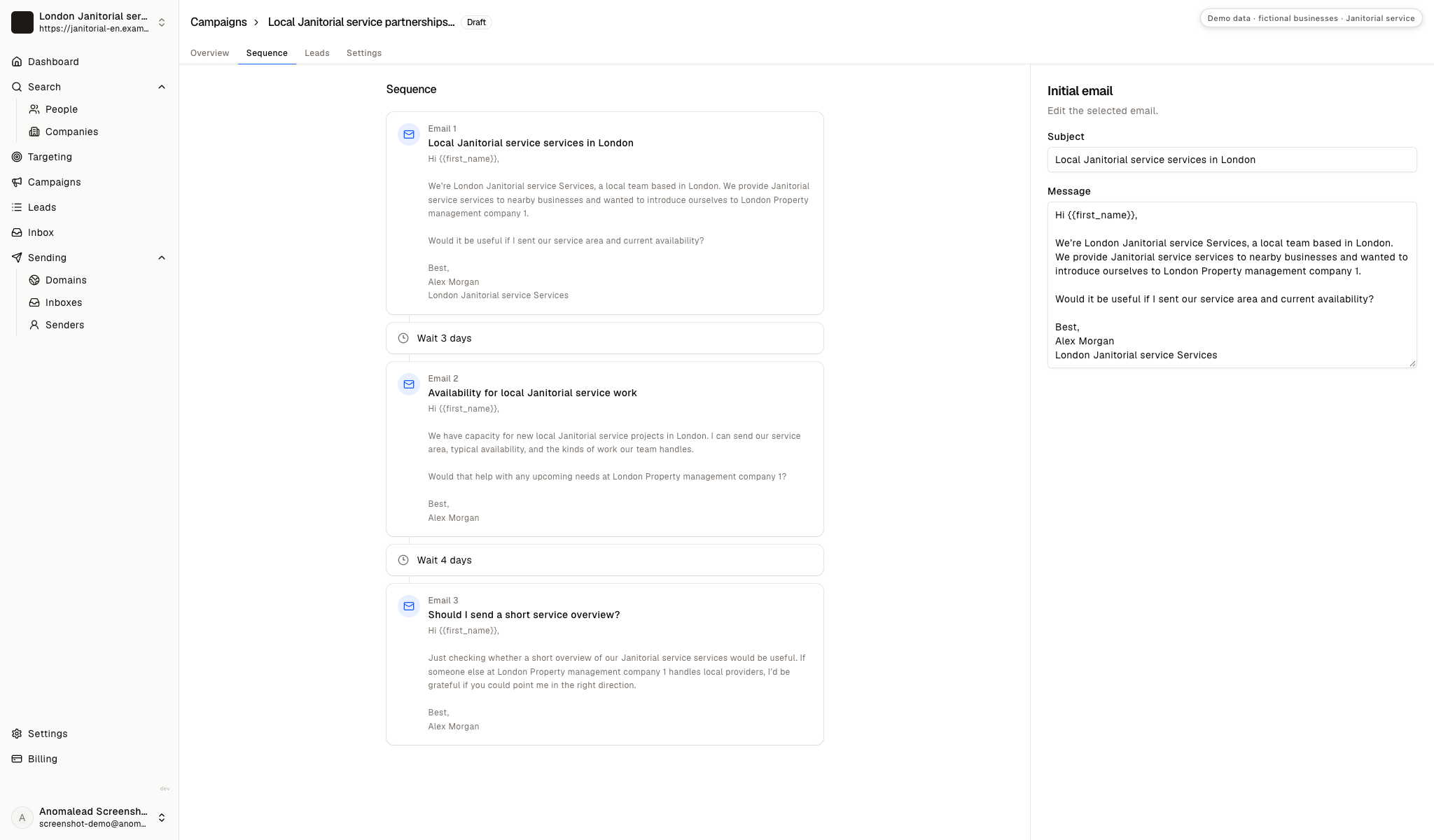
Section titled: Check each follow-up for a new reason to replyThe seeded sequence contains three emails with a three-day wait and a four-day wait. Review the schedule, claims and audience before activation. Later notes should add a useful detail, such as how you document washroom restocking or handle a shift handover, rather than resend the opening pitch.
Write to the person responsible for routine service
Section titled: Write to the person responsible for routine serviceThe seeded emails introduce a generic janitorial provider. These examples give a facilities buyer a more useful starting point by describing the recurring work and inviting a scope conversation. Replace any service detail that does not match your actual offer.
Opening email to a facilities contact
Subject: Routine cleaning coverage for your sites
Hi Jordan,
I’m Alex Morgan from London Janitorial service Services. We provide scheduled janitorial service for occupied buildings, with the routine and visit window agreed around each site’s use.
If London Property management company 1 is reviewing cleaning coverage, I can outline our service area and how we document completed work. Who coordinates the facilities schedule for your sites?
Best,
Alex Morgan
Opening email about a possible upcoming requirement
Subject: Planning a janitorial service schedule
Hello Taylor,
I’m Alex Morgan with London Janitorial service Services. We help sites set a repeatable janitorial routine for busy shared areas, washrooms and staff spaces, with responsibilities for supplies and access agreed in the scope.
If London Property management company 2 has a cleaning review coming up, would a short outline of our coverage and onboarding details be useful?
Best,
Alex Morgan
Only describe the shifts, supervision, credentials and consumable duties your team can deliver. Keep secure entry details out of prospecting messages. For more examples, adapt these B2B cold email templates to the building and role.
Use the inbox to identify the next decision
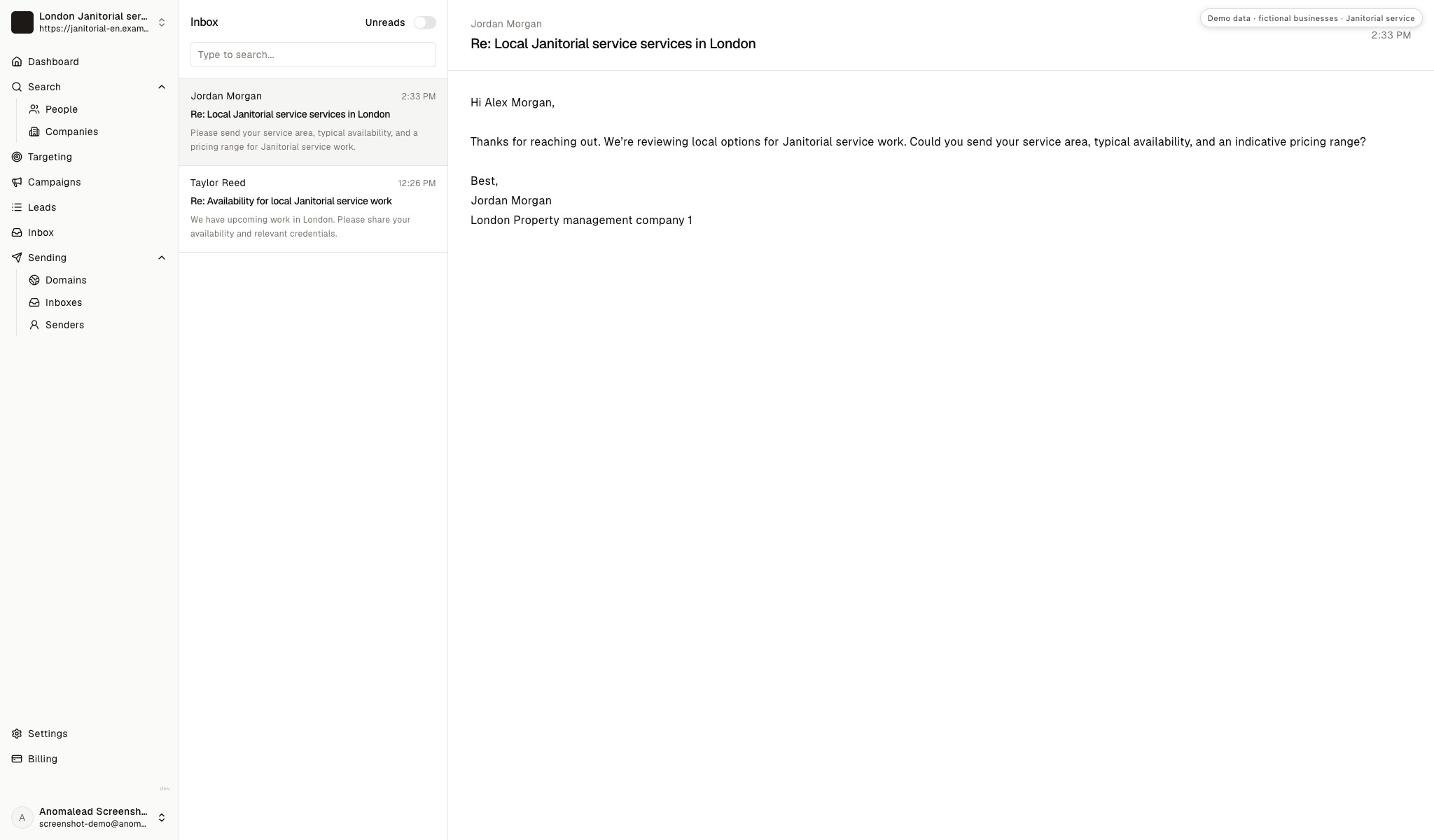
Section titled: Use the inbox to identify the next decisionThe demo inbox shows two fictional replies. Jordan Morgan asks for service area, typical availability and an indicative pricing range; Taylor Reed asks about upcoming availability, the work covered and credentials. Their questions call for different follow-ups, and the records do not show real purchase intent.
Answer the questions behind a janitorial request
Section titled: Answer the questions behind a janitorial requestTreat an interested reply as a scope conversation, not permission to send a generic rate card. Clarify the building routine, service window, access and supply duties before quoting, and answer credential questions with documents your business actually holds.
Jordan Morgan asks for coverage, availability and a pricing range
Section titled: Jordan Morgan asks for coverage, availability and a pricing rangeWe are comparing routine cleaning cover for occupied buildings. Which visit windows and washroom supply tasks can your team handle, and what site details would you need before indicating a price?
The first fixture reply asks for an indicative range, but a rate without the visit schedule and room scope can mislead both sides. Share the territory and capacity you can confirm, explain what information affects a proposal, and ask about occupied hours, task frequency and who supplies washroom stock.
A reply that moves toward a comparable scope:
Thanks Jordan. Alex Morgan. We can confirm availability and prepare a useful price once we understand the service window, room list and supply responsibilities. Could you share the routine coverage you’re reviewing for London Property management company 1?
Taylor Reed asks about availability, work covered and credentials
Section titled: Taylor Reed asks about availability, work covered and credentialsWe are reviewing cleaning cover for early and late building shifts. Which recurring areas can your team service, and what current credentials can you provide for those tasks?
The second fixture reply is an opening to establish fit. Give a truthful availability statement, list the recurring tasks in scope and attach only current credentials that apply; ask about the site schedule and onboarding process before promising a start date.
A concise answer with a scope question:
Thanks Taylor. I can send our current coverage and the credentials relevant to the work we perform. To check whether we can staff the request, could you share the site service window and routine tasks London Property management company 2 needs covered?
The facility already has a cleaning contractor
Section titled: The facility already has a cleaning contractorWe have a provider in place and are not looking to change the routine service at the moment.
Respect the existing contract and do not criticize the incumbent. If your business genuinely offers relief or overflow cover, ask whether the manager wants those details; otherwise request permission to reconnect near the next supplier review.
They ask whether every shift can keep the same standard
Section titled: They ask whether every shift can keep the same standardHow do you keep the cleaning consistent when the regular team member is away?
Explain the supervision, task records and relief plan you actually use. Avoid a blanket guarantee until you have checked the building schedule and staffing model; describe how a site issue is logged and who responds.
An honest answer that checks the service window:
We use an agreed task schedule and a supervisor check to make cover handovers clear. I can confirm the arrangements for your site after reviewing the service windows and access process. Which shifts would the contract need covered?
Set up the next prospecting block
Section titled: Set up the next prospecting blockChoose one type of occupied site, write down the shift and task pattern your crew can support, then qualify a small set of facility-led accounts against that scope. Save the buying role, access questions, supply split and review timing in your notes so each first email can address a real operating detail.
Janitorial outreach should center on a repeatable service routine. For a separate campaign aimed at property managers buying recurring cleaning across managed buildings, compare the distinct buyer path in commercial cleaning lead generation.
Janitorial client acquisition questions
Section titled: Janitorial client acquisition questionsHow can a janitorial company find facility managers?
Section titled: How can a janitorial company find facility managers?Search within the territory your crews can cover, then review property organizations and the sites they operate. Use enrichment to find likely facilities or building contacts, and verify who owns the cleaning schedule before sending a service pitch.
What should go into a janitorial contract prospect’s scope?
Section titled: What should go into a janitorial contract prospect’s scope?Describe the spaces, recurring tasks, service windows, inspection process and responsibilities for supplies and waste. Confirm how staff receive access and how the site reports a missed task before preparing a price.
How is janitorial prospecting different from commercial cleaning?
Section titled: How is janitorial prospecting different from commercial cleaning?This guide focuses on facility managers responsible for the ongoing routine inside occupied sites, including shift coverage, consumables and service checks. A campaign for property managers may instead center on cleaning coverage across their managed portfolio, so qualify the buyer and service scope separately.
Are the businesses and inbox replies in the screenshots real?
Section titled: Are the businesses and inbox replies in the screenshots real?No. London Janitorial service Services, the three London Property management company records, Jordan Morgan, Taylor Reed and the replies are fictional seeded demo data. They are not Anomalead customers and do not show real outreach results.
What does the ROI calculator predict for a janitorial contract?
Section titled: What does the ROI calculator predict for a janitorial contract?It does not predict whether a facility will sign or account for the labor and supply details of a specific building. Enter your own planning assumptions and use the output to consider whether the opportunity deserves further qualification.