


Fence contractor lead generation works best when you approach property managers who coordinate recurring maintenance across a portfolio, not just one fence replacement. They need a dependable way to inspect damaged boundaries, distinguish a repair from a larger scope, arrange access, and document work across occupied sites.
A useful first conversation is about the manager’s vendor process and the properties your crew can cover. It should not assume a specific site has a problem. Start with B2B prospecting basics, then shape your outreach around portfolio maintenance, safe access, and clear work records.
Key takeaways
- Target property managers with several relevant sites and a way to approve recurring exterior maintenance vendors.
- Qualify fence type, ownership responsibility, access rules, inspection process, and repair capacity before proposing a site visit.
- Separate a localized repair from replacement by documenting the affected run, posts, gates, material, and site constraints.
- Use the calculator for your own outreach and service assumptions; it does not forecast projects, revenue, or accepted work.
Which property managers should a fence contractor approach?
Section titled: Which property managers should a fence contractor approach?Start with property managers who coordinate maintenance at multiple properties and can explain how vendors are added, approved, and dispatched. A portfolio creates a reason to discuss consistent inspection and repair coverage, but it does not prove that a fence needs work.
- Residential rental portfolio managers: A manager responsible for several occupied rental communities may coordinate perimeter checks, damaged panels, gates, and tenant access. Ask how exterior work enters the maintenance queue and whether the manager or property owner approves a contractor. Do not treat a high unit count as evidence of a current repair.
- Commercial property managers: Office, retail, and light industrial sites can have different boundary layouts, vehicle gates, operating hours, and access controls. A manager may value one vendor who can inspect several sites and return comparable records. Confirm which sites fall within your service area and which owner signs off on a scope.
- Community association managers: Association managers often coordinate common-area upkeep while boards or committees approve larger replacements. Learn whether the manager can authorize a site review, what information the board expects, and how residents receive notice before crews enter shared spaces.
- Regional property operators with local teams: A regional operator may set vendor standards centrally while local managers control keys, tenant notices, and work windows. Find the right split: procurement for onboarding, then the local site contact for inspections and dispatch. Your coverage plan should name the areas you can actually serve.
The strongest prospect is a decision path, not simply a large portfolio. Look for a manager who can identify maintenance ownership, approval steps, and a practical way to coordinate access.
Qualify the maintenance process before saving an account
Section titled: Qualify the maintenance process before saving an accountAsk operational questions that tell you whether recurring fence work fits your crew. Keep the discussion at the property and vendor-process level until an authorized manager requests an inspection or estimate.
- Service-area and route fit: Map the managed sites against where your crews, materials, and equipment can reach them. A portfolio spread beyond your practical dispatch area can turn a multi-site opportunity into disconnected trips. Confirm how the manager groups work orders and whether local teams can request service directly.
- Fence assets and likely scope: Ask what fence types are present and whether the manager needs routine condition checks, isolated repairs, gate work, or planned replacement. Timber posts, chain link, ornamental metal, and vinyl have different repair methods and materials. Avoid diagnosing a property from a directory listing or promising a replacement before a site review.
- Responsibility and approval: Boundary ownership can be shared or governed by lease, association, or property documents. Ask who is authorized to request a site visit and who approves work that affects a common area or neighboring boundary. Do not ask a tenant or unverified contact to authorize a project.
- Access, occupants, and ground work: Find out how the manager arranges keys, gate codes, tenant notices, pets, loading areas, and restricted work windows. If a scope involves digging or new posts, confirm the local utility-location and permit process before scheduling. The property manager should coordinate permissions; your crew should follow the requirements that apply to the site.
- Records, onboarding, and crew capacity: Check what the vendor file requires, such as insurance documents, safety information, references, work-order details, before-and-after photos, or closeout notes. Be honest about inspection slots, crew availability, and the sites you can service. Ask whether the manager wants one portfolio contact or a separate approval for each property.
About the demo information
The demo operator is the fictional London Fence contractor Services. London Property management company 1, London Property management company 2, London Property management company 3, Jordan Morgan, Taylor Reed, and the displayed replies are fictional examples. They are not Anomalead customers, real property managers, service requests, completed jobs, or results.
Fence contractor lead generation starts with portfolio fit
Section titled: Fence contractor lead generation starts with portfolio fitSearch for property management companies within the places your crews can reach, then compare each account with your fence work and capacity. Public company details help you decide whom to research; they do not establish that a particular boundary is damaged or that the company needs a contractor.
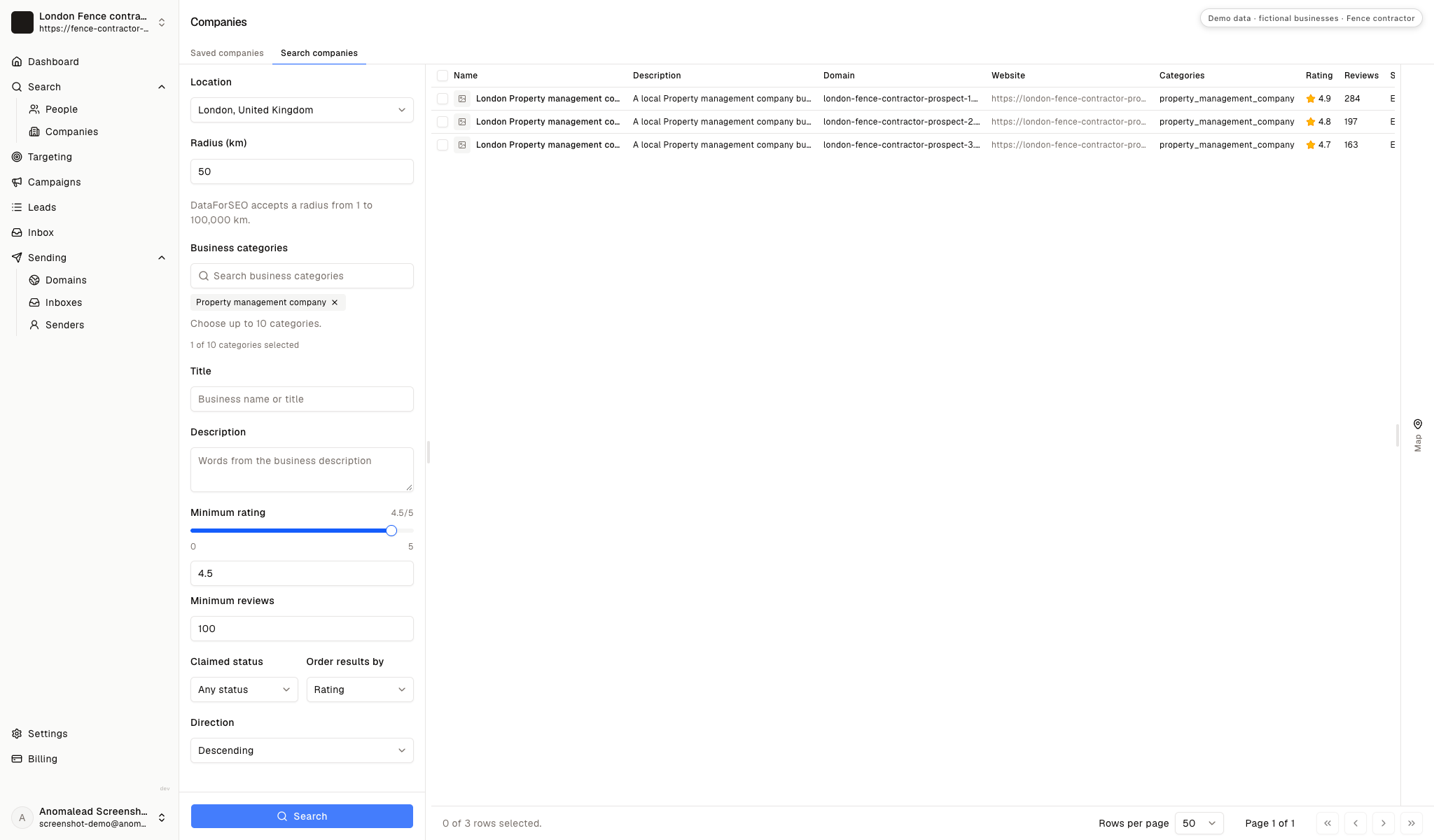
The demo shows a search form, three generic property management listings, two selected prospects, one saved company, enriched contacts, a contact list, a campaign draft, a three-email sequence, and inbox replies. It does not show fence assets, inspection findings, or repair outcomes. Use a local prospecting workflow to record what you can verify and keep assumptions separate.
Set the search around the area your crews can cover
Section titled: Set the search around the area your crews can coverChoose your service location, workable radius, property management category, and any available rating filter. These controls narrow company research; they do not identify a site with fence damage.
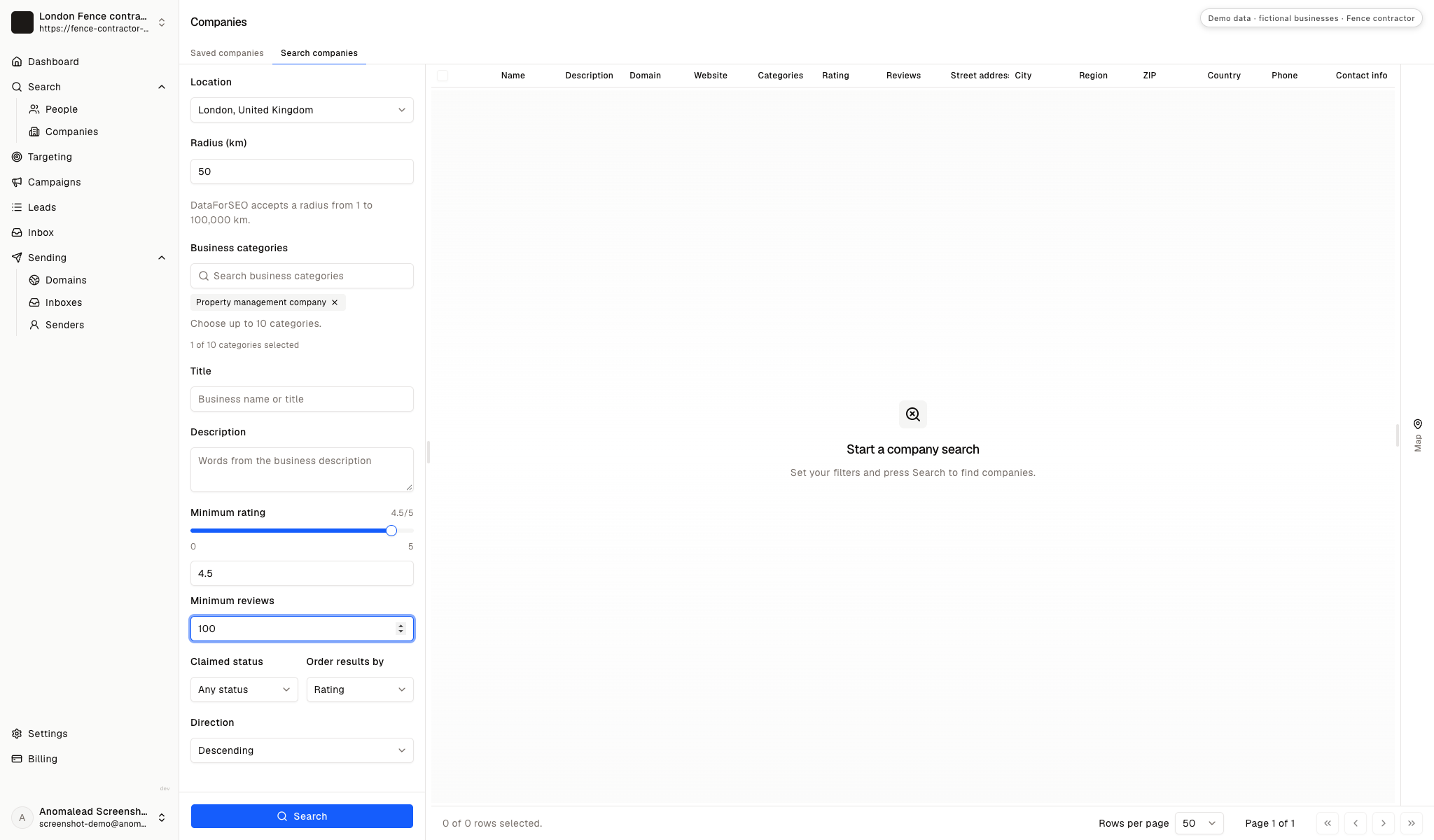
Review company listings without inferring a repair need
Section titled: Review company listings without inferring a repair needThe sample cards provide general business details and public review information. They reveal neither fence assets nor maintenance requests at any property.
Save only accounts with a plausible maintenance route
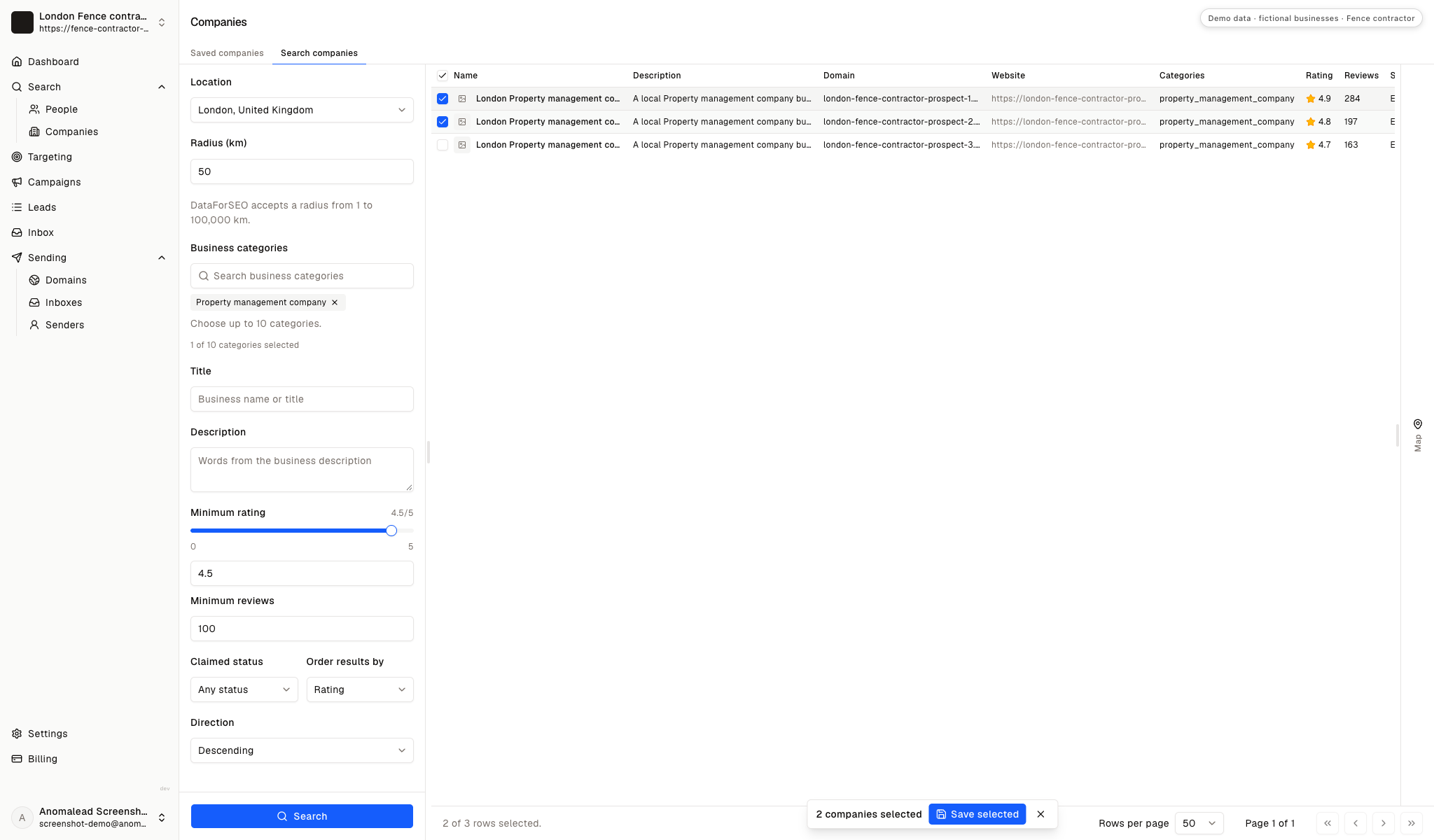
Section titled: Save only accounts with a plausible maintenance routeTwo of the three fictional listings are selected. In your own search, save a company only when its public details suggest a property-management role that could discuss exterior maintenance vendors.
Enrich the shortlist and find the vendor contact
Section titled: Enrich the shortlist and find the vendor contactA portfolio maintenance conversation may involve both procurement and site operations. Procurement explains insurance, onboarding, and vendor approval; a regional or site manager knows work-order routing, access, and who can authorize an inspection. Verify the current role before sending a proposal.
Keep your notes useful for dispatch: locations served, fence types if publicly documented, vendor onboarding steps, and the source of each fact. Do not invent asset conditions or store tenant access codes in prospect notes. For a second property-maintenance angle, landscaping lead generation also depends on portfolio coverage and coordination with site teams.
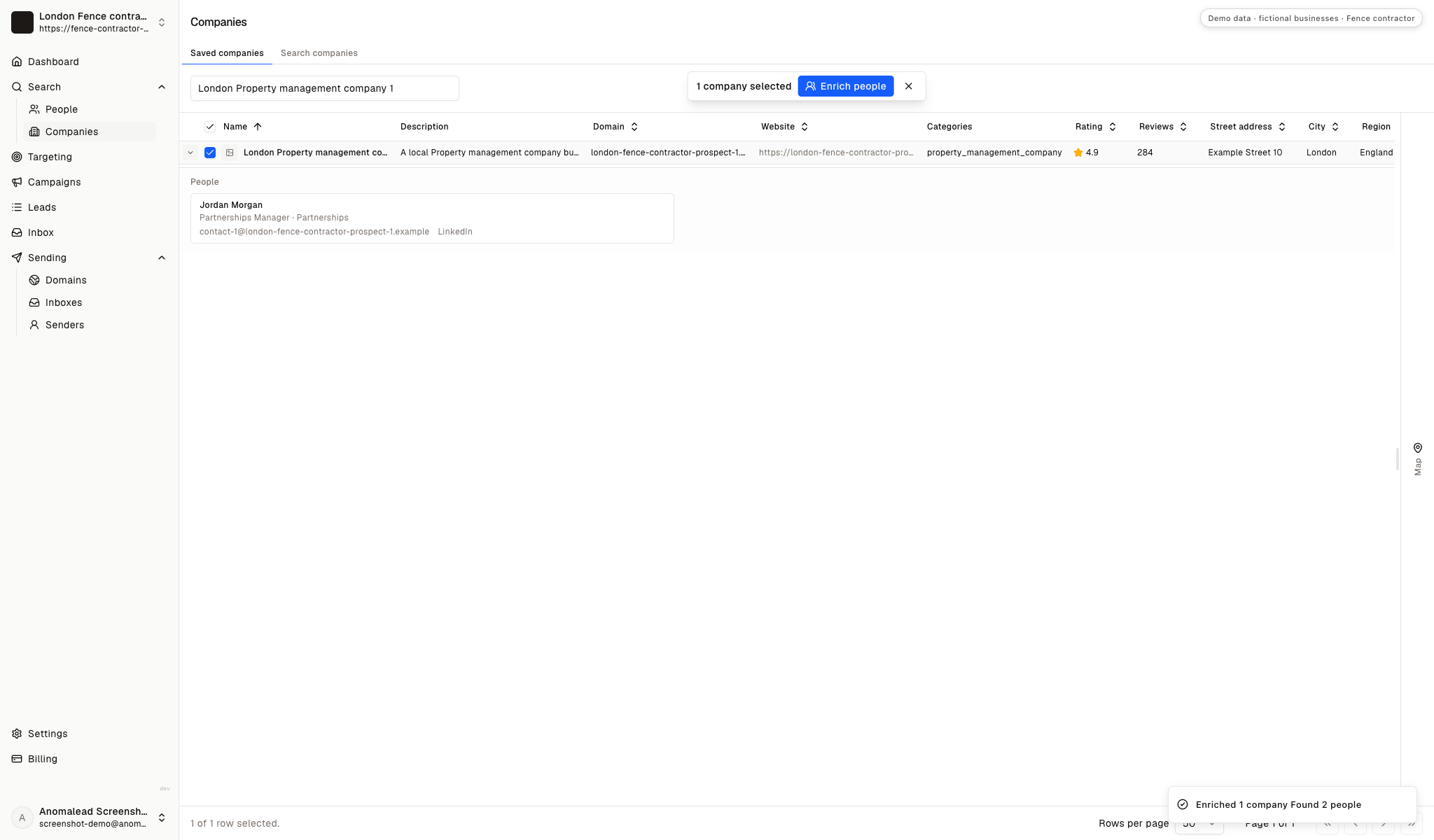
Check the saved account before enriching contacts
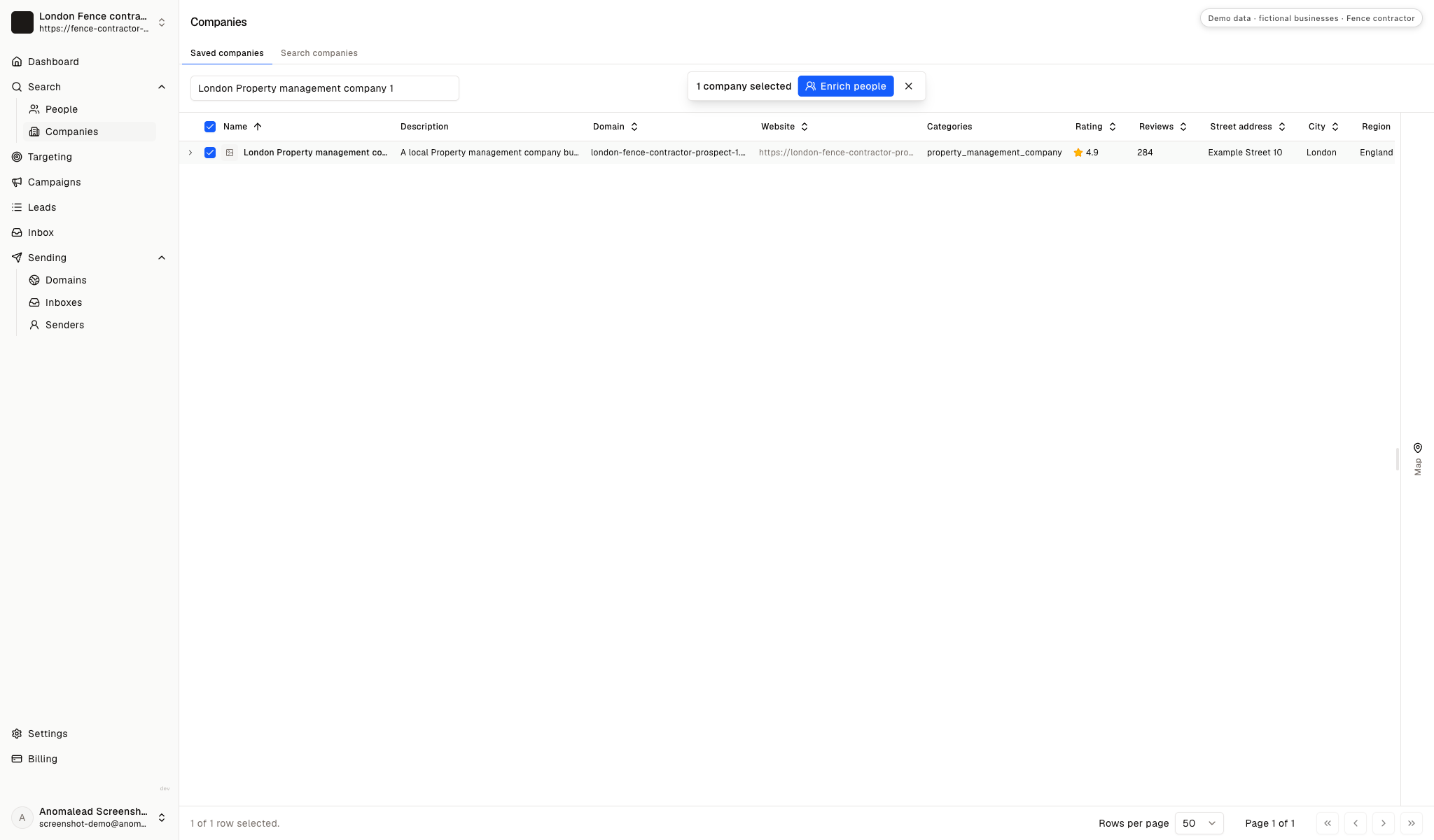
Section titled: Check the saved account before enriching contactsOne saved property management company is selected before contact enrichment. Confirm that the account operates in your territory and has a vendor process worth discussing.
Use contact titles as clues to verify
Section titled: Use contact titles as clues to verifyThe fictional Jordan Morgan and Taylor Reed appear as Partnerships Managers. Those demo titles do not establish responsibility for property procurement, maintenance, or site access.
Record vendor process beside each contact
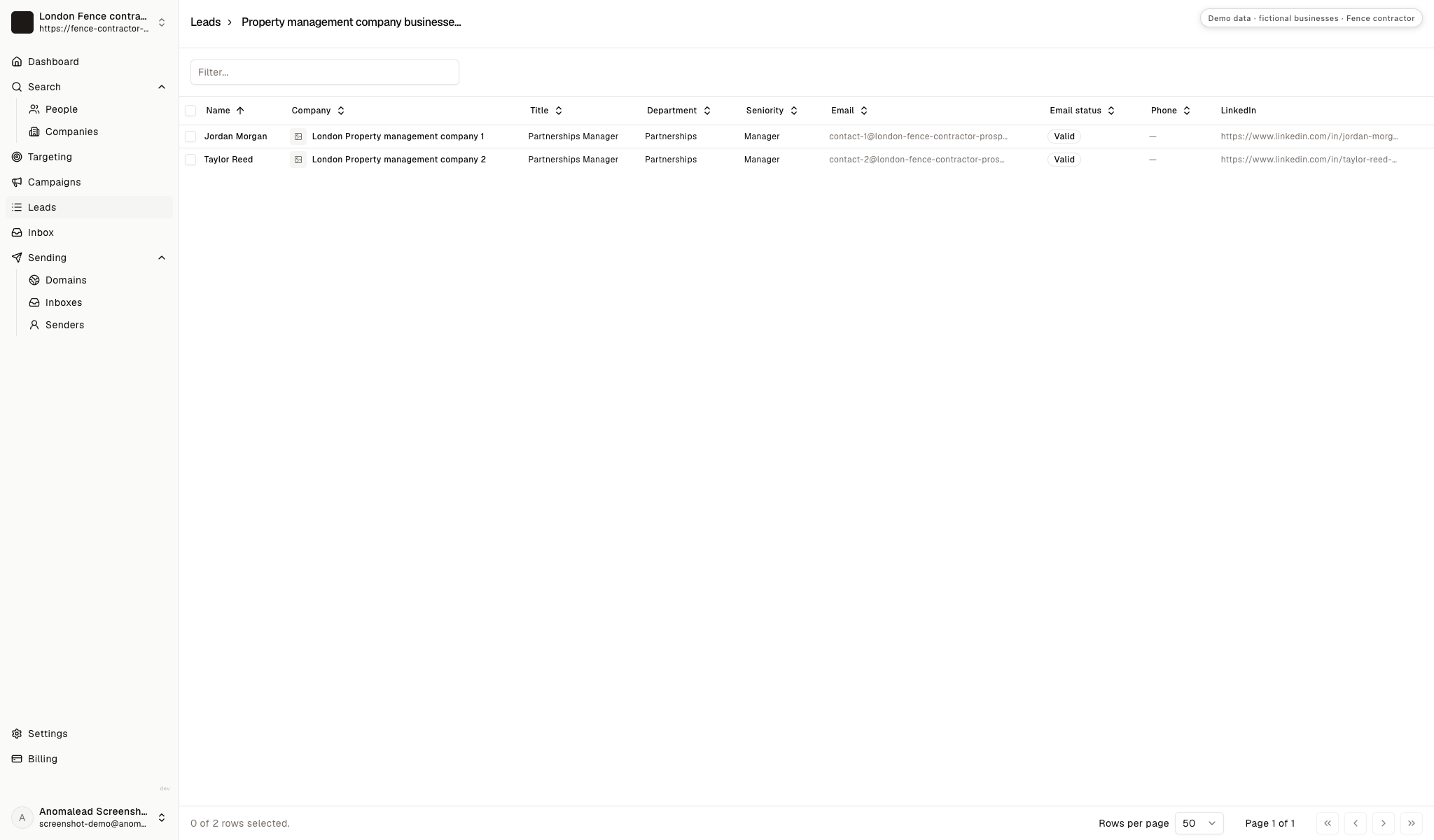
Section titled: Record vendor process beside each contactThe contact list shows two fictional company contacts and email status. In your own records, note the role source, vendor approval route, and service-area fit, not unverified fence conditions.
Estimate the value of a recurring portfolio relationship
Section titled: Estimate the value of a recurring portfolio relationshipA property manager may need periodic inspections, isolated repairs, gate adjustments, or a planned replacement scope across sites. The value to your business depends on the actual assets, your labor and material requirements, access constraints, and the manager’s approval process.
A large account is not automatically a good fit. A scattered portfolio, difficult access windows, unfamiliar fence systems, or limited crew capacity can make the work unsuitable even when there are many properties.
Enter your own assumptions for prospecting time, site visits, estimating, travel, maintenance work, and closeout records. The calculator does not predict repair requests, awarded contracts, revenue, profit, or fence condition.
Do the math on one good deal
If one new customer is worth thousands, you don’t need magic. You need a few more meetings a month.
Projected monthly results
- Deals closed
- 2.0
- Projected revenue
- £10,000
- Growth plan (1 business)
- £79/mo
- ROI
- 12,558%
Conservative math on meetings you already believe you can book. One closed deal often pays for a year of Anomalead.
Use it to compare your own workload scenarios, then qualify scope and access with an authorized property manager before preparing an estimate.
Offer a clear maintenance conversation, not an assumed project
Section titled: Offer a clear maintenance conversation, not an assumed projectA first campaign should ask how the property manager reviews exterior maintenance vendors and whether your service area is relevant. Give a concise view of inspection, repair, and replacement capabilities, then let the manager decide whether to discuss a portfolio or a particular site.
Do not state that you found damage, suggest a fence is unsafe without an inspection, or promise a response window you cannot meet. Keep the message easy to route to procurement or the local property team. Cold email examples can help with a concise structure, but make the question specific to the manager’s vendor process.
Choose recipients who can route the vendor question
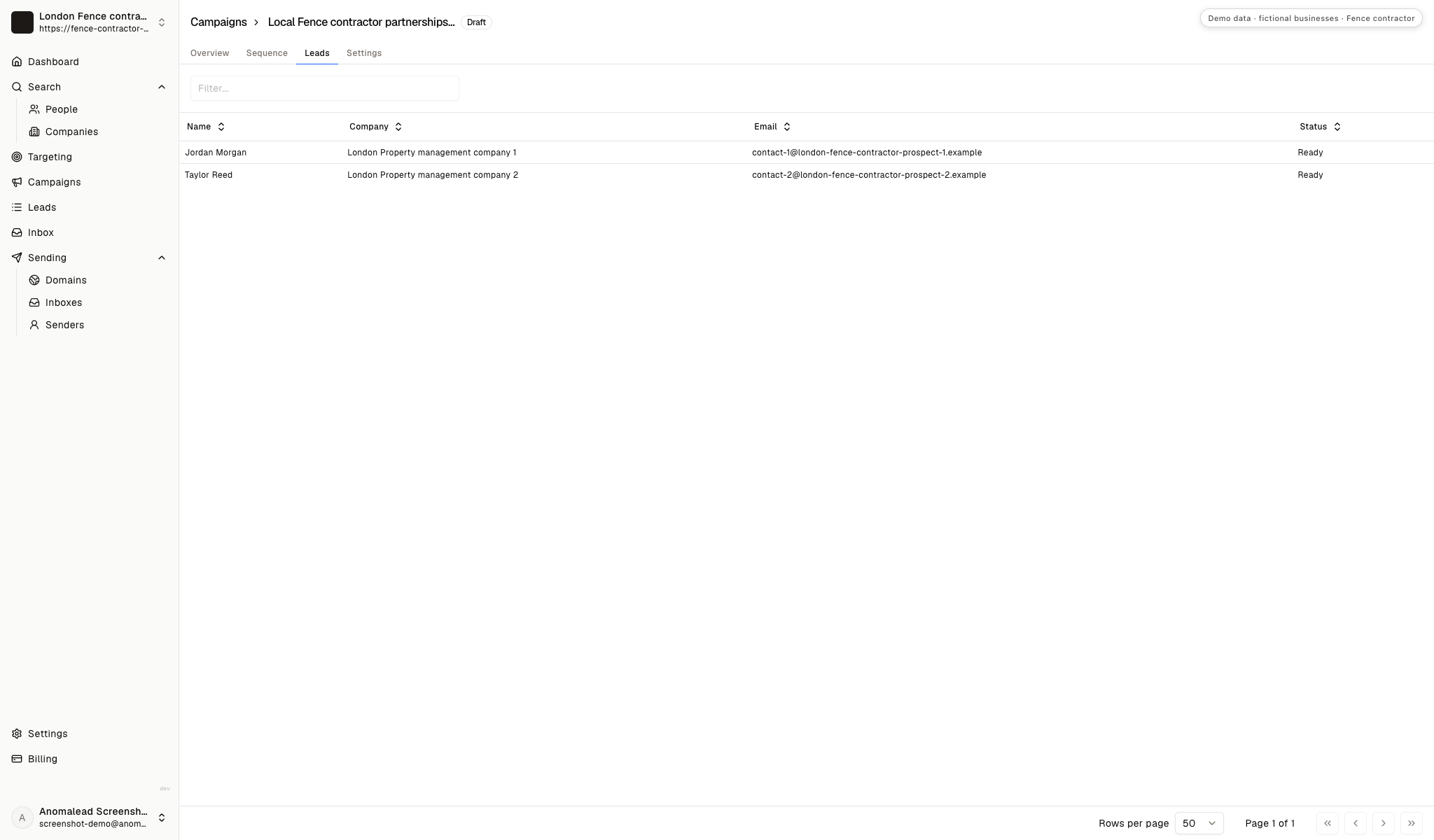
Section titled: Choose recipients who can route the vendor questionThe draft campaign shows two fictional recipients and the demo operator as sender. Check each real recipient’s role and whether vendor onboarding or portfolio maintenance belongs with them.
Review every follow-up for relevance and consent
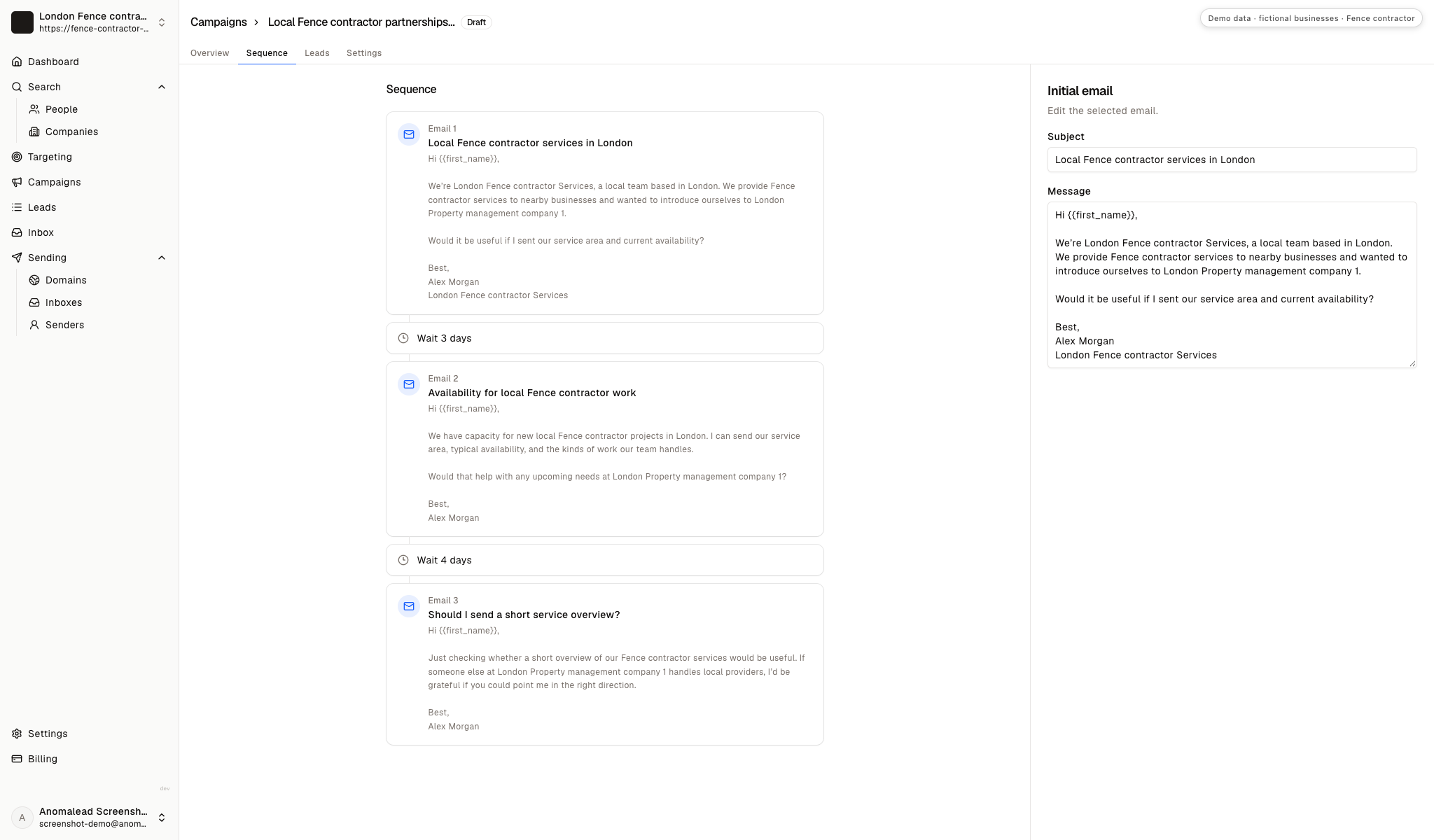
Section titled: Review every follow-up for relevance and consentThe demo sequence contains three email drafts with waiting periods between them. Replace generic copy with a useful question, and stop follow-ups when a company declines or asks not to be contacted.
Write to the portfolio manager about vendor fit
Section titled: Write to the portfolio manager about vendor fitUse one question in each message. Jordan Morgan and Taylor Reed are fictional contacts in the demo; verify a real recipient’s responsibilities before writing.
First email to confirm the vendor route
Subject: Fence maintenance coverage for your managed properties
Hi Jordan,
I’m Alex Morgan with London Fence contractor Services. We handle fence inspections, repairs, gate work, and planned replacement for property teams within our service area. Our work starts with confirming the asset, access, and approval route before we scope a site.
How does your team review local fence contractors for recurring maintenance across managed properties?
Best, Alex Morgan, London Fence contractor Services
Follow-up about portfolio coverage
Subject: Re: Fence maintenance coverage for your managed properties
Hi Taylor,
I wanted to clarify that I’m asking about your vendor process, not assuming one of your sites needs repair. Our team can discuss condition checks, isolated repairs, or a replacement scope after the authorized manager confirms the property and access details.
Would a short service-area and onboarding summary help you decide whether we fit your local vendor list?
Best, Alex Morgan
Use a clear cold email opening, and keep the next step tied to the recipient’s role rather than an unverified site issue.
Read replies as a request to qualify scope
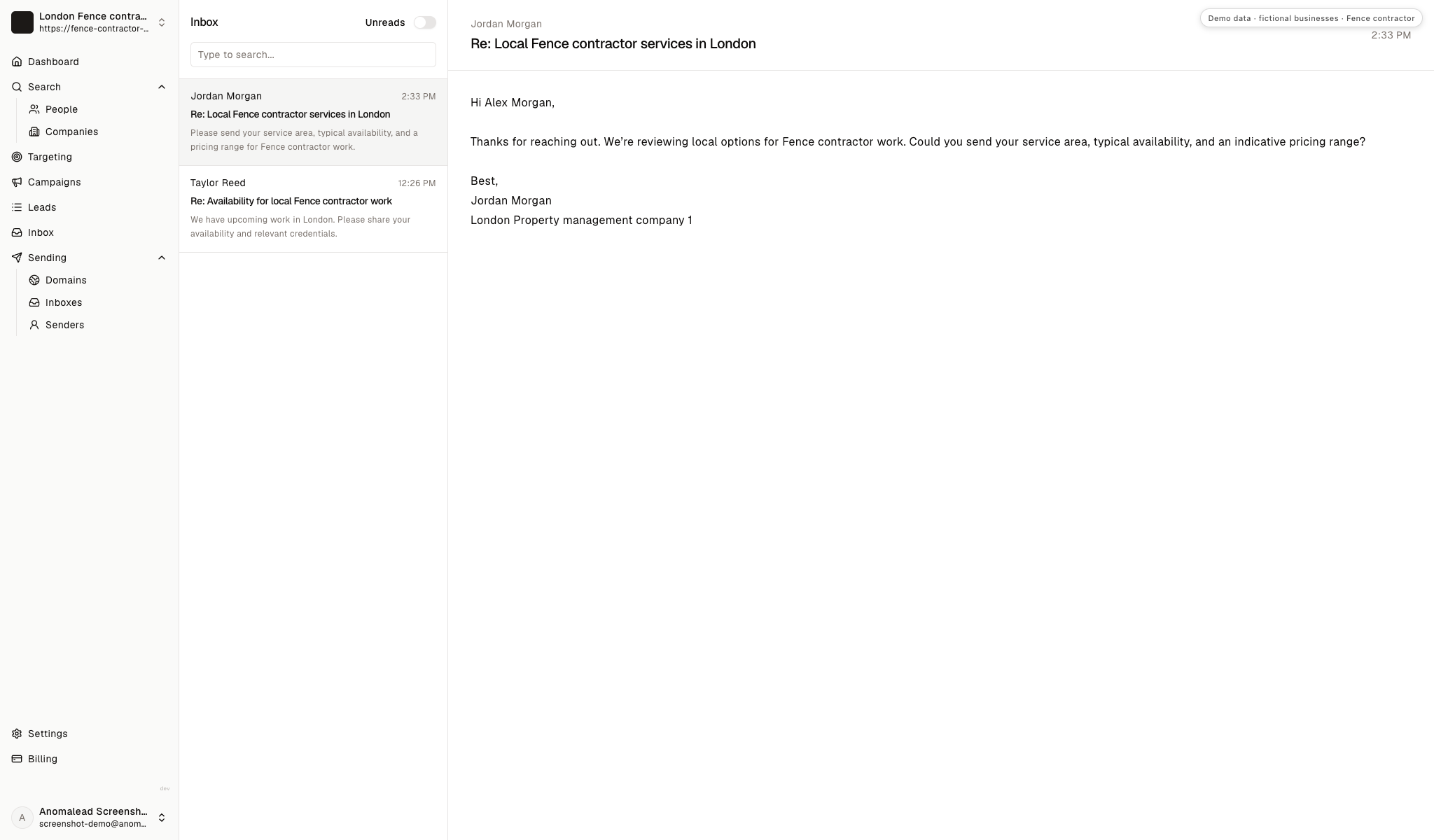
Section titled: Read replies as a request to qualify scopeThe inbox shows two fictional replies asking about service area, availability, indicative pricing, and credentials. They do not show an inspection request, approved work order, or confirmed project.
How to respond to property manager replies
Section titled: How to respond to property manager repliesThe fixture replies ask for service information and credentials. Answer with what your business can verify, then ask for the details needed to route any real maintenance request.
Jordan asks about service area, availability, and pricing
Section titled: Jordan asks about service area, availability, and pricingPlease send your service area, typical availability, and an indicative pricing range for fence work.
Reply with the locations and fence services you actually cover. Do not invent a rate or quote a project without knowing fence type, length, access, removal needs, ground conditions, and whether the request is repair or replacement.
Explain how availability is confirmed after scope and site access are understood. If useful, ask who can authorize an inspection and what vendor onboarding documents the property team needs.
Give a useful answer without guessing at cost:
Thanks, Jordan. We can send our current service area and the types of fence work our crew handles. Pricing depends on the fence system, affected run, access, and whether posts or full sections need replacement, so we would confirm scope before estimating. If a site visit is appropriate, who on your team can authorize it and share the access process?
Taylor asks about upcoming work, availability, and credentials
Section titled: Taylor asks about upcoming work, availability, and credentialsWe may have fence work coming up. Please share your availability, the work your team covers, and relevant licenses or credentials.
This matches the second fixture reply. Share current, verifiable qualifications and describe repair, gate, inspection, and replacement work your team is equipped to perform. Do not claim a credential or promise a crew date unless you have checked it.
Ask whether the request concerns a recurring portfolio review or an approved site work order. Before dispatch, confirm the authorized contact, tenant notice, access window, utilities or digging requirements, and how the manager wants closeout documented.
Confirm the next operational detail before offering a date:
Thanks, Taylor. We can provide our current service coverage, relevant credentials, and a concise outline of our inspection and repair scope. We confirm scheduling after the property, work area, approval, and access requirements are clear. Is this for a portfolio vendor review or a specific site request?
The manager says an existing vendor already handles fences
Section titled: The manager says an existing vendor already handles fencesWe already have a contractor for routine fence calls.
Acknowledge the existing arrangement and ask only whether the manager keeps a secondary vendor for overflow, different fence systems, or planned replacement. Do not press for details about the current contractor or an unreported site problem.
Leave a practical option for later:
Thanks for letting me know. Please keep your current process in place. If you review backup coverage or a scope outside that vendor’s service area, I can send our service details for your team to consider.
The manager wants a quote from a brief description
Section titled: The manager wants a quote from a brief descriptionA section is leaning at one of our properties. Can you give us a replacement price from this note?
Do not diagnose the cause or price a replacement from a short note. Clarify who owns the boundary, what portion is affected, whether the manager can authorize a site review, and whether tenants or neighboring property access must be coordinated. A site inspection can distinguish repair from replacement.
Set a responsible estimating step:
I can help scope it, but a note alone is not enough to determine repair or replacement. If you are authorized to request a visit, please share the property contact and access procedure. We can document the affected run and provide an estimate after checking the fence and site conditions.
Before you send the next batch
Section titled: Before you send the next batchChoose one property-management segment that matches your crews and build a shortlist from public business information. Verify who owns vendor onboarding, where the sites are, and how maintenance work is approved before you propose a call or inspection.
Prepare a compact vendor packet with service territory, fence systems handled, verified insurance and credentials, inspection records, and a clear access checklist. Use marketing planning for small teams only where the same property managers coordinate outdoor maintenance; keep the offer specific to fences.
Fence contractor lead generation questions
Section titled: Fence contractor lead generation questionsWhich property manager is the right contact for fence maintenance?
Section titled: Which property manager is the right contact for fence maintenance?Start with the person who can explain vendor approval and route a maintenance request, often a property manager, regional operations lead, or procurement contact. The site manager may handle access while an owner or central team approves replacement work, so confirm both roles before estimating.
Should a contractor pitch inspections or wait for a repair request?
Section titled: Should a contractor pitch inspections or wait for a repair request?A brief conversation about the manager’s inspection and vendor process can be appropriate when the company coordinates recurring property maintenance. Do not claim that a fence is damaged based on a listing; offer an inspection only after an authorized manager confirms the site and access.
What details help separate fence repair from replacement?
Section titled: What details help separate fence repair from replacement?A site review should identify the fence material, affected run, post condition, gate operation, access constraints, and any removal or ground work. The property manager should confirm who owns or controls the boundary and who can approve the scope.
Are the businesses shown in the demo real?
Section titled: Are the businesses shown in the demo real?No. The property management listings, contacts, and inbox replies are fictional fixture data. They are not Anomalead customers, real work requests, completed jobs, or evidence of contractor results.
What does the ROI calculator predict?
Section titled: What does the ROI calculator predict?It helps you model assumptions about your own prospecting and delivery effort. It does not predict repair demand, awarded work, revenue, profit, or the condition of a property’s fences.