

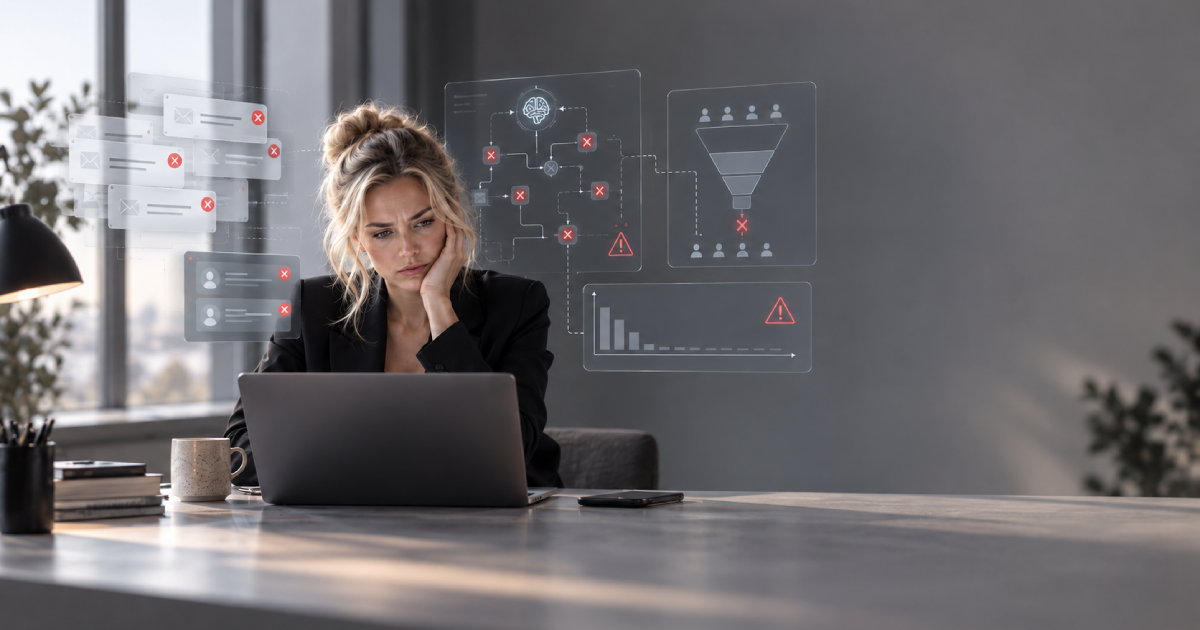
Every AI automation agency pitches the same thing: save time, cut costs, automate the busywork. In 2026, generic AI-generated cold email converts below 1% in most B2B sectors (bizaigenius, Why AI Automation Agency Cold Outreach Fails, 2026), a figure consistent with the sub-1% floor reported for unoptimized campaigns by Amplemarket and Saleshandy (2026). The pitch is fine. The delivery is the problem.
That's not a small gap. It means an agency sending 1,000 cold emails a month books fewer than 10 replies, and a meaningful share of those never even reach an inbox before a spam filter or a bulk sender rule intercepts them. This post breaks down why that's happening in 2026 specifically, and what the agencies still booking calls are doing instead.
Key takeaways
- Generic AI-personalized cold email converts below 1% in most B2B sectors, while top-quartile campaigns with verified lists still hit 5.5%+ (Amplemarket, 2026; Saleshandy, 2026)
- Since November 2025, Gmail rejects noncompliant bulk senders outright with a 5xx error instead of sending them to spam (Redsift, 2026)
- 88% of B2B buyers expect personalized outreach, but only 41% of vendors deliver it, and 73% actively avoid vendors who send irrelevant messages (Markettailor, 2026)
- The AI agent market grew from $8.03B in 2025 to a projected $11.78B in 2026 (Layer3Labs, 2026), which means more agencies are competing for the same inboxes with less differentiation, not more
What's actually broken about AI automation agency cold outreach in 2026?
Section titled: What's actually broken about AI automation agency cold outreach in 2026?The core problem is that automation removed the friction that used to cap outreach volume, and that friction was doing more work than anyone gave it credit for. In 2026, the average cold email reply rate across all industries sits at 3.43%, but an analysis of over 1.37 million emails found the real average closer to 2.09% (Cleanlist, Cold Email Response Rate — 2026 Data, 2026). Generic AI outreach falls well below even that.
Here's the mechanism nobody talks about: writing a genuinely researched cold email used to take 15 to 20 minutes per prospect, so a founder could only send maybe 30 a day before burning out. AI collapsed that cost to seconds, so the same founder now sends 500. The email quality per prospect dropped, but the total inbox pressure across every recipient's mailbox went up by an order of magnitude. Volume didn't replace quality; it just made mediocre quality visible at scale, and spam filters were built to catch exactly that pattern.
Every automation agency pitching "save time with AI" sounds like every other automation agency pitching "save time with AI." When a prospect gets three nearly identical emails in one week, all opening with a compliment about their "impressive growth," the fourth one gets deleted unread regardless of what it actually says.
Why does generic AI personalization get you flagged as spam?
Section titled: Why does generic AI personalization get you flagged as spam?Mailbox providers can now detect templated, mass-personalized copy with high accuracy, which means agency outreach frequently never reaches a human at all (bizaigenius, 2026). If an email could be sent to any company in any industry with three words swapped, that's the exact pattern spam classifiers are trained to catch.
This is a shift from a few years ago. Personalization tokens ({{firstName}}, {{companyName}}, a scraped LinkedIn headline) used to be enough to pass as human-written. Filters have since caught up to sentence-structure patterns, not just keyword stuffing, so swapping in a variable no longer disguises a template underneath it.
Buyers have caught up too. 88% of B2B practitioners say their buyers expect personalization, but only 41% say they actually deliver it at that level, and 73% of B2B buyers now actively avoid vendors that send irrelevant outreach (Markettailor, The State of B2B Personalization 2026, 2026). That's the gap most AI automation agencies are stuck in: pitching personalization at scale while every recipient can tell it's still a template.
The fix isn't fewer variables; it's a different unit of personalization. Buyers in 2026 expect messages to reference their actual business problem, not their business card.
How did Gmail and Yahoo's 2026 rules change the math?
Section titled: How did Gmail and Yahoo's 2026 rules change the math?Since November 2025, Gmail rejects noncompliant bulk mail outright with a 5xx error instead of routing it to spam, meaning the message never arrives anywhere a person could find it (Redsift, 2026 bulk email sender requirements checklist, 2026). That's a harder failure than landing in a spam folder: there's no recovery, no chance a prospect digs it out later.
Any domain sending 5,000 or more messages a day to Gmail addresses is permanently classified as a bulk sender, which triggers mandatory SPF, DKIM, and DMARC alignment, one-click unsubscribe, and a spam complaint rate held under 0.3% (with Google specifically targeting under 0.1%) (Redsift, 2026). Hit 0.3% and you lose access to Google's mitigation tools until you hold below that line for seven consecutive days.
Domain reputation compounds this. Deliverability problems start appearing above a 0.1% spam rate, degrade meaningfully between 0.2% and 0.5%, and create real blacklist risk above 0.5% (Reachly, Domain Reputation Cold Email: 2026 Guide, 2026). Roughly 23% of all cold email deliverability failures trace back to domain reputation alone, not copy or targeting.
| Threshold | What happens |
|---|---|
| Under 0.1% spam rate | Considered safe; excellent senders stay under 0.02% |
| 0.1%–0.3% spam rate | Deliverability starts degrading; Gmail's compliance line sits at 0.3% |
| 0.3%–0.5% spam rate | Lose access to Google mitigation tools; must hold under the line for 7 days to regain it |
| Above 0.5% spam rate | High risk of outright blacklisting |
Source: Redsift, 2026 bulk email sender requirements checklist, 2026; Reachly, Domain Reputation Cold Email, 2026
Why doesn't sending more volume fix a broken message?
Section titled: Why doesn't sending more volume fix a broken message?Sending more emails through a broken system doesn't dilute the problem, it multiplies it. Campaigns targeting fewer than 50 recipients average a 5.8% reply rate, nearly three times the 2.1% seen in large blasts (Saleshandy, I Analyzed 53M Cold Emails, 2026). Smaller, more targeted sends outperform larger ones because the sender actually has time to research each prospect.
Put the market-growth stat next to the adoption stat and the real problem shows up. The AI agent market grew from $8.03B in 2025 to a projected $11.78B in 2026, a 46.61% CAGR (Layer3Labs, 2026). But only about 18% of U.S. firms had adopted AI by the end of 2025, and just 14% of small and mid-sized businesses have it fully embedded (Layer3Labs, 2026). Content saturation isn't the same as delivery saturation: there are more agencies pitching AI automation than there are businesses that have actually implemented it, which means the demand exists, but it's buried under a wall of nearly identical pitches competing for the same skeptical inbox.
Verified email lists get roughly double the reply rate of unverified ones (Cleanlist, 2026), which means a smaller, cleaner, more relevant list beats a bigger one every time volume and precision trade off against each other.
What does AI automation agency outreach that works in 2026 actually look like?
Section titled: What does AI automation agency outreach that works in 2026 actually look like?The agencies still booking calls in 2026 use AI differently: to support genuine research and sharper positioning, not to replace either one (bizaigenius, 2026). The first follow-up email in a sequence averages an 8.4% reply rate, the highest of any single step, because by then the sender has a specific reason to write back in (Saleshandy, 2026).
Three things separate the outreach that converts from the outreach that doesn't:
- Research replaces tokens. Instead of a scraped headline dropped into a template, the email references a specific, verifiable detail about the prospect's business: a recent hire, a tool they're visibly using, a gap in their public reviews.
- Warm touchpoints come first. A short LinkedIn comment, a piece of content, or a mutual referral before the cold email lowers the "who is this" friction that kills reply rates on a pure cold-first approach.
- Infrastructure is treated as a first-class problem. Domain warmup, authentication, and complaint-rate monitoring get planned before the first send, not patched after a domain gets flagged.
None of this requires abandoning automation. It requires pointing automation at research and infrastructure instead of at writing the fourth version of the same email. That's the model Anomalead is built around for agencies selling into local business niches such as plumbers, dentists, restaurants, clinics, and salons: search Google Maps by category and city to build the list, get the actual owner's email instead of a generic info@ address, and send from domains and mailboxes that are already set up and warmed, so you skip the cold-start deliverability mistakes described above. Every sequence is reviewable before it goes out, nothing sends until a person approves it, and replies land in one shared inbox instead of five disconnected tools.
Agencies running this across multiple clients get client workspaces and whitelabeling on top, so it doesn't turn into a separate stack per account.
Legal services still average a 10% response rate in 2026, the highest of any tracked vertical, largely because the outreach in that space tends to reference a specific, checkable situation rather than a generic pain point (Saleshandy, 2026). That's the model worth copying, regardless of industry.
Frequently asked questions
Section titled: Frequently asked questionsWhy is cold outreach failing for AI automation agencies in 2026?
Section titled: Why is cold outreach failing for AI automation agencies in 2026?Most agencies run the same three AI prompts through the same three tools, so every inbox gets near-identical "save time with AI" pitches. Spam filters now catch templated, mass-personalized copy with high accuracy, and Gmail's 2026 bulk sender rules can reject noncompliant sends outright before a human ever sees them.
What reply rate should an AI automation agency expect from cold email in 2026?
Section titled: What reply rate should an AI automation agency expect from cold email in 2026?Generic AI-generated outreach converts below 1% in most B2B sectors, while the overall market average sits closer to 3.43%. Top-quartile campaigns with clean lists and real research still hit 5.5% or higher, and elite campaigns pass 10%, so the gap is about approach, not the channel being dead.
Did Gmail and Yahoo change the rules for cold email in 2026?
Section titled: Did Gmail and Yahoo change the rules for cold email in 2026?Yes. Since November 2025, Gmail rejects noncompliant bulk mail outright with a 5xx error instead of routing it to spam, so the message never arrives at all. Senders now need SPF, DKIM, and DMARC alignment, one-click unsubscribe, and a spam complaint rate that stays under 0.3%, with Google targeting under 0.1% specifically.
Is cold email dead for AI automation agencies in 2026?
Section titled: Is cold email dead for AI automation agencies in 2026?No, but the version most agencies run is. Legal, consulting, and other high-trust verticals still average 10% reply rates when the list is verified and the message is specific. What's dead is the volume-first model: buying a list, writing one template, and hoping AI personalization tokens carry the rest of the work.
How many emails can an AI automation agency send per day before triggering bulk sender rules?
Section titled: How many emails can an AI automation agency send per day before triggering bulk sender rules?Any domain sending 5,000 or more messages a day to Gmail addresses is classified as a bulk sender permanently, even if volume later drops. Most agency outreach stays well under that threshold per domain, but the same authentication and complaint-rate rules increasingly apply below it too, since Yahoo and Microsoft have tightened their own thresholds in parallel.
The bottom line
Section titled: The bottom lineCold outreach isn't dead for AI automation agencies in 2026; the version that treats it as a volume game is. Generic, templated AI personalization gets caught by smarter spam filters, buyers who've learned to spot it, and bulk sender rules that reject noncompliant mail before it lands at all. The agencies still converting are the ones spending that saved time on research and infrastructure instead of on writing email number four.
If you're rebuilding your outreach approach for 2026, start with the list and the sending setup before touching the copy.