


HVAC lead generation works best when a company chooses buyers that match its services and capacity. Property managers may need dependable maintenance across a portfolio, while facilities teams may need planned servicing and a clear process for urgent requests. This guide follows an HVAC company using Anomalead to find local organizations, check their fit, reach relevant decision-makers and respond to buying signals.
The goal is a repeatable way to build a focused pipeline, not a list of interchangeable businesses. A boiler specialist, a heat-pump installer and a commercial air-conditioning contractor will each qualify prospects differently. If you are new to selling to other businesses, the overview of what B2B lead generation involves explains the basics this workflow builds on.
Key takeaways
- Pick one buyer per campaign, such as residential managing agents or commercial facilities managers, because each one judges an HVAC contractor on different things.
- Qualify every prospect against the plant you service, the area your technicians can reach and your capacity before you look up any contacts.
- Write first emails that name the building type and the maintenance problem, then ask one question that is easy to answer.
- Answer replies the same working day with coverage, response times and insurance in the email itself, and move toward a site visit or asset list.
Which buyers should an HVAC company approach?
Section titled: Which buyers should an HVAC company approach?Start by separating the buyers you want to reach. Each role is responsible for different buildings, decisions and service needs.
- Residential managing agents: They oversee buildings for owners or residents and coordinate maintenance across a portfolio. They need predictable service plans, clear work records and a reliable process for urgent heating problems.
- Commercial facilities managers: They look after offices, retail spaces and other commercial buildings. Expect questions about air conditioning, ventilation, planned maintenance, access arrangements and how your team records completed work.
- Lettings and property management offices: They coordinate repairs and maintenance for individual owners. Work may be more reactive, such as heating faults or equipment inspections, but a well-matched local office can provide repeat work across the areas your team serves.
Pick one of these buyers for each campaign. A single email that tries to speak to all three will read as generic to each of them.
How to qualify HVAC prospects before saving them
Section titled: How to qualify HVAC prospects before saving them- Plant you are qualified for: Check that the buildings and equipment match your team's training, qualifications and services. If a prospect mainly operates systems your technicians do not service, leave it off the list.
- A service area you can cover: Travel time, access arrangements and technician availability all affect the service you can provide. Prioritize businesses with sites your team can reach reliably.
- Portfolio size against your capacity: A large portfolio may require more coverage than you can staff. A smaller account with a manageable number of buildings can be a better first fit while your team builds capacity.
- A local decision-maker: Some organizations choose service providers centrally, while others give local property or facilities managers authority. Check who evaluates contractors before deciding whom to contact.
About the screenshots
The screenshots below come from a demo workspace. Northbank Heating & Air and every property management company, contact and reply shown are fictional businesses created for this guide. They are not Anomalead customers, and nothing in them is a real campaign result.
Find HVAC prospects in Anomalead
Section titled: Find HVAC prospects in AnomaleadThe walkthrough below runs from search to inbox in nine steps, grouped into finding companies, choosing contacts and launching the campaign. At each step you make a small decision that keeps the list tight, so the outreach at the end can be specific.
Choose the buyer category and service area
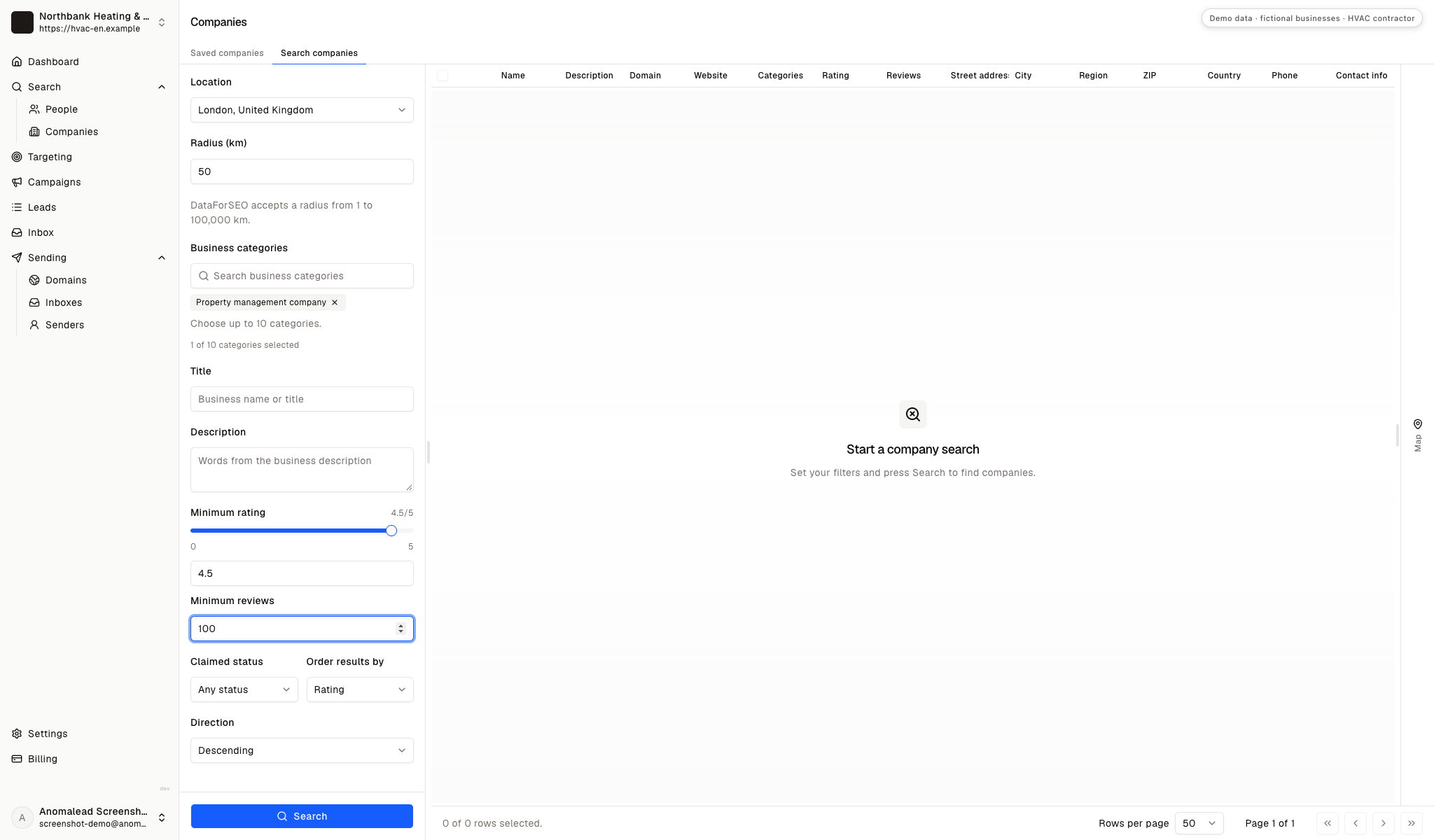
Section titled: Choose the buyer category and service areaChoose the business category that best describes the buyers you want to reach, then set a search area your technicians can realistically serve.
Start with a practical radius and qualify the results against travel time, response commitments and team capacity. A wider search is useful only when you can deliver the same service consistently across it.
Read the local results
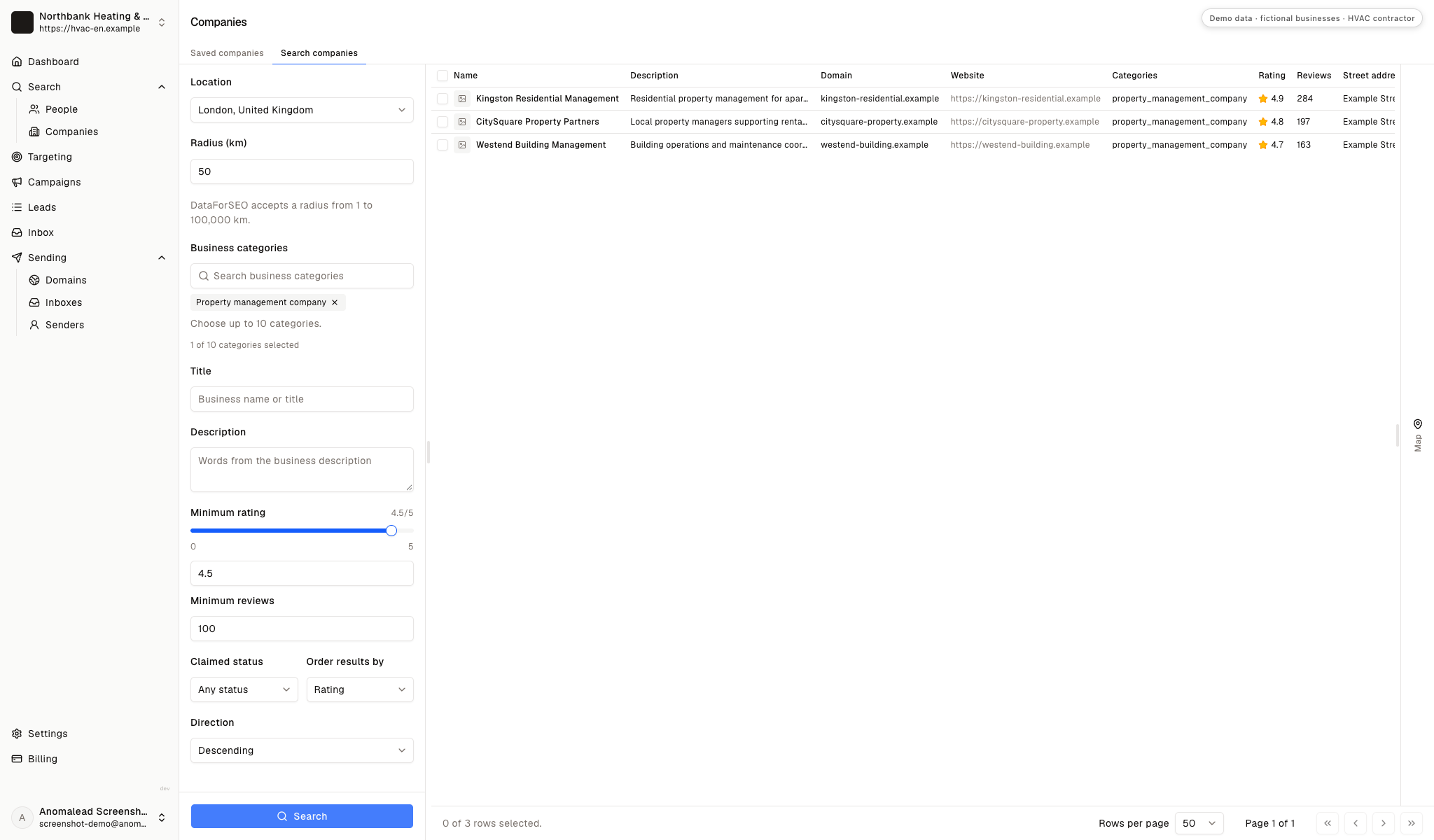
Section titled: Read the local resultsTreat the results as a list to review, not a list to email. Company descriptions can indicate whether a prospect manages residential buildings, commercial sites or both, and whether maintenance is handled internally or through an existing provider. Keep companies whose likely needs match your services.
Save only the firms you would call
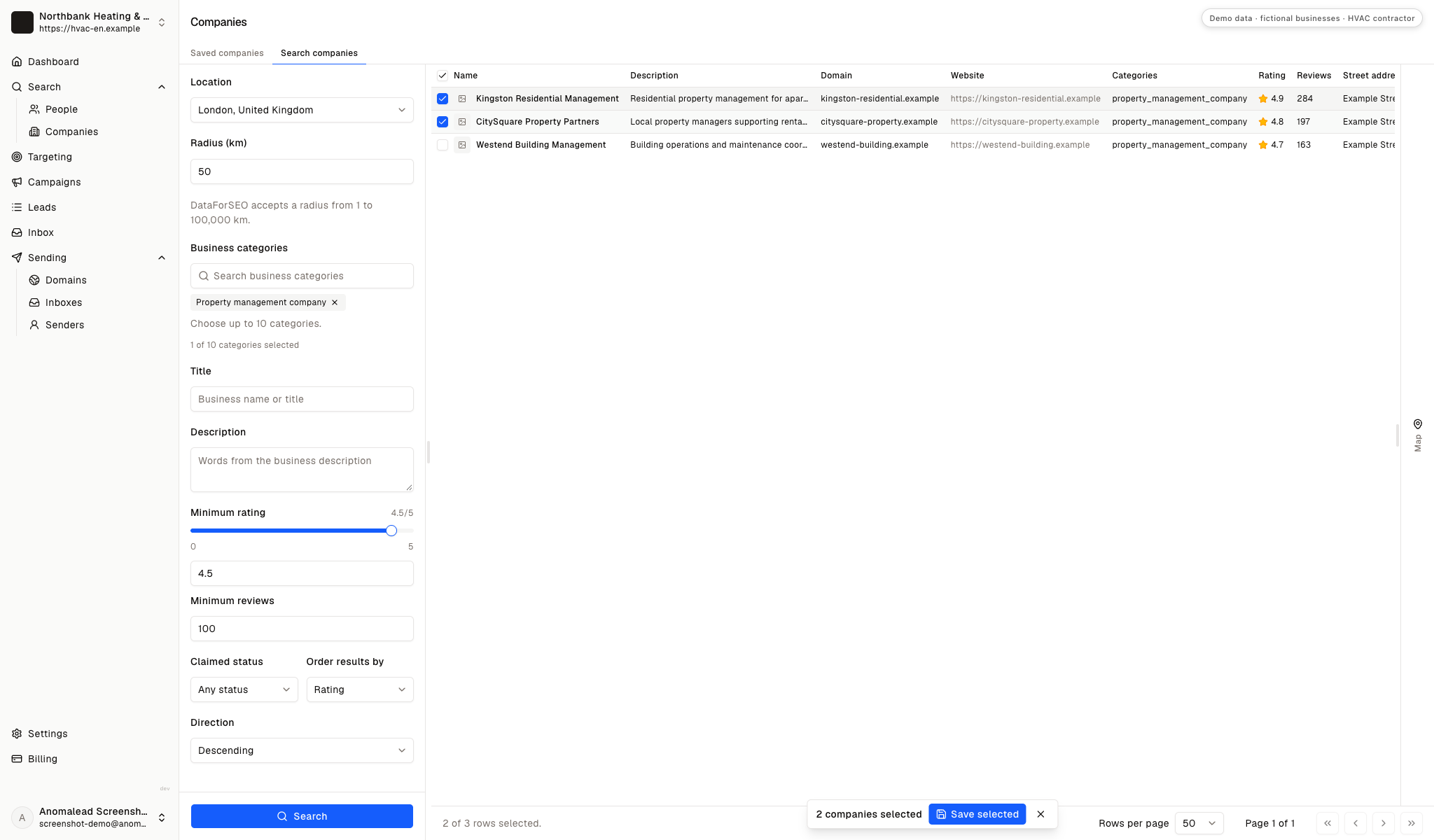
Section titled: Save only the firms you would callSelect companies whose buildings and likely needs match your services and service area. In the demo, two of the three are saved and the third is left for a later pass. Leaving out a weak fit keeps the campaign relevant and gives your team more time for suitable prospects.
Enrich the shortlist and choose contacts
Section titled: Enrich the shortlist and choose contactsOnce the shortlist holds only companies you could serve, look for the people who choose contractors there. This is where most HVAC lead generation lists go wrong: the right company with the wrong person gets no reply.
Review the shortlist before enrichment
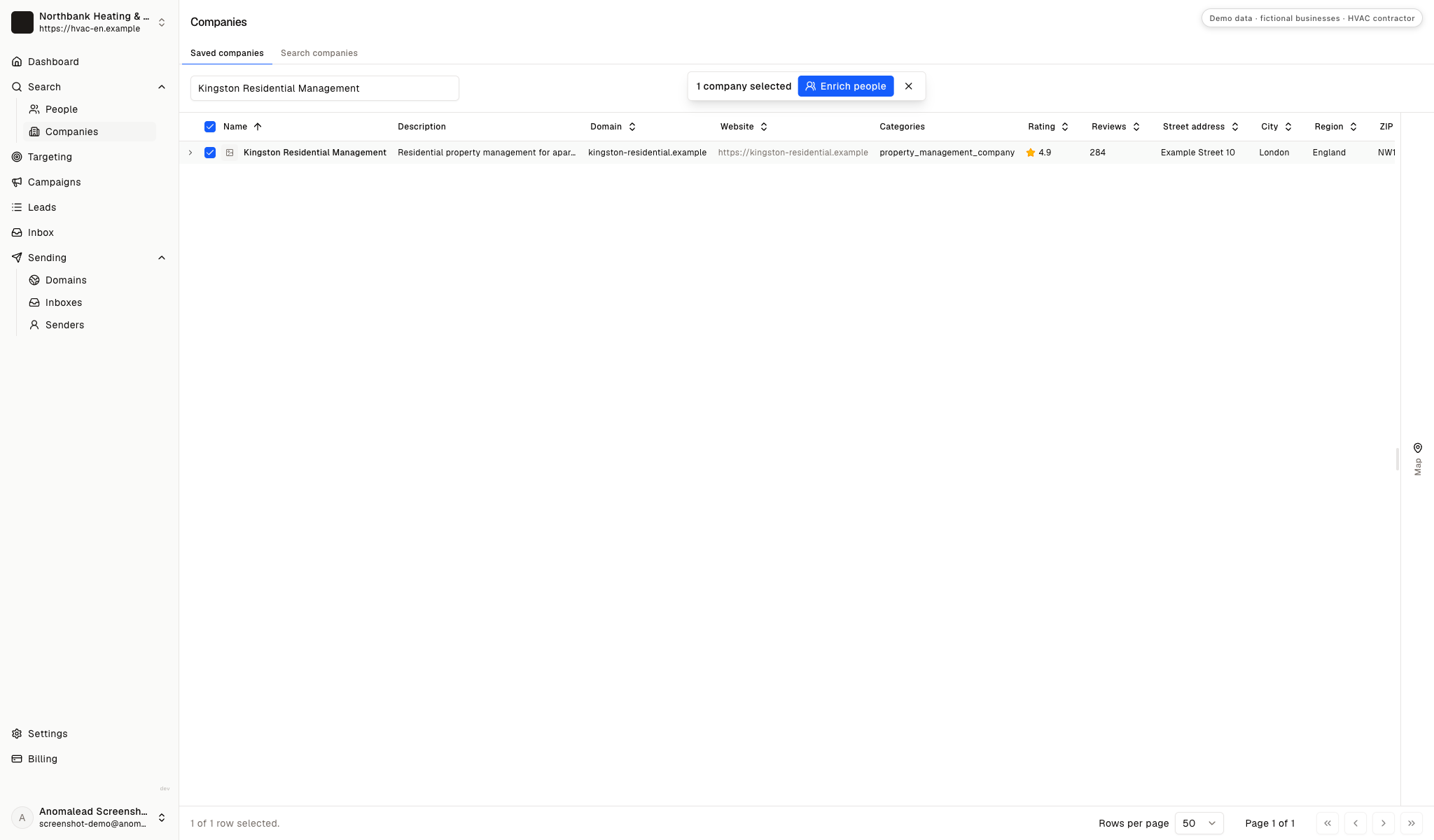
Section titled: Review the shortlist before enrichmentSaved companies sit in one place, so review each one before looking for contacts. Ask whether your team could handle the likely work if the company replied tomorrow. If the fit or capacity is unclear, verify it or remove the prospect before enrichment.
Choose the right person at each firm
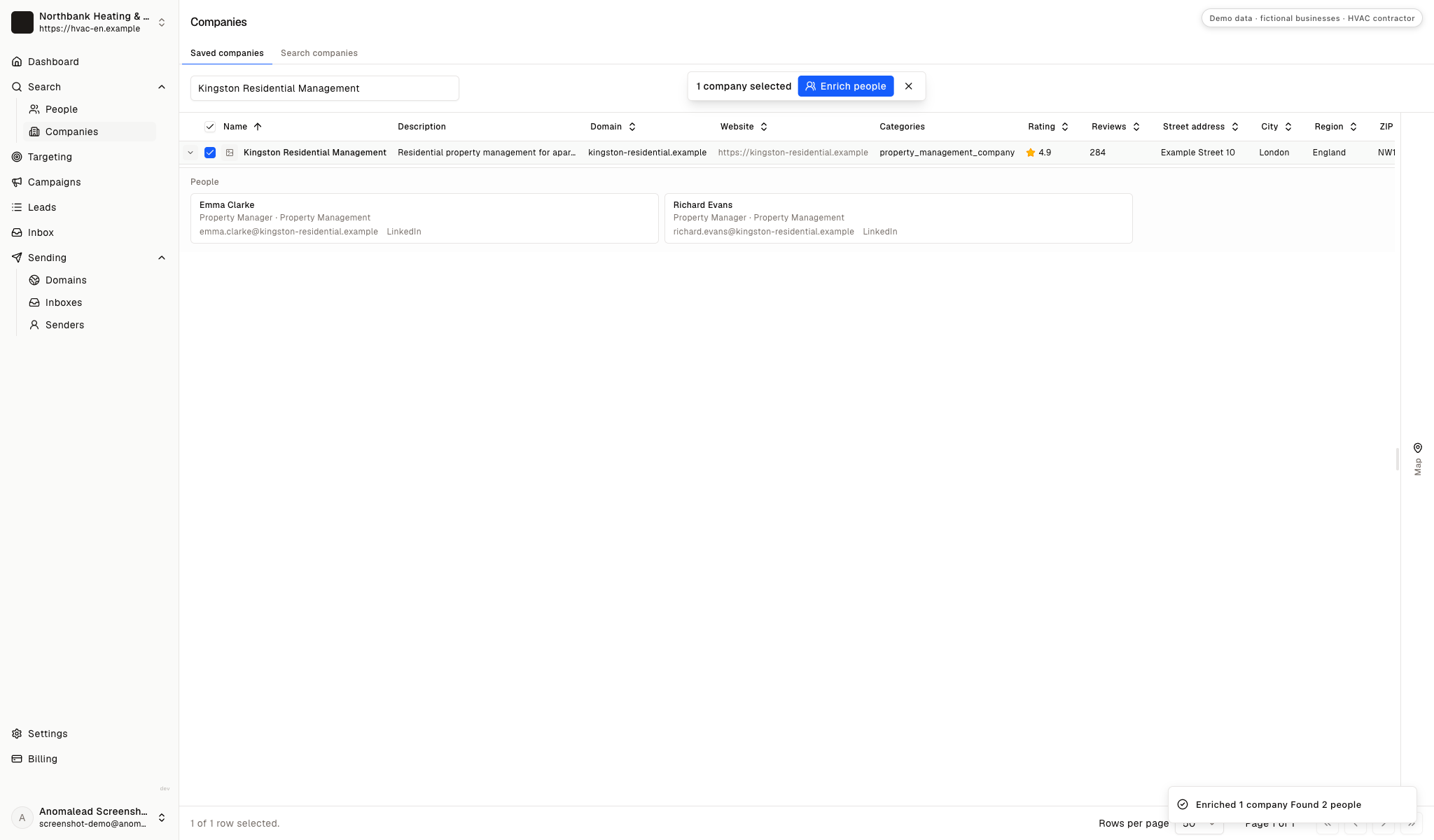
Section titled: Choose the right person at each firmEnrichment returns the people Anomalead finds for the company. At a managing agent, property managers usually look after specific blocks, so two names at the same firm may be responsible for different buildings.
Pick the one whose buildings you can best serve, or write each a different first email. Sending the same message to two colleagues in the same office is the quickest way to be ignored by both.
Check the contact list you will send to
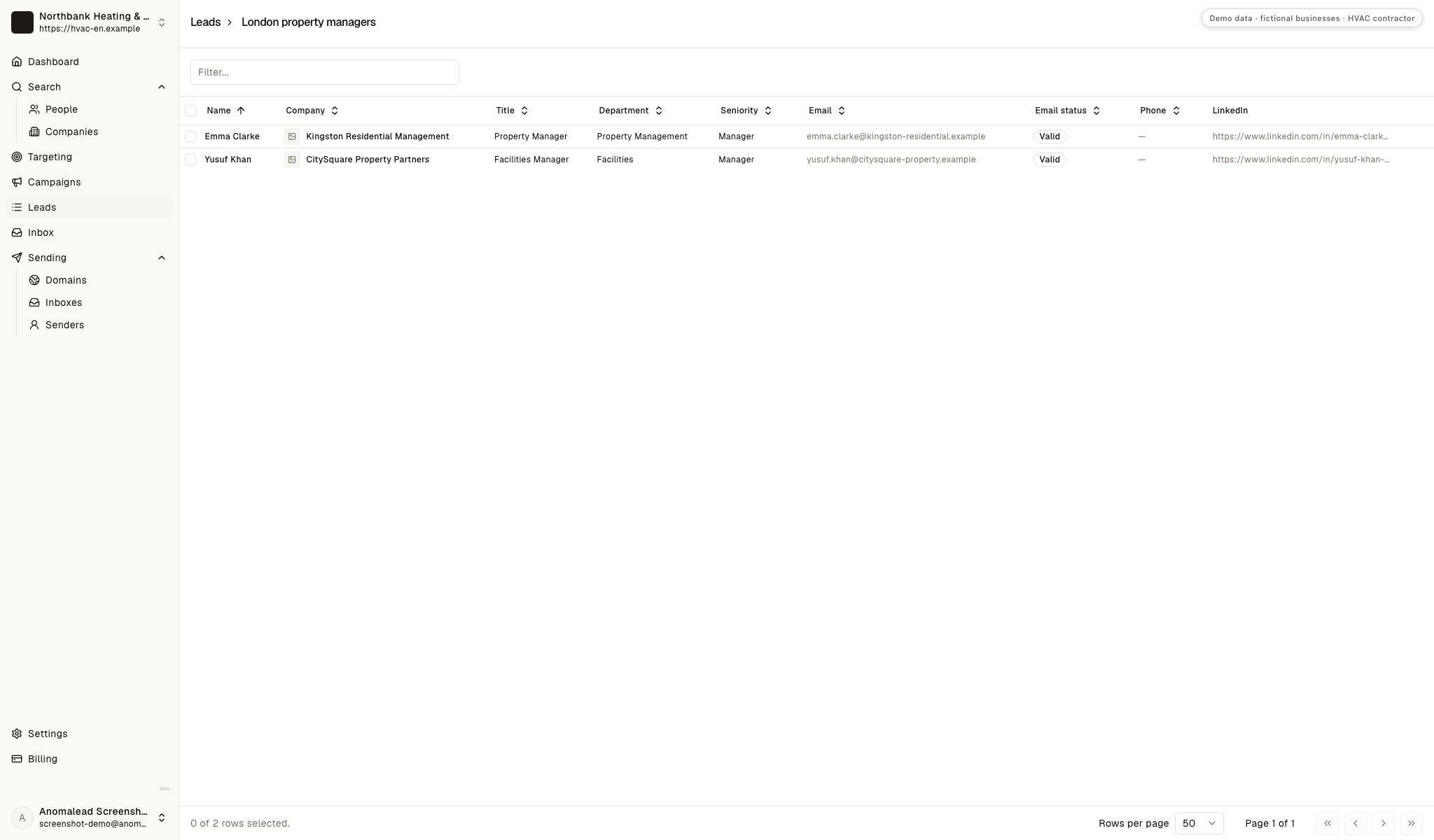
Section titled: Check the contact list you will send toThe example list includes a property manager and a facilities manager. They may care about different outcomes: consistent coverage across a portfolio, or planned maintenance and a clear process for service requests. Check each contact's role and email status before moving on.
Is a property management account worth pursuing?
Section titled: Is a property management account worth pursuing?A suitable property-management or facilities account can lead to recurring maintenance and future repair work across multiple buildings. Whether pursuing that account makes sense depends on your contract values, available capacity and conversion assumptions.
Use figures from work your company has actually won, and keep meeting and close-rate assumptions conservative.
The deal value, meetings and close rate in the calculator are planning assumptions you enter yourself. They are not benchmarks, forecasts or promised results.
Do the math on one good deal
If one new customer is worth thousands, you don’t need magic. You need a few more meetings a month.
Projected monthly results
- Deals closed
- 2.0
- Projected revenue
- £10,000
- Growth plan (1 business)
- £79/mo
- ROI
- 12,558%
Conservative math on meetings you already believe you can book. One closed deal often pays for a year of Anomalead.
If the numbers only work with an optimistic close rate, tighten the list further before sending rather than sending more.
Launch the campaign and read the replies
Section titled: Launch the campaign and read the repliesWith a curated list and a realistic view of what an account is worth, the last three steps are about sending something a property manager would actually answer. For the general structure of a first email, see how to write a cold email.
Pick the campaign recipients
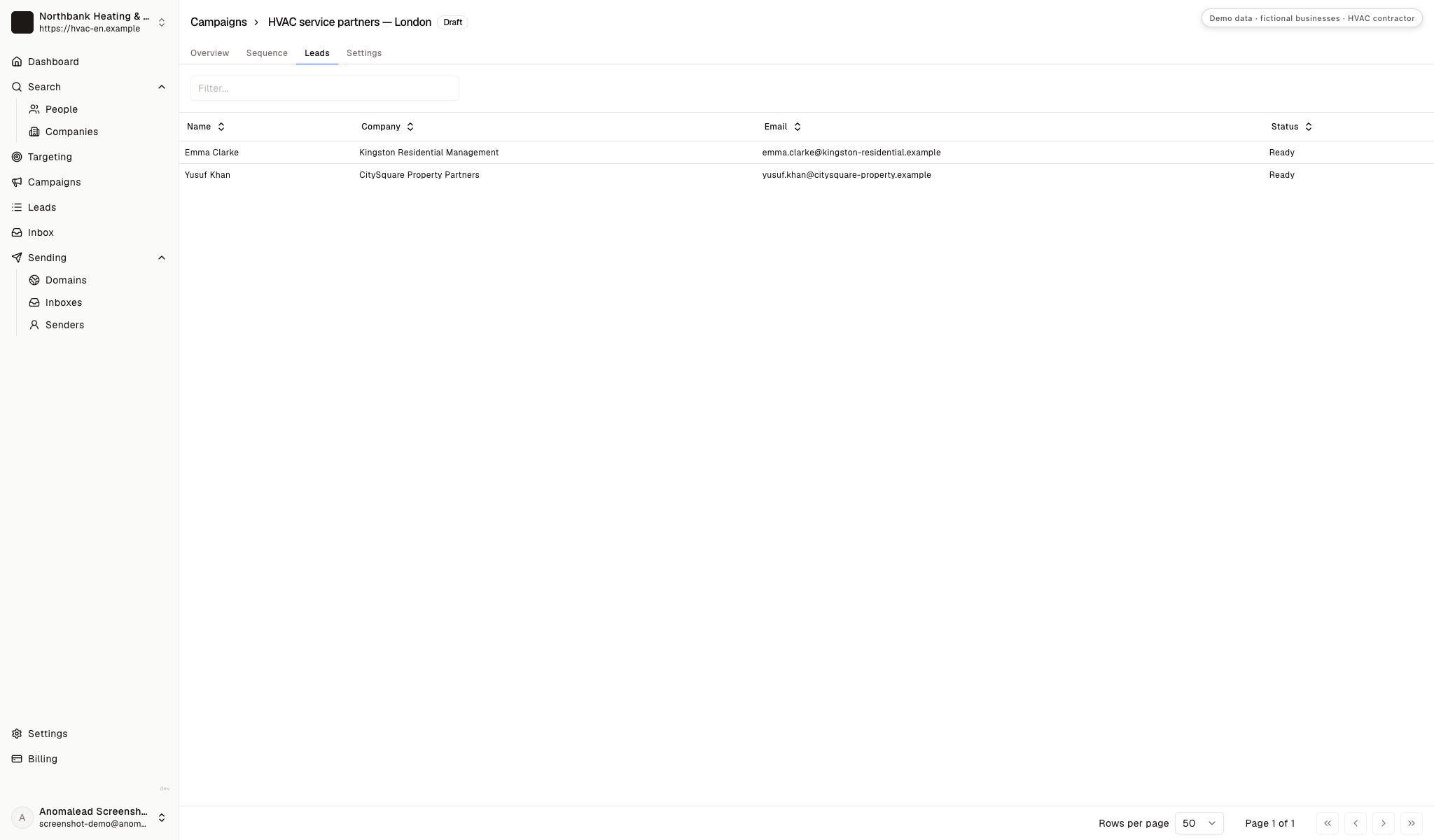
Section titled: Pick the campaign recipientsThe demo campaign is still a draft, so this is the last easy point to remove someone. Keep recipients who share one reason for hearing from you. If you wrote separate messages for managing agents and facilities teams, split them into separate campaigns.
Review the sequence before it sends
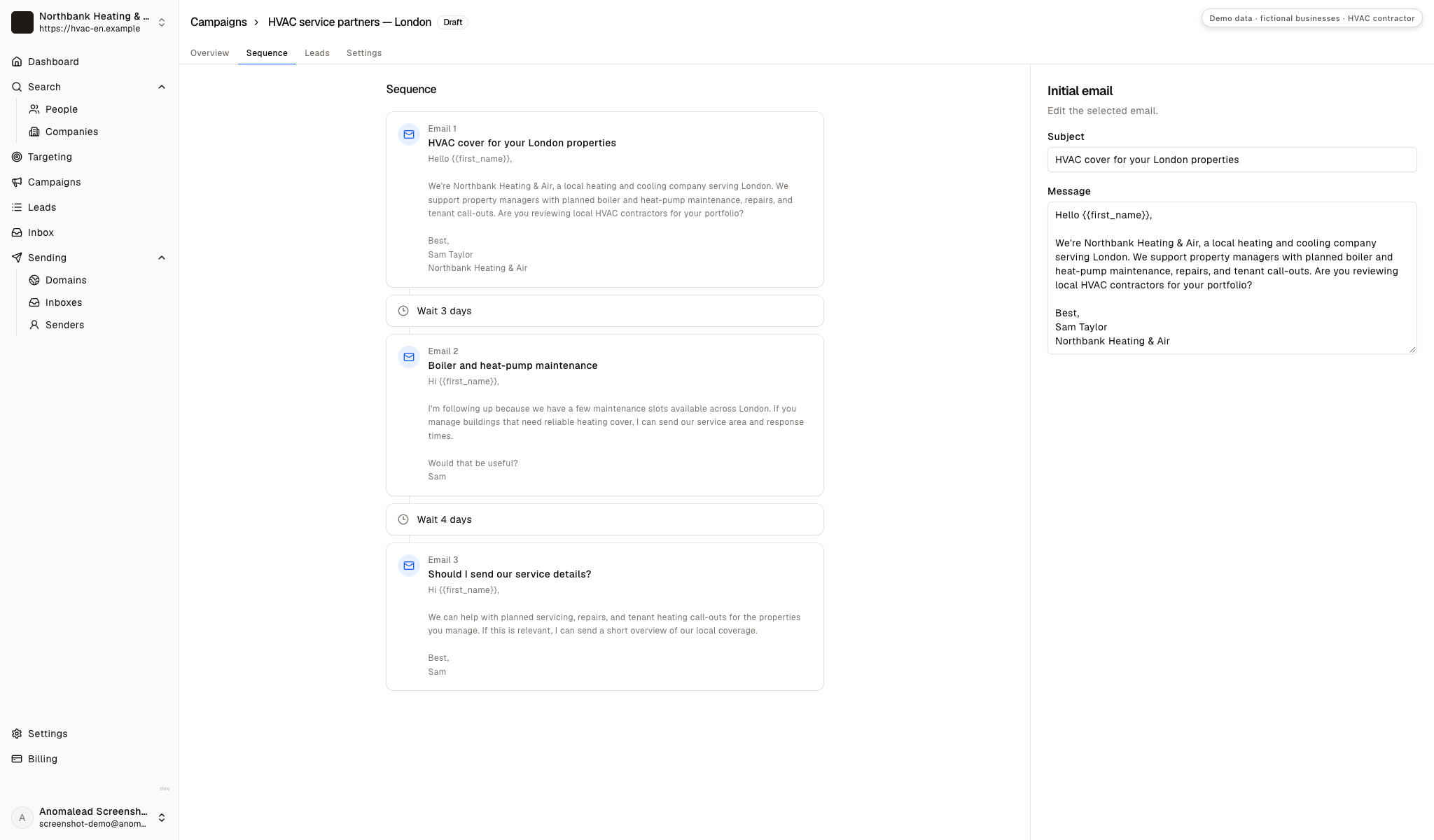
Section titled: Review the sequence before it sendsThe demo sequence has three emails, with a three-day wait after the first and a four-day wait after the second. Read each one from the recipient’s perspective. The first should identify the service and ask a useful question; later messages should add relevant detail instead of repeating the same pitch.
Add one line that reflects the buyer’s role, such as portfolio maintenance for a property manager or planned servicing for a facilities team. Keep any availability claim only if your company can honor it.
Rewrite the first email for each buyer
Section titled: Rewrite the first email for each buyerThe demo sequence is a reasonable starting point. The versions below go one step further by naming the kind of building and the problem the reader already has. Rewrite them in your own words and only state what is true for your business.
First email to a residential managing agent
Subject: Heating maintenance for your managed buildings
Hi Emma,
I run Northbank Heating & Air, a local heating and cooling company. We maintain shared and individual building systems and can discuss planned visits as well as urgent call-outs.
If you are reviewing maintenance providers for any of the buildings Kingston Residential manages, I can send an overview of our services, coverage and insurance. Would that be useful for your next supplier review?
Sam Taylor, Northbank Heating & Air
First email to a commercial facilities manager
Subject: Summer AC servicing for your commercial buildings
Hi Yusuf,
Northbank Heating & Air services commercial air conditioning and heating systems. We can discuss planned maintenance, access requirements and the service records your team needs.
If CitySquare is reviewing providers for planned visits or service requests, I can send an overview of our capabilities and insurance. Is that something you are considering?
Sam Taylor, Northbank Heating & Air
Only mention response times, qualifications and working hours your team can consistently provide. A property manager will rely on what you say in the first email. For more openers and follow-ups, see these B2B cold email templates.
Read the replies in the inbox
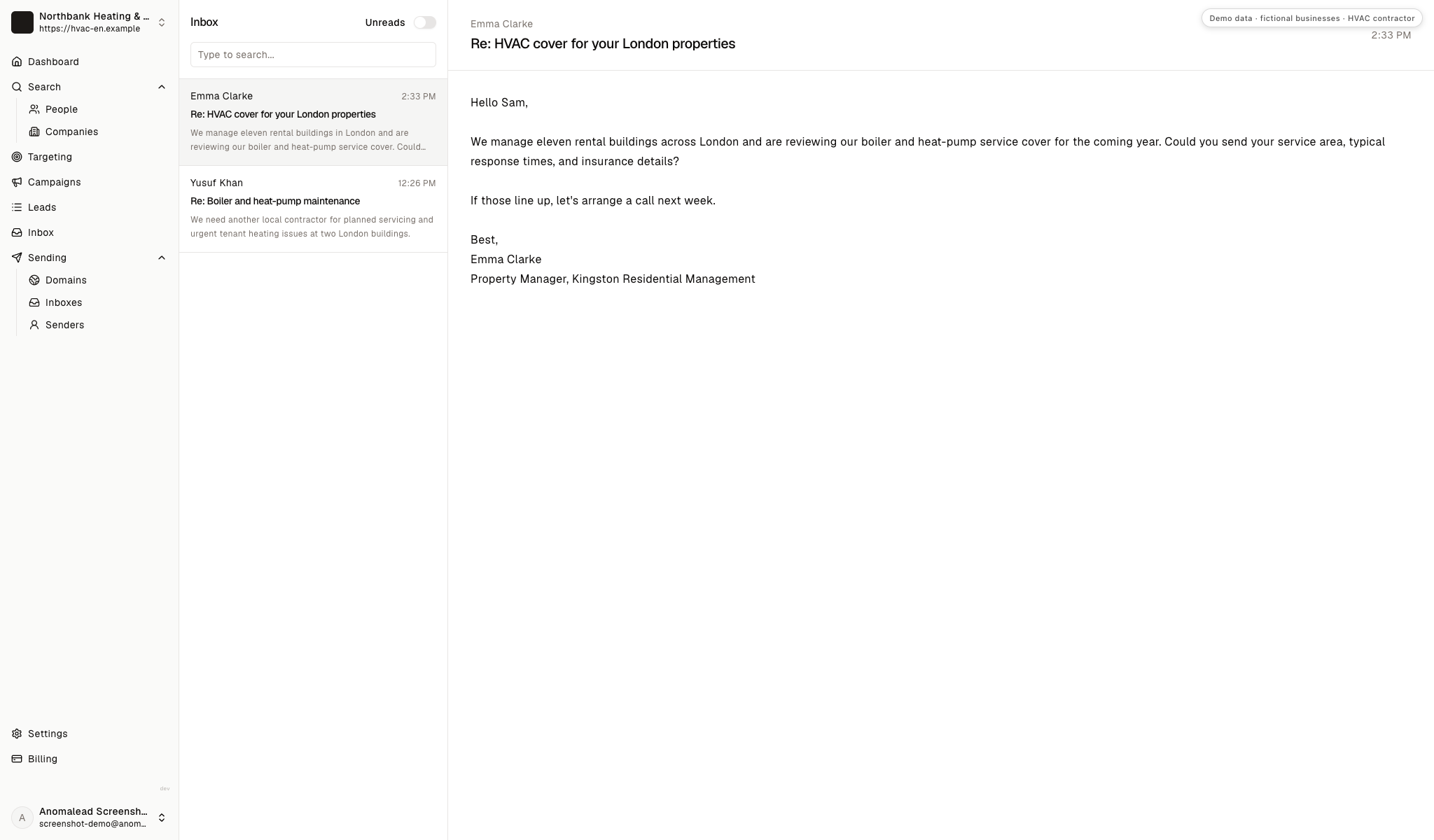
Section titled: Read the replies in the inboxThe demo inbox contains two replies. One property manager is reviewing heating and heat-pump maintenance and asks about service coverage, response times and insurance. A facilities manager is looking for another contractor for planned servicing and urgent requests. Both show interest, but they need different follow-up.
How to respond to HVAC prospects
Section titled: How to respond to HVAC prospectsReply the same working day if you can. A quick, complete answer is the first evidence of the response times you are claiming.
They ask for your service area, response times and insurance
Section titled: They ask for your service area, response times and insuranceWe manage eleven rental buildings across your service area and are reviewing our boiler and heat-pump service cover for the coming year. Could you send your service area, typical response times, and insurance details?
Answer each question in the email itself, not only in attachments. Explain which areas you cover, give response times your team can meet for urgent and routine work, and attach the relevant insurance and qualification documents.
Then ask one question that moves toward a quote: which of the eleven buildings have communal plant, and when does the current contract end?
A reply that answers and moves forward:
Thanks Emma. We cover the areas your team serves and can confirm the response times we can provide for urgent and routine work. I have attached our insurance and qualification documents.
To prepare for a call next week, could you tell me which buildings have communal boilers or heat pumps, and when the current service contract ends? Tuesday or Thursday morning both work for me.
They need an extra contractor for specific buildings
Section titled: They need an extra contractor for specific buildingsWe need another local contractor for planned servicing and urgent tenant heating issues at two managed buildings.
This is a contractor onboarding conversation. Ask where the buildings are, what equipment they use, how service requests are raised and which documents are required before work begins.
Offer a site visit to one building. Seeing the plant room lets you quote planned servicing properly instead of guessing.
A short reply that sets up a visit:
Thanks Yusuf, happy to help. Could you share the addresses of the two buildings and the boiler or heat pump models on site? If it is easier, I can visit the first building this week and send a planned servicing proposal afterwards.
They already have a maintenance contract
Section titled: They already have a maintenance contractWe already have a contractor on a PPM contract, so we are fine for now.
Do not argue with the incumbent. Ask to be considered as a backup for out-of-hours call-outs or overflow work, and ask when the contract is next reviewed so you can follow up then, not before.
They ask for a price list straight away
Section titled: They ask for a price list straight awayCan you just send over your rates?
Send your standard call-out and hourly rates if you publish them, but explain that planned servicing is quoted per building once you know the plant. Ask for an asset list or a site visit so your quote is comparable with what they pay now.
Before you send the next batch
Section titled: Before you send the next batchReview who replied and which buyer roles engaged. Use that signal to choose the next prospect segment and refine the message around the service those buyers need.
Keep each list small enough that your team can answer every relevant reply promptly. A clear, timely response is part of the service experience you are selling. If you also take on plumbing work, the plumbing lead generation guide covers a similar buyer list from a different angle.
HVAC lead generation questions
Section titled: HVAC lead generation questionsWhich buyers should HVAC companies contact first?
Section titled: Which buyers should HVAC companies contact first?Start with buyers that match your strongest work and available capacity. Property managers may need recurring maintenance across their portfolios, while facilities teams may be looking for planned servicing or support with urgent requests. Run separate campaigns when their needs and decision processes differ.
What should an HVAC company check before contacting a prospect?
Section titled: What should an HVAC company check before contacting a prospect?Confirm that the prospect’s buildings and equipment fit your services, that your contact is involved in choosing providers, and that your team can meet the response times you promise. Be ready to share relevant insurance, qualification and service information.
How wide should an HVAC company search for leads?
Section titled: How wide should an HVAC company search for leads?Choose an area your team can serve reliably within the response times you promise. Qualify results against travel, staffing and the work you want to win instead of choosing the largest radius available.
Are the businesses and replies in the screenshots real?
Section titled: Are the businesses and replies in the screenshots real?No. Northbank Heating & Air and the property managers, contacts and replies shown are fictional demo data. They are not Anomalead customers and do not represent real campaign results.
Does the ROI calculator predict signed HVAC contracts?
Section titled: Does the ROI calculator predict signed HVAC contracts?No. It combines the contract value, meeting count and close rate you enter. Treat the output as a planning estimate based on your own assumptions, not as a prediction.