


Home improvement lead generation works best when property managers can see which planned upgrades your team can scope, phase and close out without disrupting the whole building. Start with portfolios that have a repeatable need, such as unit-turn refreshes or common-area improvements, then qualify the approval path and site constraints before proposing work. For the broader process, review B2B lead generation basics, then make the campaign about one clear project type.
A property manager is not buying a vague promise to improve buildings. They need a defined scope, finish and material choices, a schedule that accounts for residents or tenants, clear change control, and records that support approval and handover. This guide focuses on planned upgrades and repair packages, not one-off handyman tickets or an open-ended general contracting pitch.
Key takeaways
- Target property managers with a specific upgrade package that fits the building type and your team’s current capacity.
- Qualify the decision route, existing conditions, finish choices, access, phasing and required permits before treating a project as ready to quote.
- For occupied sites, explain how work areas, resident notices, noisy tasks and shared access will be coordinated before mobilization.
- Put scope changes, approvals, schedule assumptions and closeout records in writing so the manager can compare and hand over the proposal.
Which property managers have a reason to plan improvement work?
Section titled: Which property managers have a reason to plan improvement work?Begin with managers responsible for a defined building portfolio and a recurring upgrade decision. A useful prospect can identify the asset, the approval owner and the moment when a planned refresh or repair package enters review.
- Regional or portfolio property managers: They coordinate work across buildings and may need repeatable common-area or unit-turn packages. Check whether they set vendor standards or only review budgets.
- Asset and capital-project managers: They may plan finish renewals or building upgrades against an approved scope. Ask how existing conditions, phasing, approvals and change requests are documented.
- On-site property managers: They see worn finishes and daily access constraints firsthand. They can explain resident notices, access windows and handover requirements, even if another person approves the work.
- Turnover or maintenance coordinators: They prepare vacant units between occupants and can identify repeatable refresh work. Keep the offer to planned packages with defined exclusions, not every repair.
Use a focused first-contact email to find the person who owns the next project review, and verify whether approval sits at the property or portfolio level.
Qualify an upgrade before calling it a project
Section titled: Qualify an upgrade before calling it a projectA building improvement is ready for a useful conversation when the work area, decision path and operating constraints can be described. Ask enough to determine whether your team can survey and plan it, without presenting an early inquiry as a committed job.
- Package and boundaries: Name a reviewable package, such as unit-turn painting and flooring or a common-area refresh. State exclusions and whether you handle design, permits, trade coordination or only the specified work.
- Conditions and finish choices: Ask what drawings or condition records exist, who selects finishes, how samples are approved, and how concealed damage or substitutions become documented changes.
- Occupied-site phasing: Clarify which spaces stay open, how work zones and deliveries are managed, and who sends resident notices. Plan noise, dust and shared-route closures with the site contact.
- Approvals and timing: Confirm who signs the scope, what purchase review comes first, and whether permits or inspections apply. Treat dates as assumptions until materials, access and site conditions are checked.
- Closeout and repeatability: Ask what handover needs: completion notes, product details, applicable warranty information, inspection records or open items. A consistent closeout pack helps compare work across properties.
About the demo companies and replies
London General contractor Services, London Property management company 1, London Property management company 2, London Property management company 3, the contacts and the inbox replies are fictional demo data. They are not Anomalead customers, real businesses or evidence of project wins. The interface examples show a prospecting workflow, not completed improvement work.
Home improvement lead generation starts with a defined property segment
Section titled: Home improvement lead generation starts with a defined property segmentSearch for property managers in areas your team can survey, supply and support through closeout. Choose a defined offer, such as unit-turn packages or shared-space finishes, before reviewing companies.
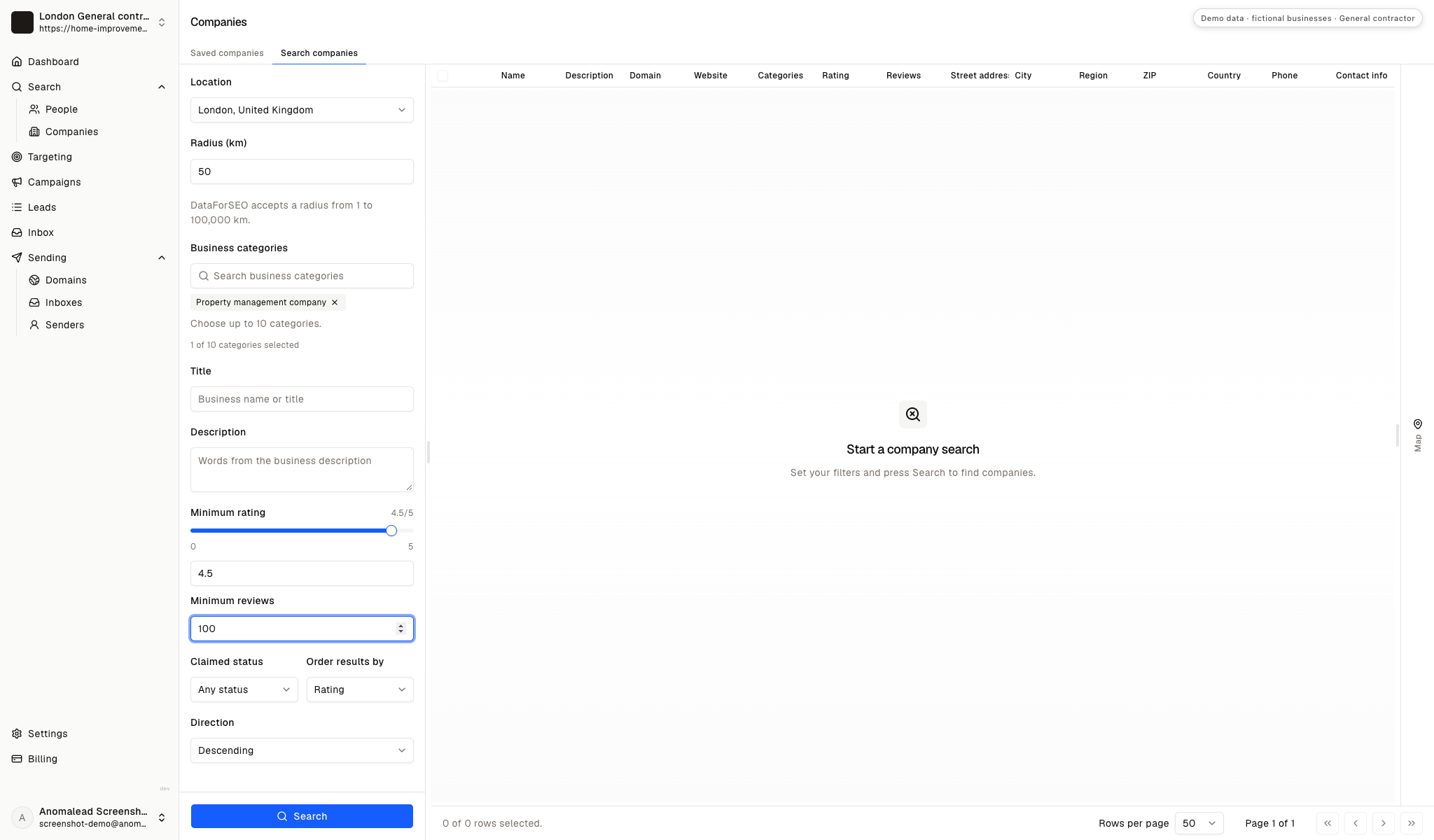
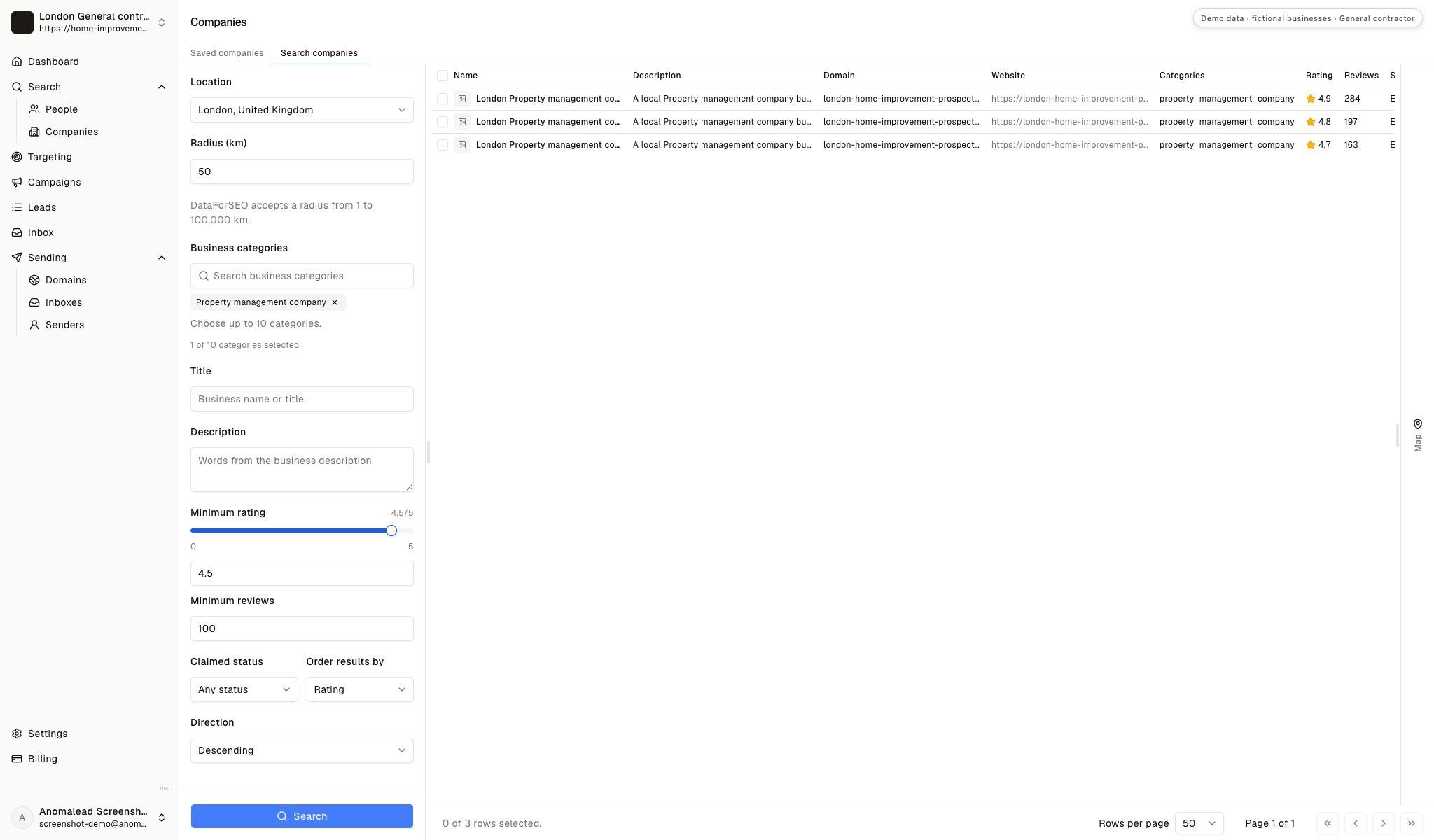
The form shows location, radius, company category and rating filters. Its three fictional results and review details are interface examples, not proof of an upcoming project or vendor approval.
Set a search area your project team can cover
Section titled: Set a search area your project team can coverSet the location and radius around sites your team can survey, supply and service.
Review property-management companies before saving them
Section titled: Review property-management companies before saving themThree fictional property managers appear with ratings and review counts; neither signals a planned project.
Save only portfolios that fit a defined upgrade package
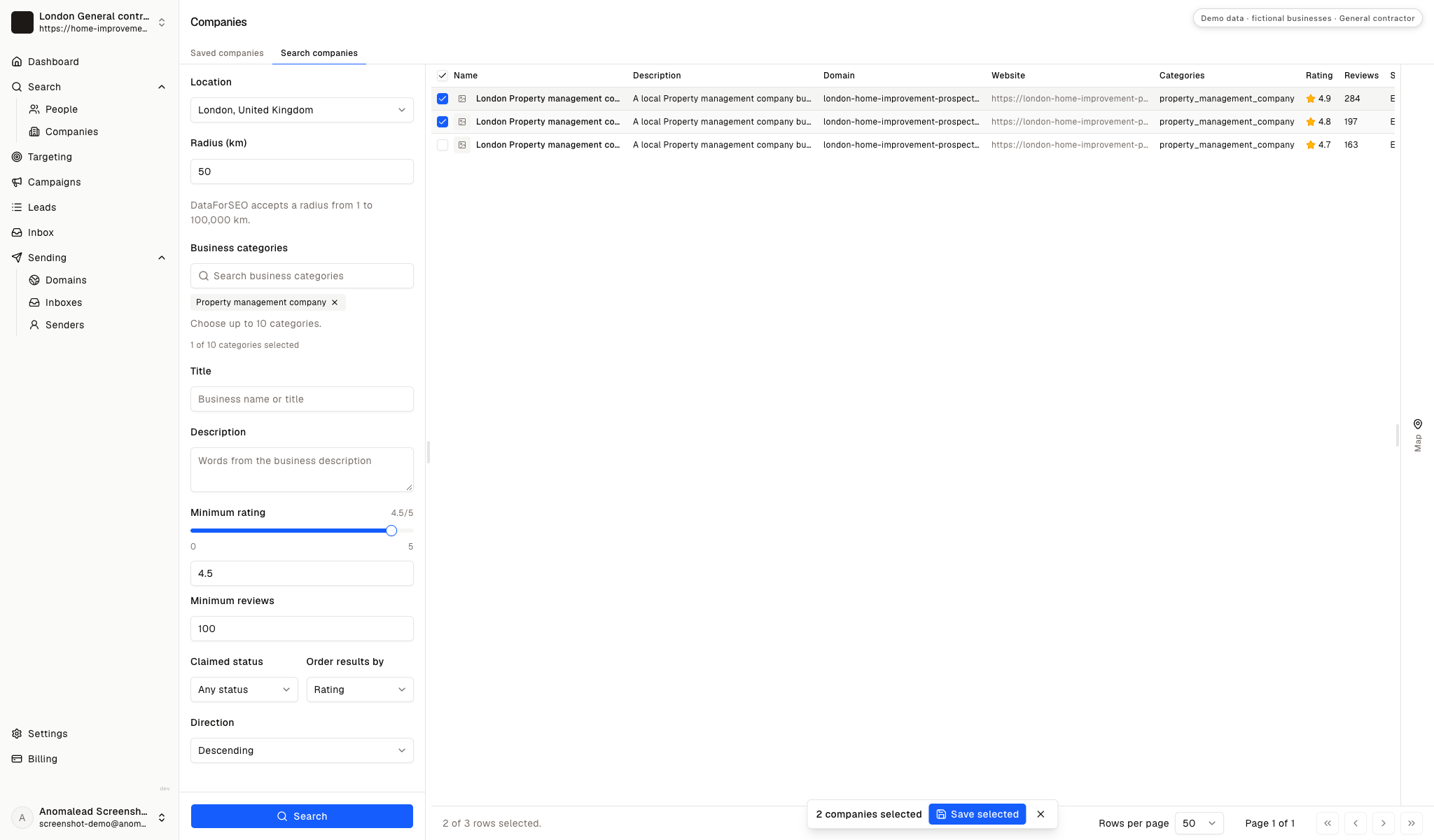
Section titled: Save only portfolios that fit a defined upgrade packageTwo of the three demo companies are saved; keep only portfolios suited to your chosen package.
Research the people behind the property improvement decision
Section titled: Research the people behind the property improvement decisionProperty managers may separate contractor intake, site access and purchase approval. Find who owns the scope, materials, access and authorization before choosing a contact.
Enrichment finds business contacts; it cannot confirm a budget, permit or active project. Keep notes professional and ask about the approval process directly. Do not put resident information or access codes in a prospecting record.
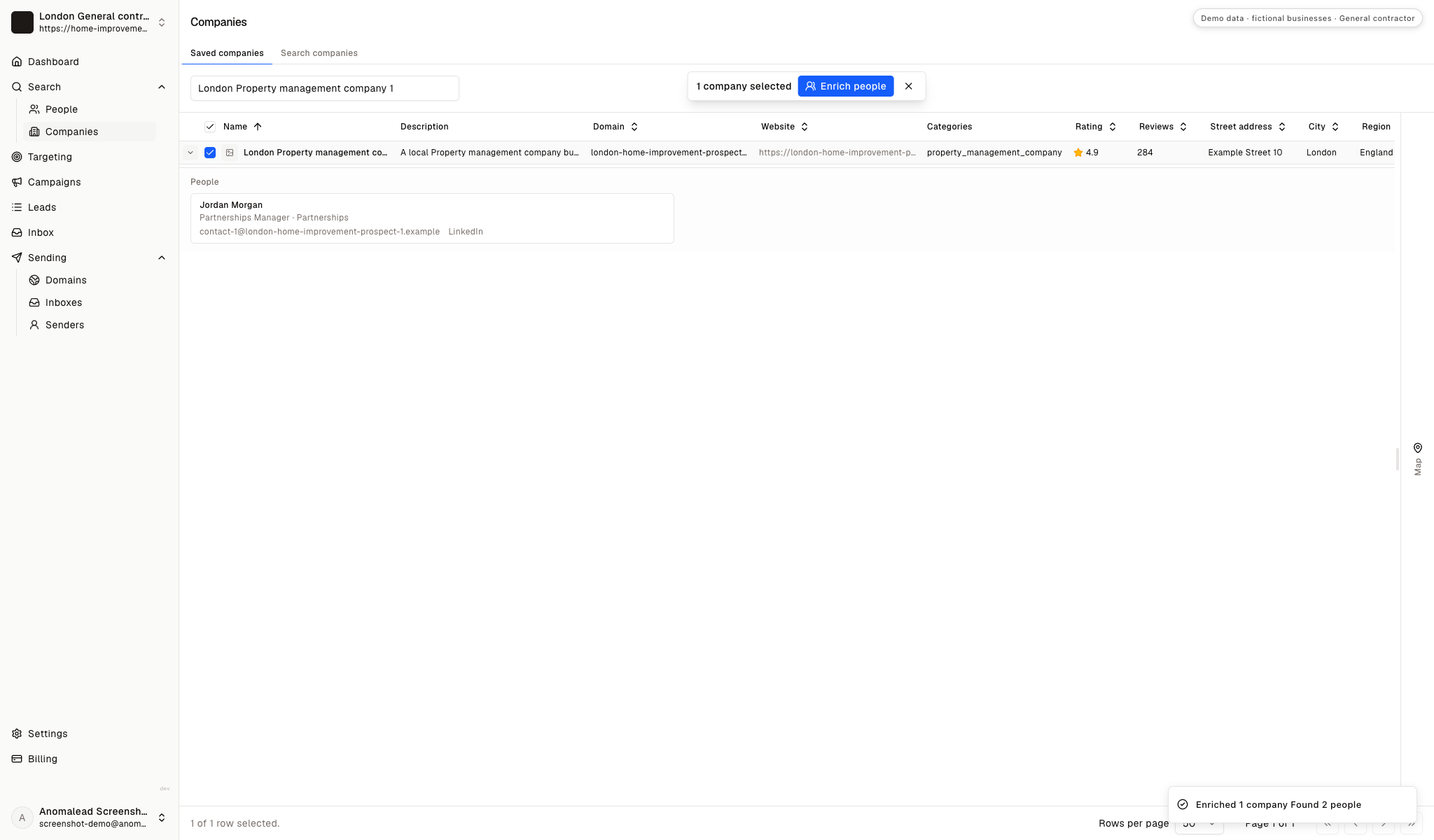
Inspect the saved company before enriching contacts
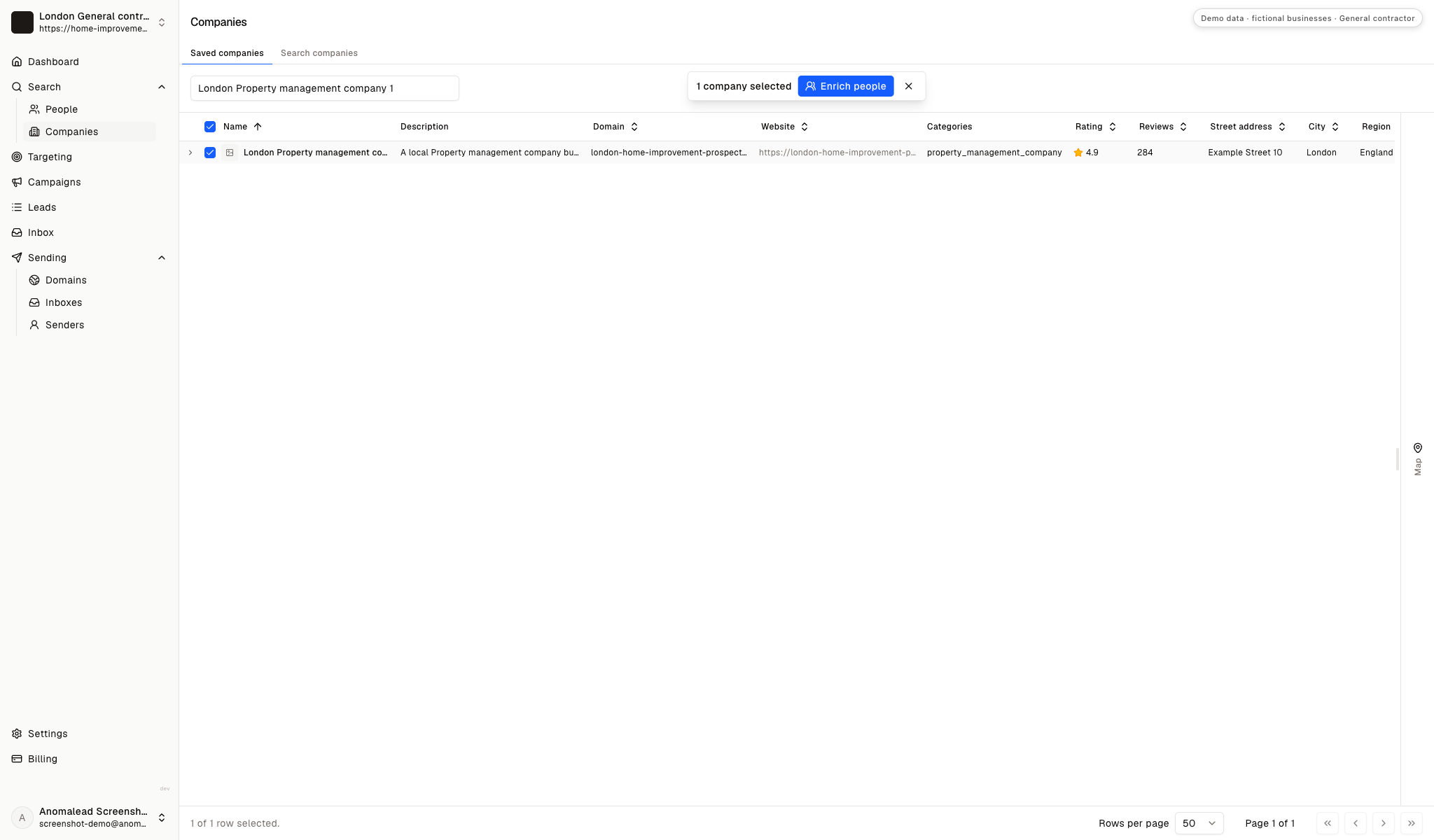
Section titled: Inspect the saved company before enriching contactsReview the selected company and fit before using the contact-enrichment action.
Find who shapes the project scope and approval route
Section titled: Find who shapes the project scope and approval routeThe demo lists Jordan Morgan and Taylor Reed as fictional property-company contacts.
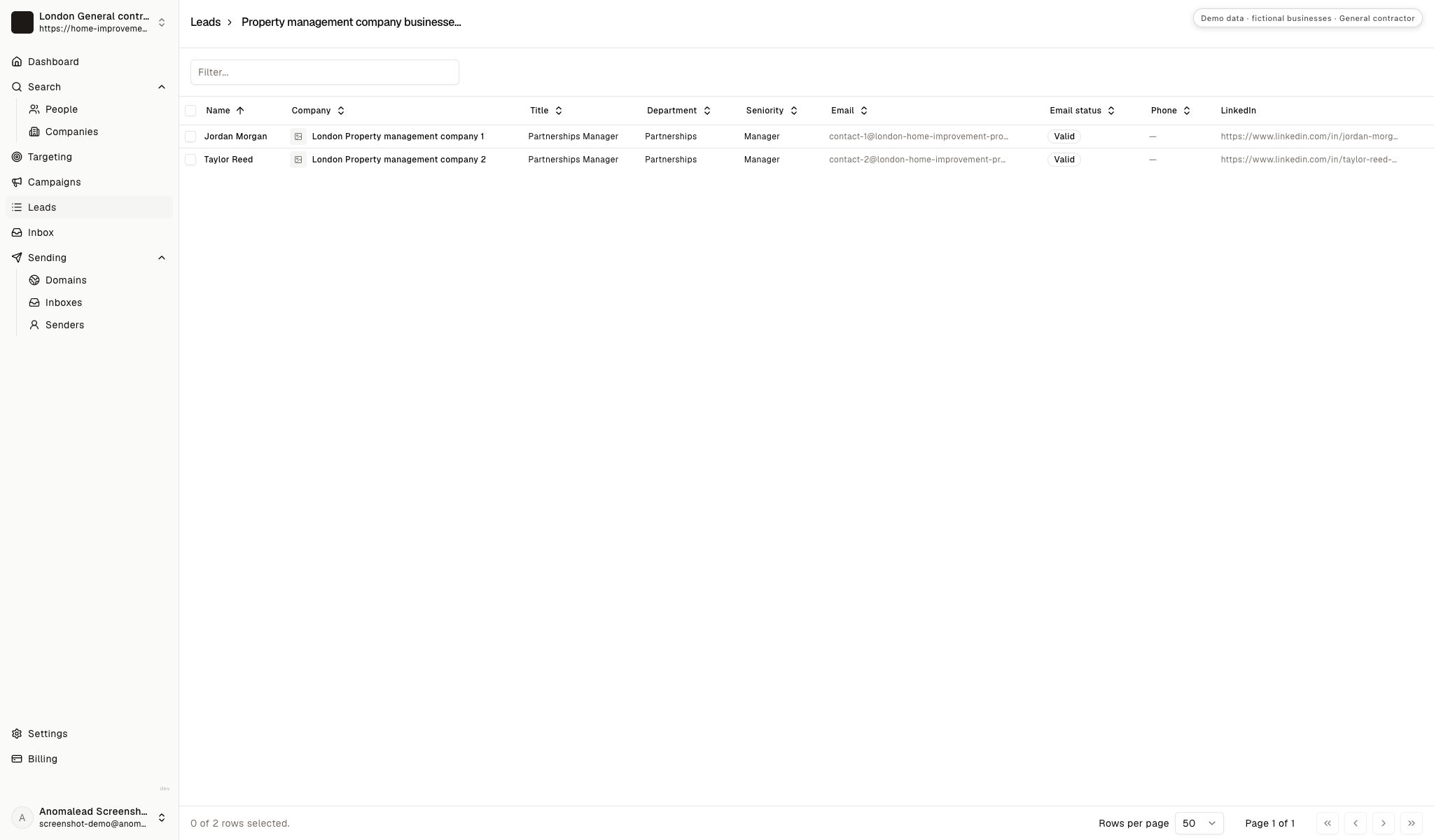
Check the people and project context on your list
Section titled: Check the people and project context on your listThe saved lead list contains two professional contacts for campaign review.
Estimate the effort behind a property upgrade account
Section titled: Estimate the effort behind a property upgrade accountA portfolio relationship can require site reviews, finish decisions, occupied-area phasing and closeout before work repeats. Compare that effort with your actual project-lead and crew capacity.
Enter your own assumptions about outreach, review effort and potential project value. The calculator shows how those inputs relate; it does not predict approvals, signed work, timing, revenue or profit.
Do the math on one good deal
If one new customer is worth thousands, you don’t need magic. You need a few more meetings a month.
Projected monthly results
- Deals closed
- 2.0
- Projected revenue
- £10,000
- Growth plan (1 business)
- £79/mo
- ROI
- 12,558%
Conservative math on meetings you already believe you can book. One closed deal often pays for a year of Anomalead.
Include estimating, sample review, permit coordination, site supervision, changes and closeout in your assessment. An inquiry is not booked work.
Launch with one upgrade package and a clear review request
Section titled: Launch with one upgrade package and a clear review requestA good first note names the upgrade package and explains why it may fit the portfolio. Describe your process for site conditions, occupied phasing, finish approval and closeout without assuming the manager has an active project.
Ask for the next step, such as a vendor-review conversation or permission to send a scope overview. Before an estimate, confirm access authority, available drawings and how changes are approved.
Choose recipients who share the same project question
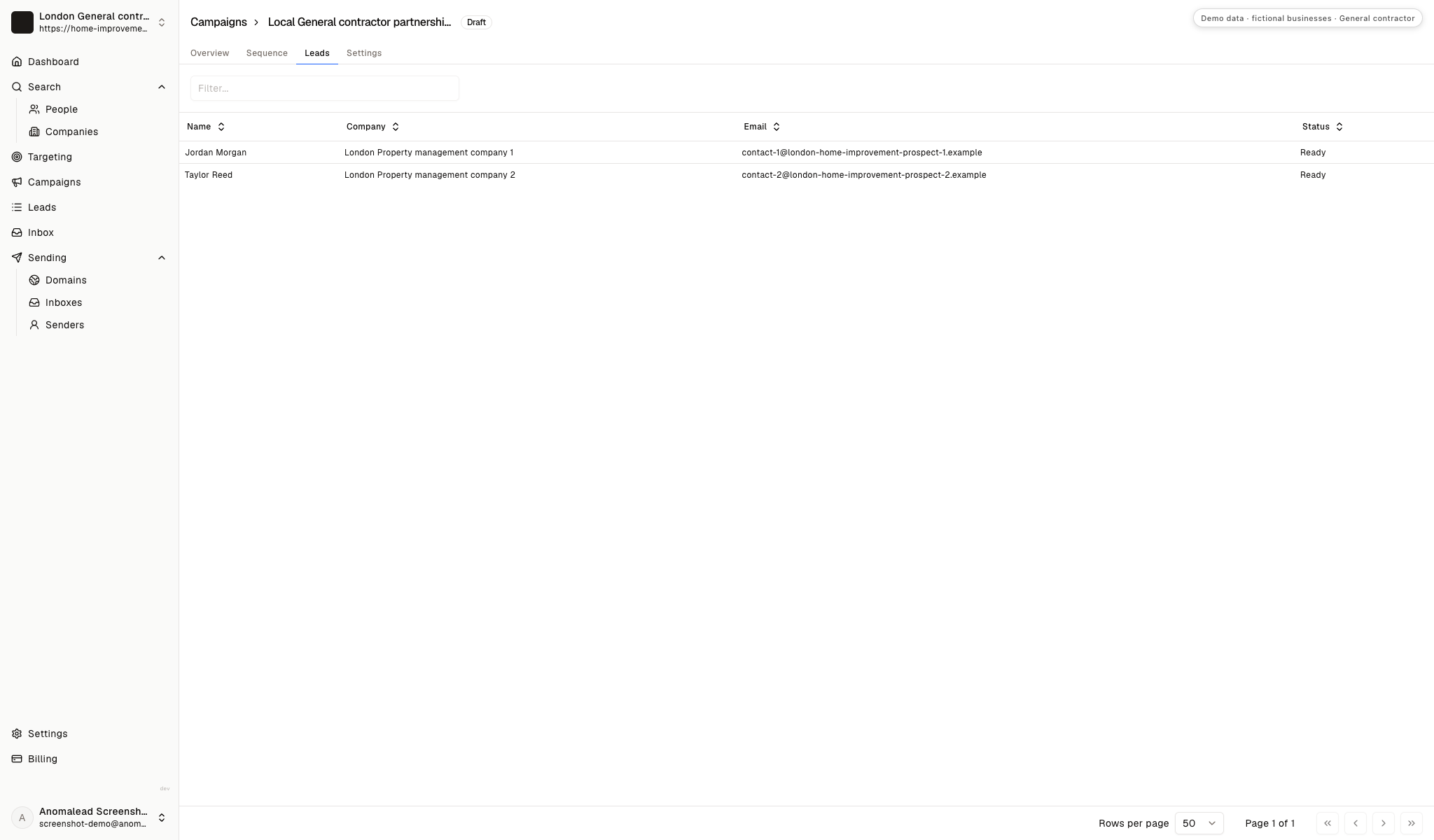
Section titled: Choose recipients who share the same project questionTwo contacts are selected in the draft improvement-services campaign.
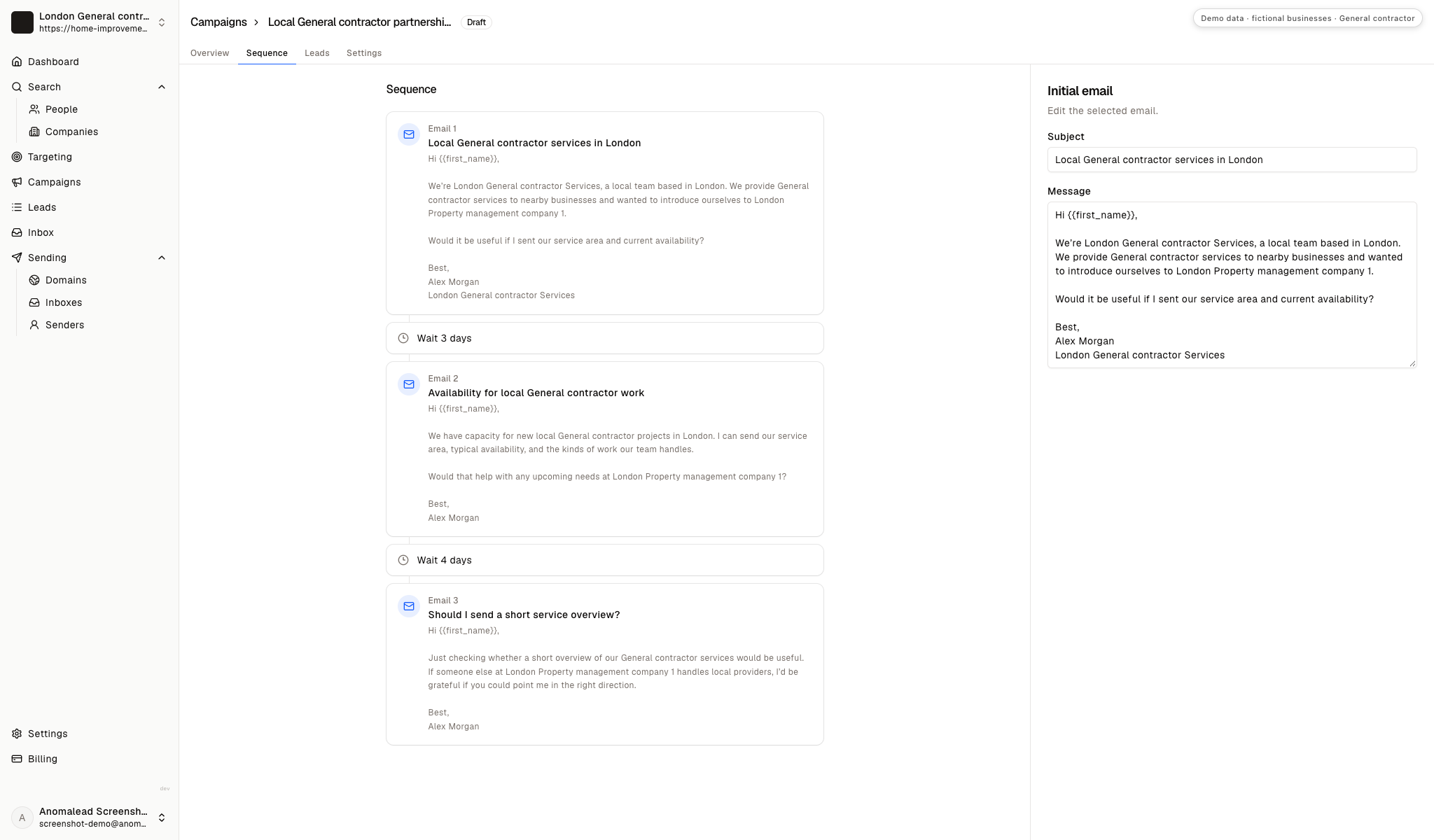
Review each step before the improvement campaign goes live
Section titled: Review each step before the improvement campaign goes liveThe editor shows three emails and two wait steps before activation.
Write to the project owner, not the whole property office
Section titled: Write to the project owner, not the whole property officeJordan Morgan and Taylor Reed are fictional demo contacts. Use the example only after replacing its service description with capabilities, coverage and credentials your company can verify.
First note about a planned upgrade package
Subject: A scoped option for planned property upgrades
Hi Jordan,
I’m Alex Morgan with London General contractor Services. We plan defined improvement packages, from unit-turn finish refreshes to common-area repairs. We review site conditions, material choices, access and approvals before proposing work.
Would a short overview of our project process help with your next property improvement review?
Best, Alex Morgan, London General contractor Services
Follow-up about phased site work
Subject: Re: A scoped option for planned property upgrades
Hi Taylor,
I’m following up with a practical way to review planned work across a managed property. We can discuss occupied areas, finish standards, access, permit checks where applicable and how changes and closeout are recorded. Any schedule would follow a site review.
Who coordinates access and vendor review for the upcoming improvement work?
Best, Alex Morgan
Use B2B email examples to shape the message, then make the scope and question specific to a property manager’s project review.
Use project questions to guide the next conversation
Section titled: Use project questions to guide the next conversationJordan and Taylor ask about coverage, availability, pricing, work scope and credentials.
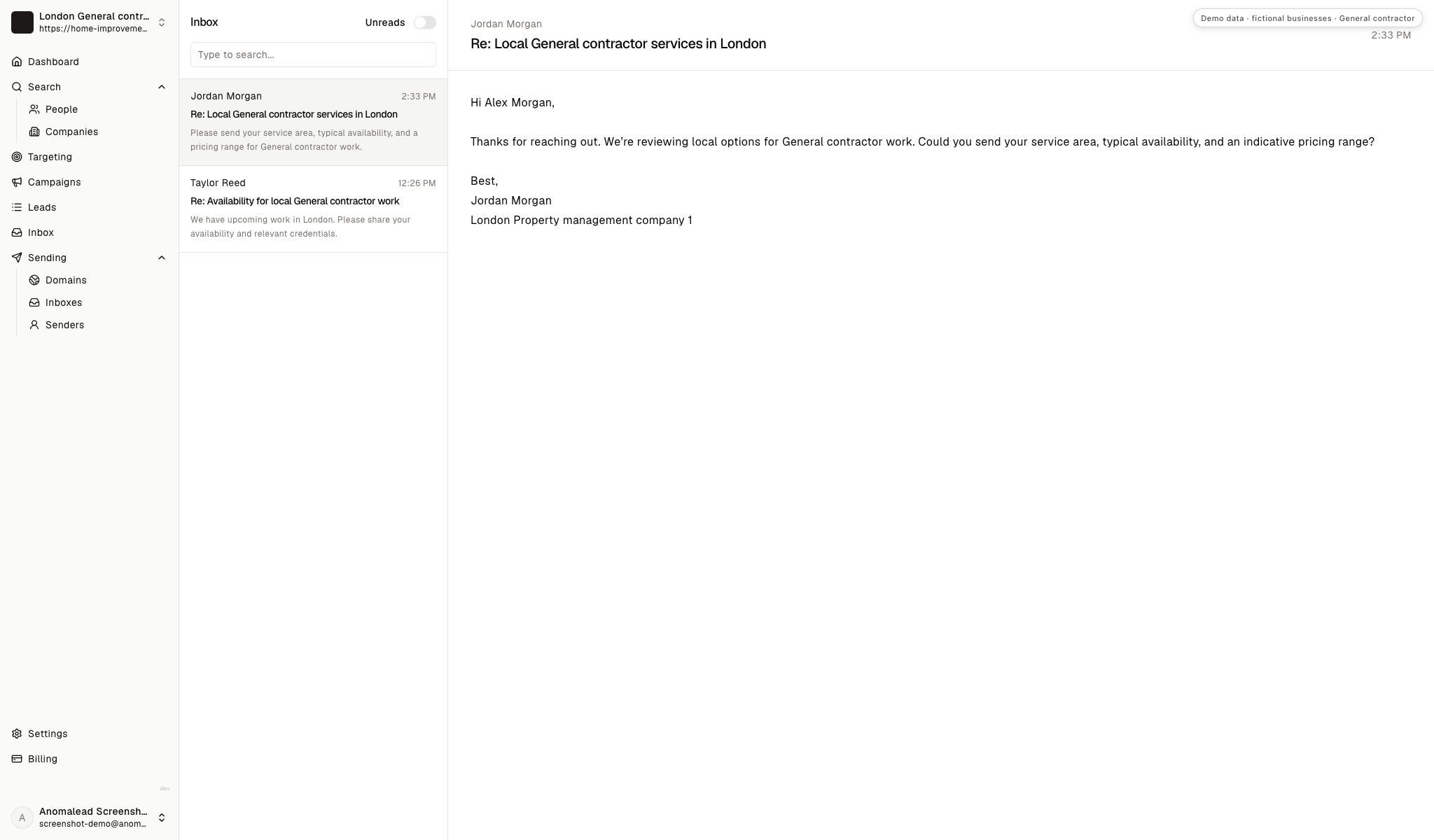
How to answer a property manager’s project questions
Section titled: How to answer a property manager’s project questionsAnswer the question before proposing a meeting. Name the work you can take on, what still needs checking, and avoid treating an inquiry as permission to start.
Jordan asks for service area, availability and an indicative price range
Section titled: Jordan asks for service area, availability and an indicative price range“Please send your service area, typical availability and a pricing range for improvement work.”
Name the areas you serve and how you confirm capacity. Explain that price depends on site conditions, finish choices, access and scope; do not invent a standard rate. Offer a scope call or site review after confirming the property and approval contact.
Answer directly, then qualify the package:
“Thanks, Jordan. Our service overview lists the areas we cover, and I can confirm capacity once we know the project window. Price depends on work areas, finishes, site conditions and access, so we review those before quoting. Which property type and upgrade package are you considering?”
Taylor mentions upcoming work and asks about availability, scope and credentials
Section titled: Taylor mentions upcoming work and asks about availability, scope and credentials“We have upcoming work. Please share your availability, the work you cover and relevant credentials.”
Send current credentials and insurance that fit the proposed work. Ask about the property type, package and vendor review steps; do not promise a start before checking material lead times, access and approvals.
Set up a fit check before discussing dates:
“Thanks, Taylor. I can send current capability and insurance information. Could you share the general upgrade package and service area, without resident details? Once we understand approval and access, we can decide whether a site review makes sense.”
The project has a budget but finish choices are still open
Section titled: The project has a budget but finish choices are still open“We have a budget, but finish selections and the work sequence are still under review.”
Ask who approves finishes and whether building standards or samples apply. Separate confirmed tasks from open decisions and label alternates rather than presenting assumptions as approved scope.
Keep the proposal flexible where decisions remain:
“We can start by separating confirmed work from finish decisions. Who approves the material standard, and should we show clearly labeled alternates once the work areas are confirmed?”
The property will remain occupied during the upgrade
Section titled: The property will remain occupied during the upgrade“Residents will be in place during the common-area work. How would your team manage access?”
Discuss work-zone limits, shared routes, delivery windows, notices and who authorizes entry. Make sequencing conditional on a site review and the property’s communication process.
Make access planning part of the scope:
“We would map work zones and shared routes with the site contact before setting a sequence. Which areas must remain open, and who coordinates resident notices and access approval?”
Choose the next portfolio segment to qualify
Section titled: Choose the next portfolio segment to qualifyChoose one repeatable package, such as unit-turn finishes or a shared-space refresh, and list property managers whose building types fit. Use focused campaign planning to organize outreach around the project owner and review process.
For each firm, note the approval contact, access owner, finish standards, occupied-site limits and closeout needs. Ask one practical next-step question, then qualify the site before estimating. A clear scope gives the next property conversation somewhere concrete to start.
Home improvement lead generation questions
Section titled: Home improvement lead generation questionsWhich property managers should an improvement contractor approach first?
Section titled: Which property managers should an improvement contractor approach first?Start with teams that oversee buildings suited to a defined package your crew can deliver. A portfolio lead can explain approvals, while a site manager knows access and resident coordination. Verify who signs off before sending a detailed proposal.
What should be clear before estimating a property upgrade?
Section titled: What should be clear before estimating a property upgrade?Confirm work areas, existing conditions, finish standards, access, occupied-site phasing and approval route. Ask whether drawings, permits or inspections apply. Mark assumptions until a site review confirms them.
How should a contractor plan work in an occupied building?
Section titled: How should a contractor plan work in an occupied building?Treat phasing and communication as part of scope. Agree on work zones, shared routes, deliveries, notices and access approval before proposing a schedule.
Are the companies and replies in the screenshots real?
Section titled: Are the companies and replies in the screenshots real?No. London General contractor Services, the property-management companies, contacts and replies are fictional demo data. They are not customers and do not show real projects or campaign results.
Does the calculator predict whether a property project will be won?
Section titled: Does the calculator predict whether a property project will be won?No. It relates assumptions you enter about outreach and a possible project. It does not predict approvals, signed work, schedule, revenue or profit.