


Family law lead generation through local employers should create a private path for an employee to contact a lawyer, not turn the employer into a source of case details. A business owner can share a neutral resource when someone asks, while the person decides whether to contact the firm directly.
This distinction keeps a sensitive personal matter out of workplace prospecting. The guide shows how to qualify an employer contact, describe a discreet resource, and handle replies without asking who needs help. Start with B2B prospecting fundamentals, then adapt the workflow to a service people choose for themselves.
Key takeaways
- Approach local employers that can share a neutral legal resource when an employee asks for one.
- Keep the employee in control of any contact and do not ask the employer to identify people or describe their family situations.
- Explain your service area, intake process, and verified practice scope without promising a result or response time.
- Use the calculator to assess your own outreach and resource-support effort, not to forecast clients or case outcomes.
Which local employers can share a discreet family-law resource?
Section titled: Which local employers can share a discreet family-law resource?Look for businesses with an owner or people lead who can approve a neutral resource list or an employee-requested introduction. The employer is opening a door to information, not referring a named employee or choosing counsel for them.
- Owner-led professional offices: A small firm may keep a list of outside services for staff and decide who can add a listing. Ask whether the owner already shares community or legal resources when an employee requests them, and make clear that no personal details need to be shared.
- Businesses with an HR or people lead: The HR contact may manage an employee handbook, benefits information, or a private support directory. Offer wording the business can review for its own policy; do not ask HR to screen employees or report who follows a link.
- Multi-location local operators: A local owner may approve an employee resource centrally while different sites distribute it. Confirm who controls the policy and whether the resource needs to work across the places where your firm can accept clients.
- Employers that already provide wellbeing resources: A business with a resource directory may have a process for sharing outside support without endorsing a provider. Ask how new listings are reviewed and whether staff can contact a firm privately and on their own initiative.
A company is a suitable prospect only if its resource process respects employee choice. A large workforce alone does not show that anyone wants family-law advice.
Qualify the resource channel without asking about employees
Section titled: Qualify the resource channel without asking about employeesThe first discussion should cover the employer's process, not a worker's personal circumstances. Agree what the business may share, what the firm can provide, and how an interested person can make contact privately.
- A real resource-sharing process: Ask whether the employer maintains a benefits page, staff handbook, support directory, or a process for answering employee requests. If it does not, offer a simple contact card or approved listing rather than proposing access to staff records.
- Employee-initiated contact: The employee should decide whether to contact the firm and what to say. Do not request names, reason for seeking advice, relationship status, or a manager's account of a private situation.
- Practice location and service fit: Confirm the places where your lawyers can advise and the types of family matters the firm accepts. Jurisdiction can affect separation, finances, parenting arrangements, and court procedure, so do not describe a service beyond the team's authorized scope.
- Private intake and conflict checks: A prospective client may need to provide the other party's name so the firm can check for conflicts. Explain how that person should contact the firm directly and which secure channel to use after the firm confirms the intake steps.
- Fees and professional rules: Use a current, approved explanation of consultation fees and what they cover. Review any workplace listing, event, referral arrangement, or fee-sharing proposal against the professional-conduct and marketing rules that apply to the firm.
About the demo information
The demo operator is the fictional London Family law attorney Services. London Corporate office 1, London Corporate office 2, London Corporate office 3, Jordan Morgan, Taylor Reed, and the displayed messages are fictional. They are not Anomalead customers, real employers, client matters, consultations, or results.
Family law lead generation begins with a suitable resource gatekeeper
Section titled: Family law lead generation begins with a suitable resource gatekeeperSearch for local office businesses that publish an employee support, benefits, or people function. Use their public information to identify who approves outside resources, then ask whether a private family-law contact would fit the employer's process. A company profile cannot show a worker's personal need.
The demo shows a search form, three generic company profiles, two saved prospects, contact records, a list, a campaign draft, and inbox replies. It does not show an employee resource policy or a person seeking legal help. Use local business prospecting to record public facts and keep unverified assumptions separate.
Set the search around your own service area
Section titled: Set the search around your own service areaChoose the place your firm serves, a workable radius, the corporate office category, and any available rating filter. Those settings narrow company research; they do not identify an employee who needs a lawyer.
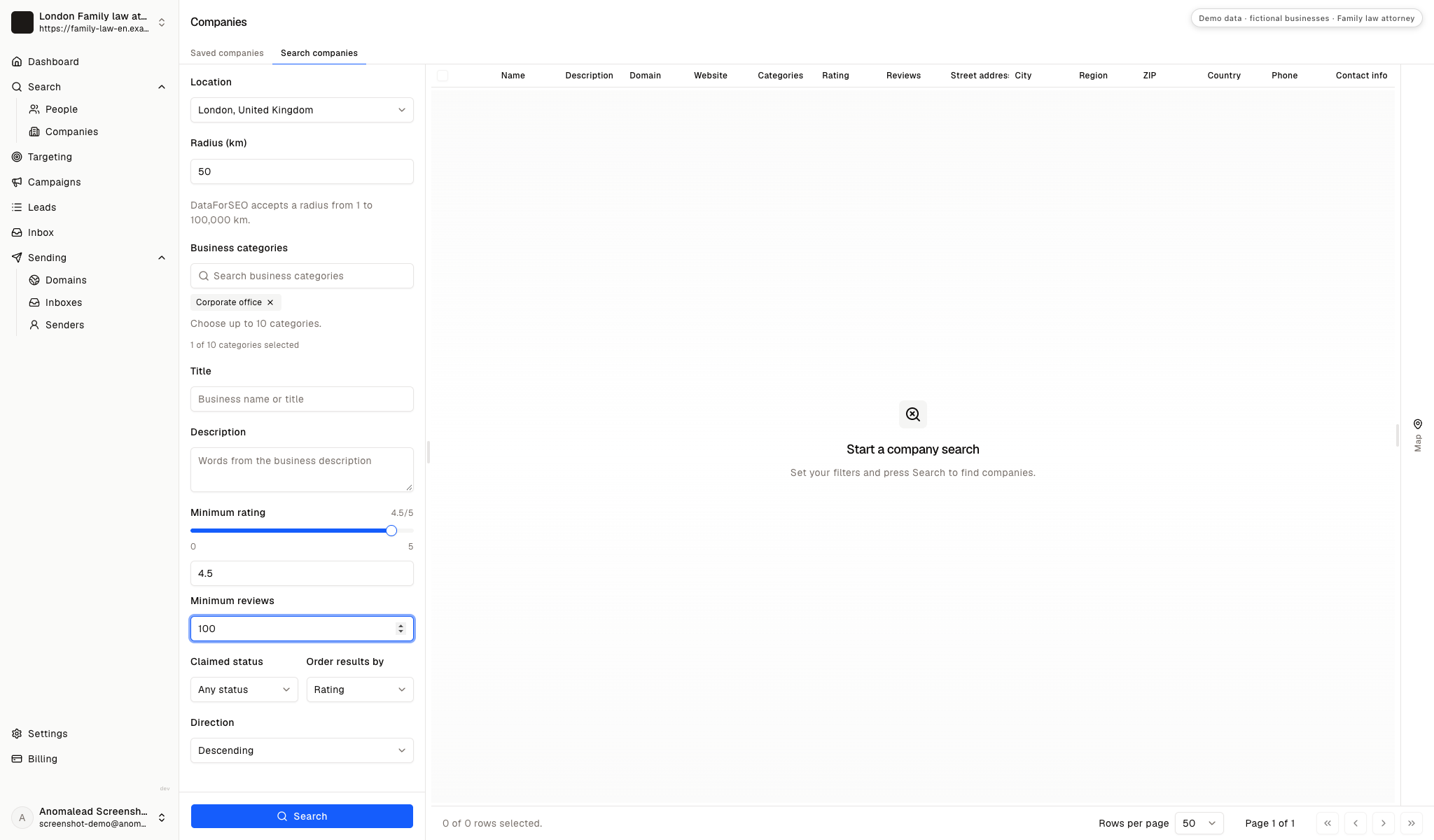
Review the company profile, not its employees' private lives
Section titled: Review the company profile, not its employees' private livesThree fictional corporate offices appear with general profile information, ratings, and review counts. The screen contains no employee support policy, request for advice, or family information.
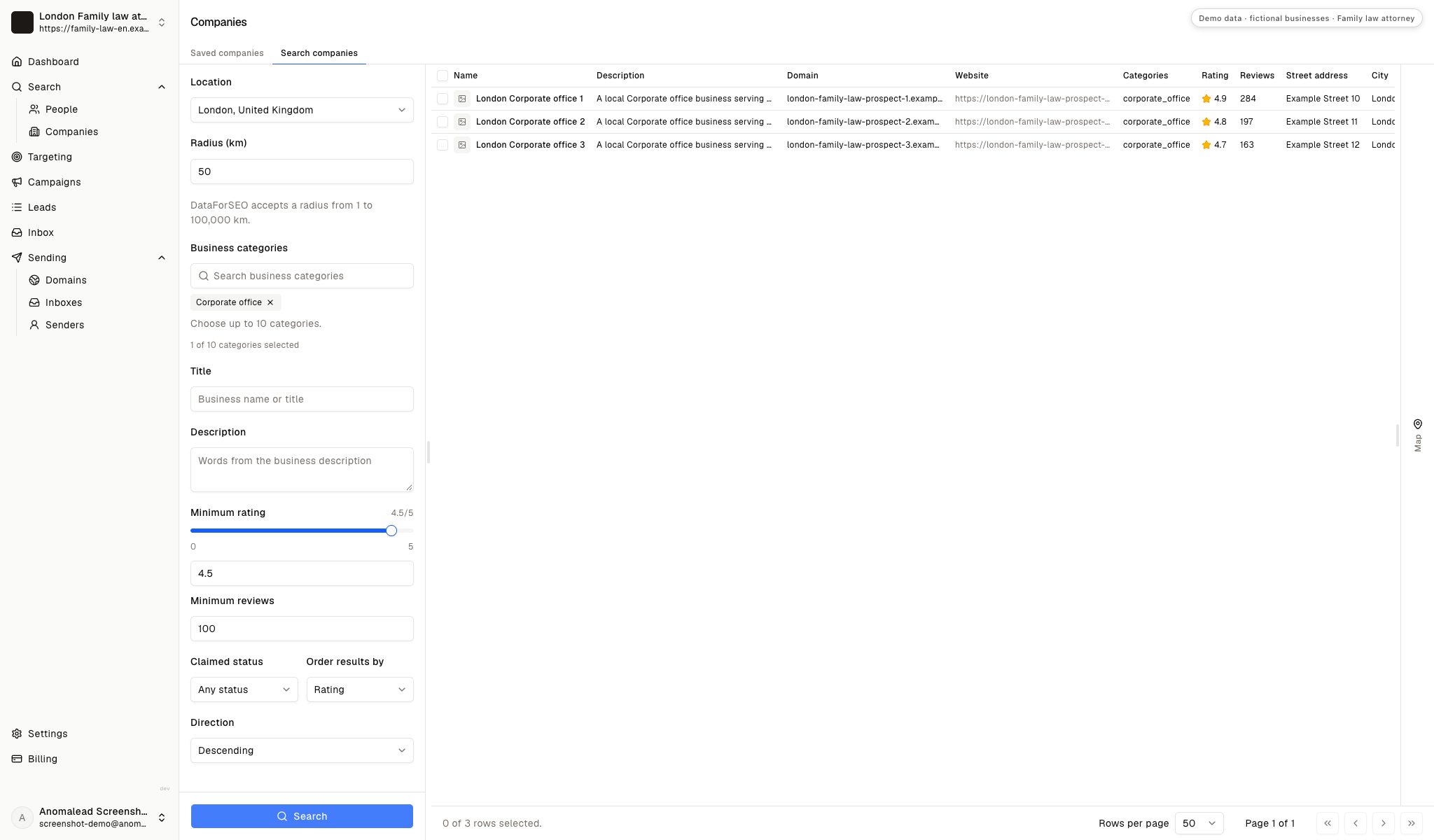
Save businesses with a plausible resource process
Section titled: Save businesses with a plausible resource processTwo of the three demo offices are selected. In your own search, save a business only when public information suggests a real owner or people function to ask about employee resources.
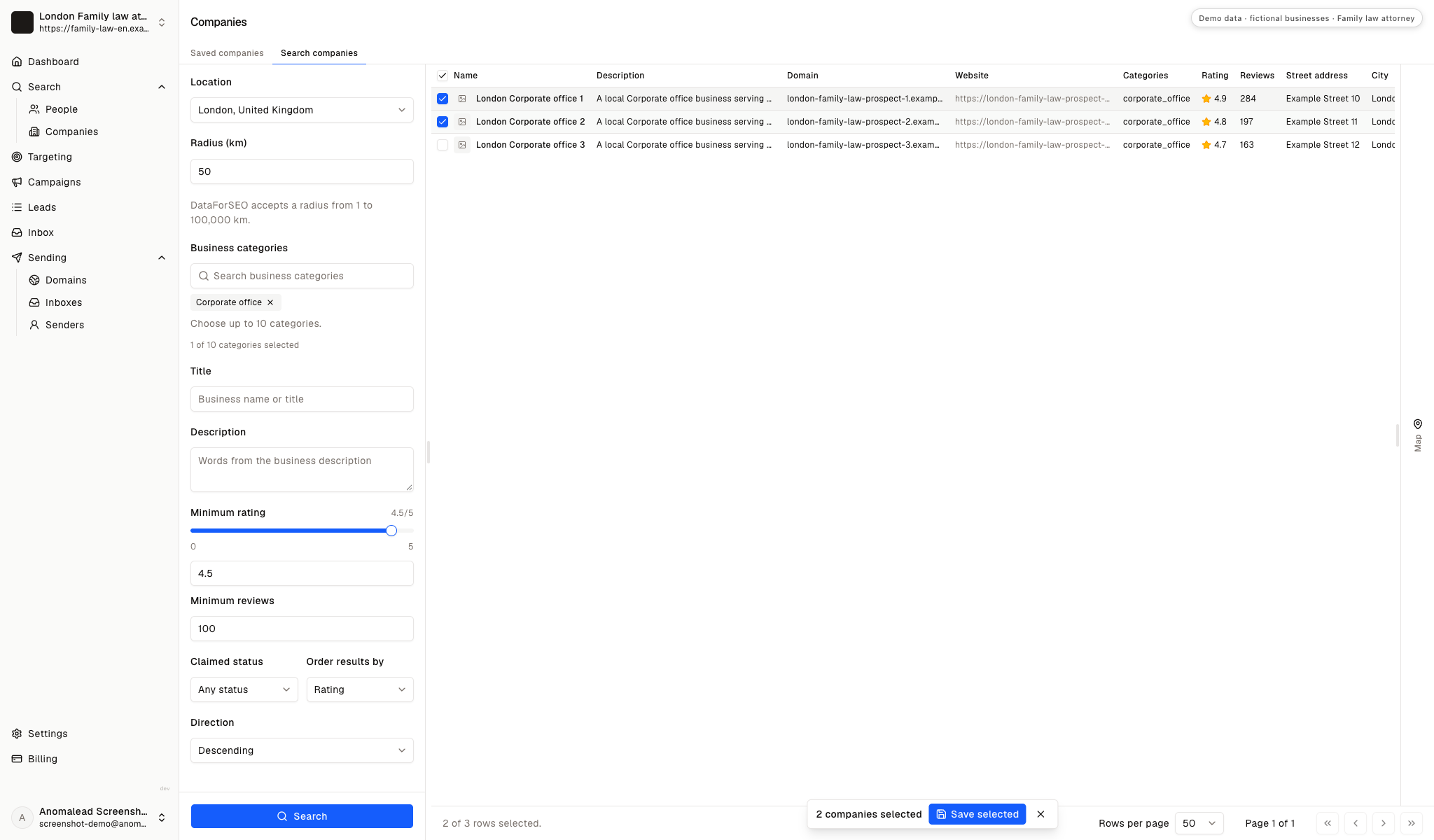
Find the person who approves outside employee resources
Section titled: Find the person who approves outside employee resourcesA business owner, HR lead, or benefits contact may approve a neutral listing, but the demo's Partnerships Manager titles do not prove that authority. Check a current company source and ask who owns the resource policy before describing a possible arrangement.
Keep the first exchange about policy and distribution. Do not ask who has contacted a family lawyer or ask the company to identify likely clients. A respectful first outreach email should let the owner decline without explaining the business's employee matters.
Choose one company to research before adding contacts
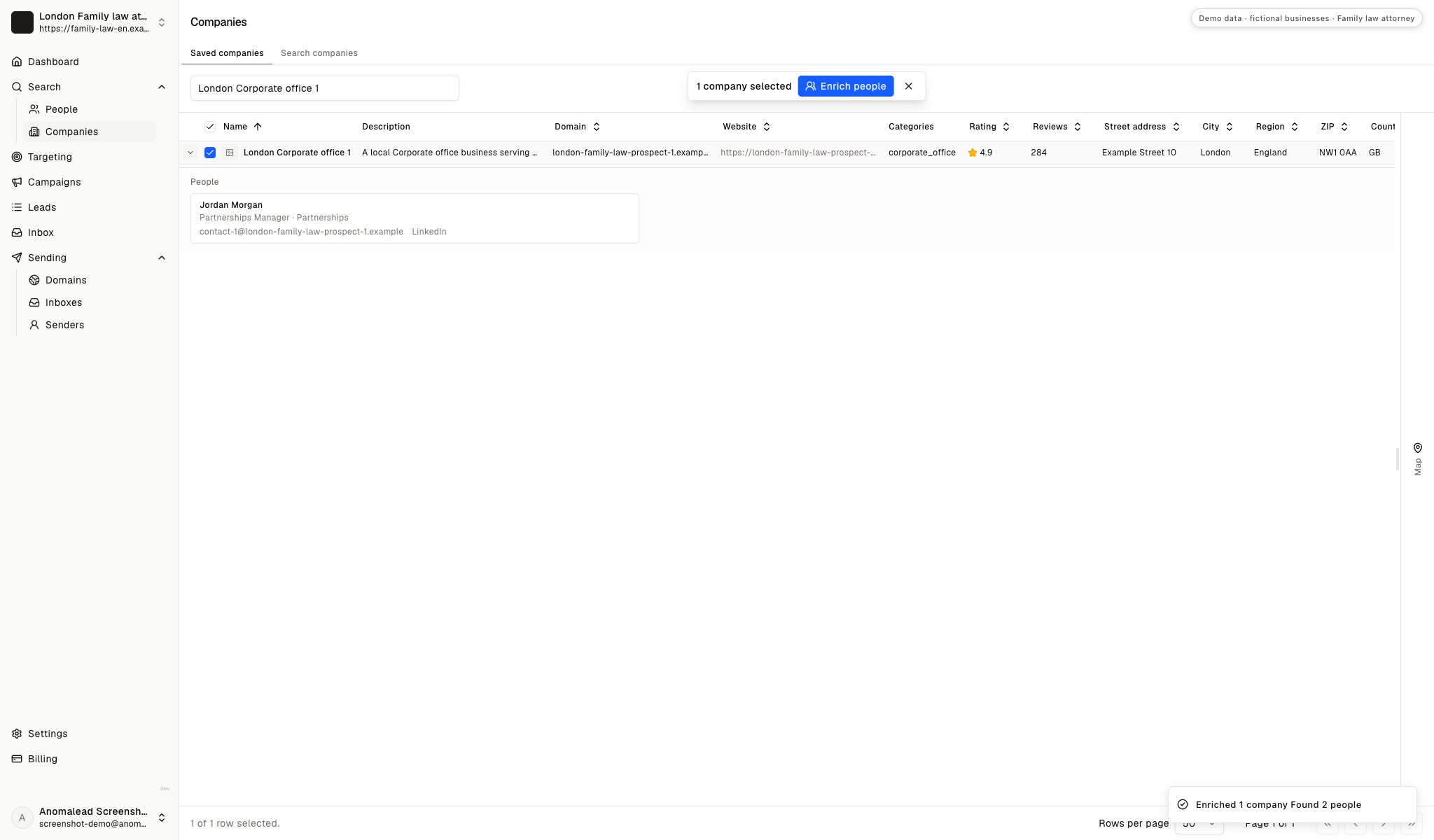
Section titled: Choose one company to research before adding contactsThe shortlist selects one saved company and presents an Enrich people action. Verify any proposed contact's current role publicly, then decide whether that person manages employee resources.
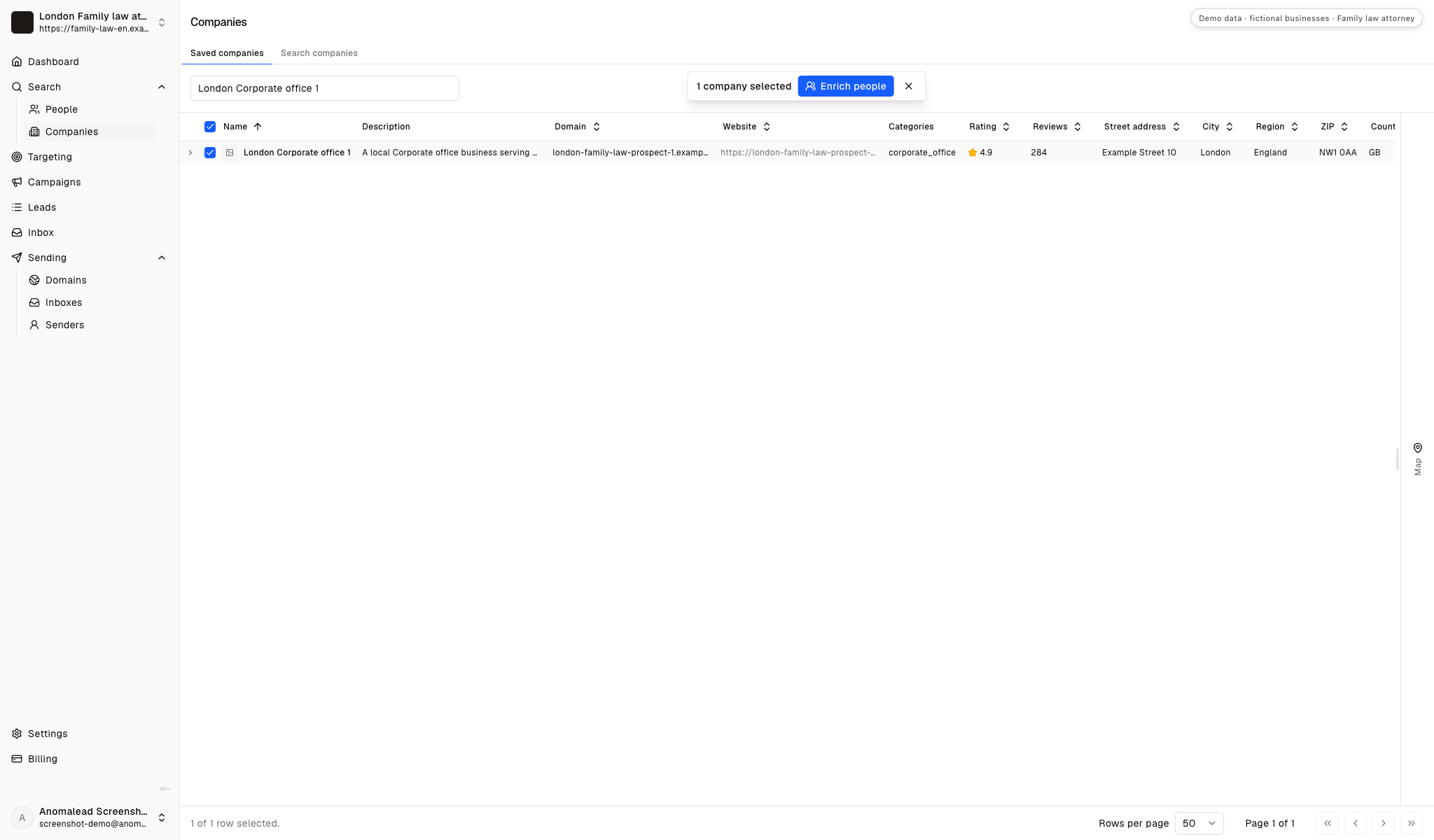
Treat contact titles as clues to verify
Section titled: Treat contact titles as clues to verifyTwo fictional partnership contacts appear in the fixture, but their displayed department says nothing about who approves employee resources. Verify that responsibility independently before reaching out.
Track resource-policy research beside each contact
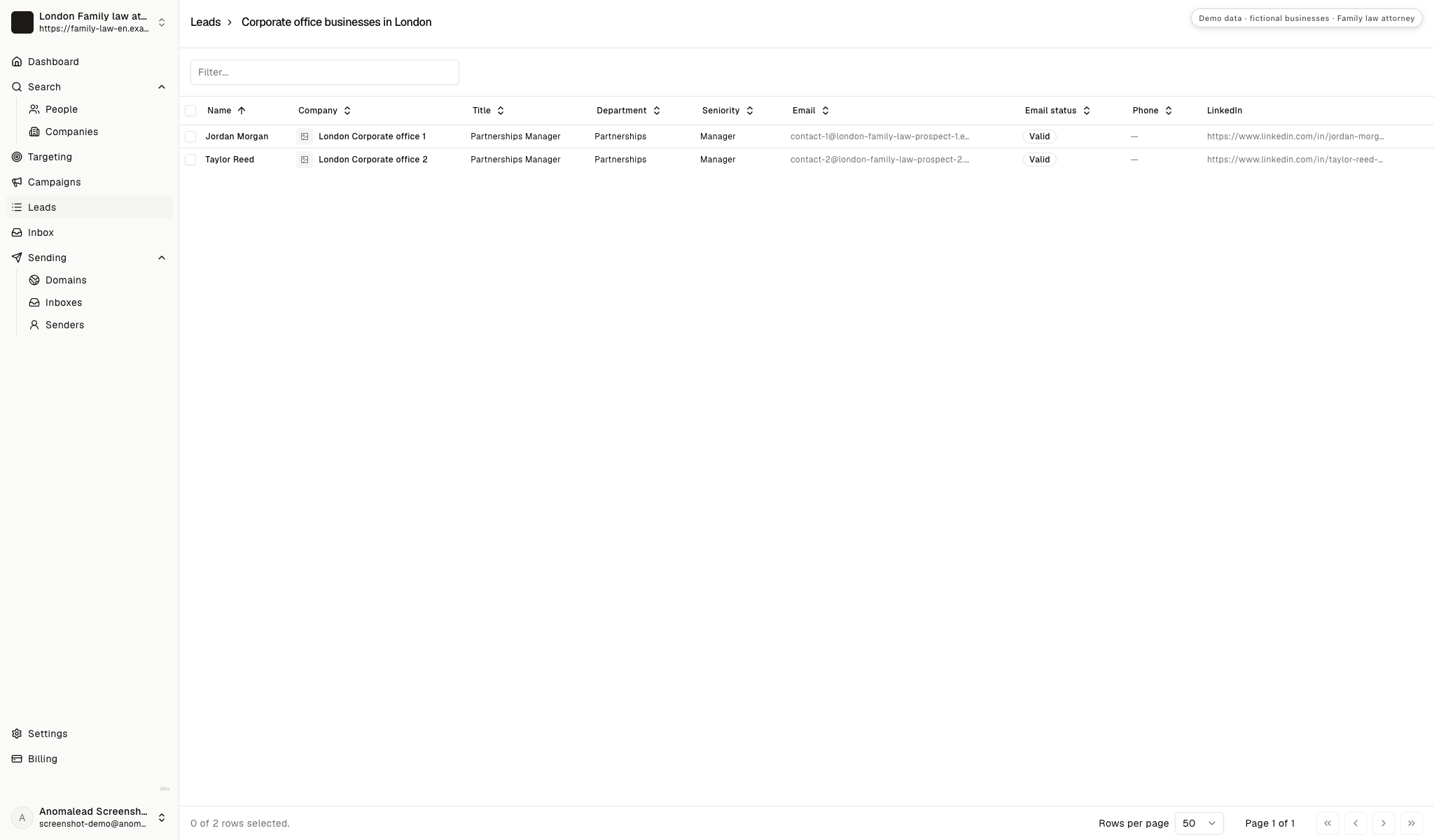
Section titled: Track resource-policy research beside each contactThe demo list contains two fictional contacts and their email status. Note public sources for each role and whether the company shares outside resources; never add an employee's name or personal situation to a prospecting record.
Estimate the work of maintaining an employer resource channel
Section titled: Estimate the work of maintaining an employer resource channelAn employer listing can make a contact easier to find, but it does not create a client or an instruction. Consider the staff time needed to discuss the resource, review approved wording, explain intake, and keep the information current.
The value depends on the firm's own outreach effort and the employer's policy. Do not treat the number of employees or offices as a count of people who will seek family-law advice.
Enter your own assumptions for outreach, consultation time, resource updates, and legal intake. The calculator does not predict employee requests, clients, accepted matters, case outcomes, revenue, or profit.
Do the math on one good deal
If one new customer is worth thousands, you don’t need magic. You need a few more meetings a month.
Projected monthly results
- Deals closed
- 2.0
- Projected revenue
- £10,000
- Growth plan (1 business)
- £79/mo
- ROI
- 12,558%
Conservative math on meetings you already believe you can book. One closed deal often pays for a year of Anomalead.
Keep the business case separate from personal case details. A resource channel should be judged on a clear process and a suitable service fit, not on access to employee information.
Offer an employee-controlled route, not an employer referral list
Section titled: Offer an employee-controlled route, not an employer referral listExplain that a business may share a neutral contact when a person independently asks for family-law information. The employee chooses whether to contact the firm, and the employer does not learn who follows through or receive updates about any matter.
Ask who approves outside resources and what language the business needs to review. Do not propose access to a staff list, collect employee concerns, or promise that a consultation will solve a legal problem. The B2B email examples can help with a short partner note, but keep this privacy boundary explicit.
Check that the campaign reaches the right business contact
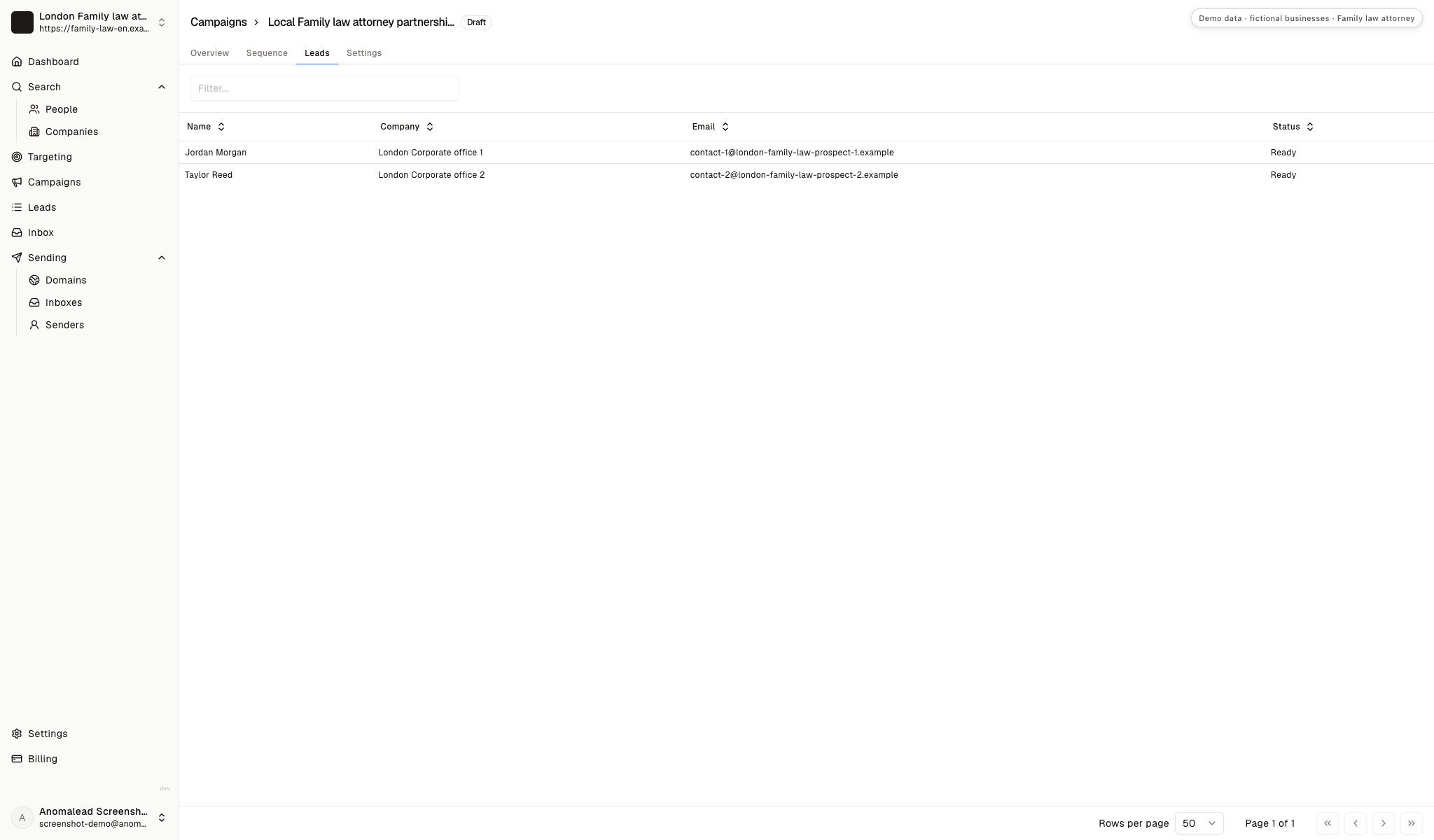
Section titled: Check that the campaign reaches the right business contactThe draft campaign lists two fictional contacts and the demo family-law practice. In a real campaign, verify each recipient's role and whether an introductory note about employee resources is appropriate.
Make follow-ups brief and easy to decline
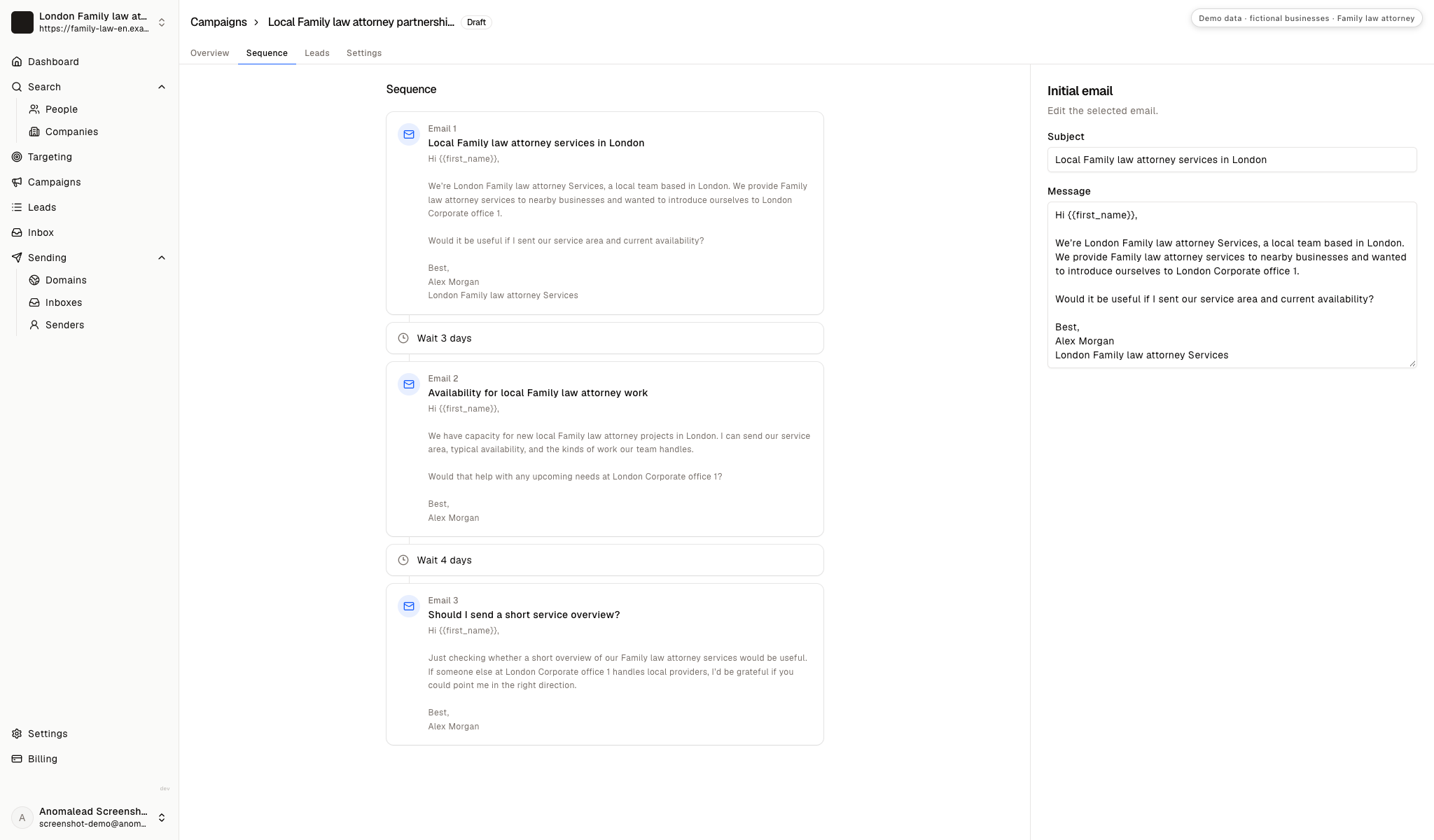
Section titled: Make follow-ups brief and easy to declineThe sequence screen shows three draft emails with scheduled waits. Replace generic copy with the resource policy question, and stop follow-ups if the business declines or the contact asks not to hear again.
A private resource note to a local employer
Section titled: A private resource note to a local employerUse one clear question about the employer's process. The demo names Jordan Morgan as a Partnerships Manager, but verify that a real person owns employee resource listings before contacting them.
First resource inquiry
Subject: A private family-law contact option for employees
Hello Jordan,
I’m Alex Morgan at London Family law attorney Services. Our firm speaks directly with individuals who choose to ask about family-law matters, within the locations and services our team covers.
Does your company share a neutral contact when an employee asks where to find independent family-law support? We would not ask the employer to identify the person or tell us why they are looking.
Regards, Alex Morgan, London Family law attorney Services
Brief follow-up about the resource process
Subject: Re: A private family-law contact option for employees
Hello Taylor,
I wanted to clarify that this is a resource-policy question, not a request for employee referrals. A person who wants to speak with a lawyer would contact our office directly, and the employer would not receive case information.
Would a short description of our service area and private intake process help you decide whether a listing fits your company's policy?
Regards, Alex Morgan
Use a clear subject for a professional introduction and keep the next step voluntary for both the employer and the employee.
Treat a reply as a business-process question
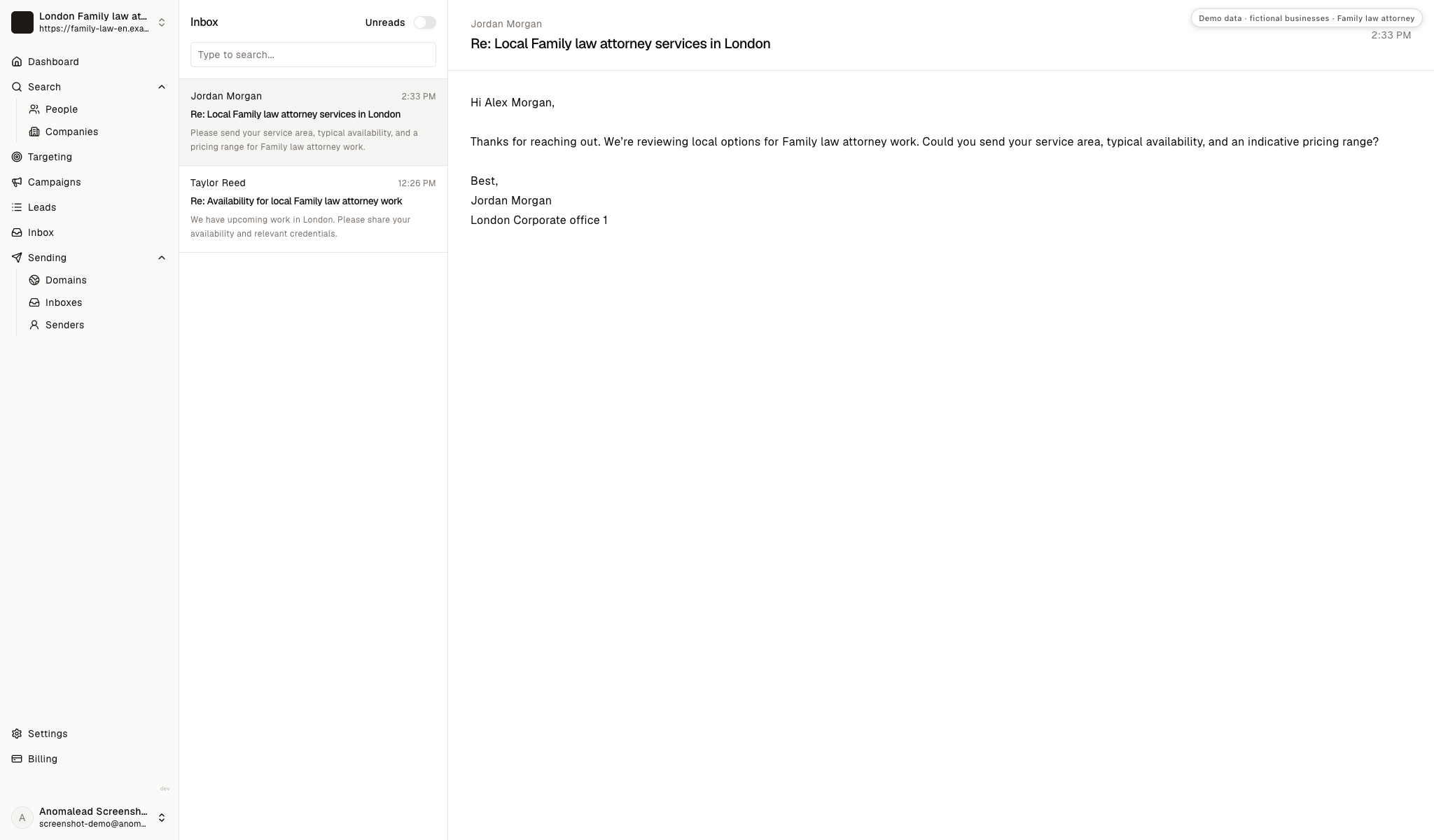
Section titled: Treat a reply as a business-process questionThe inbox shows two fictional replies asking about service area, availability, pricing, and credentials. It contains no employee request, family details, or instruction to the law firm.
Answer employer questions while preserving private choice
Section titled: Answer employer questions while preserving private choiceThe seeded replies are generic business questions. Keep your answer about service, process, and verified credentials; do not ask the owner to name an employee or explain a family situation.
Jordan asks for service area, availability, and indicative fees
Section titled: Jordan asks for service area, availability, and indicative feesWe are reviewing local family-law options for our employees. Please share where your firm works, when consultations are usually available, and an indicative fee range.
This reflects the first demo reply. Describe the places and family-law services your firm actually covers, then point to an approved fee explanation. Do not invent a consultation price or imply that an employer can book for an employee.
Explain that the individual contacts the firm directly to ask about current availability, intake, and whether the firm can consider the matter. The employer should not send names or personal details.
Answer without assuming a client exists:
Thanks, Jordan. Our firm can share its current service area and approved fee information. Availability depends on the individual contacting us and the scope of their enquiry. If your policy allows a neutral listing, we can send wording for you to review; no employee details need to come to us through the business.
Taylor mentions upcoming work and asks for scope and credentials
Section titled: Taylor mentions upcoming work and asks for scope and credentialsA family-law question may come up at our office. Please outline the work your lawyers cover, current availability, and relevant credentials.
This follows the second fixture reply but does not make the employer a client. Clarify whether the contact means a neutral employee resource or a request for an individual to speak with the firm. Share only current, verifiable qualifications and a broad service outline.
Do not confirm an appointment or accept a matter through the employer. The person seeking advice must contact the firm, complete intake, and receive information about the firm's process directly.
Clarify the resource before discussing timing:
Thanks, Taylor. We can share the family-law services our team is authorized to provide and our current credentials. Our intake team can discuss availability directly with anyone who chooses to contact us. Are you considering a neutral resource for employees, rather than sending details of a particular person?
The owner offers to share an employee's personal details
Section titled: The owner offers to share an employee's personal detailsAn employee asked me about separation. Can I send you their name and situation?
Ask the owner not to send the person's name, relationship history, financial documents, or other private information. The individual should choose whether to contact the firm and explain the matter through its approved intake route.
If there is an immediate safety concern, point the business to an appropriate local emergency or crisis resource reviewed by counsel. A marketing conversation is not emergency support.
Protect the employee's choice:
Please do not send the employee's name or personal details. If they want to speak with a lawyer, you can share our contact information and they can decide whether to call us directly. We will explain our intake steps to them in private.
The company already lists a family-law provider
Section titled: The company already lists a family-law providerWe already provide employees with a family-law contact through our benefits resources.
Respect the current arrangement and ask no questions about who uses it. If the owner is reviewing its resource list and welcomes another neutral option, offer the same public service information you would give any individual.
Close without pressure:
Thank you for letting me know. Please continue with the resource your company has chosen. If you review the list later and would like another option for employees to consider privately, I can send our service information for your team to assess.
Choose one resource gatekeeper and write the privacy boundary
Section titled: Choose one resource gatekeeper and write the privacy boundaryThis week, select one local business whose owner or people lead controls an employee resource list. Check its public process, ask who reviews outside contacts, and draft one note that makes employee choice and privacy explicit.
Before approaching employers, have the responsible lawyer review the listing language, intake route, and marketing rules. The law firm client development guide can help organize a broader plan, but keep each person's decision to contact counsel private.
Questions about family-law resources at local businesses
Section titled: Questions about family-law resources at local businessesCan a business owner refer an employee to a family lawyer?
Section titled: Can a business owner refer an employee to a family lawyer?A business can share neutral contact information when someone asks, if that fits its own policies. The employee should choose whether to contact the firm, and the employer should not send personal details or expect updates about a matter.
What should a family lawyer ask a business before offering a resource?
Section titled: What should a family lawyer ask a business before offering a resource?Ask who approves outside resource listings, how information reaches staff, and what the employer's privacy policy permits. Do not ask whether a named employee is separating, seeking advice, or using a service.
Should the employer arrange an employee's family-law consultation?
Section titled: Should the employer arrange an employee's family-law consultation?The person seeking advice should contact the firm directly and make their own decision about representation. A manager should not collect case facts or book a consultation on someone's behalf unless the person has clearly asked for that help and the firm's intake process allows it.
Are the businesses in the demo actual employers?
Section titled: Are the businesses in the demo actual employers?No. The corporate office names, contact profiles, and replies are fictional demonstration data. They are not Anomalead customers, real employers, family-law clients, or evidence of outcomes.
What does the ROI calculator predict for a family-law firm?
Section titled: What does the ROI calculator predict for a family-law firm?It lets the firm model its own assumptions about outreach and the effort needed to maintain a resource channel. It does not predict employee requests, clients, accepted matters, legal outcomes, revenue, or profit.