


Employment law lead generation works best when a firm builds trusted referral routes with HR consultants who advise employers but do not provide legal advice. The aim is a suitable introduction, not a promise that every workplace question will become an instruction.
Start with the consultant’s client base, the legal work your team can accept, and the safeguards needed before anyone shares case facts. This guide covers that process and a careful first email. For a wider view of business lead generation basics, keep partner research separate from client intake.
Key takeaways
- Approach HR consultants whose employer clients need a clear route to independent legal advice.
- Agree who the client is, how introductions work, and when conflict checks must happen before discussing a matter.
- Keep employee names and case documents out of prospecting messages; use an approved intake channel after consent and checks.
- Describe the work your firm can assess, then let the employer choose whether to seek advice.
Which HR consultants can introduce the right employer?
Section titled: Which HR consultants can introduce the right employer?Prioritize advisers who already support employers with workplace processes and know when a legal question sits outside their remit. A useful partner understands the client relationship and can make a transparent introduction without sharing confidential details first.
- Outsourced HR providers: They may handle policies, absence processes, investigations, or manager support for several employers. Ask how clients currently find independent legal advice when an issue needs a solicitor’s assessment.
- Independent HR consultants: A consultant serving a defined sector may know the practical context behind a referral, such as shift patterns or a dispersed workforce. Confirm whether the consultant wants a named contact for occasional introductions or a more formal referral arrangement.
- Workplace relations specialists: These advisers can be close to grievance, conduct, or capability processes. The referral boundary matters: the consultant can manage an HR process while the employer gets separate legal advice on its position and options.
- HR firms supporting organizational change: Restructures and changes to working arrangements can raise questions that an employer should assess with qualified counsel. Check the consultant’s service mix and whether they work with employers in the jurisdictions your firm covers.
Do not treat a large contact list as a referral channel. The fit depends on employer overlap, a clear client choice, and compatible professional boundaries.
Qualify the relationship before discussing a matter
Section titled: Qualify the relationship before discussing a matterA sound partner conversation settles process before it gets near a live case. Ask about the consultant’s work, the employer’s role, and the checks your firm requires; do not invite sensitive facts over an ordinary email.
- Employer profile and jurisdiction: Find out which types of employers the consultant serves and where those employers operate. The firm should only describe jurisdictions and services its lawyers are equipped and authorized to cover.
- The point at which advice is needed: A request may concern a contract review, a grievance, an investigation, a proposed change, or a dispute. Ask for the broad category only; do not request the employee’s identity, allegations, health information, or documents during prospect qualification.
- Client choice and instruction: The employer normally needs to decide whether to instruct a firm and who will pay for the work. Clarify whether the consultant introduces the employer, stays involved as its HR adviser, or expects a joint meeting, and explain that representation begins only after your firm accepts the instruction.
- Conflicts and secure intake: Your firm may need the names of parties and related entities to check for conflicts before it can hear more. Explain which limited identifiers are safe to provide for that check and which secure channel to use for case materials once the firm confirms the next step.
- Referral terms and professional rules: If a repeat relationship is proposed, record how introductions, fees, client consent, confidentiality, and follow-up are handled. Have the responsible lawyer review the arrangement against the professional-conduct and marketing rules that apply to the firm.
About the demo information
The demo operator is the fictional London Employment attorney Services. London Employment consultant 1, London Employment consultant 2, London Employment consultant 3, Jordan Morgan, Taylor Reed, and the displayed messages are fictional. They are not Anomalead customers, real legal matters, client instructions, or evidence of results.
Employment law lead generation begins with referral-fit research
Section titled: Employment law lead generation begins with referral-fit researchSearch for HR consultancies that serve employers in the places and sectors your firm can advise. Use public service descriptions to form a hypothesis, then confirm the relationship directly. A directory listing cannot tell you whether a consultant has a client who needs counsel.
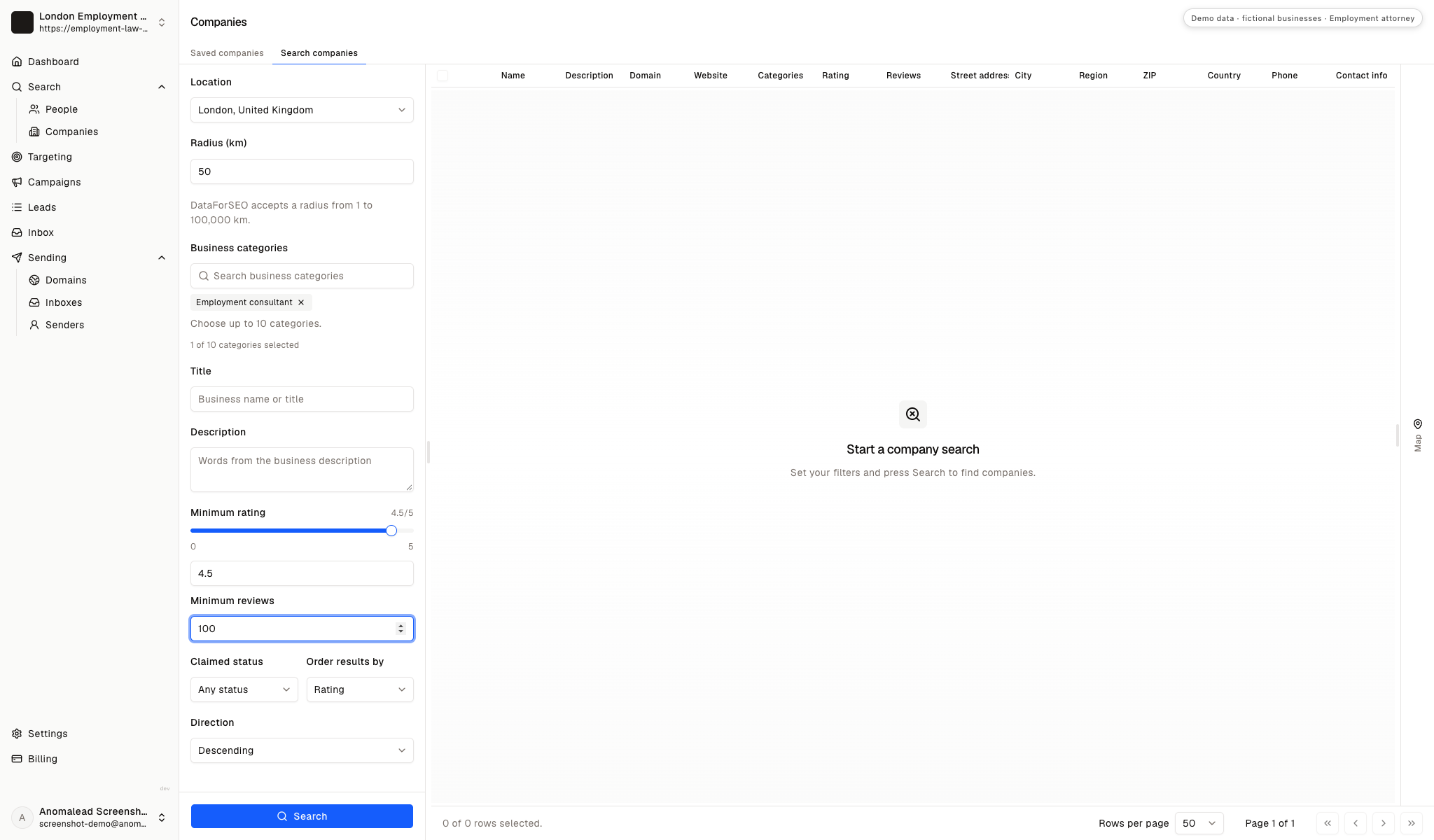
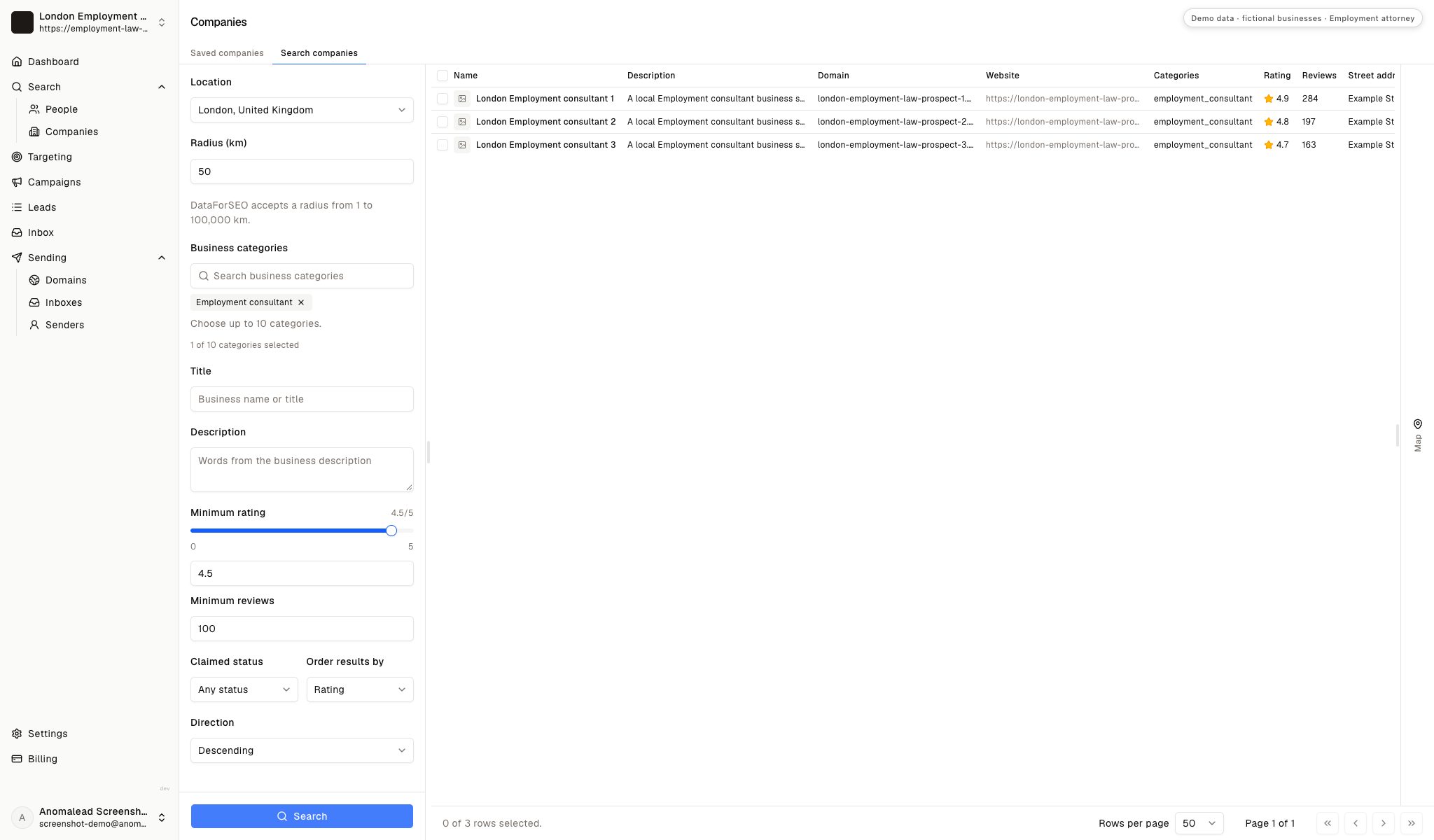
The demo shows a search form, three generic company profiles, two saved prospects, contact details, a list, a campaign draft, and replies. It does not show a legal need, referral agreement, client consent, or case information. Use a practical prospecting workflow to record what a company publishes and what still needs confirmation.
Set the search to your service area
Section titled: Set the search to your service areaChoose a location, a workable radius, the employment consultant category, and any available rating filter. The search parameters narrow the company list; they do not reveal a consultant’s client relationships or legal needs.
Review public profiles before saving a firm
Section titled: Review public profiles before saving a firmThe result cards display three fictional employment consultants with general profile details, domains, ratings, and review counts. None of those fields confirms an employer referral, a legal issue, or a firm's suitability for a particular matter.
Save only consultants worth checking further
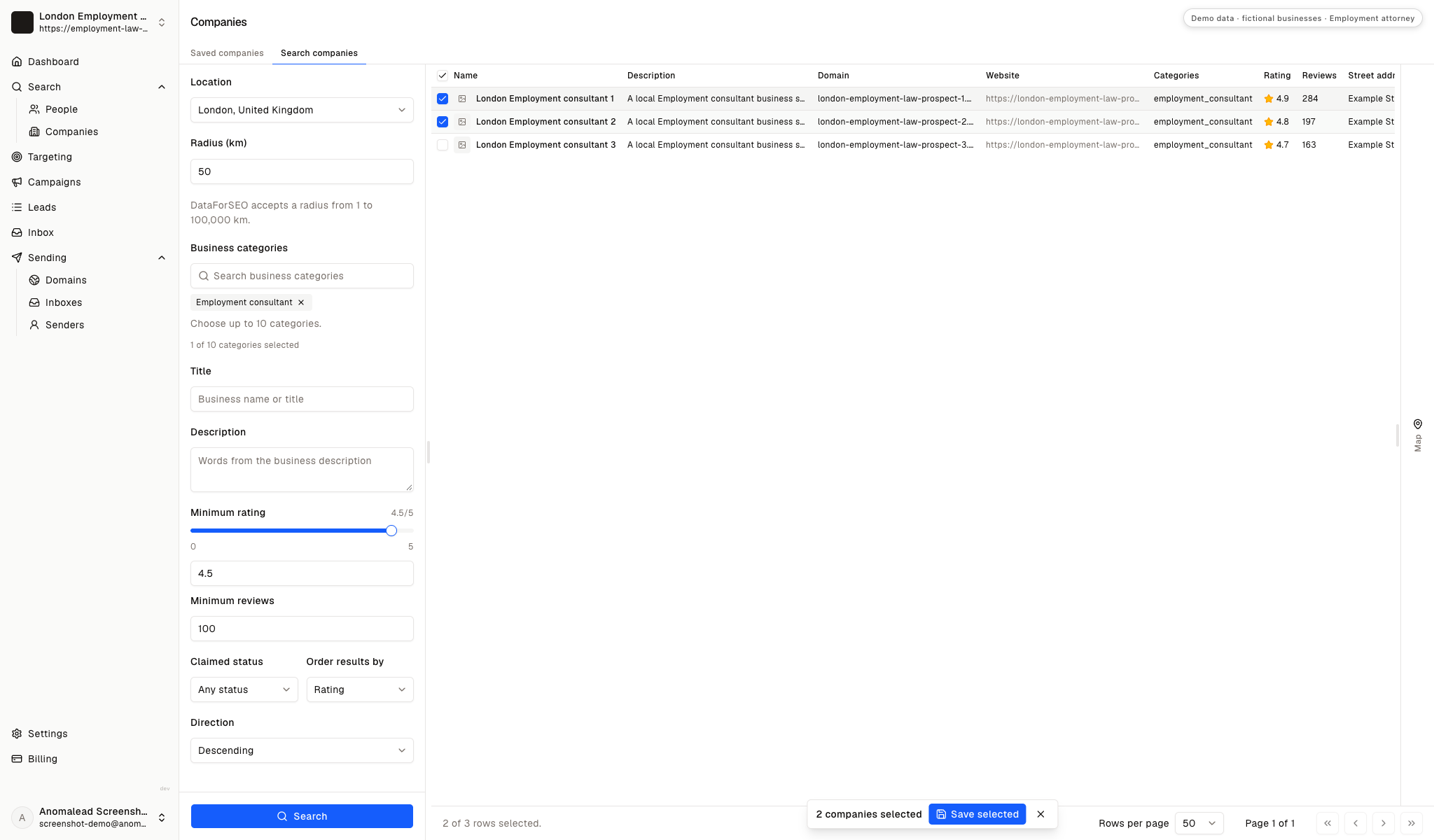
Section titled: Save only consultants worth checking furtherTwo of the three fictional firms are selected in the demo. In your own list, save an organization only after its employer-facing work appears relevant to the legal services and locations your team can handle.
Find the adviser who manages employer referrals
Section titled: Find the adviser who manages employer referralsThe best first contact is often the consultant who owns client relationships or decides which specialist firms they introduce. A partnerships title may be a useful starting point, but it does not prove that a person handles HR referrals or legal matters.
Check the company’s public team pages and service descriptions, then ask who coordinates external legal support. Do not send a conflict-check list or client story to an unverified contact. For broader outreach planning, ways to write a clear first email help keep one respectful question at the center.
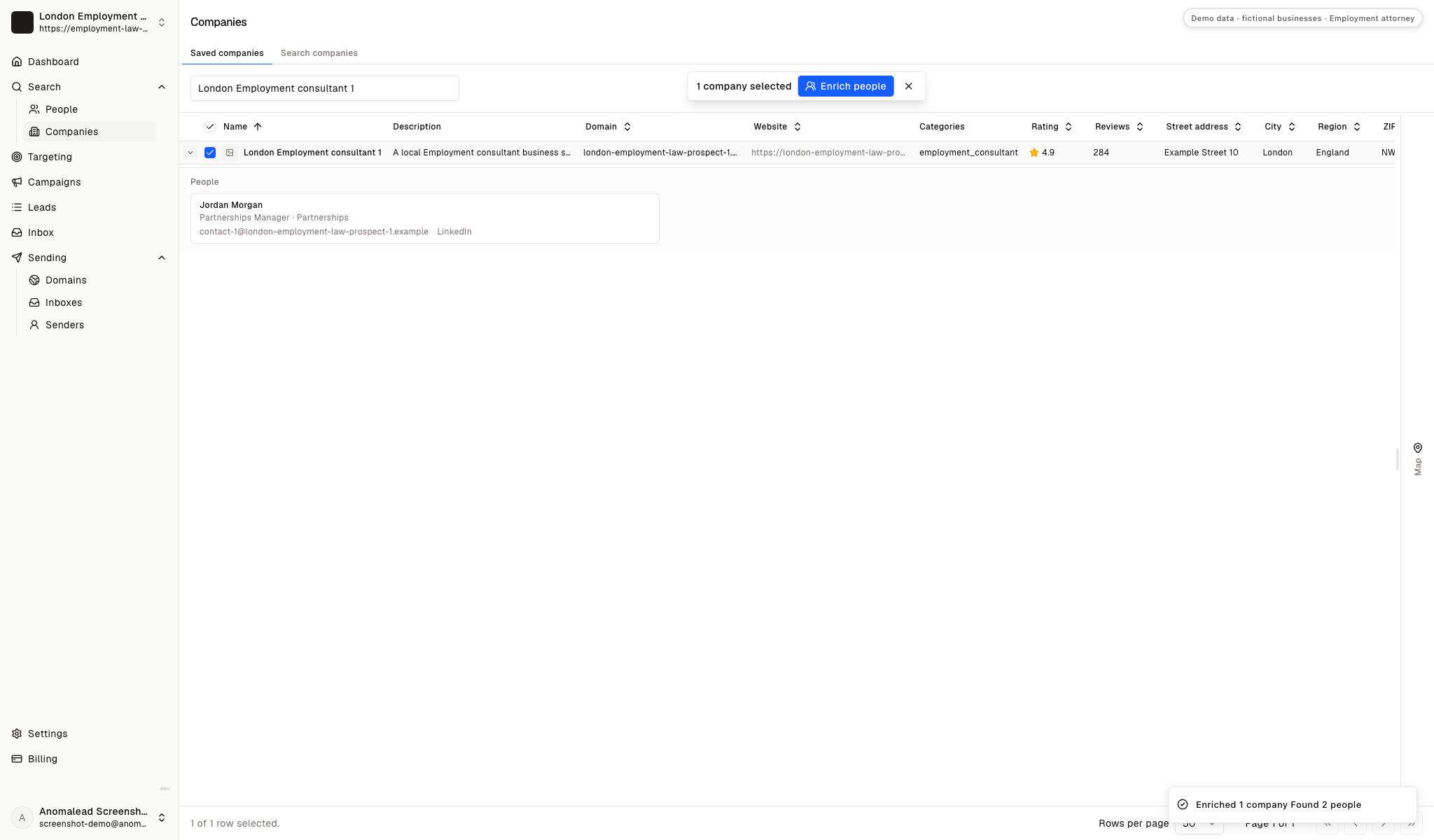
Choose a saved company for contact research
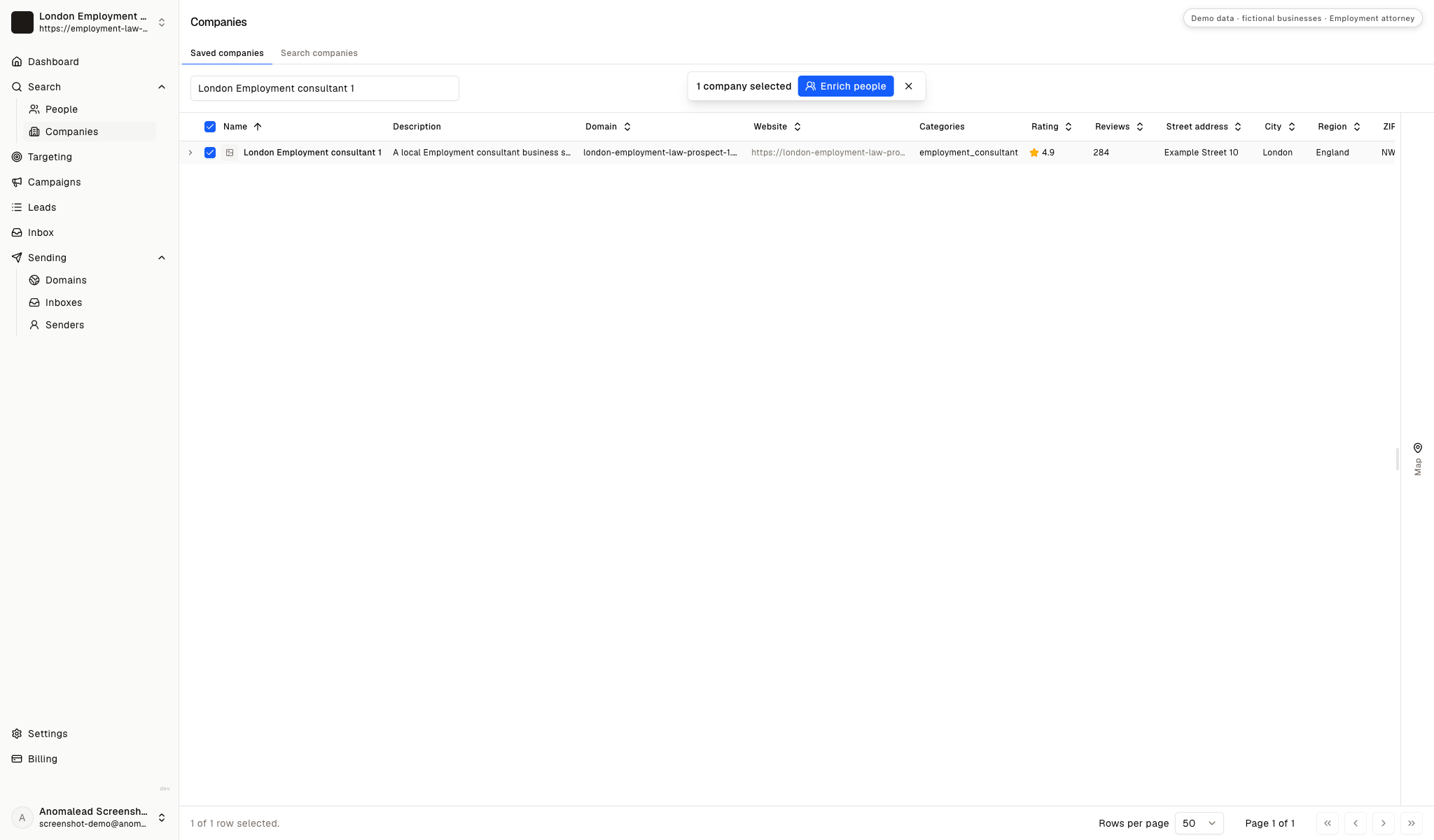
Section titled: Choose a saved company for contact researchThe shortlist view selects one saved organization and offers an Enrich people action. Before using a contact record, verify that the person still works there and has a relevant role through a public source.
Check who handles external specialist relationships
Section titled: Check who handles external specialist relationshipsThe demo lists Jordan Morgan and Taylor Reed as fictional Partnerships Managers. Confirm a real person’s responsibilities from a current company source before assuming they choose employment-law referral partners.
Keep qualification notes beside each contact
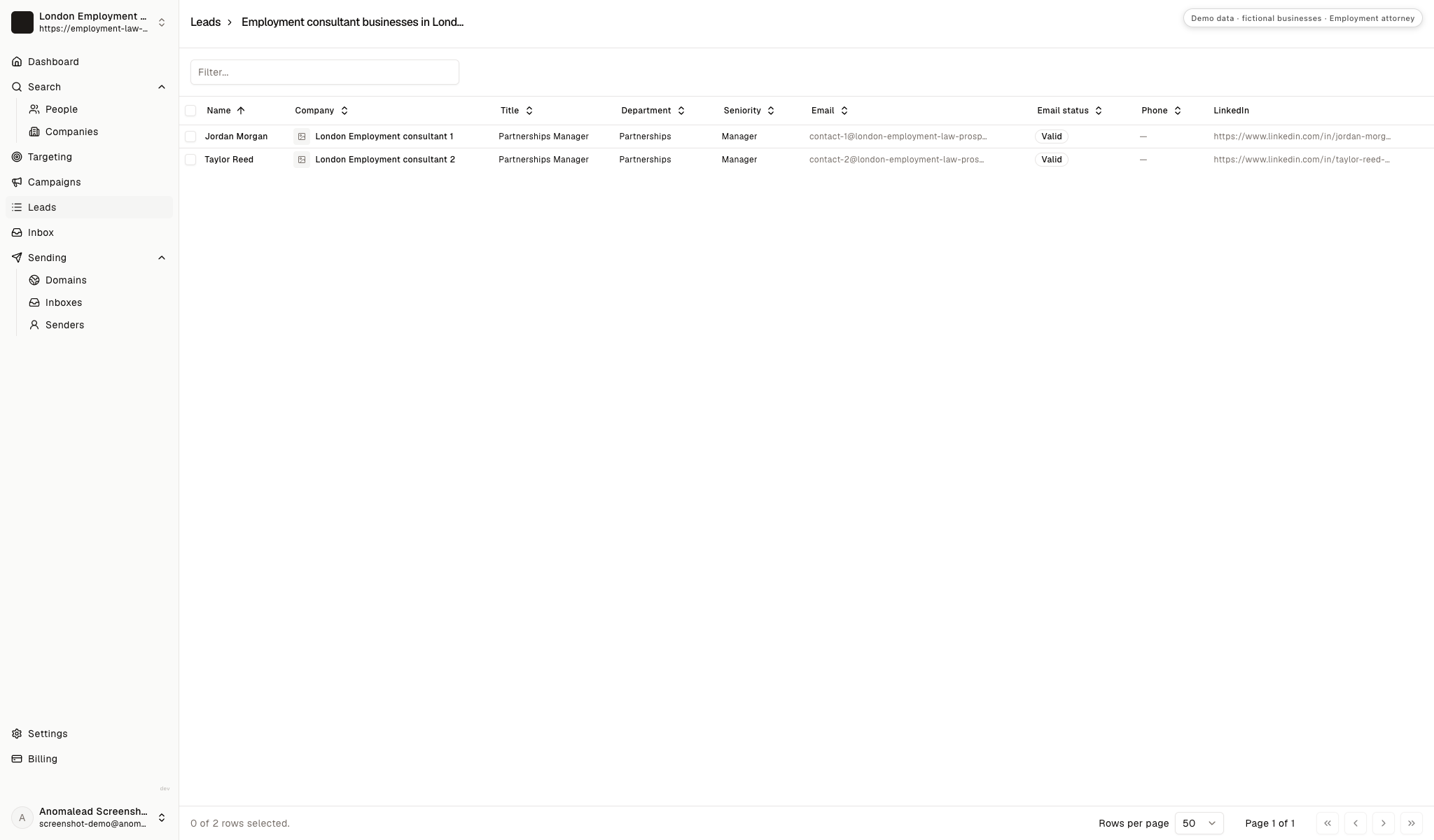
Section titled: Keep qualification notes beside each contactThe demo list contains two fictional people and their email status. Add notes about public employer sectors, the likely decision maker, the source for each claim, and whether the person asked you to stop contacting them.
Assess the value of a well-qualified referral partner
Section titled: Assess the value of a well-qualified referral partnerA suitable HR relationship can create access to employer conversations, but a contact is not a client instruction. Assess the time required to maintain the relationship, screen a potential matter, check conflicts, and deliver the work your firm agrees to accept.
The business case depends on your own practice mix and capacity. Treat a referral route as useful only if its likely work fits your service scope and professional obligations.
Enter your own assumptions for partner outreach, consultation time, legal review, conflict checks, and matter delivery. The calculator does not estimate referrals, instructions, case outcomes, revenue, or profit.
Do the math on one good deal
If one new customer is worth thousands, you don’t need magic. You need a few more meetings a month.
Projected monthly results
- Deals closed
- 2.0
- Projected revenue
- £10,000
- Growth plan (1 business)
- £79/mo
- ROI
- 12,558%
Conservative math on meetings you already believe you can book. One closed deal often pays for a year of Anomalead.
Exclude any value you cannot support with your firm's own records. A calculator cannot replace conflict review or a decision about whether to accept an individual matter.
Explain the referral boundary in the first message
Section titled: Explain the referral boundary in the first messageA first note should explain which employer questions your firm can assess and how a consultant can make an introduction with the employer’s consent. Avoid implying that your team will endorse a consultant, accept every matter, or advise an employee before the firm has checked conflicts and scope.
Ask for a brief conversation about referral process, not details of a live dispute. Share a secure intake route only after the firm has explained what information is appropriate to submit. The B2B email examples can help you compare concise formats, but adapt the wording to your professional rules.
Confirm the recipients before drafting
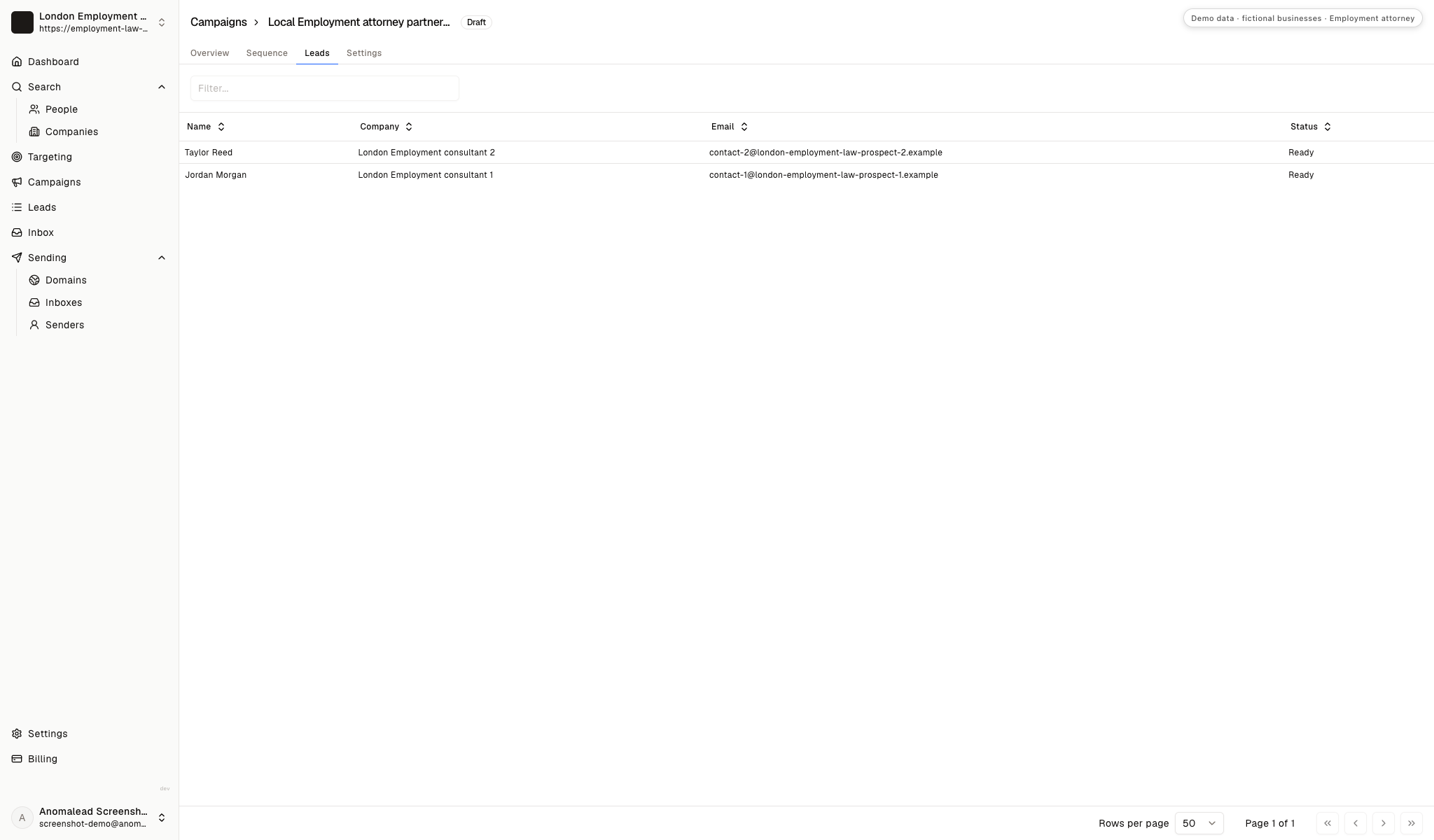
Section titled: Confirm the recipients before draftingThe draft campaign contains two fictional consultant contacts and the demo law practice. For a real campaign, check the recipient’s role and whether contact is appropriate before adding the address.
Make follow-ups stop when a person declines
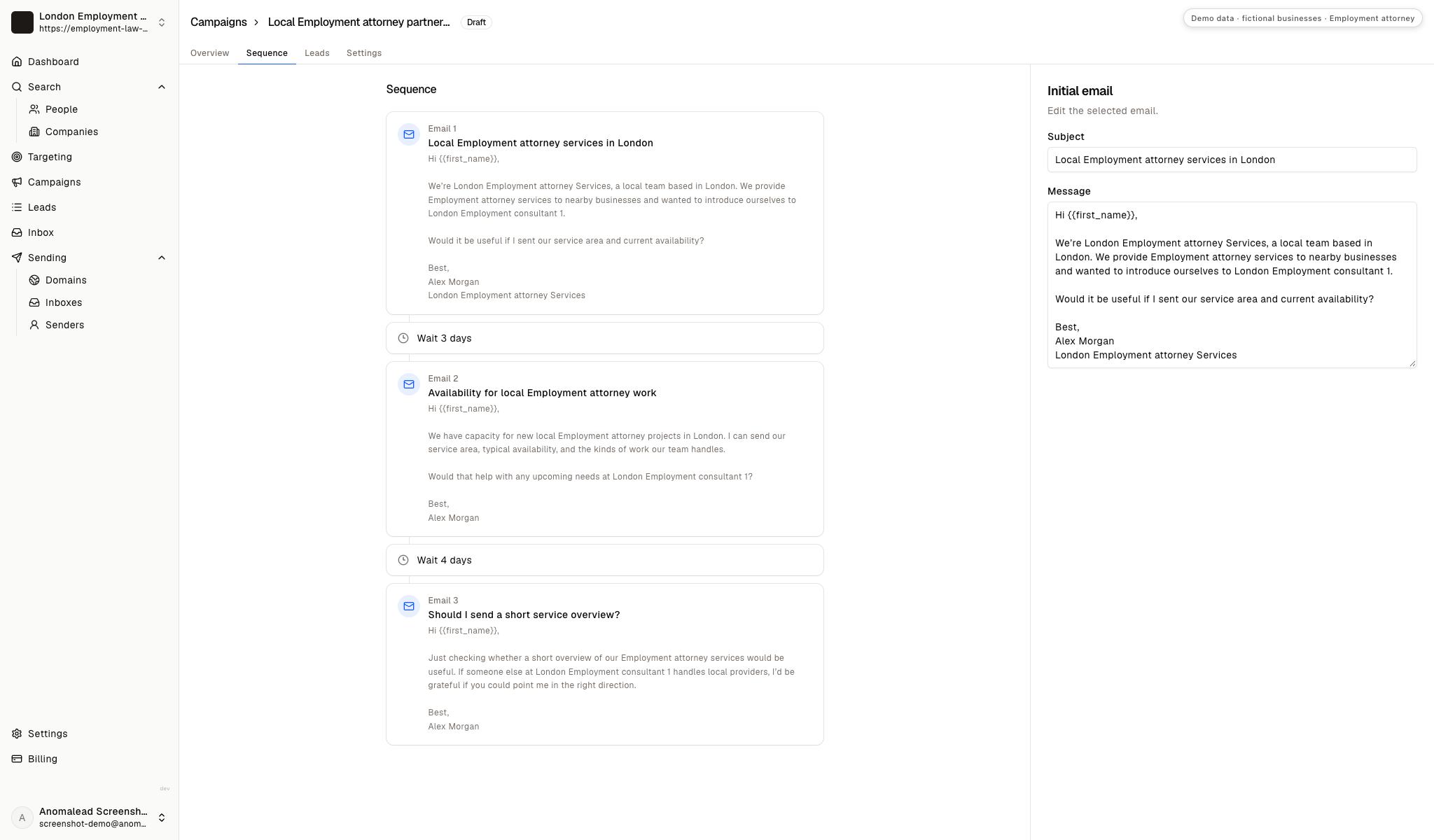
Section titled: Make follow-ups stop when a person declinesThe sequence view shows three draft emails and scheduled waits. Replace generic text with the firm's scope and a clear referral-process question; stop follow-ups after a refusal, opt-out, or sign that the contact is not relevant.
A first note to an HR consultant
Section titled: A first note to an HR consultantUse a short message to explore whether the consultant wants a transparent route to independent employment-law advice. The sample below is written for Jordan Morgan, whose demo title is Partnerships Manager; confirm the real recipient's role before sending.
Partnership introduction
Subject: A clear route for employer employment-law questions
Hello Jordan,
I’m Alex Morgan at London Employment attorney Services. We advise employers on employment-law questions within the jurisdictions and services our team covers, after the firm completes its intake and conflict checks.
When one of your employer clients needs independent legal advice, would a short conversation about a consent-based introduction process be useful? We would keep the client in control and would not ask you to send case facts by email.
Regards, Alex Morgan, London Employment attorney Services
Reply after interest
Subject: Re: A clear route for employer employment-law questions
Hello Taylor,
Thank you for getting back to me. We can outline the work our team is able to assess and explain how a prospective employer can contact us directly.
Could we first compare the kinds of employer questions you see and the point at which you would want a separate legal adviser involved? Please do not send employee names or documents before we confirm the conflict-check and intake process.
Regards, Alex Morgan
Keep the next step about process and consent, not a promise of a result. For a more specific email subject line approach, make the subject describe the partner conversation rather than a legal outcome.
Read a reply as a request to clarify scope
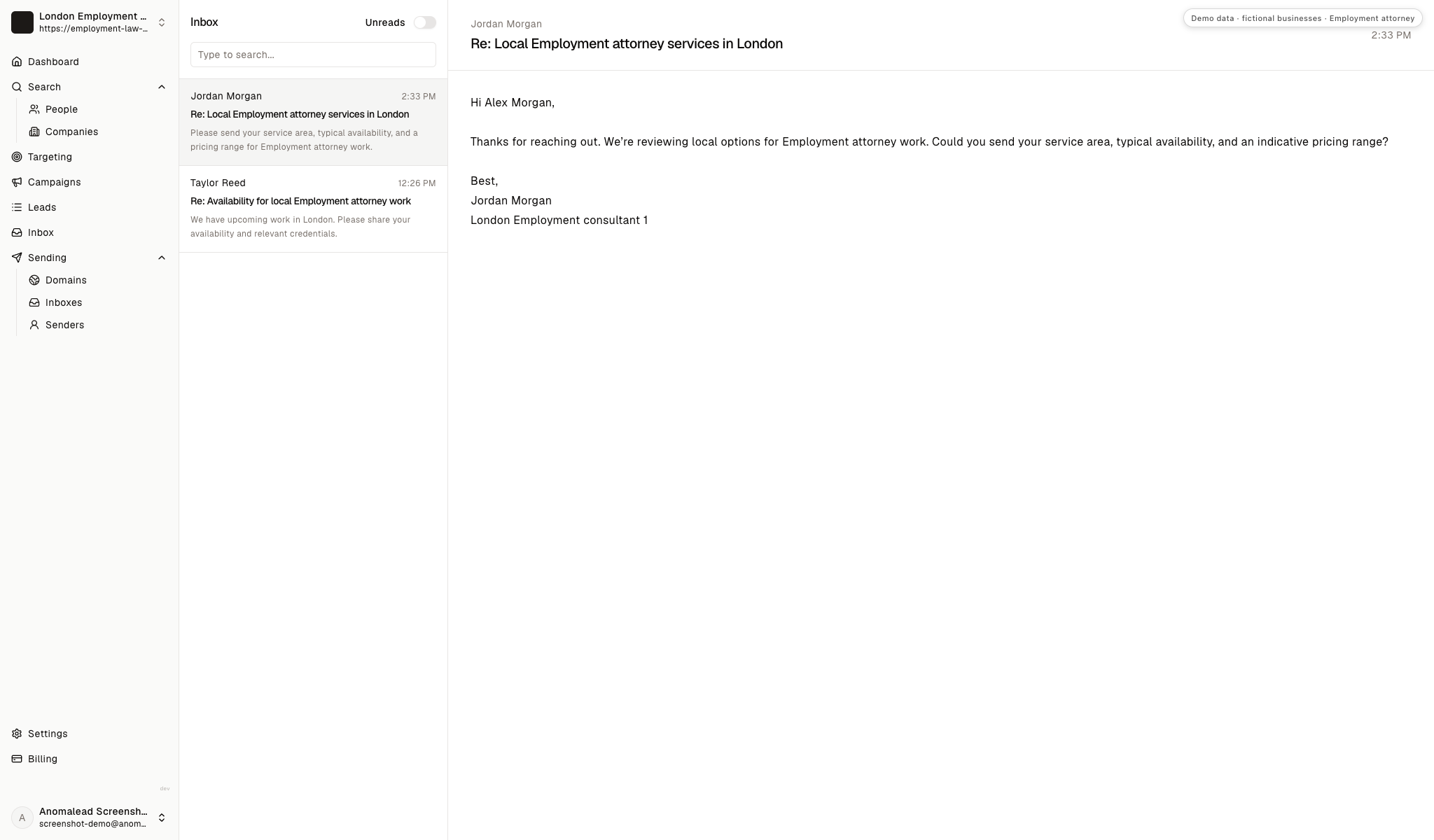
Section titled: Read a reply as a request to clarify scopeThe demo inbox contains two fictional replies asking for service-area, availability, pricing, and credential details. It contains no employment matter, referral consent, or instruction.
Handle partner replies without inviting confidential facts
Section titled: Handle partner replies without inviting confidential factsJordan Morgan and Taylor Reed's demo replies are generic. In a real conversation, answer the question asked, explain your firm's scope, and move a possible matter into the approved intake process only when the prospective client has chosen to contact you.
A consultant asks for your service area, availability, and fee range
Section titled: A consultant asks for your service area, availability, and fee rangeWe are reviewing local employment-law options for our employer clients. Could you share your service area, typical availability, and indicative fees?
The first demo reply asks for the same practical details. Give the areas and matter types your firm actually covers, then explain that availability depends on conflicts and scope. Do not give a fee estimate before the firm knows what the employer is asking it to assess.
Invite the employer to contact the firm directly with a nonconfidential outline. Do not ask the HR adviser to send employee names, allegations, or documents through ordinary email.
Answer the service and fee question:
Thanks, Jordan. We can confirm the jurisdictions and employment-law work our team can assess. Timing depends on the scope and conflict checks, and our intake team can explain the fee basis once the employer shares a nonconfidential outline directly. Please do not send employee names or case papers by email.
A consultant has a possible matter and asks about credentials
Section titled: A consultant has a possible matter and asks about credentialsWe may have an employer matter coming up. Please share your availability, the work your team covers, and relevant credentials.
This mirrors the second demo reply. Send current credentials and a plain description of the services your firm can assess; do not imply that a qualification means the firm can accept every instruction.
Confirm availability only after the prospective employer contacts the firm, the conflict process begins, and a lawyer can review the proposed scope. If the employer says a deadline may be near, route the enquiry promptly through the firm's intake process without trying to assess it in the partner thread.
Share credentials without promising a date:
Thanks, Taylor. We can send our current credentials and a summary of the employment-law work the team handles. Please ask the employer to contact us directly so we can check conflicts and review the scope before confirming availability. Do not send employee records or case details by email.
The consultant offers to forward an employee's case file
Section titled: The consultant offers to forward an employee's case fileWould it help if I sent you the employee's account and investigation papers?
Pause the transfer. Employee accounts, health details, disciplinary records, and investigation papers may be sensitive. Explain that the employer should use the firm's approved channel only after consent, conflict review, and confirmation of the firm's intake instructions.
Keep the boundary clear:
Thank you for checking first. Please do not forward those papers yet. Ask the employer to contact us directly so we can explain the conflict check and secure intake steps before any case material is shared.
The consultant already has a regular law firm
Section titled: The consultant already has a regular law firmOur clients already have employment solicitors they can call.
Respect the existing arrangement and do not suggest that a client should switch firms. You can offer a contact for a future matter only if the consultant says an additional option would be useful and the firm's conduct rules allow the approach.
Close without pressure:
Understood, and thank you for explaining. Please keep working with the advisers your clients have chosen. If your process changes and an employer asks for another independent option, you are welcome to contact us about our scope and intake steps.
Choose one HR segment and define the introduction
Section titled: Choose one HR segment and define the introductionThis week, select one kind of HR consultancy whose employer clients overlap with your firm's actual scope. Review its public services, identify the person who manages external relationships, and draft a message that asks about a consent-based introduction rather than a live case.
Before outreach begins, have the responsible lawyer review your referral wording, intake route, and contact rules. The employment-law firm prospecting plan can complement this partner angle, but keep the employer's choice and the firm's conflict process at the center.
Employment law referral partnership questions
Section titled: Employment law referral partnership questionsWho should an employment law firm approach for employer referrals?
Section titled: Who should an employment law firm approach for employer referrals?Start with HR consultants and outsourced HR providers serving employers in the firm's service area and jurisdictions. Confirm that they want a transparent route to independent legal advice before proposing any ongoing arrangement.
Can an HR consultant send employee documents to a law firm?
Section titled: Can an HR consultant send employee documents to a law firm?Do not invite case documents through an ordinary prospecting email. The prospective client should consent, the firm should explain its conflict checks, and sensitive records should only move through the firm's approved intake channel.
What should a firm ask before accepting a referred enquiry?
Section titled: What should a firm ask before accepting a referred enquiry?Clarify who the prospective client is, the relevant parties, the broad issue, the jurisdiction, timing concerns, and who can authorize the work. Follow the firm's conflict and intake procedures before deciding whether it can accept the instruction.
Are the companies shown in the demo real?
Section titled: Are the companies shown in the demo real?No. The employment consultants, contacts, profiles, and inbox replies are fictional demonstration data. They do not represent Anomalead customers, actual legal matters, employer instructions, or business results.
What does the ROI calculator predict for an employment law firm?
Section titled: What does the ROI calculator predict for an employment law firm?It lets the firm explore its own assumptions about outreach and the work involved in a potential referral relationship. It does not predict referrals, accepted instructions, legal outcomes, revenue, or profit.