


Bankruptcy lawyer lead generation works best when the attorney becomes a clear, careful resource for accountants whose business clients are weighing difficult debt decisions. Accountants may notice cash pressure in bookkeeping, tax planning, or creditor reconciliations, but they should not have to assess legal options or send client records to make an introduction useful.
This guide shows how to identify accounting practices with relevant small-business clients, agree on a client-led referral path, and handle the first conversation without promising a legal result. If you are building a business pipeline from scratch, the B2B lead generation basics explain the research and follow-up behind this partner workflow.
Key takeaways
- Approach accountants who serve owner-operated companies and can make a voluntary introduction when a client asks for qualified legal help.
- Keep the referral client-led: never ask an accountant to share a client’s name, financial records, or circumstances without permission.
- Explain your practice scope, consultation process, credentials, and service area in plain terms, while leaving case assessment to the lawyer.
- Treat a useful referral as a confidential consultation opportunity, not a promised filing, debt reduction, or case outcome.
How bankruptcy lawyer lead generation can build accountant referrals
Section titled: How bankruptcy lawyer lead generation can build accountant referralsStart with accounting practices that advise small businesses before financial pressure turns into an urgent crisis. A strong partner understands when a client needs legal advice, knows how to make a discreet introduction, and respects the client’s choice of counsel.
- Independent accounting firms for small businesses: These firms help owners review cash flow, tax obligations, creditor balances, and business records. A bankruptcy attorney can explain how a confidential legal consultation works when an owner asks about options, without asking the accountant to interpret the law.
- Bookkeeping and outsourced finance practices: Bookkeepers often maintain the records an attorney may later need to understand a business’s financial position. Offer a referral route that starts with the client’s request; do not ask the bookkeeper to forward ledgers, account details, or a list of financially stressed customers.
- Accountants advising sole proprietors: A sole proprietor may mix household and business finances, and the applicable process can depend on local law and the person’s legal structure. Make your practice scope clear and let the lawyer determine which consultation is appropriate.
- Turnaround and restructuring advisers: These professionals may support a business that is considering operational changes alongside legal advice. Clarify whether your work complements theirs, where responsibilities separate, and how the client can choose whether to speak with your firm.
A referral relationship is worthwhile when it gives an accountant a safe next step for a client who asks for legal help, without turning the accountant into a case screener.
Qualify the accounting practice before requesting introductions
Section titled: Qualify the accounting practice before requesting introductions- Client profile matches your practice: Check whether the firm advises individuals, owner-managed businesses, partnerships, or companies. Your intake capacity and legal scope should match the client types the accountant actually serves.
- A genuine reason to create a referral path: Look for services such as small-business bookkeeping, tax preparation, cash-flow reporting, or creditor reconciliation. These can create a natural moment for a client to ask for legal help, but they do not prove that a particular client needs bankruptcy advice.
- The right relationship owner: A partner, practice manager, or client-services lead may set referral procedures. The accountant who handles a client’s day-to-day books may have a different role, so ask who approves a professional resource list.
- Privacy and consent are understood: Agree that the client can contact your firm directly or authorize an introduction. Avoid receiving names, statements, tax files, or details about a person’s financial hardship before the client chooses to share them.
- Professional standards and conflicts: Ask how the practice reviews referral relationships and whether it has existing partners. Check the advertising, confidentiality, referral, and professional-conduct rules that apply to your own practice before proposing any arrangement.
What the demo data represents
The screenshots use the fictional operator London Bankruptcy attorney Services, generic accounting-firm records including London Accounting firm 1 and London Accounting firm 2, and fictional contacts Jordan Morgan and Taylor Reed. These people and businesses are not Anomalead customers and the inbox replies are not real referrals or campaign outcomes. The sample office records do not confirm that an accounting firm handles insolvency matters.
Find accountant prospects in Anomalead
Section titled: Find accountant prospects in AnomaleadThe search screens demonstrate how to assemble and review a company list, not how to identify a person in financial distress. Their generic accounting-firm records are fictional examples. In a real market, research the practice’s public service mix, then ask its relationship owner whether a client-requested legal resource would fit the firm’s process.
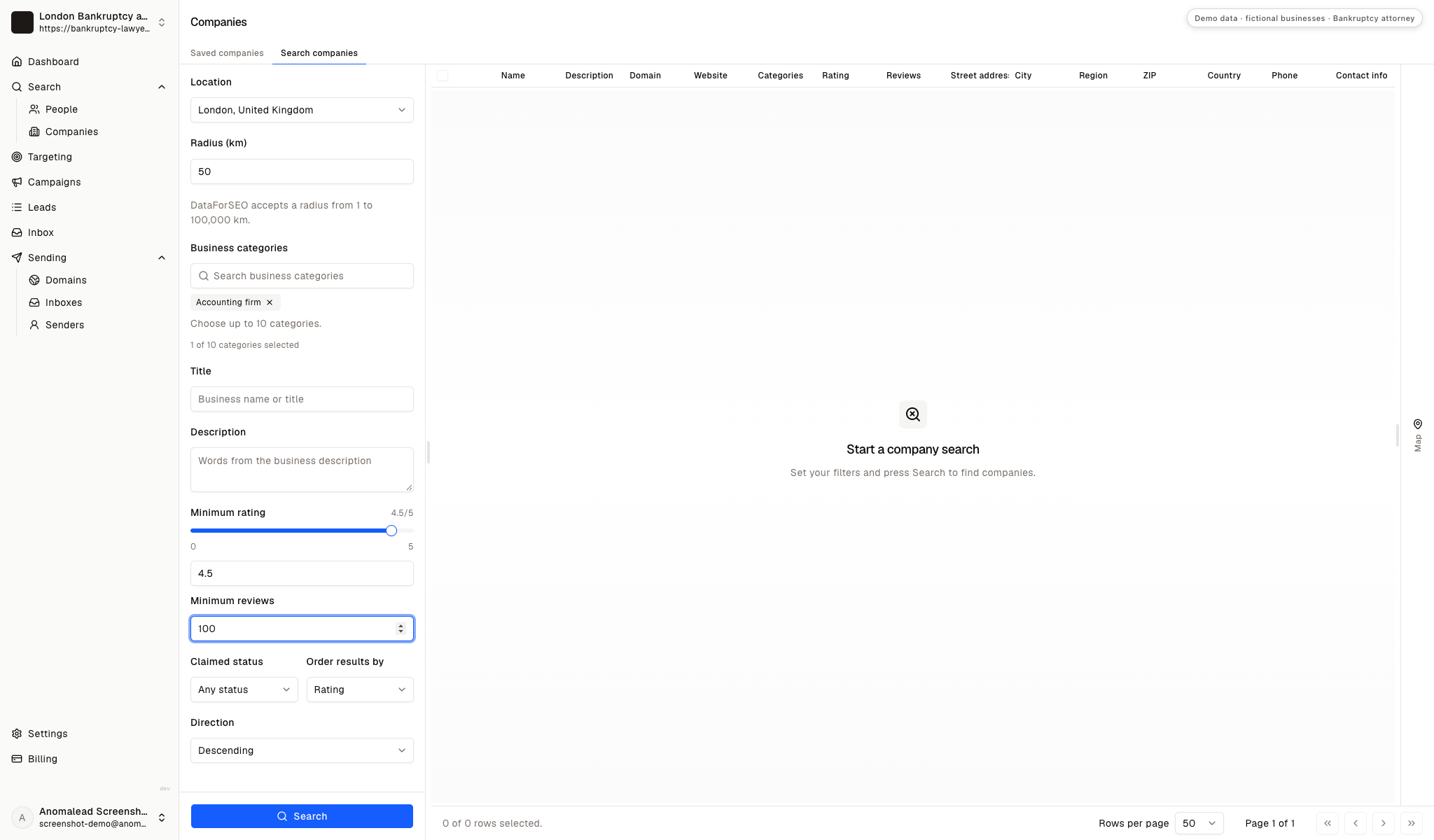
Set the search around local accounting practices
Section titled: Set the search around local accounting practicesChoose the service area where your lawyers can accept consultations, then select the accounting-firm category configured for this example. A city radius helps create a research list; it does not define who is eligible for legal help.
If your firm works across several locations or practice areas, decide which office can respond before widening the search. Referral partners need to know where a client can speak with the right lawyer.
Review firms as potential professional partners
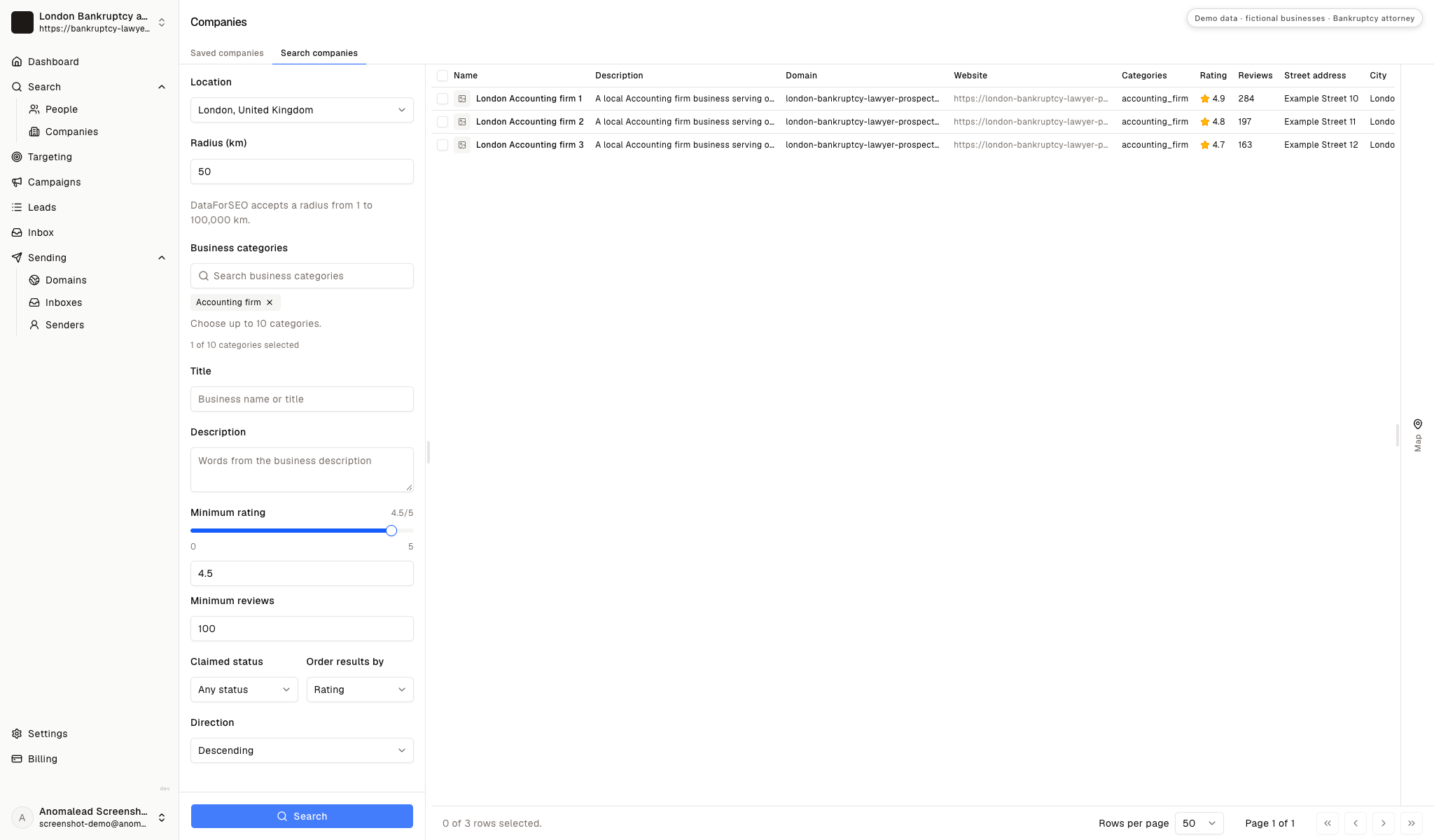
Section titled: Review firms as potential professional partnersThe results show three fictional accounting firms with descriptions, domains, ratings, and review counts. Those fields can support company research, but they do not reveal the firms’ client mix, referral policies, or current relationships.
Check the practice website for services, industries served, office locations, and the person who manages professional relationships. Keep a record only when there is a clear reason your consultation process could help a client who asks.
Save firms with a plausible partner fit
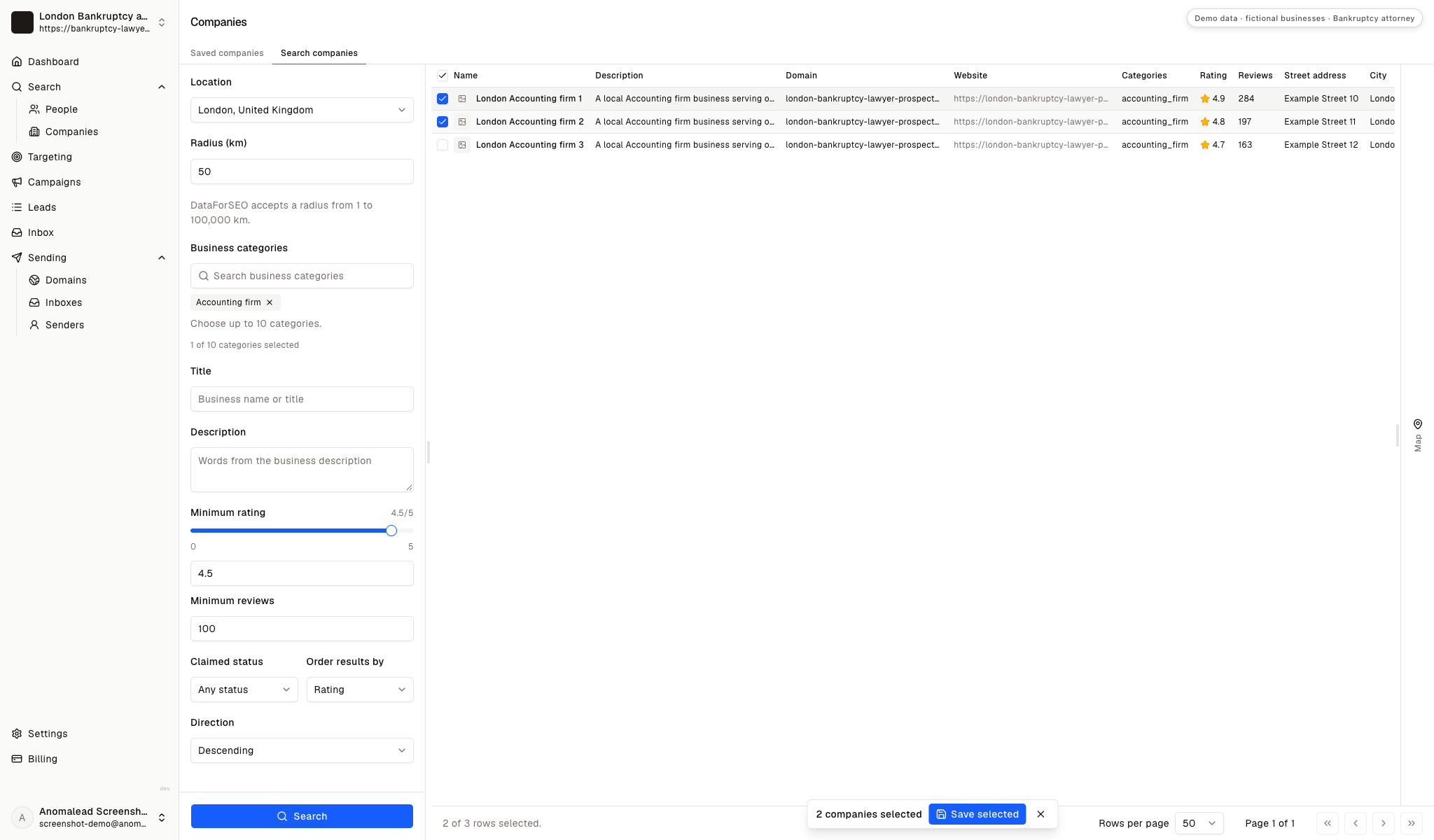
Section titled: Save firms with a plausible partner fitThe demo selects two of the three results and leaves one out. For your own list, save practices whose publicly described work aligns with your legal scope and whose service area matches your intake capacity.
Note the reason for each selection, such as small-business accounting or a local office. Do not infer that the practice has a client who needs bankruptcy counsel.
Find the person who owns professional referrals
Section titled: Find the person who owns professional referralsEnrich a practice only after its public services look relevant. A partner or practice manager can explain how the firm handles outside professional resources; a staff accountant may know client needs but have no authority to approve a referral process.
For a broader research workflow, the guide to finding business leads covers company and contact qualification. In legal partnerships, add a privacy check before any client introduction.
Recheck the firms before contact research
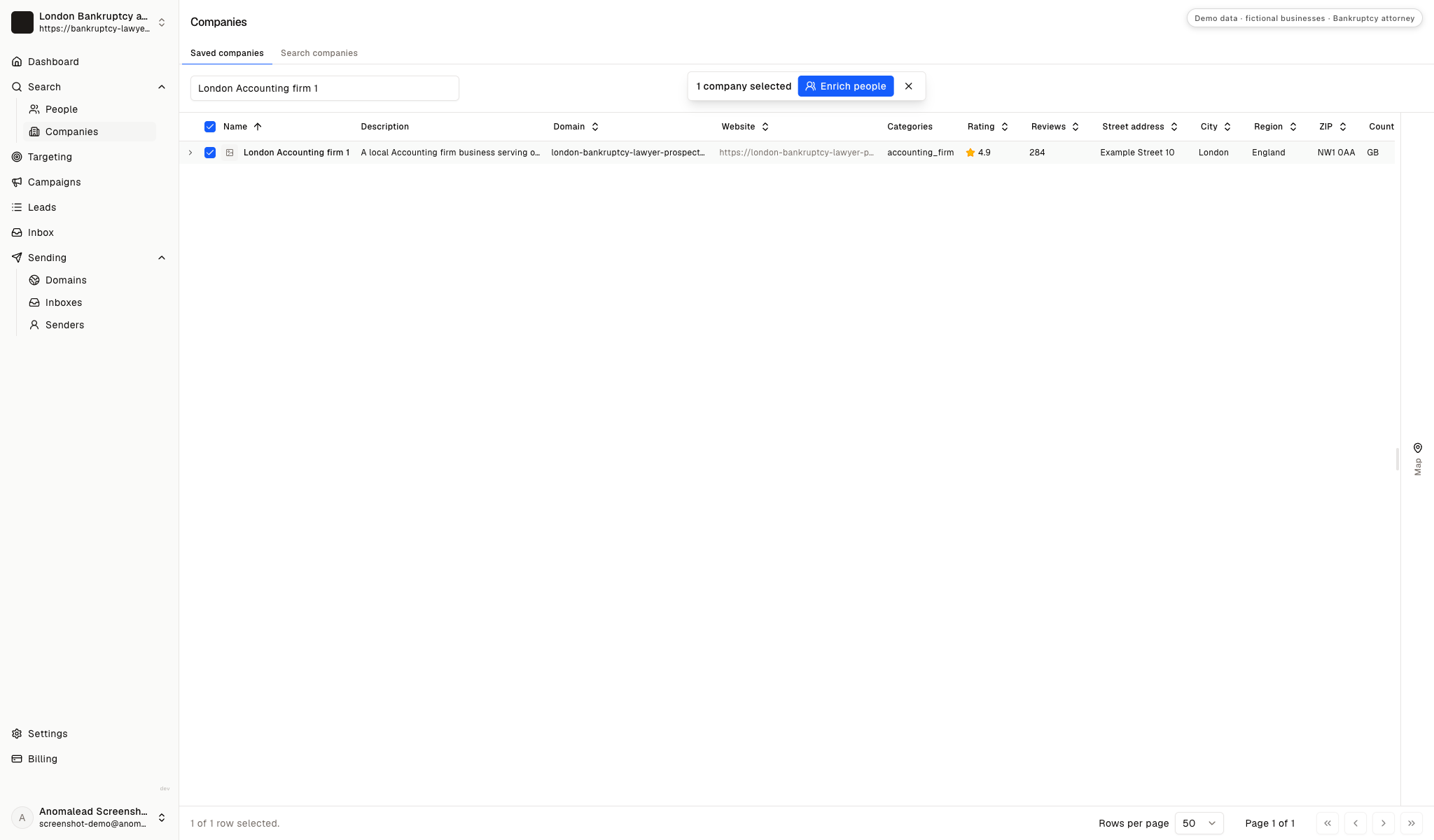
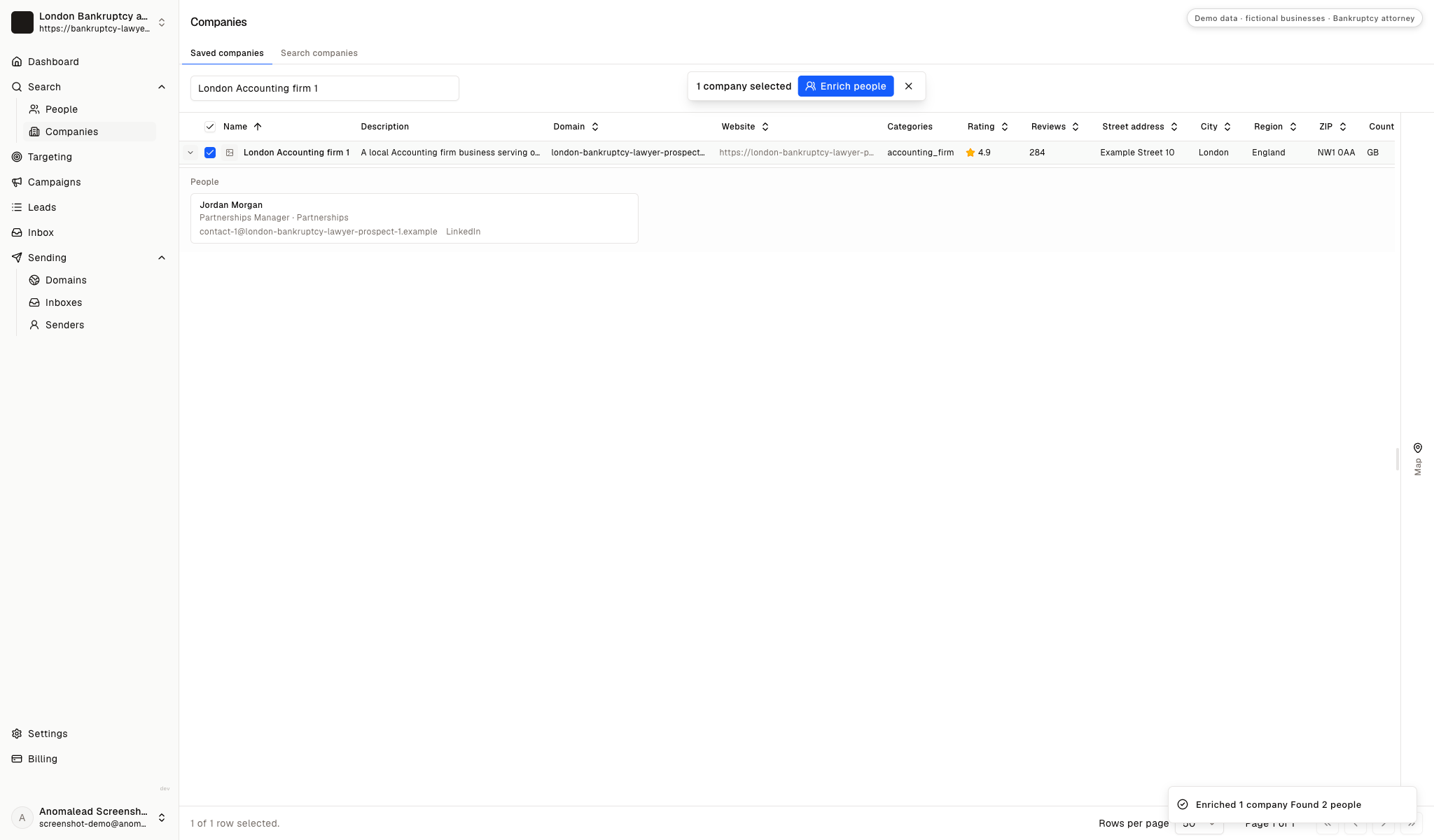
Section titled: Recheck the firms before contact researchThe saved-company view shows London Accounting firm 1 selected and the Enrich people action available. The record is a fictional generic example, not evidence that the firm has referred a client or handles bankruptcy matters.
Remove a practice if its work falls outside your scope, the office is beyond your consultation area, or its referral expectations would compromise client choice or confidentiality.
Check who manages the relationship
Section titled: Check who manages the relationshipThe demo returns Jordan Morgan and Taylor Reed as Partnerships Managers at two fictional firms. Those titles illustrate enrichment; a real accounting practice may assign referral guidance to a partner, managing director, or client-services lead.
Verify each person’s responsibilities before writing. If they do not set professional-resource policy, ask who does rather than sending details about legal matters to a general contact.
Keep a focused list of practice decision-makers
Section titled: Keep a focused list of practice decision-makersThe lead list contains two fictional contacts with valid email status. Confirm the contact still works at the practice and record the public reason it fits your referral conversation.
Do not add accountants because you believe they have clients in debt trouble. The list should describe professional fit, not a guess about confidential client circumstances.

Is an accountant relationship worth developing?
Section titled: Is an accountant relationship worth developing?A professional relationship may create a trusted route for clients who choose to ask for legal guidance. Its value depends on relevant consultations, the time your team spends supporting the practice, and whether your intake capacity can respond without delaying existing matters.
Use your own records to estimate the staff time for introductions, consultations, conflict checks, and follow-up.
The calculator uses assumptions you enter for account value, meetings, and close rate. It does not predict referrals, client eligibility, filings, debt relief, case outcomes, or campaign performance.
Do the math on one good deal
If one new customer is worth thousands, you don’t need magic. You need a few more meetings a month.
Projected monthly results
- Deals closed
- 2.0
- Projected revenue
- £10,000
- Growth plan (1 business)
- £79/mo
- ROI
- 12,558%
Conservative math on meetings you already believe you can book. One closed deal often pays for a year of Anomalead.
If the model only works when every introduction becomes a matter, revise it. A client can benefit from an informed consultation even when no engagement follows.
Prepare a careful professional introduction
Section titled: Prepare a careful professional introductionAn accountant is more likely to consider a referral process when the lawyer explains how the client retains control. Describe the consultation path, the information you need from the client, and how the firm can make an introduction only after the client agrees.
Use the principles in how to write a cold email to keep the first note short, then check that your wording follows the professional rules that apply to your practice.
Select recipients who own firm-level relationships
Section titled: Select recipients who own firm-level relationshipsThe draft campaign contains two fictional recipients marked ready. For real outreach, include people who can discuss the practice’s process for professional referrals, not staff chosen because you suspect a client has debt problems.
Keep the campaign in draft until the audience, claims, and request are accurate. A referral note should not ask the accountant to disclose a client name or send documents.

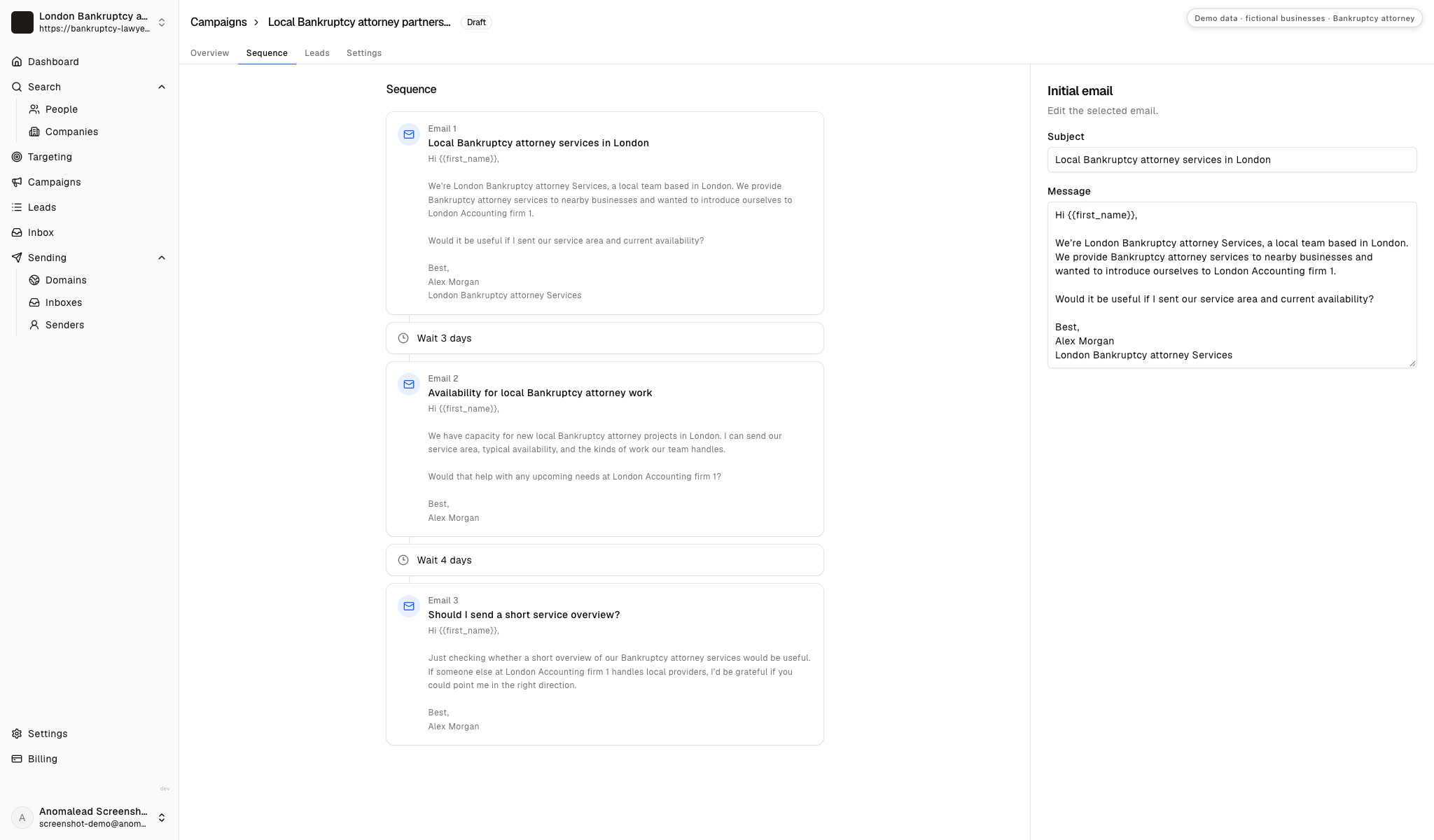
Review each follow-up for discretion
Section titled: Review each follow-up for discretionThe demo editor shows three emails with a three-day wait after the first and a four-day wait after the second. These are visible workflow settings, not evidence of a suitable cadence for professional referrals.
Use later notes to clarify your consultation route or share the scope of your practice. Avoid language that pressures the accountant to identify clients or suggests a particular legal outcome.
Offer a client-led route to a legal consultation
Section titled: Offer a client-led route to a legal consultationThe examples offer a process, not a legal conclusion. Use only accurate scope and credential details, and invite the accountant to share the information with clients rather than passing client information to you.
First email to an accounting partner
Subject: A discreet consultation option for clients
Hi Jordan,
I’m Alex Morgan at London Bankruptcy attorney Services. We speak with people who want to understand whether a confidential legal consultation fits their situation, including owners referred by their accountant.
Would a short overview of our practice scope and client-led introduction process be useful for your professional-resource list?
Best,
Alex Morgan, London Bankruptcy attorney Services
Follow-up about the introduction process
Subject: Keeping the client in control of a referral
Hi Jordan,
One practical detail: the client can contact our office directly or ask you to introduce us. We do not need client names, records, or a description of their finances before they decide to speak with a lawyer.
Would a one-page explanation of the consultation process help your team answer that request?
Regards,
Alex Morgan
For a concise subject line, see the guide to cold email subject lines. Keep the invitation neutral and do not imply that a consultation guarantees a particular result.
Read the questions in the shared inbox
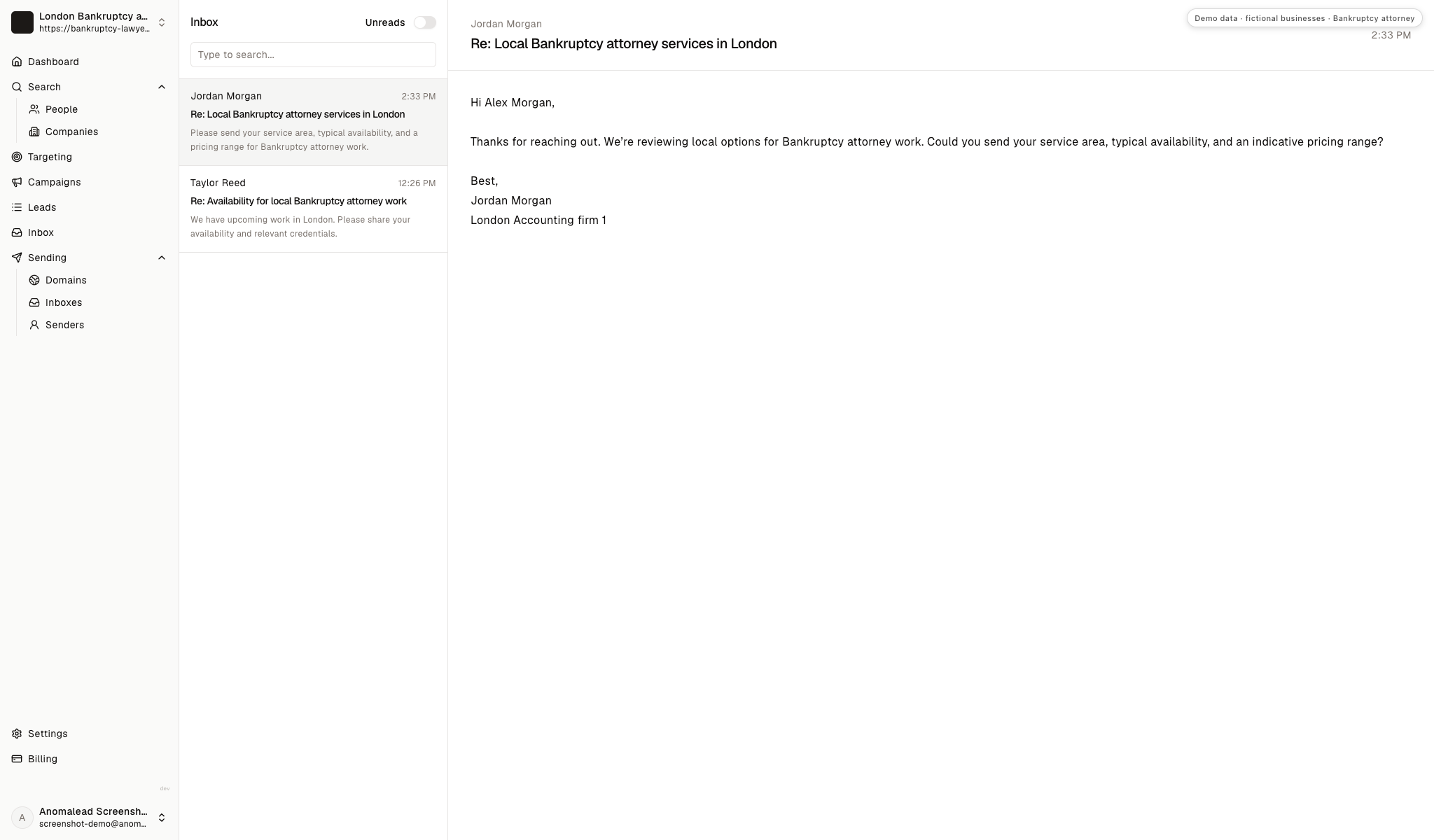
Section titled: Read the questions in the shared inboxThe inbox contains two fictional replies. Jordan Morgan asks about service area, availability, and a pricing range; Taylor Reed mentions possible upcoming work and requests credentials. These are demo questions, not referrals or active client matters.
Answer with your consultation scope, intake process, and current availability. If the accountant is asking about a client, ask the client to contact the firm or authorize an introduction before any personal details are shared.
Handle accountant replies without crossing client boundaries
Section titled: Handle accountant replies without crossing client boundariesReply promptly with information about your own practice, not an assessment of a person you have not met. Keep every next step voluntary and client-directed.
The contact asks for service area, availability, and a fee range
Section titled: The contact asks for service area, availability, and a fee rangeJordan Morgan asks where the firm accepts consultations, when a lawyer is available, and how fees are discussed.
State the locations and consultation format your practice actually offers. Explain that fees depend on the service requested and are discussed with the prospective client, not estimated from an accountant’s description.
Ask whether the firm would prefer a neutral resource sheet it can share when a client asks for legal help. Do not request names or financial documents.
A careful reply could say:
Hi Jordan,
Our practice overview explains the locations and consultation options we currently offer. Fees depend on the service a person requests and are discussed directly with that person. Would a neutral resource sheet for clients who ask about a legal consultation be useful to your team?
Best,
Alex Morgan, London Bankruptcy attorney Services
The accountant mentions upcoming work and asks for credentials
Section titled: The accountant mentions upcoming work and asks for credentialsTaylor Reed says a client may ask for help and requests availability, practice scope, and relevant credentials.
Share current credentials, practice areas, and intake steps that you can verify. Avoid describing a client’s situation or suggesting that a particular procedure is suitable before the lawyer has assessed it.
Invite the client to contact your office directly, or ask the client to authorize an introduction. Confirm the next available consultation only after the person chooses to speak with you.
Keep the reply factual and client-led:
Hi Taylor,
I can send our current practice overview and credentials. If the client wants to speak with us, they can contact the office directly or authorize an introduction. We would discuss their circumstances with them before identifying any legal options.
Thank you,
Alex Morgan
The firm cannot share a client without consent
Section titled: The firm cannot share a client without consentThe accountant says its confidentiality process prevents sharing a client’s details without the client’s permission.
Agree with the boundary and offer a neutral page, contact card, or consultation explanation the accountant can give to the client. The client can decide whether to make contact.
The practice already has a legal referral resource
Section titled: The practice already has a legal referral resourceThe accountant says clients already receive information about another local lawyer or referral service.
Ask whether the firm reviews its resource list and what practice scope it wants covered. Do not criticize another provider or ask the accountant to steer a client away from counsel the client selected.
Make the next partner list more useful
Section titled: Make the next partner list more usefulReview which accounting practices asked about your consultation process and which already have a clear referral route. Use that signal to focus the next search on firms serving the business types your practice can accept.
Keep the follow-up focused on professional scope, client choice, confidentiality, and your capacity to respond. If you also serve business clients through general counsel, the law firm lead generation guide covers a different buyer path.
Questions bankruptcy attorneys ask about accountant referrals
Section titled: Questions bankruptcy attorneys ask about accountant referralsWhich accountants make useful referral partners for bankruptcy attorneys?
Section titled: Which accountants make useful referral partners for bankruptcy attorneys?Look for practices that advise small-business owners, sole proprietors, or companies on bookkeeping, tax, and financial records. A good partner can share a neutral legal resource when a client asks, while leaving legal advice and case assessment to the attorney.
Can an accountant send a client’s financial records before an introduction?
Section titled: Can an accountant send a client’s financial records before an introduction?Build the process around client choice and the confidentiality rules that apply to both practices. A client can contact the lawyer directly or authorize an introduction, then decide what information to share during intake.
Are the companies and contacts in these screenshots real?
Section titled: Are the companies and contacts in these screenshots real?No. The screens show generic fictional records such as London Accounting firm 1 and fictional contacts Jordan Morgan and Taylor Reed. They are not Anomalead customers, real referrals, or campaign results.
What does the ROI calculator predict for referral relationships?
Section titled: What does the ROI calculator predict for referral relationships?It does not predict referrals, legal eligibility, filings, debt relief, case outcomes, or campaign performance. Enter your own assumptions about account value and sales activity to consider whether partner development fits your practice.
How should a bankruptcy attorney describe a consultation to an accountant?
Section titled: How should a bankruptcy attorney describe a consultation to an accountant?Explain who the practice can speak with, how an appointment is requested, what credentials and scope you can verify, and how the client stays in control. Avoid promising relief or suggesting that a specific legal process applies before reviewing the person’s circumstances.