


Car insurance lead generation for a local agency can start with a useful relationship at a dealership. A buyer who has chosen a vehicle may still need to compare cover, understand what information an insurer needs or arrange a conversation before collection. The dealership can make that next step easier by offering a clear route to an independent insurance professional. The dealer is a potential business partner, not proof that its buyers have asked for a quote or agreed to share personal details.
This guide explains how to identify dealerships that fit your service area, find the person responsible for buyer support or partnerships and propose a simple handoff the buyer controls. Begin with the dealership’s locations, vehicle mix and customer journey. Confirm the agency’s licenses, products, carriers and current capacity before describing what it can offer. Do not quote or imply a premium from a company profile or vehicle listing. For the general process, see the basics of B2B lead generation; a trustworthy insurance introduction adds consent, accurate information and a clear separation between the sale of the vehicle and the sale of cover.
Key takeaways
- Approach dealerships whose location, vehicle range and buyer process match the agency’s permitted products and service capacity.
- Propose a buyer-controlled route to a quote, with the agency collecting driver and vehicle details only after the person chooses to continue.
- Confirm who owns the dealership’s finance, insurance or customer-support process; a generic business contact may not run partnerships.
- Keep vehicle purchase decisions separate from insurance advice, eligibility decisions and any promise about price or acceptance.
Which dealership relationships can support a local insurance conversation?
Section titled: Which dealership relationships can support a local insurance conversation?A useful partner has a customer journey where a buyer may welcome a separate insurance contact. Look for a specific point in that journey, then ask how the dealer handles the handoff today.
- Independent dealerships helping buyers arrange collection: A local used-car dealer may hear that a buyer needs time to compare policies or confirm cover before collecting a vehicle. That does not authorize the dealer to send the buyer’s contact details to your agency. Offer a voluntary next step such as a card, a short link or an introduction made only after the buyer agrees. Ask who manages the handover and what timing is useful. Describe the agency’s actual service area and product access, and leave the buyer free to compare another provider.
- Dealership groups with a defined customer-care process: A group operating several locations may want a consistent way to tell customers where to ask an insurance question. Start with the role that oversees customer experience, finance and insurance, or local partnerships. Learn whether each branch uses the same process and which team approves an external provider. Explain what the agency can answer, what it cannot decide for the dealer and how a customer can opt out. Do not assume that a group-wide agreement applies to every site.
- Specialist vehicle sellers with distinct coverage questions: A seller of commercial vehicles, performance cars or imported models may encounter buyers who need help understanding how use, vehicle specification or garaging affects an application. The agency should confirm that its appointed markets can consider that vehicle and use before outreach implies a fit. Ask the dealership which questions its staff hear, without requesting buyer names, registration numbers or driving histories. A specialist conversation is valuable only when the agency has a suitable route to review the risk.
Avoid partners whose locations fall outside your authority, whose vehicle mix your markets will not consider or whose staff expect you to promise a rate before a full review. If the handoff depends on compliance approval, carrier appetite or a buyer’s explicit request, document that condition before launching it.
Check the partnership before searching for individual contacts
Section titled: Check the partnership before searching for individual contacts- Match location and authority. Check every branch against the agency’s operating territory and applicable permissions. A dealership group may have sites in several jurisdictions, so record which location a proposed introduction would serve.
- Understand the buyer moment. Is the dealership asking about cover before collection, after a vehicle has been selected or during a later service visit? The right explanation and response time depend on when the buyer is likely to want help.
- Identify the process owner. Finance and insurance managers, sales managers and customer-care leads may have different responsibilities. Confirm who approves an external insurance option and who can describe the customer journey.
- Check market fit without promising eligibility. Vehicle age, modifications, business use, driver details and garaging may affect insurer appetite. Confirm the agency has a suitable route to review the type of enquiry before describing a product as available.
- Agree how consent and information work. The buyer should choose whether to contact the agency and provide personal details directly through an approved channel. Write down what dealership staff may say, what they must not collect and how a request to stop is handled.
About the demonstration data
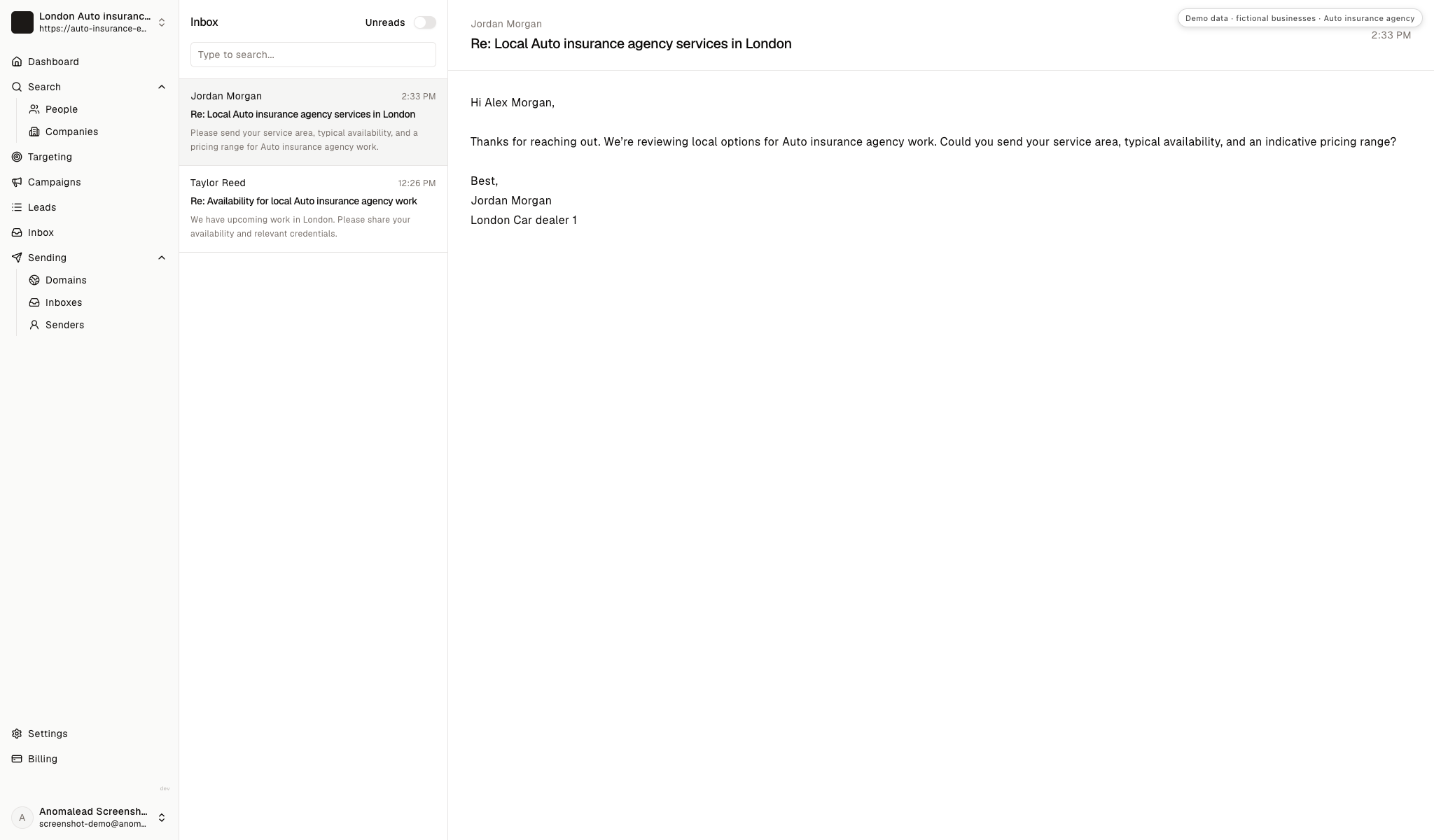
The screenshots show fictional London businesses in an English interface. The example email uses the fixture names London Auto insurance agency Services, London Car dealer 1 and Jordan Morgan; the inbox also shows a fictional reply from Taylor Reed. These records and messages are sample data, not Anomalead customers, real dealerships, policy enquiries or campaign results. The written workflow adds an opt-in handoff because the seeded screen data does not demonstrate buyer consent or an insurance transaction.
Build a dealership partnership search in Anomalead
Section titled: Build a dealership partnership search in AnomaleadUse Anomalead to build a research list of dealerships, then do the partnership work outside the search screen. Set a practical radius around the agency’s service territory and select car dealers as the buyer category. Review each company’s locations and vehicle focus. Save only a firm with a clear business reason to discuss a buyer-controlled insurance option. Enrich the account with a person who oversees customer support, finance or partnerships, then verify that role from a current public source. Record the partner hypothesis and the question you need answered. A saved dealer is a prospect for a business conversation; it is not an individual insurance lead. The customer chooses separately whether to speak with the agency.
Set the search to the agency’s territory and dealer category
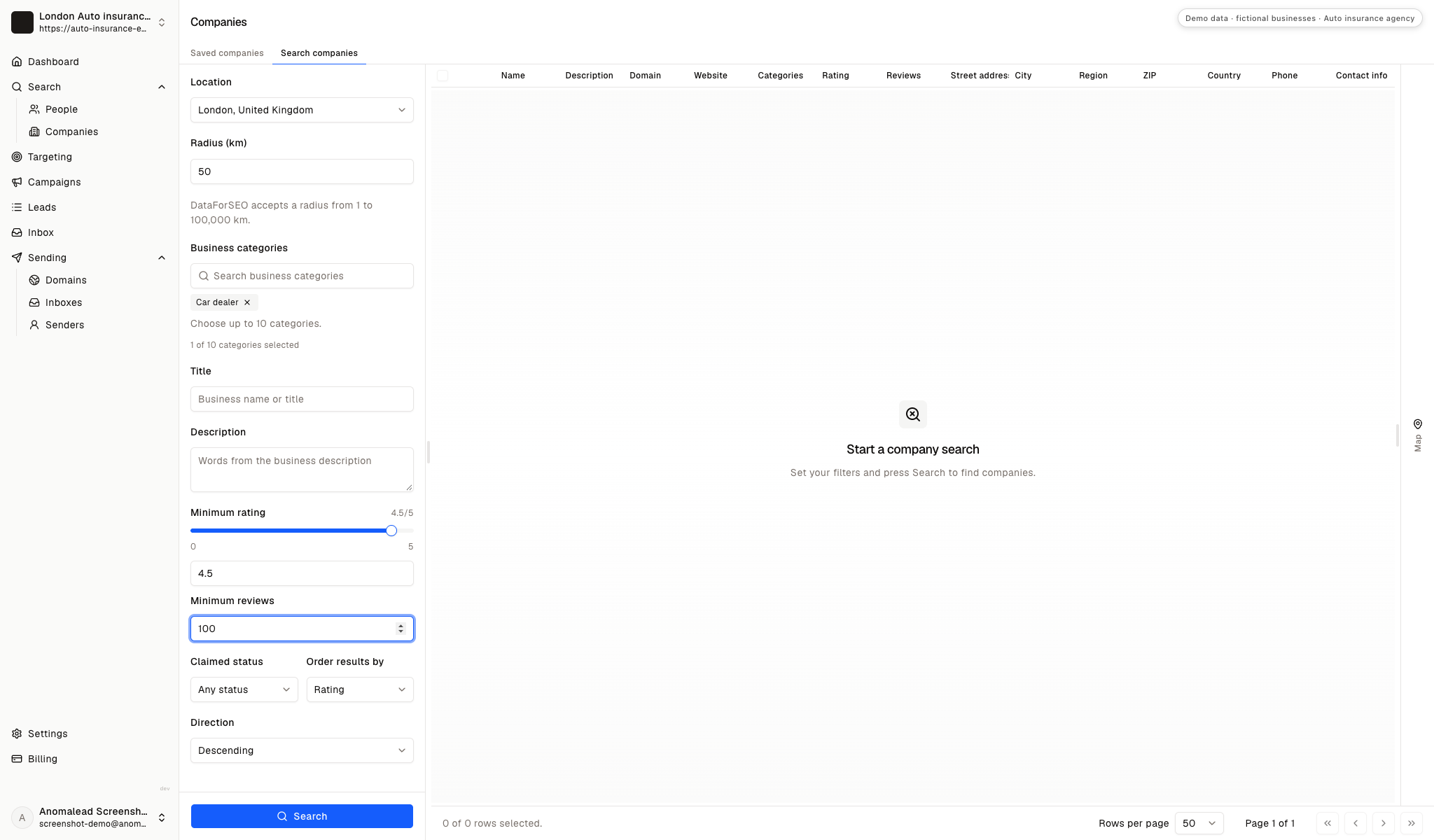
Section titled: Set the search to the agency’s territory and dealer categoryThe demo search shows a city, radius, dealership category and review filter. These settings find candidate businesses; they do not identify a buyer who wants insurance. Start with areas the agency can serve and keep territory limits visible while reviewing results.
Treat search settings as a research boundary, not a statement about licensing or insurer eligibility.
Review each dealership as a possible partner
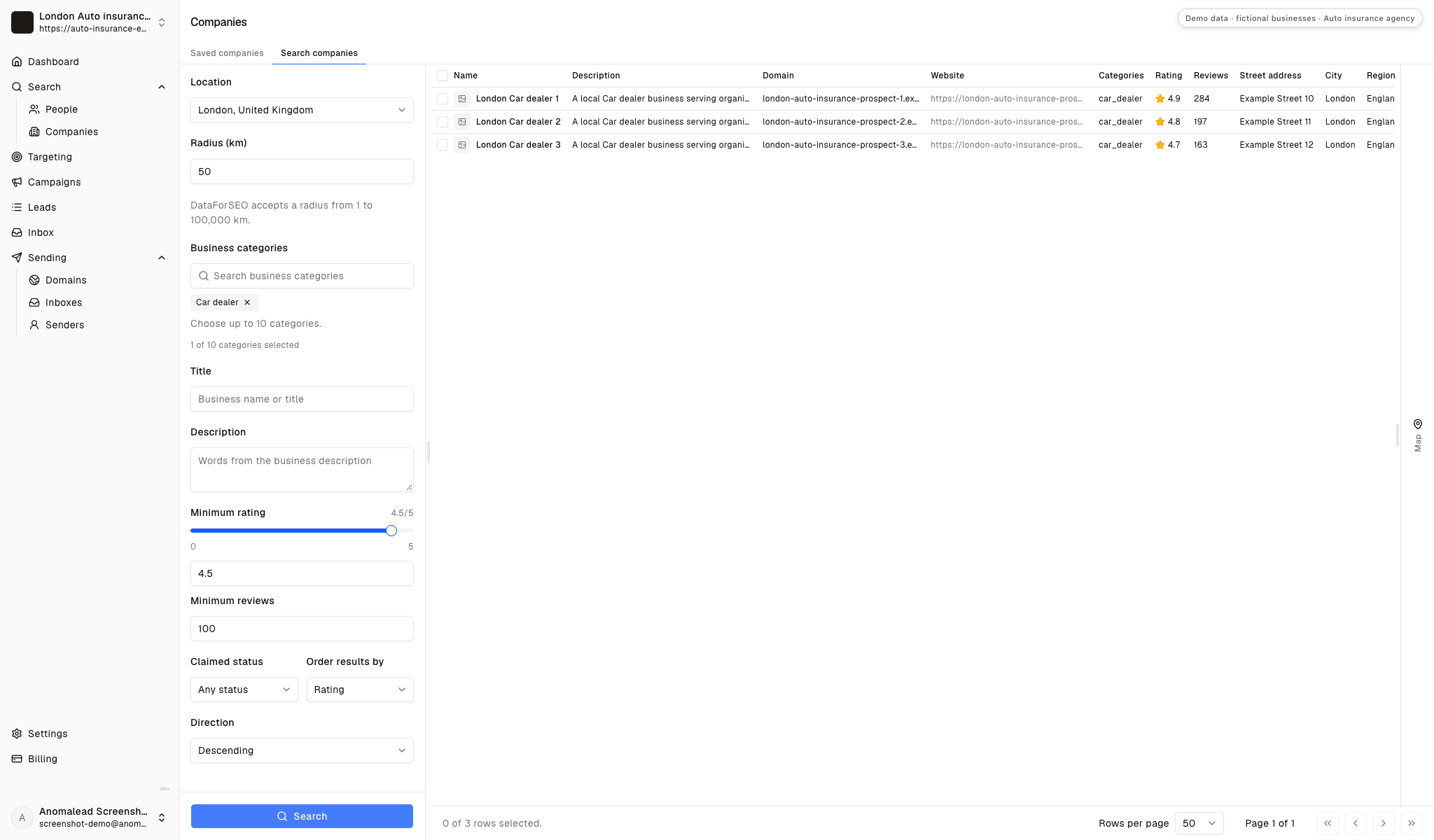
Section titled: Review each dealership as a possible partnerThe demo displays three fictional dealer profiles with public ratings and review counts. Those details can help distinguish businesses for further research, but they do not show its insurance process, buyer consent or willingness to partner. Check the dealer’s own site and current branch information before recording a reason to contact it.
Save dealerships with a specific customer-journey question
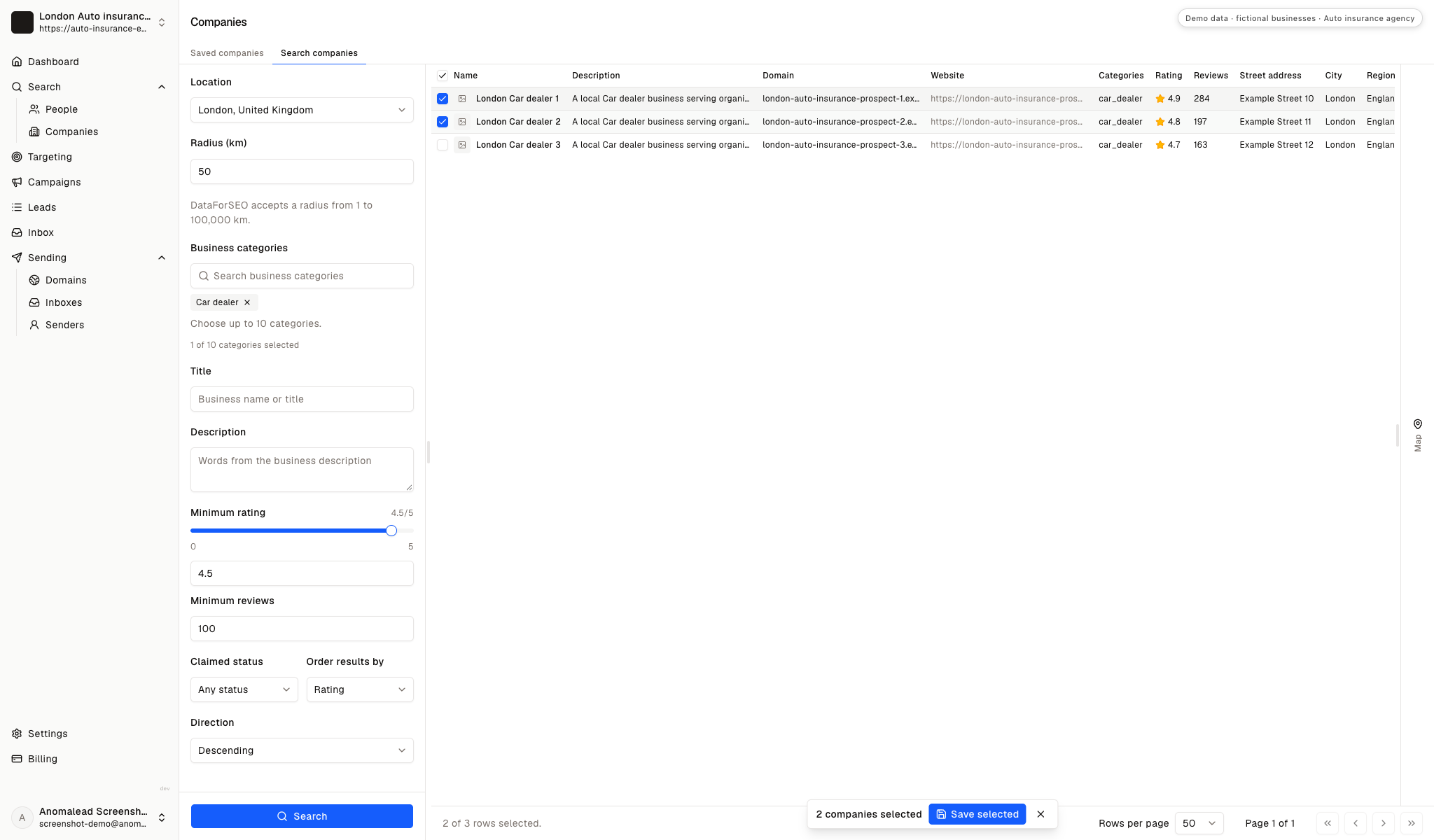
Section titled: Save dealerships with a specific customer-journey questionTwo of the three fictional profiles are selected in the demo. In practice, save a dealership only when you can name the location, relevant vehicle or buyer journey and the question for its partnership owner. A strong review score alone is not a reason to add a company to an insurance outreach list.
Find the person who owns the buyer handoff
Section titled: Find the person who owns the buyer handoffFind the person who can explain how a buyer moves from choosing a vehicle to collection and where an optional insurance conversation could fit. At one location that might be a finance and insurance manager; in another it could be the sales director or customer-care lead. Verify the title and branch from the dealership’s own information or a current professional profile. Ask who approves an outside provider and whether the dealer prefers a link, a printed card or a consent-based introduction. Do not buy or request lists of vehicle buyers. Keep only the professional contact data needed for this business discussion. The guide to finding business contacts covers the wider research workflow.
Recheck the dealership before enriching it
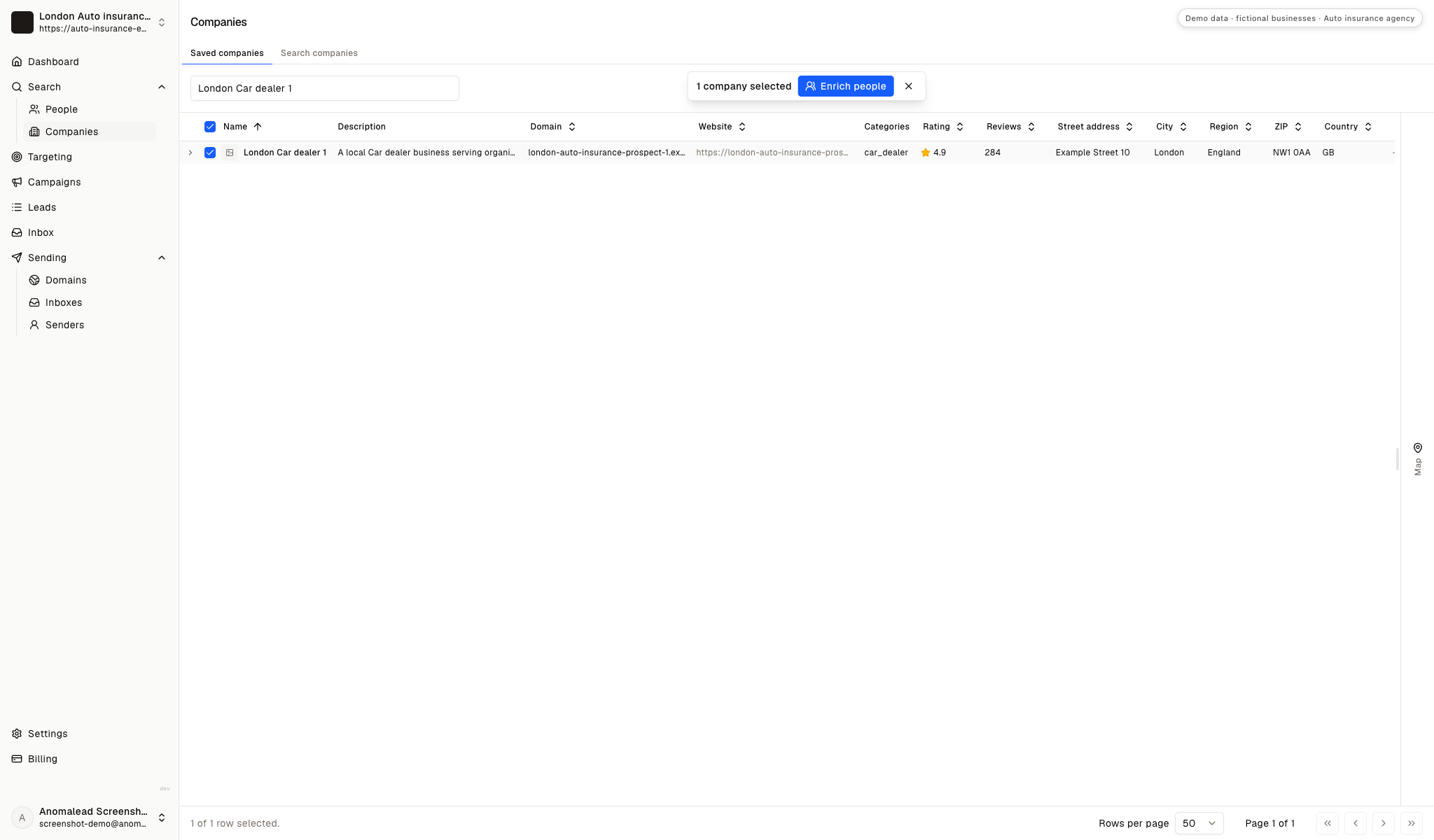
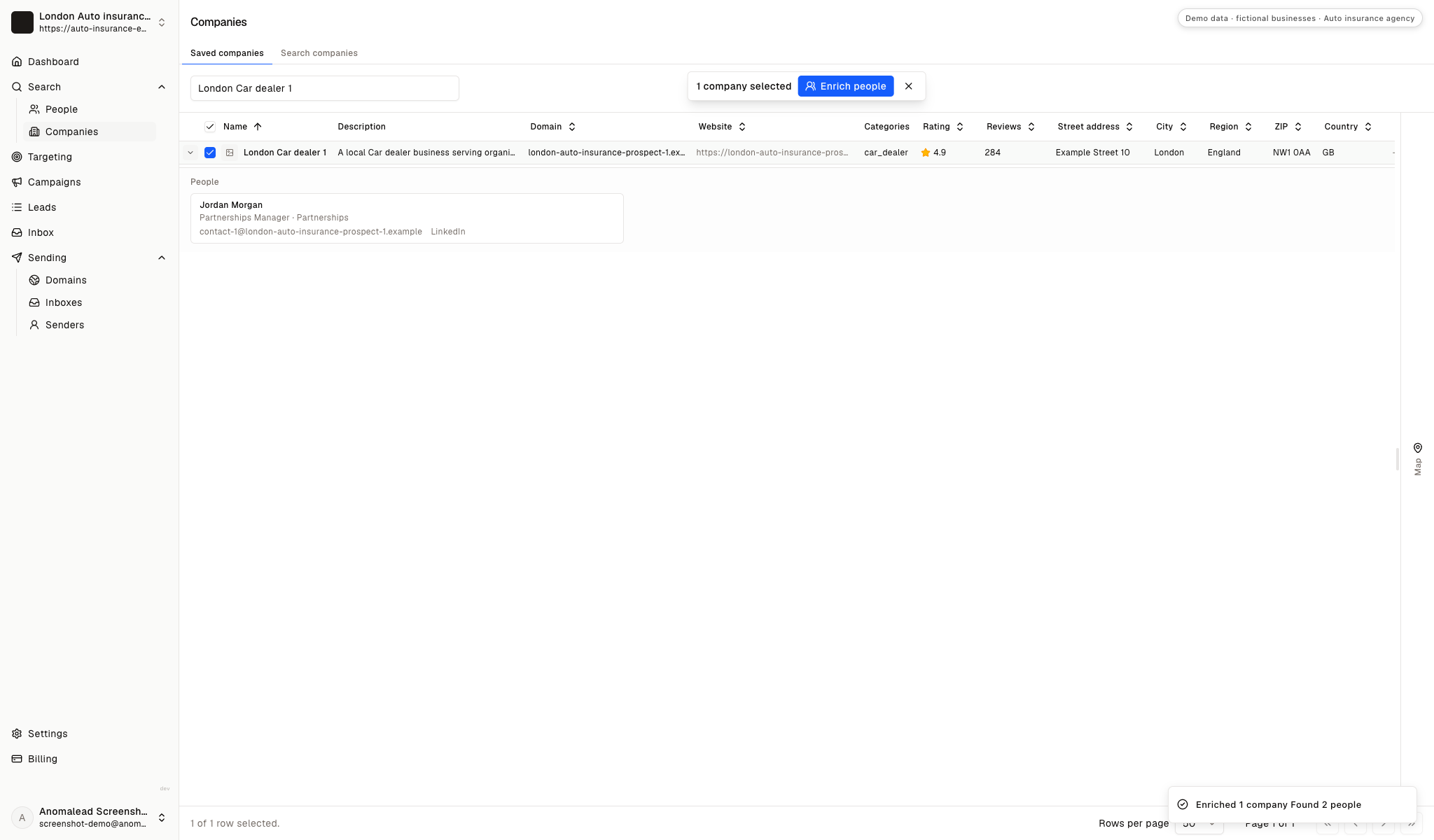
Section titled: Recheck the dealership before enriching itThe demo shortlist identifies a selected business before contact discovery. Review the branch, vehicle focus and reason for a partnership discussion. Remove a duplicate listing or a location outside the agency’s territory before spending time on individual contacts.
Treat a suggested contact as a role to verify
Section titled: Treat a suggested contact as a role to verifyThe demo contact card contains a name, partnerships title, work email and profile. The title is a research clue, not proof that the person approves insurance providers or controls a buyer handoff. Confirm the current role and ask whether another colleague owns this process.
Use public professional information to check that the person still works at the dealership.
Review the contact list before a partner introduction
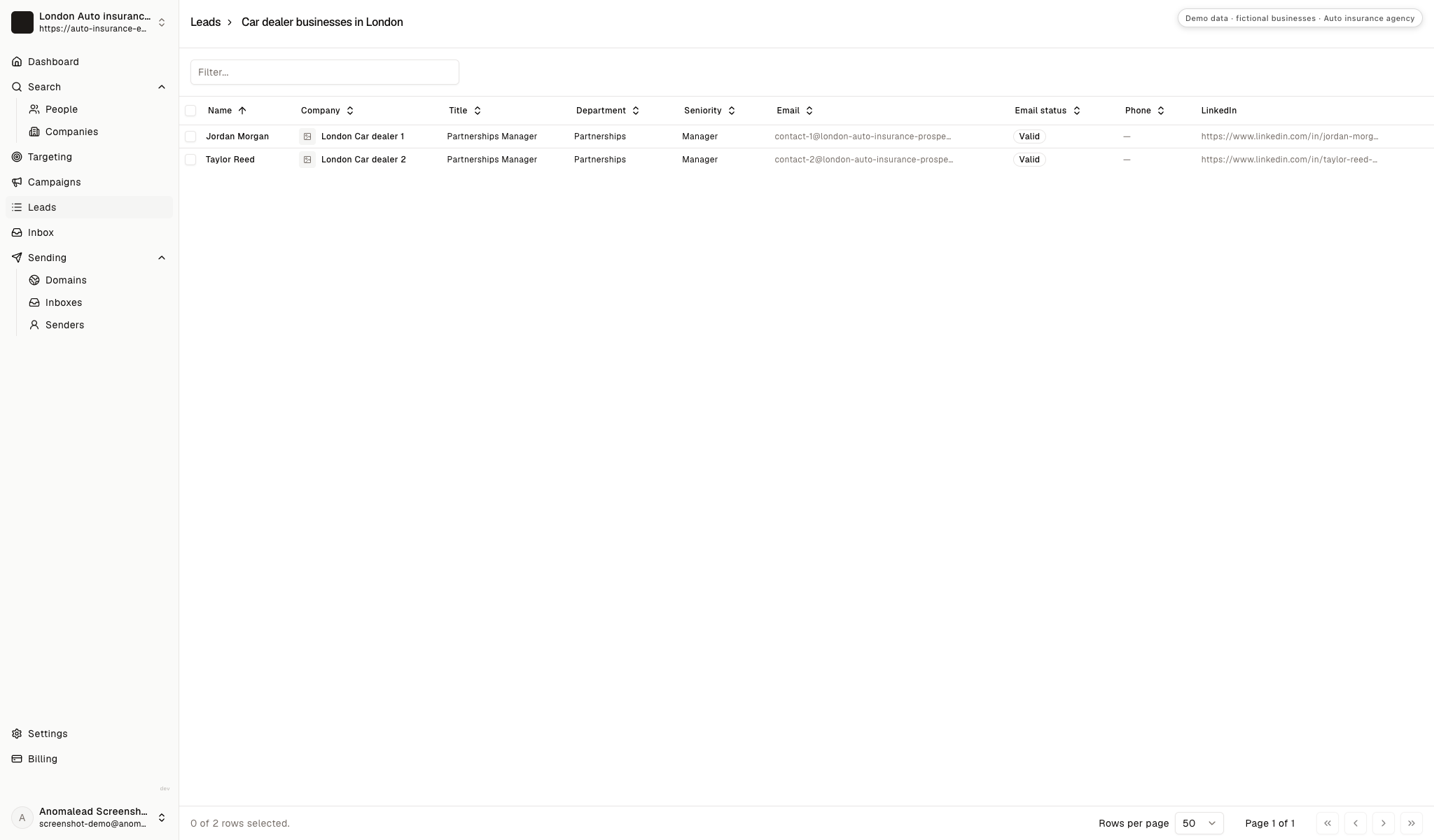
Section titled: Review the contact list before a partner introductionThe sample contact list contains two fictional people at separate dealerships. Check each person’s branch, current role and connection to customer support or finance. Keep only business information needed to arrange a conversation, and remove anyone who is not relevant or has declined contact.
Estimate whether a dealer partnership merits agency time
Section titled: Estimate whether a dealer partnership merits agency timeA dealership relationship may create useful conversations, but it also takes time to approve a handoff, train staff and answer buyer questions. Estimate the work from your own experience and operating plan.
Any calculator inputs are planning assumptions supplied by your team. They do not forecast referrals, quote acceptance, premiums, commission or revenue.
Do the math on one good deal
If one new customer is worth thousands, you don’t need magic. You need a few more meetings a month.
Projected monthly results
- Deals closed
- 2.0
- Projected revenue
- £10,000
- Growth plan (1 business)
- £79/mo
- ROI
- 12,558%
Conservative math on meetings you already believe you can book. One closed deal often pays for a year of Anomalead.
If the idea works only when every buyer accepts an introduction, revisit the customer journey. Start with a small, approved pilot and review whether buyers find the optional step useful before expanding it.
Propose a customer-controlled route to cover
Section titled: Propose a customer-controlled route to coverWrite to the dealership about one moment in its customer journey. Say where the agency operates, what kind of insurance conversation it can handle and how a buyer would choose to continue. Ask whether the dealership already offers a neutral way to compare cover or whether an optional contact route would help. Do not claim to beat another provider, guarantee acceptance or quote without the details required by the insurer. Make clear that the dealer’s vehicle sale does not depend on speaking with your agency. For a useful structure, adapt these B2B cold email examples and subject line ideas. Follow local rules for insurance promotion, introductions, customer information and electronic outreach.
Choose a contact who owns the dealership process
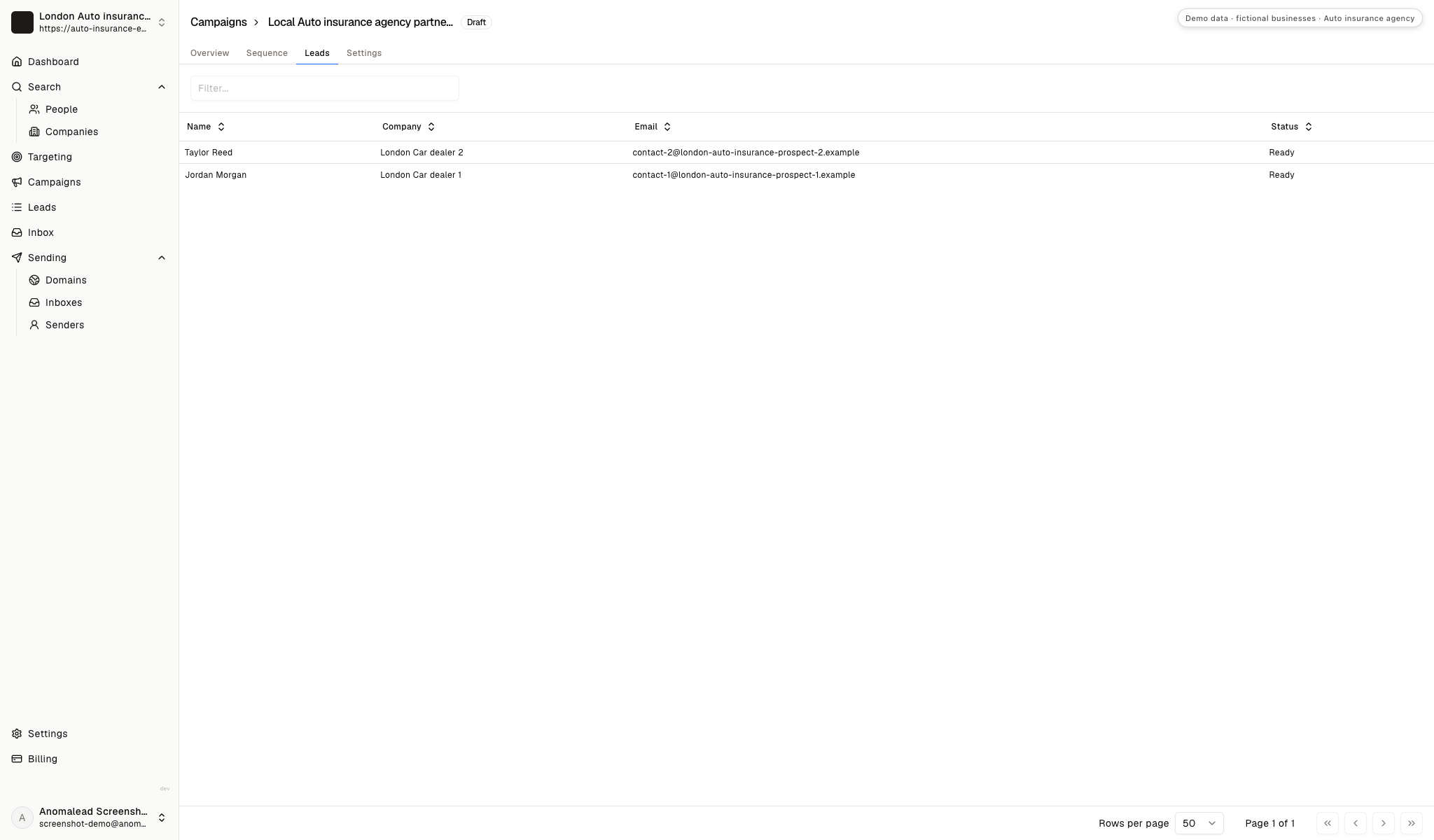
Section titled: Choose a contact who owns the dealership processThe demo draft has two recipients. For a real partner approach, select the role responsible for customer-care, finance or approved local partnerships, and explain why the conversation is relevant to that person. Avoid sending the same pitch to several employees at one branch.
Check every claim before scheduling a follow-up
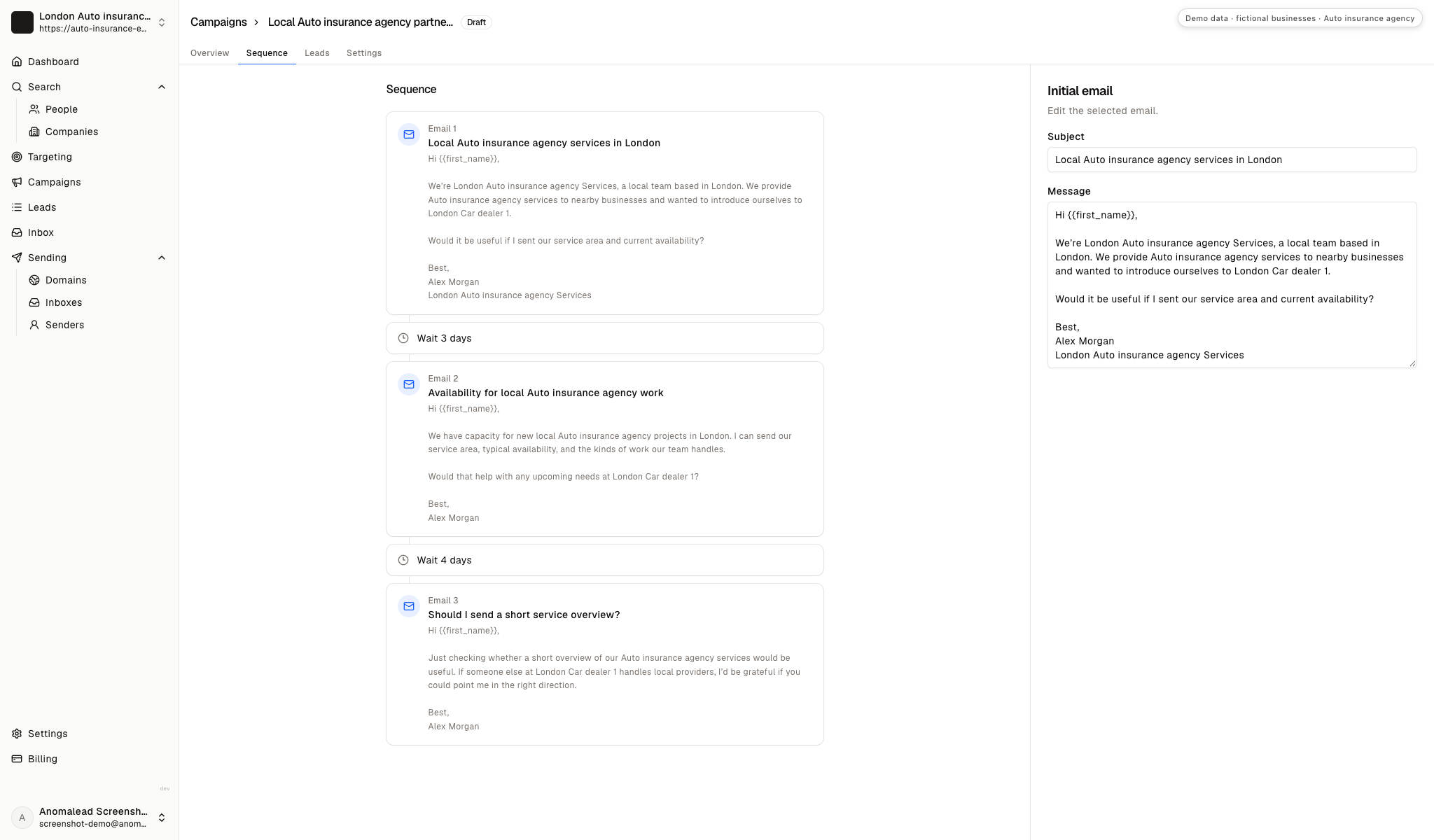
Section titled: Check every claim before scheduling a follow-upThe demo sequence screen shows drafted messages and wait intervals. It demonstrates campaign review, not delivery or results. Check the dealership name, branch, agency territory and permitted product language in each message. Stop the sequence after a refusal or if the contact points you to a different process owner.
Confirm that every follow-up preserves the buyer’s choice and does not imply a guaranteed quote.
Introduce an optional quote handoff to the dealer
Section titled: Introduce an optional quote handoff to the dealerThis fictional note asks about the dealership’s existing buyer journey. It does not request buyer information or suggest that a policy is already available.
First email to a dealership partnership contact
Subject: A simple insurance option for buyers
Hi Jordan,
I’m reaching out from London Auto insurance agency Services. We work with local drivers who want to discuss car cover, and I wondered how London Car dealer 1 currently handles insurance questions before collection.
We could offer a separate, optional route for a buyer to contact us directly. The buyer would choose whether to continue and provide any driver or vehicle details to our agency. Your team would not need to share a customer list.
Would you be the right person to discuss whether that fits your handover process, or does another colleague own it?
Best,
Alex Morgan
London Auto insurance agency Services
Keep the vehicle sale independent from any insurance discussion, and do not imply that a dealership endorsement guarantees cover or a preferred price. The guide to writing a cold email can help with a concise introduction; adapt it to local insurance, referral and privacy requirements.
Read partner replies without treating them as quote requests
Section titled: Read partner replies without treating them as quote requestsThe demo inbox shows two fictional dealership replies. A business contact may ask about agency territory, product scope or how a buyer would reach the team. That is a partnership question, not an instruction to quote a customer. Confirm approval and consent requirements before moving to an operational handoff.
Answer partner questions while keeping the buyer in control
Section titled: Answer partner questions while keeping the buyer in controlSort responses into a possible partnership, a request for more detail, a referral elsewhere or a clear decline. Answer what the dealership asked, explain the proposed customer step and state any approval still needed.
The dealer asks how a buyer would contact the agency
Section titled: The dealer asks how a buyer would contact the agencyThe customer could use a link or contact card that takes them directly to our agency. They would decide whether to make an enquiry and provide their details through our approved channel. We would not need your team to send a buyer list. We can map that step against your current handover once the right process owner is involved.
Describe only a route the agency can maintain and that has passed the required review.
The dealer asks whether every vehicle can be insured
Section titled: The dealer asks whether every vehicle can be insuredWe would need to review each driver and vehicle against the information required by the insurer. Vehicle type, use, modifications, location and other application details can affect whether a market is suitable. I can explain the enquiry route, but I cannot promise acceptance or a price before that review.
Avoid blanket eligibility claims and do not provide an indicative premium without a permitted, accurate basis.
The dealership already has an insurance arrangement
Section titled: The dealership already has an insurance arrangementThanks for letting me know. I respect the current arrangement. If you review the process later and would like to discuss a separate customer-controlled option, I would be happy to reconnect. I will stop following up about this now.
Record the decision and do not continue the sequence after a clear no.
A contact asks you to receive a list of recent buyers
Section titled: A contact asks you to receive a list of recent buyersWe should not exchange customer details without a clear, approved basis and the buyer’s informed choice. A safer starting point is an optional link or a direct introduction only after the buyer has agreed. If you already have an approved process, we can ask the relevant compliance contacts to review it before launch.
Do not accept personal data while consent, purpose and handling arrangements are unsettled.
Keep partner research separate from driver enquiries
Section titled: Keep partner research separate from driver enquiriesFor each dealership, record its branch, vehicle focus, buyer moment, source, likely process owner and the question to ask. Note the approval still needed and the buyer-controlled route agreed. Keep business contacts separate from driver enquiries. After a small pilot, ask whether staff could explain the option clearly; replies and profile ratings do not show policy sales. Revisit the wording if agency authority, insurer appetite or territory changes.
Car insurance lead generation questions
Section titled: Car insurance lead generation questionsHow can a local agency find dealership partners?
Section titled: How can a local agency find dealership partners?Start with dealerships inside the agency’s territory and check that their vehicle mix and customer journey fit its actual products. Find the person who owns finance, insurance, customer support or partnerships, then ask whether an optional buyer-controlled route would help.
Should a dealer send the agency a list of recent buyers?
Section titled: Should a dealer send the agency a list of recent buyers?Do not assume it may share customer details. Agree on a reviewed process in which buyers choose whether to contact the agency and provide information directly. Get appropriate compliance and privacy review before any data transfer.
Can an agent promise a quote before receiving vehicle details?
Section titled: Can an agent promise a quote before receiving vehicle details?No. A meaningful quote depends on accurate information and the insurer’s underwriting process. The partner discussion can explain how to begin an enquiry without implying that a buyer or vehicle is eligible.
What should the first dealership email say?
Section titled: What should the first dealership email say?Identify the agency and its local service, describe one possible point in the buyer journey and ask who owns that process. Keep the handoff optional, do not request buyer records and make no claim about price or acceptance.
Can every dealer use the same handoff?
Section titled: Can every dealer use the same handoff?Not automatically. Locations, permissions, staff roles and customer processes can differ. Confirm the approved wording and route for each group or branch before inviting its staff to mention the agency.