


Architecture lead generation is most useful when a studio reaches development teams before the design brief, consultant team and early feasibility work are already fixed. A developer considering a local site may need an architect to test how a programme fits the plot, assemble an initial brief or coordinate a renovation concept. Those are possible openings for a conversation, not proof that a project is funded or that planning permission will be granted.
This guide shows how to define the studio’s project fit, research local developers, identify a credible contact and ask about the next design decision. Keep site plans, ownership details and project files out of an unprotected first email. For the broader process, see B2B lead generation, then focus the search on places, building types and project stages the studio can support.
Key takeaways
- Prioritize developers and project teams with a verifiable local site or renovation signal that fits the studio’s building types and service area.
- Qualify project stage, land or building control, intended use, decision roles and consultant status before suggesting design work.
- Treat planning constraints and site feasibility as questions to investigate, not outcomes an architect can guarantee from a public listing.
- Use a short first message to ask who is shaping the brief or whether an early design conversation would help.
Which local project teams may need an architect early?
Section titled: Which local project teams may need an architect early?A promising account is not simply a company that owns property. Look for a specific development or renovation decision that could benefit from architectural input while the brief is still flexible. Confirm who controls the project, how far it has progressed and whether the studio’s experience fits.
- A developer assessing a site before fixing the brief: A property developer may be reviewing a site acquisition, change of use or a small multi-unit proposal. Before committing to a layout, the team may need an initial conversation about access, circulation, daylight, servicing, massing or the relationship between the building and its street. Ask what is known about the site and what question the team is trying to resolve. A public listing does not confirm ownership, a live project or permission to develop.
- A contractor planning a renovation or fit-out: A general contractor can encounter design questions before a price or construction sequence is settled. An architect may help clarify existing conditions, user requirements, drawing responsibilities and coordination with structural or building-services consultants. Find out whether the contractor is acting for an owner, whether an architect is already appointed and which design decisions remain open. Do not treat a contractor’s presence as authority to change the client’s brief.
- An owner preparing an adaptive-reuse project: An owner considering a new use for an older or underused building may need help recording the existing layout, setting an early brief and identifying where specialist input is needed. The first conversation can establish project stage, access to the property and the people involved. Heritage, accessibility and local planning requirements vary by site and jurisdiction, so avoid implying that a concept review confirms compliance or approval.
Pass on opportunities outside the studio’s location, building-type experience, insurance or available design capacity. If the project needs a surveyor, engineer, heritage consultant or planning adviser first, say so and clarify what architectural work can begin once the right information is available.
Check project fit before researching individual contacts
Section titled: Check project fit before researching individual contacts- Confirm that the opportunity concerns a real site or building. Record the address or area, current use and the public source for the project signal. A company profile or generic property listing is not evidence that the developer controls the site.
- Find the stage and open design question. Is the team comparing sites, preparing a brief, testing a concept, assembling a planning submission or coordinating technical design? Each stage calls for different deliverables, contributors and fee conversations.
- Identify the decision group. A development director may approve a feasibility study, while an asset manager, land agent, contractor or investor contributes information. Confirm who owns the brief, who appoints consultants and who can authorize access to drawings or the building.
- Check the studio’s experience and capacity. Match building type, scale, location and likely programme with completed work and staff availability. Ask whether structural, services, access, fire or heritage expertise is needed, and distinguish the studio’s role from that of other consultants.
- Discuss information handling before requesting drawings. Existing plans, tenant details, ownership records and site photographs may be confidential or security-sensitive. Agree who may share them, what may be reviewed and which approved channel will hold the files.
About the demonstration data
The screenshots show fictional London office listings in an English interface. The example messages use fictional London data, including London Architect Services, London Real estate developer 1, Jordan Morgan and Taylor Reed. Companies, people and replies are demonstration records, not Anomalead customers, real development opportunities or campaign results.
Architecture lead generation starts before the design brief is fixed
Section titled: Architecture lead generation starts before the design brief is fixedDefine the locations, building types and project stages the studio can support before searching. The demonstration’s real-estate-developer category is a broad search filter; it does not show that a developer has a site, budget or need for an architect. Treat results as research leads, then verify the project signal and contact role from reliable public sources and a direct conversation. A local lead generation plan can keep geography, fit criteria and follow-up in one process.
Set the search area and project-side category
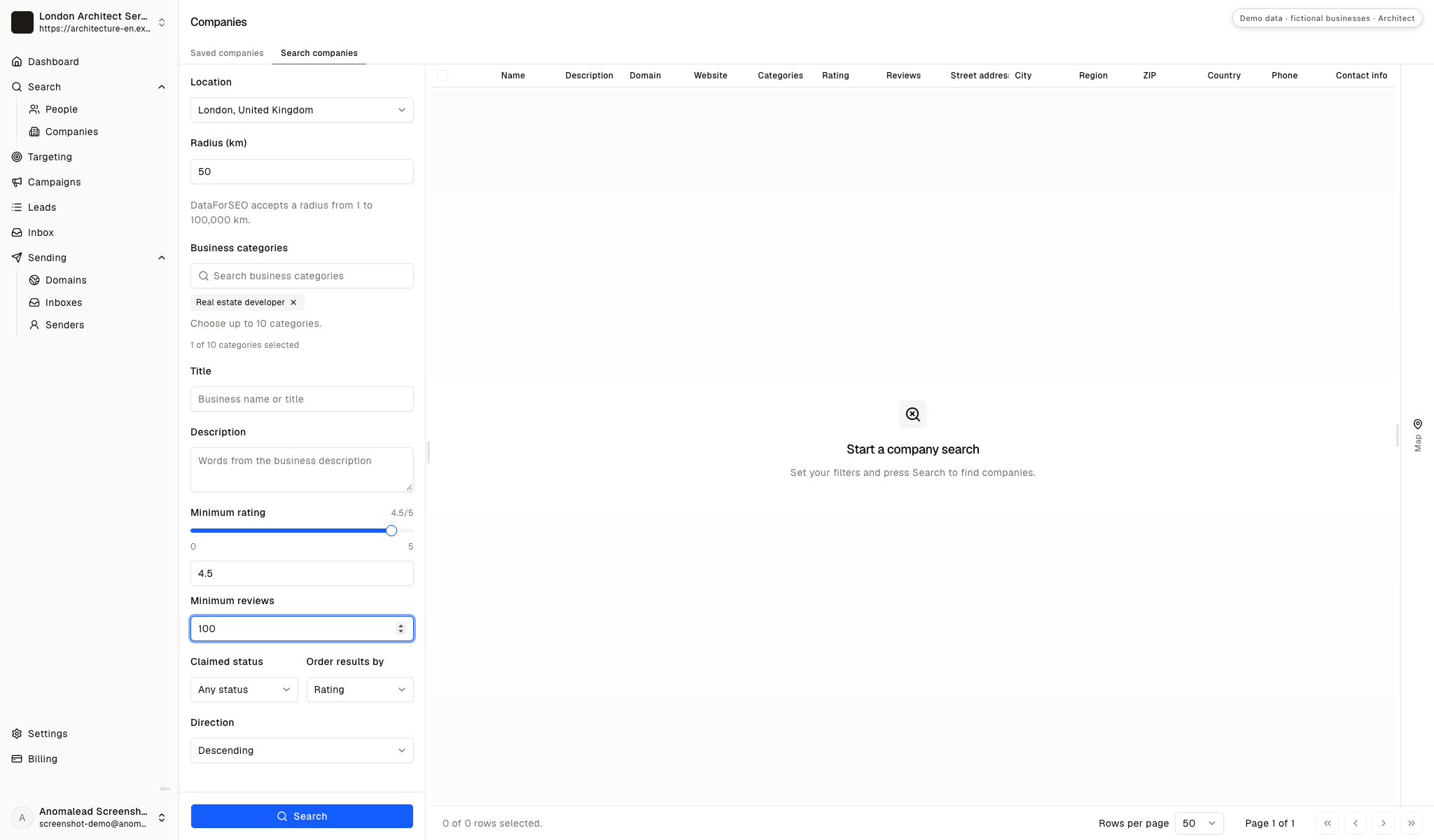
Section titled: Set the search area and project-side categoryThe demo form shows location, radius, a real-estate-developer category and a review filter. These are search controls, not evidence of a live development or architectural requirement. Set an area the studio can serve and a category that helps locate possible project partners.
Review each company before saving it
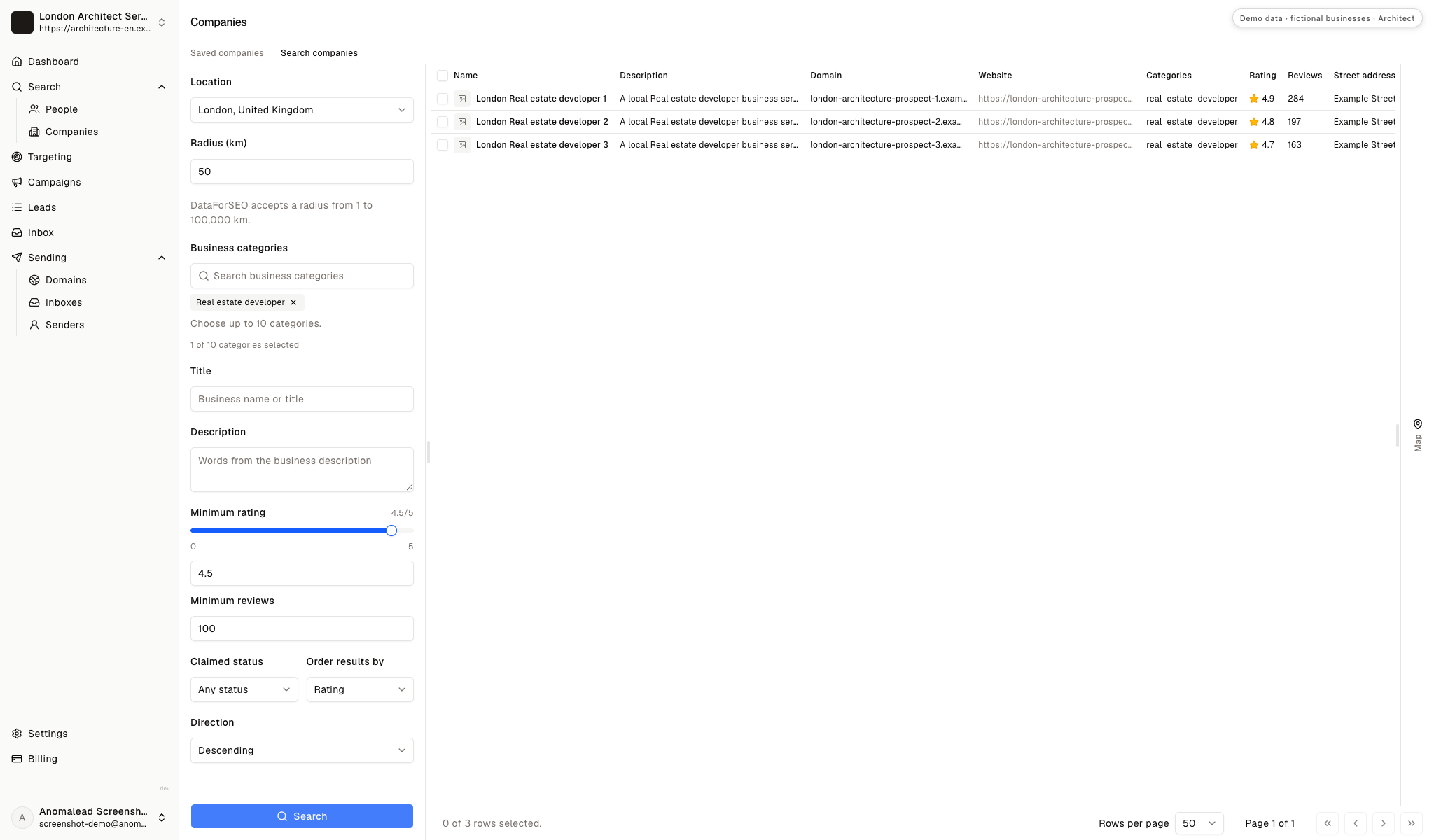
Section titled: Review each company before saving itThree fictional developer businesses appear with public ratings and review counts. Those fields can help research an account, but they say nothing about land control, project stage, design scope or planning status. Open other reliable sources before deciding whether a conversation is relevant.
Save only accounts with a reason for follow-up
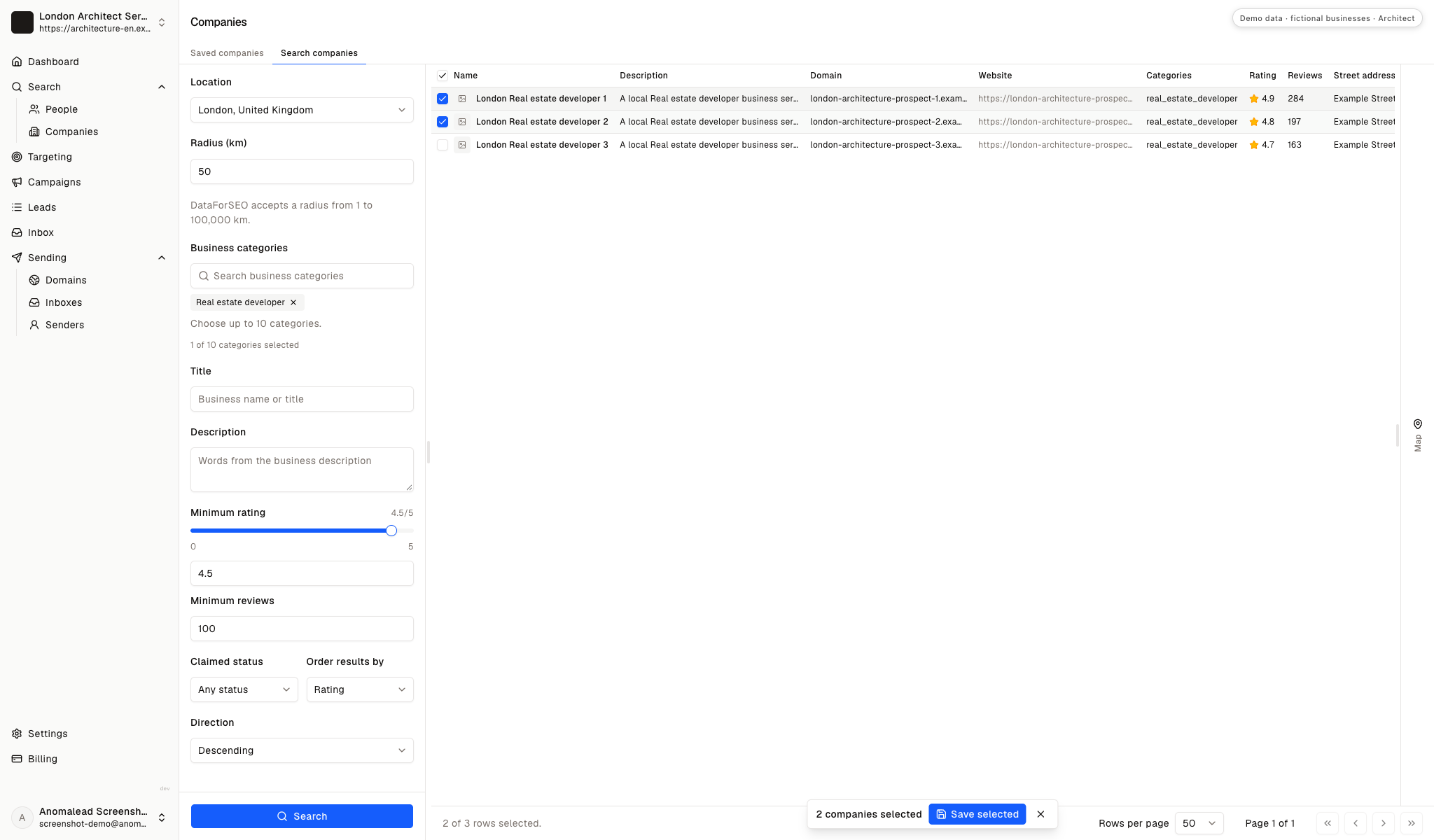
Section titled: Save only accounts with a reason for follow-upTwo of the three demo profiles are selected. In a real search, keep a developer only when the location and a verifiable project signal fit the studio’s work. Record what still needs confirmation instead of treating a selected row as a qualified opportunity.
Find the person who knows where the brief stands
Section titled: Find the person who knows where the brief standsIn a development team, a project or development director may own the brief while an asset manager, land agent or contractor supplies context. Contact data can suggest a route into the organization, but it cannot confirm commissioning authority or access to project information. Ask who is coordinating the design team and what stage the project has reached before discussing drawings or fees.
Check the developer account before looking for people
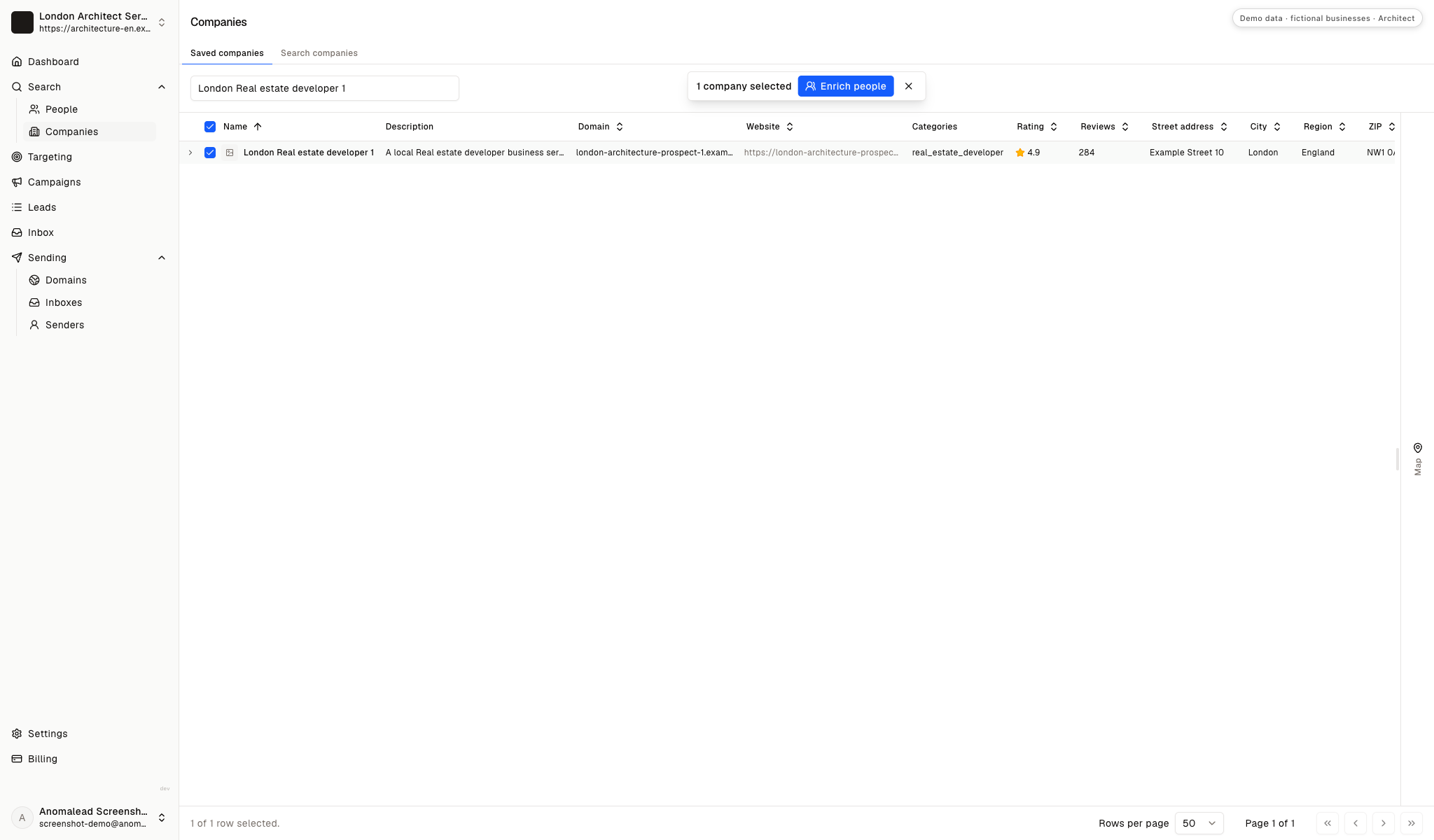
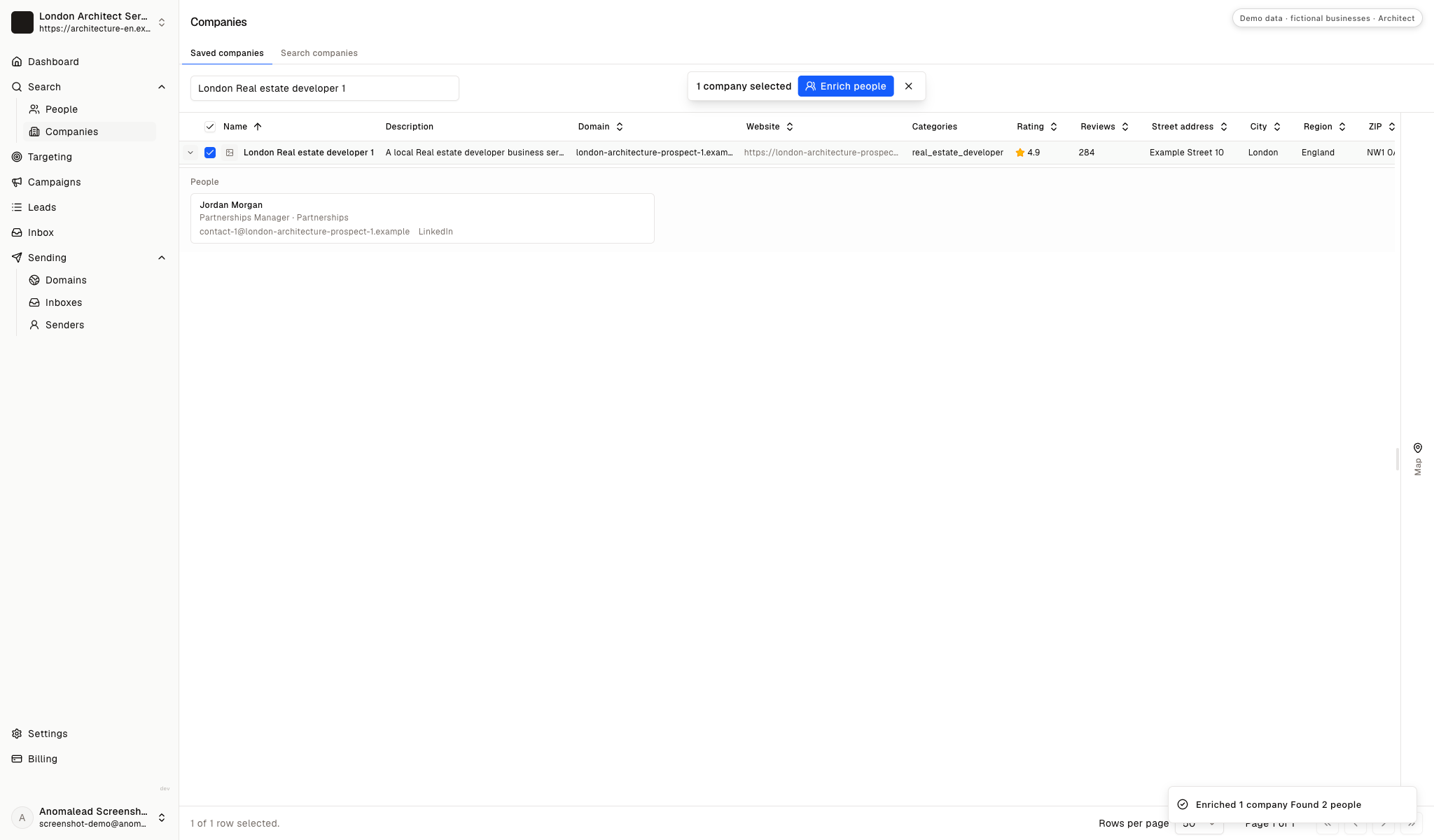
Section titled: Check the developer account before looking for peopleOne saved company is selected before the interface offers contact enrichment. The selection identifies the account under review; it does not confirm a site, an open brief or permission to contact a project team.
Treat the suggested contact as a possible route into the team
Section titled: Treat the suggested contact as a possible route into the teamThe demo reveals a possible company contact. A Partnerships Manager title does not establish that the person commissions architects or controls a brief. Verify the company relationship and ask who is shaping the project or appointing consultants.
Verify the company and role before drafting outreach
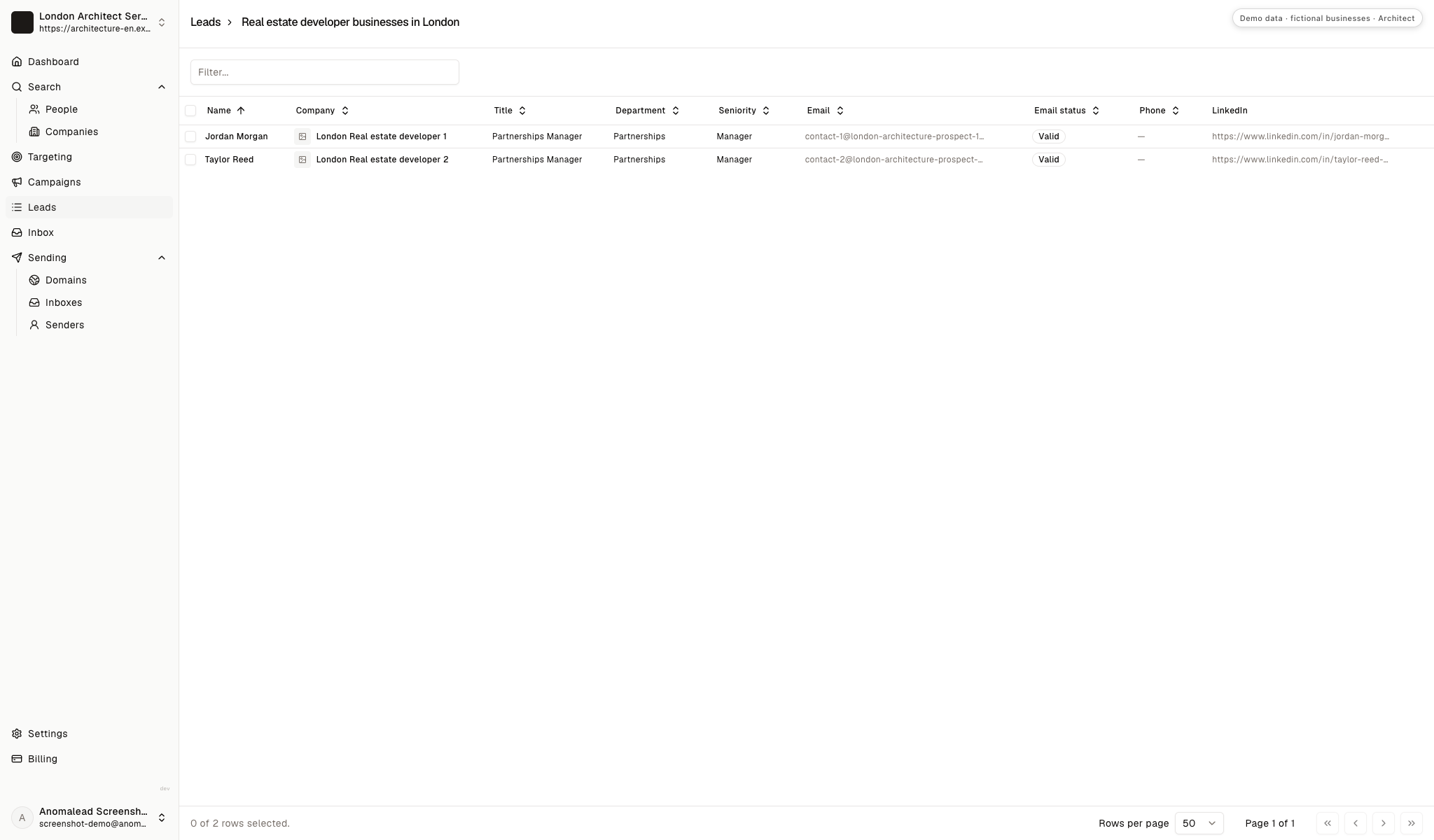
Section titled: Verify the company and role before drafting outreachThe contact list shows two fictional people at different companies. Check their current role and connection to the project, then keep only the details needed for a relevant message. Do not infer access to plans or project authority from an email address.
Estimate the effort behind a project-based design opportunity
Section titled: Estimate the effort behind a project-based design opportunityA project can be commercially suitable only when its stage, likely scope and delivery capacity align. Build your own assumptions for early design work, consultant coordination, revisions and the time between appointment and fee collection. The calculator does not supply a market fee or predict a commission.
Every input is your own planning assumption. The calculator does not forecast project awards, fee levels, planning outcomes, client retention or studio revenue.
Do the math on one good deal
If one new customer is worth thousands, you don’t need magic. You need a few more meetings a month.
Projected monthly results
- Deals closed
- 2.0
- Projected revenue
- £10,000
- Growth plan (1 business)
- £79/mo
- ROI
- 12,558%
Conservative math on meetings you already believe you can book. One closed deal often pays for a year of Anomalead.
If the opportunity depends on an approval, specialist report or delivery date outside the studio’s control, state that dependency and revise the scope before pursuing it.
Start with an early design question, not a full appointment pitch
Section titled: Start with an early design question, not a full appointment pitchA first note should identify the project signal and ask whether an early conversation about the brief would help. Do not attach unsolicited concept images or ask for plans in an unprotected email. How to write a cold email covers structure; make the question specific to the site, stage or design coordination issue you can actually support.
Select contacts who can clarify the project stage
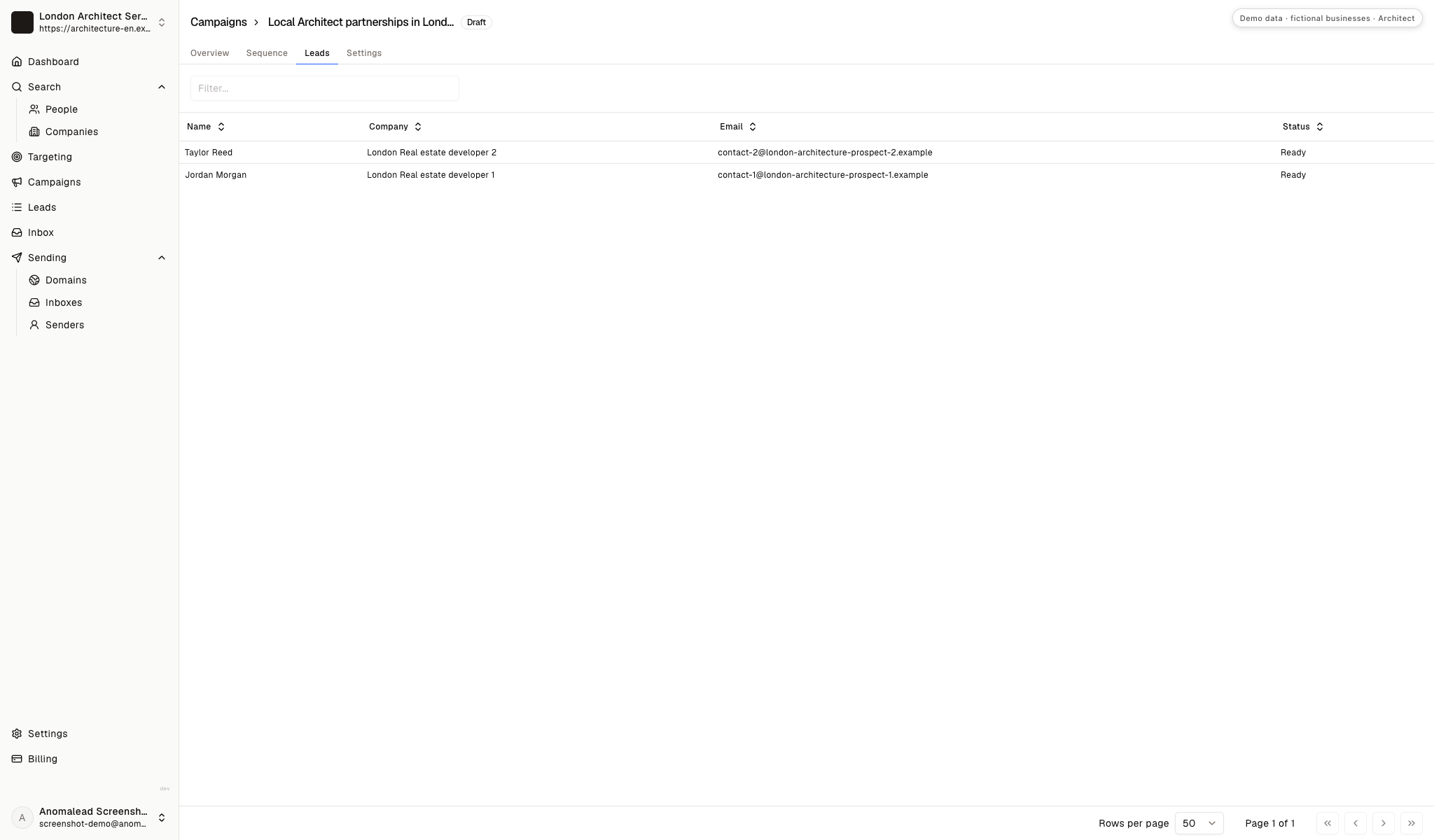
Section titled: Select contacts who can clarify the project stageThe demo campaign has two selected recipients. For a real project, contact the person whose role can answer whether the brief is open or direct you to the person commissioning consultants. Keep the first group small and relevant to one project signal.
Review every follow-up against the project timetable
Section titled: Review every follow-up against the project timetableThe sample sequence spaces emails three and four days apart. That timing does not guarantee a reply. Remove repeated claims, make each message easy to answer and stop when someone declines. A design project has its own decision timetable, so do not keep nudging after the team has closed the conversation.
A brief introduction to a local development team
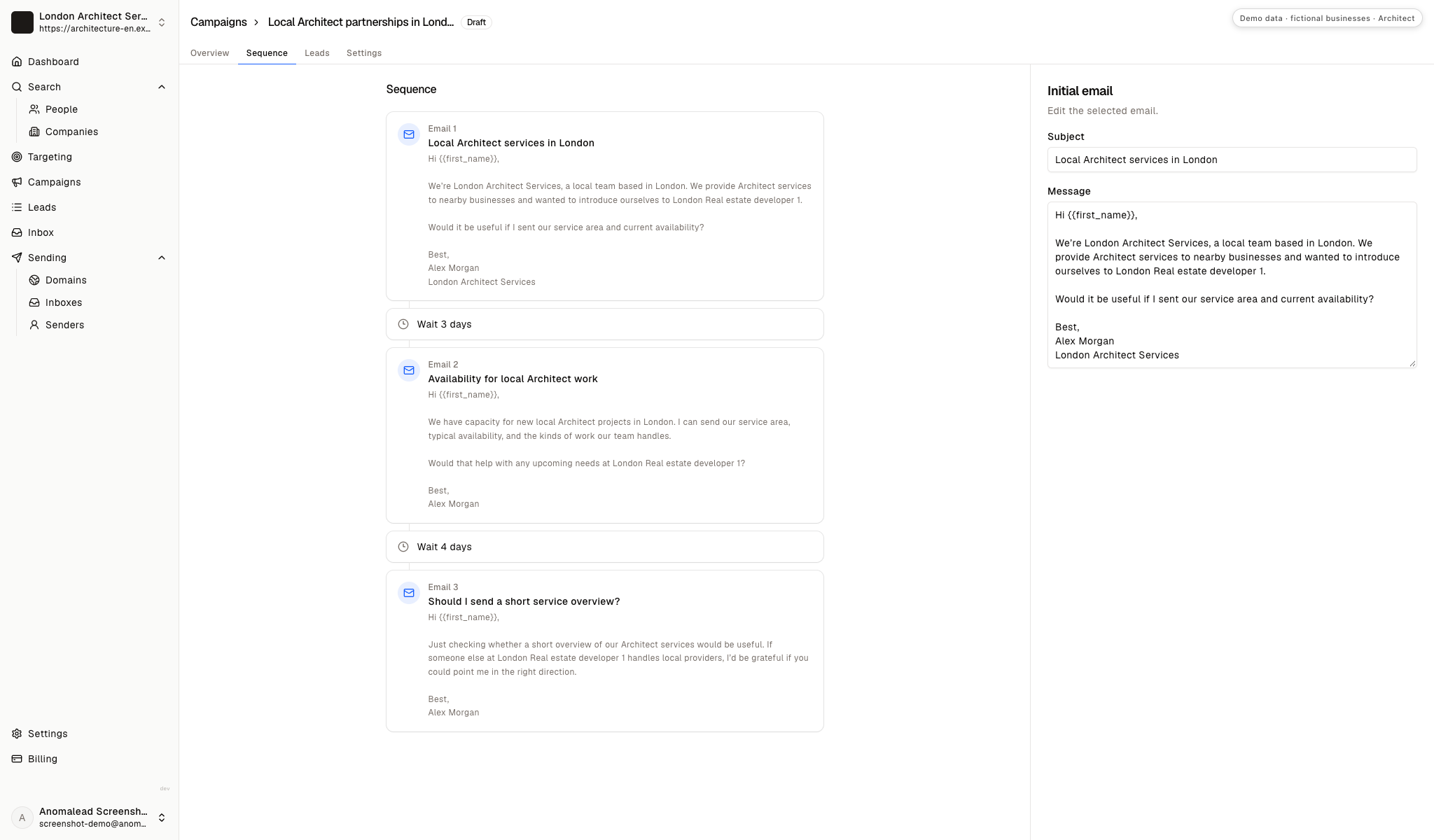
Section titled: A brief introduction to a local development teamThis message offers an early design conversation around a development brief. It does not claim to know the site constraints or promise permission.
First email to a possible development contact
Subject: Is the design brief still taking shape?
Hi Jordan,
I’m Alex Morgan at London Architect Services. We work with local development teams on early architectural briefs and design coordination for new-build and renovation projects.
When a team is reviewing a site or a change of use, a short design conversation can help clarify what is known, what needs checking and which consultants should be involved. We would first ask about the project stage and the decision the team needs to make. We do not need drawings for an introductory conversation.
Would you be the right person to ask whether London Real estate developer 1 has an upcoming project where early architectural input would be useful?
Best,
Alex Morgan, London Architect Services
Adapt the description to project types and stages the studio can support. These B2B cold email examples and subject line ideas can help with format; avoid implying planning approval or a guaranteed project outcome.
Keep commercial replies separate from confidential drawings
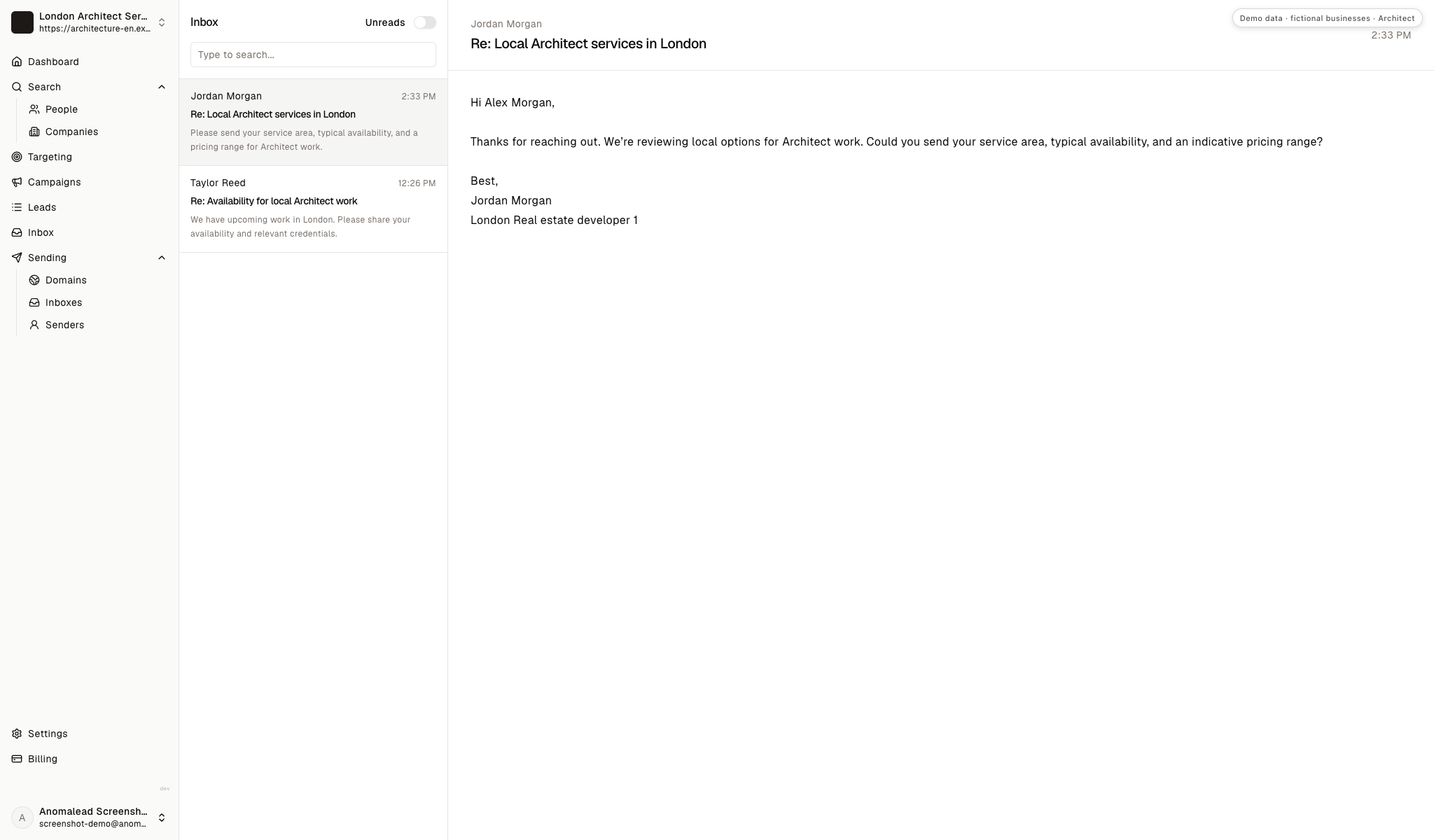
Section titled: Keep commercial replies separate from confidential drawingsThe demo inbox contains two replies. You can discuss service area, likely availability and relevant credentials without asking for drawings or ownership documents. If both sides want to explore a project, agree who can share the files and how they will be transferred before reviewing them.
Answer clearly about project fit, scope and credentials
Section titled: Answer clearly about project fit, scope and credentialsThe sample replies ask about service area, timing, pricing and relevant qualifications. Respond with verifiable information, explain what the studio can assess at this stage and identify dependencies such as surveys or specialist consultants. Keep confidential plans and ownership records out of an ordinary email thread.
The developer asks about area, availability and fees
Section titled: The developer asks about area, availability and feesPlease send your service area, typical availability and an indicative fee range for early architecture work.
Describe where the studio works and ask about the project stage, site information and expected deliverables before estimating a fee. Feasibility review, concept design and coordinated technical work involve different effort. Do not infer a price from a company listing or promise an approval.
Do not ask for ownership records or building plans in an unprotected reply. If there is a defined project to discuss, agree who can share information and which secure channel to use.
A reply that avoids an invented fee:
Thanks for asking. We work in the locations listed in our introduction. Availability depends on the project stage and the work the team needs. A fee would follow a discussion of the brief, existing information and any consultant coordination rather than a guess from a public profile.
We do not need drawings for an initial conversation. Would a short call with the person shaping the brief be useful?
The contact expects a project and asks about credentials
Section titled: The contact expects a project and asks about credentialsWe may have a project coming up. Please share your availability, experience and credentials.
Send a current portfolio or capability note with relevant building types, project stages and named team roles. State which services the studio provides and where surveyors, engineers, access consultants or heritage advisers would be needed. Ask about the decision timetable before committing.
A response with a concrete next step:
Thank you. I can send a short portfolio showing relevant project types and the design stages our team supports. We can confirm availability after learning the site, brief, target dates and other consultants involved.
If you can share the likely stage and who is coordinating the brief, I can suggest a short introductory call. Please do not attach confidential plans until we have agreed how to handle them.
The developer already has an architect
Section titled: The developer already has an architectWe have appointed an architect and are not looking to replace them.
Respect the existing appointment. Do not suggest that the team should replace its architect. If relevant, ask whether a separate future site, a defined peer review or a temporary capacity need might require additional support. If not, close the conversation politely.
A reply that preserves the relationship:
Understood. We are not asking you to replace an appointed architect. If a separate project later needs a defined feasibility review or additional design capacity, I would be glad to share a short capability note.
The contact will not send plans by email
Section titled: The contact will not send plans by emailWe cannot share drawings or ownership information in an initial email thread.
Confirm that no files are needed for an introductory conversation. If a project review is agreed, identify the authorized sender, permitted recipients and secure transfer method first. Avoid retaining plans that the studio does not need and do not forward project material to consultants without permission.
A reply that respects project confidentiality:
That makes sense. We do not need plans for an initial discussion. If we decide to review a defined project, we will agree who can share the documents and use an appropriate secure channel before any files are transferred.
Organize the next prospect list around project stages
Section titled: Organize the next prospect list around project stagesRecord the public site or renovation signal, the person who confirmed their role, the current project stage and the studio’s capacity to respond. A property listing, a new company or a planning reference does not by itself establish that a developer controls a brief or wants an architect. Connect each signal to a design task the studio can actually undertake.
For the next batch, choose one local building type or development stage, review a small set of accounts and prepare a question about the brief, site information or consultant team. Identify what would have to be confirmed before a paid scope. You can compare professional-service buyer roles in law firm lead generation, while keeping the design process and project confidentiality specific to architecture.
Questions about architecture lead generation
Section titled: Questions about architecture lead generationShould I contact every developer with a property listing?
Section titled: Should I contact every developer with a property listing?No. A listing can be a research clue but does not prove site control, a funded project or a need for architectural services. Check reliable sources, identify the stage and ask who is shaping the brief before proposing work.
What should an architect qualify before discussing a fee?
Section titled: What should an architect qualify before discussing a fee?Clarify the site, intended use, project stage, expected deliverables, decision roles, existing consultants, available surveys and target dates. Distinguish early feasibility from concept and technical design, then describe assumptions and exclusions in a written scope.
Can I promise planning approval after an introductory review?
Section titled: Can I promise planning approval after an introductory review?No. A preliminary conversation can identify questions to investigate, but approval depends on the site, evidence, design, authority process and applicable local rules. Explain what the studio can assess and which matters require specialist advice.
Are the firms and replies in the screenshots real?
Section titled: Are the firms and replies in the screenshots real?No. The screenshots show fictional London records, including London Architect Services and London Real estate developer 1. The sample names Jordan Morgan and Taylor Reed are fictional demonstration contacts, not clients or campaign results.
Does the calculator forecast project fees or awards?
Section titled: Does the calculator forecast project fees or awards?No. It combines assumptions entered by the reader. It does not predict appointments, fee income, planning decisions, project delivery or the studio’s future revenue.