


Accounting lead generation works when a firm targets businesses whose bookkeeping and reporting needs fit its actual service model. Owner-led companies often need a reliable month-end process before they need a broad finance overhaul, so lead with the recurring work you can deliver and ask about scope before discussing fees.
This guide shows how to identify those local buyers, check whether a handoff is realistic, and open a conversation without requesting financial records in an unsecured email. Start with the B2B lead generation basics, then shape the search around your own coverage, software experience and available staff.
Key takeaways
- Prioritize owner-led businesses adding locations, sales channels or transaction volume when those changes create bookkeeping work your firm is equipped to handle.
- Qualify the accounting scope, current workflow, reporting cadence and decision owner before estimating the effort or quoting a recurring service.
- Use public business details to start a conversation, but move financial statements, payroll data and account access through an approved secure process.
- Lead with a specific month-end or reporting problem your team can assess; do not promise tax savings, cleaner books or a particular financial result.
Which local businesses are ready for ongoing accounting support?
Section titled: Which local businesses are ready for ongoing accounting support?The strongest prospects are owner-led companies whose transaction volume or operating structure has outgrown an informal bookkeeping routine. Focus on a defined recurring need rather than assuming every growing business wants to outsource its entire finance function.
- A founder adding operational complexity: A service company opening another location, adding a new sales channel or hiring its first operations lead may need consistent coding, reconciliations and a dependable monthly close. Confirm what changed and which tasks the owner wants to hand off; a growth signal alone does not prove that the books need outside support.
- An owner who cannot get timely management reports: Some owners can see bank activity but still lack a regular view of receivables, payables or operating costs by location. Ask which report they use to run the business and when it needs to be ready. Offer only the reporting and bookkeeping work your staff can support, and keep interpretation of business decisions with the client.
- A finance or operations lead rebuilding the workflow: A small finance team may want help with a defined backlog, reconciliations or a documented handoff before a busy reporting cycle. The owner still approves scope and access, while the finance lead can explain the ledger, close checklist and internal review process. Do not treat a contact’s job title as permission to receive confidential records.
A prospect is a poor fit when the request depends on unreviewed tax advice, access your firm cannot secure, a deadline your team cannot meet or work outside its qualifications. Refer that need to an appropriate provider rather than stretching the engagement.
Screen the accounting work before adding a decision-maker
Section titled: Screen the accounting work before adding a decision-maker- Define the deliverable first. Separate historical cleanup from recurring bookkeeping, reconciliation, payroll support and management reporting; each has a different handoff and review burden.
- Ask about the current ledger and close routine. Identify the accounting system, who enters transactions, how receipts are captured and which reconciliations are unfinished. Do not infer the software or the condition of the books from the company category.
- Match timing to the reporting calendar. Confirm the client’s month-end, board or lender reporting dates and any filing work in scope. A rushed close is not a good fit if your team cannot review the source records in time.
- Check access, confidentiality and responsibility. Agree who can approve access, where statements and payroll files will be exchanged, who reviews the work and what the client retains internally. Start with a secure, approved channel instead of requesting sensitive documents in cold outreach.
- Confirm qualifications and service boundaries. Describe relevant accounting credentials and the work the team is authorized and insured to provide, where those requirements apply. Do not imply that bookkeeping support replaces a separate tax, audit or assurance engagement.
About the demo data
The screenshots use fictional London corporate-office records in a standard prospecting workflow. London Accounting firm Services, Jordan Morgan, Taylor Reed and the company names in the inbox are seeded examples, not Anomalead customers; the screens do not show accounting records, client results or real campaign outcomes.
Find local companies with a bookkeeping or reporting need
Section titled: Find local companies with a bookkeeping or reporting needSearch for the type of organization your team can serve, then narrow the area to places where you can support a reliable onboarding and close. The demo category is a generic corporate office, so its results do not establish that a company needs an accountant. Use the search to build a review list, then qualify the actual work through public information and a direct conversation. A local lead-generation plan can help you set a repeatable prospecting rhythm.
Set the search around the businesses you can support
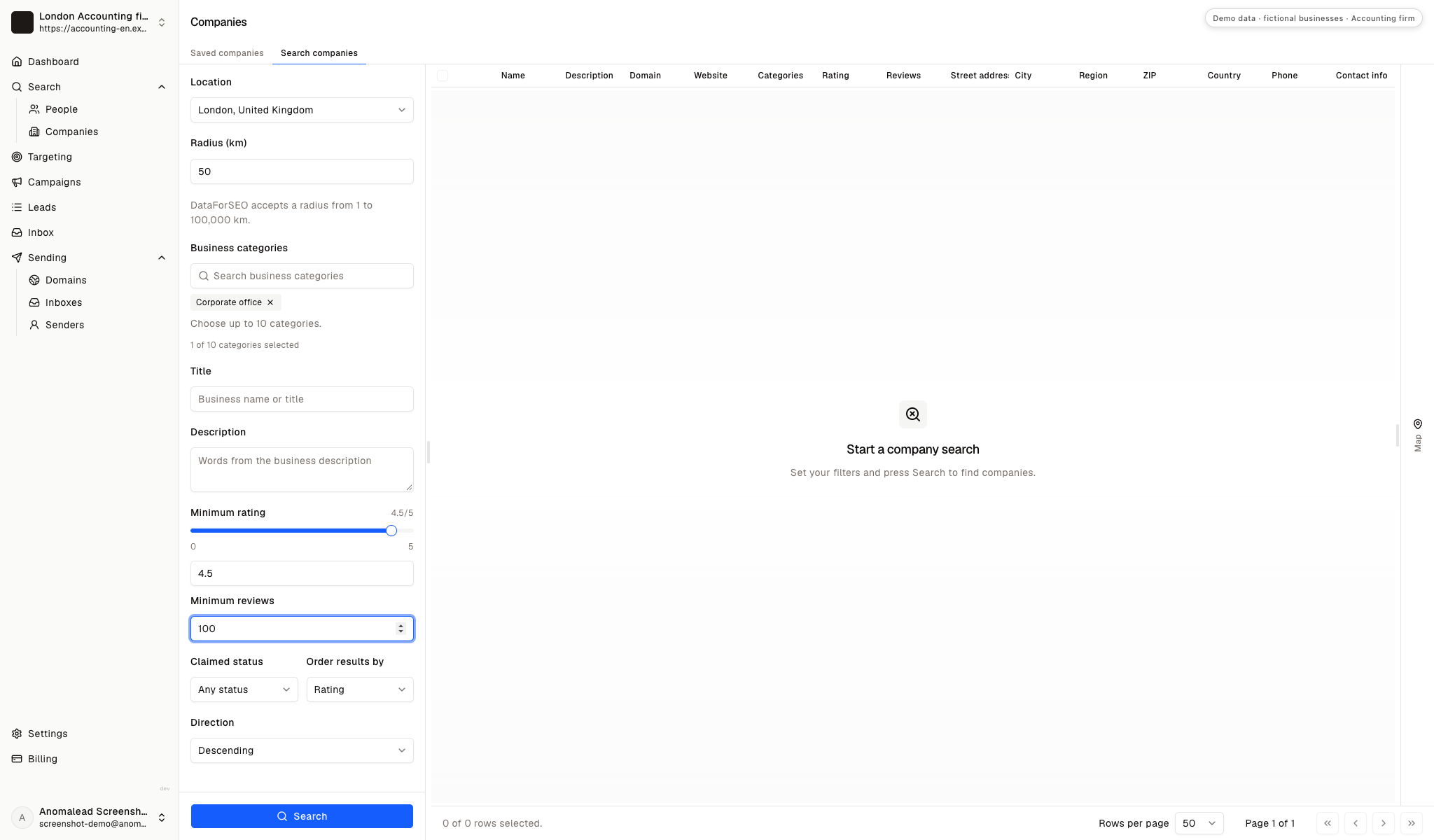
Section titled: Set the search around the businesses you can supportThe demo form shows a location, search radius, corporate-office category and rating filter. These settings demonstrate the search controls, not an accounting qualification signal.
Review the company records before saving
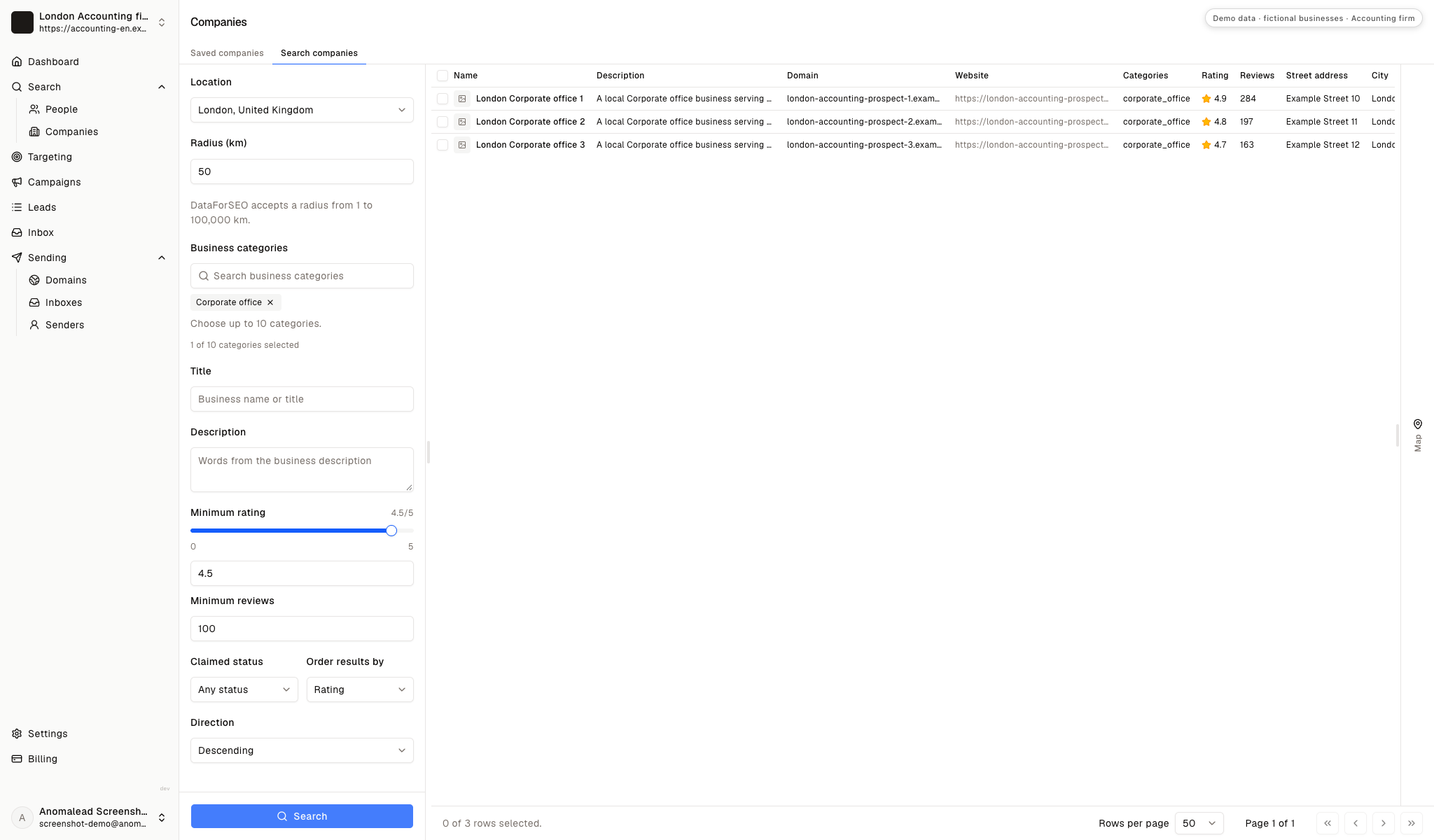
Section titled: Review the company records before savingThree fictional corporate-office listings appear with ratings and review counts. Those public profile details can help you decide what to inspect next, but they say nothing about bookkeeping needs or financial condition.
Keep only accounts worth researching
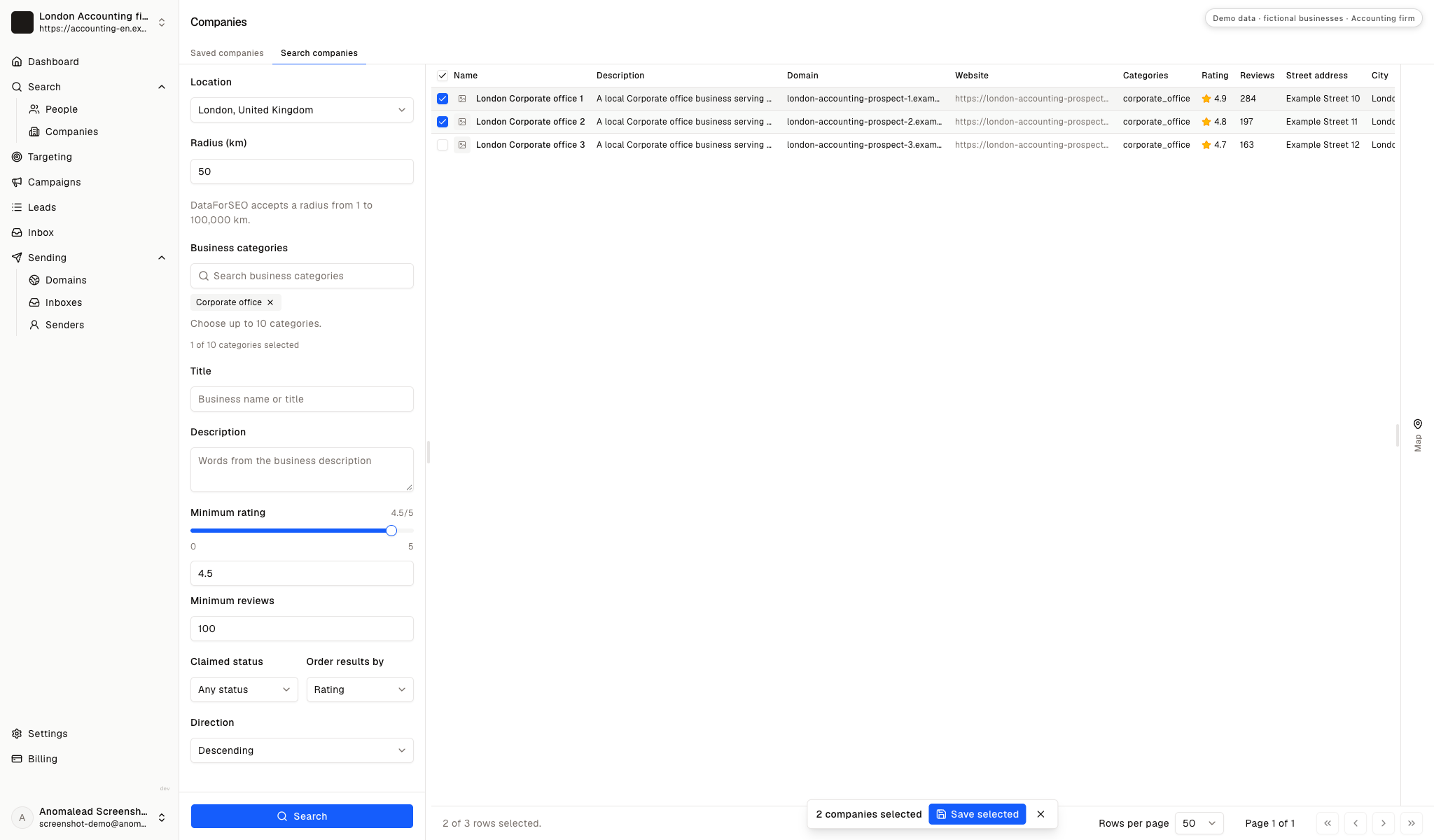
Section titled: Keep only accounts worth researchingThe demo selects two of the three company records for later review. For an accounting campaign, save a business only when its public profile and service area make a follow-up question reasonable.
Find the person who owns the finance workflow
Section titled: Find the person who owns the finance workflowFor a small business, the owner often approves an outside accounting relationship, while an office or finance lead knows how transactions and reports move through the company. Use contact data to find a plausible person, then confirm responsibility instead of assuming the title is right. Ask about the close process and preferred channel before requesting any ledger access.
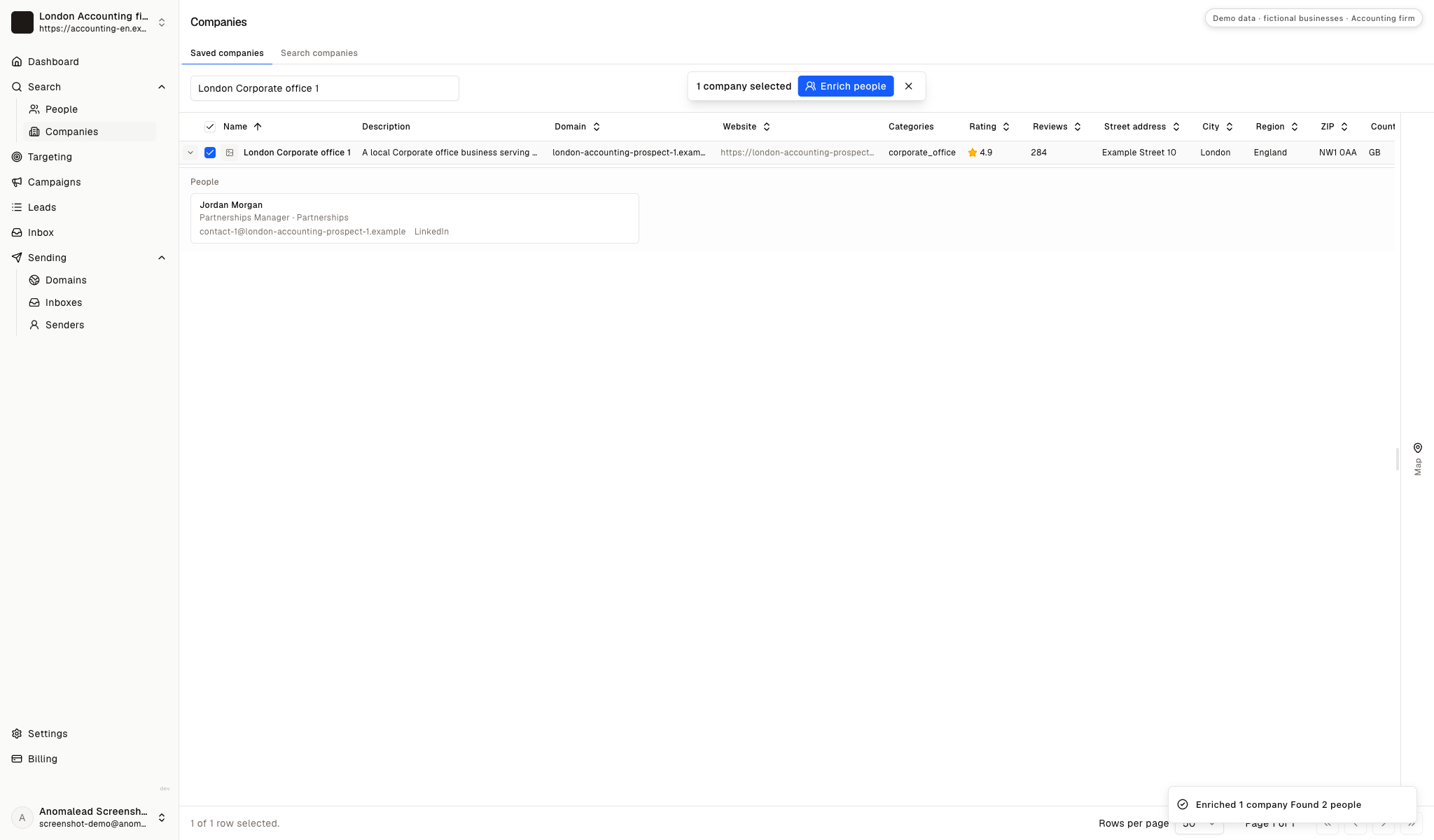
Recheck the account before looking up a person
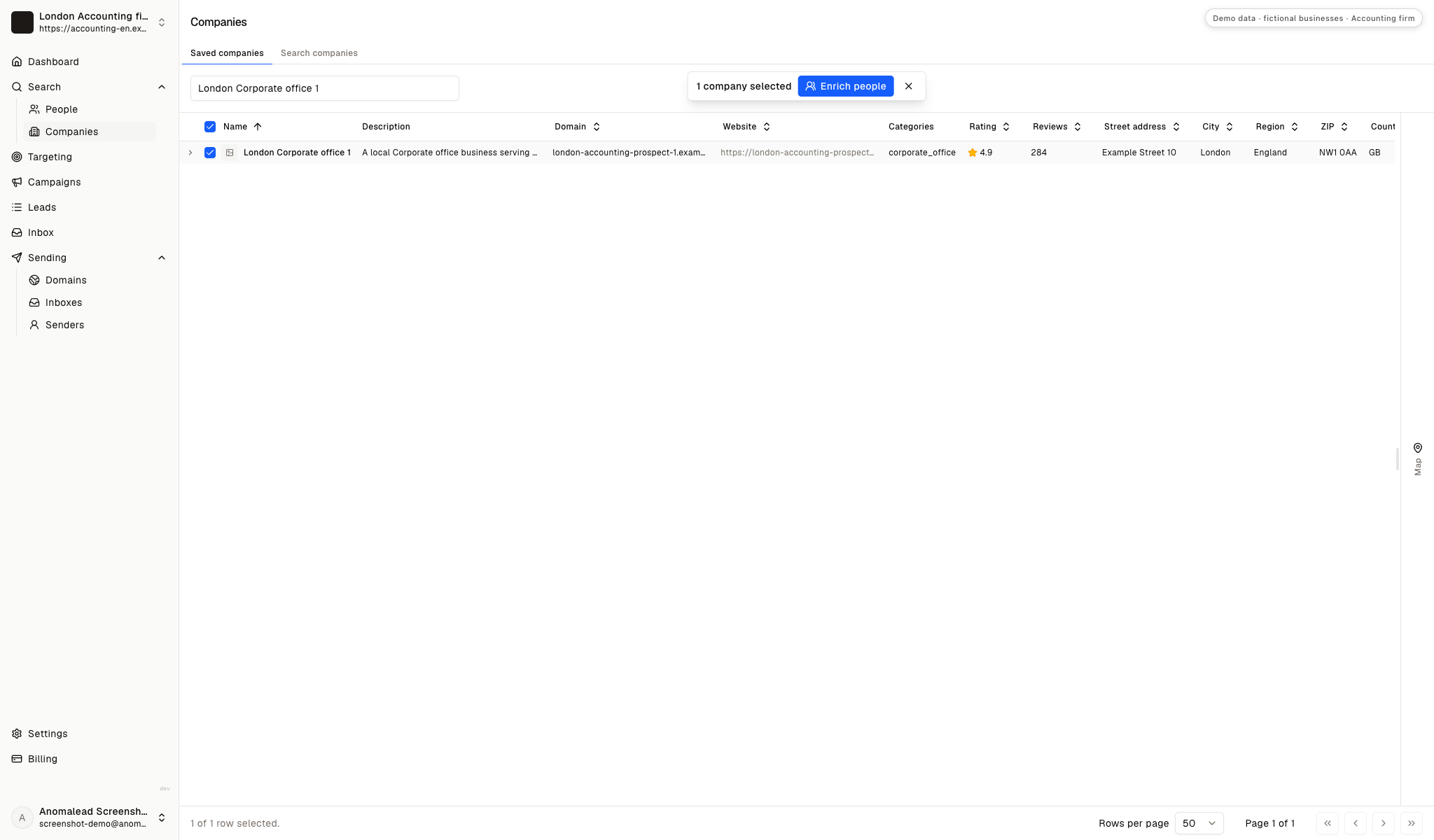
Section titled: Recheck the account before looking up a personOne saved company is selected and the interface offers an Enrich people action. This step confirms the target account you plan to research; it does not reveal a bookkeeping gap.
Use a contact suggestion as a starting point
Section titled: Use a contact suggestion as a starting pointThe demo shows a possible contact record at the selected company. A title such as Partnerships Manager may not own accounting procurement, so ask whether the person handles finance-provider reviews or can identify the owner or finance lead.
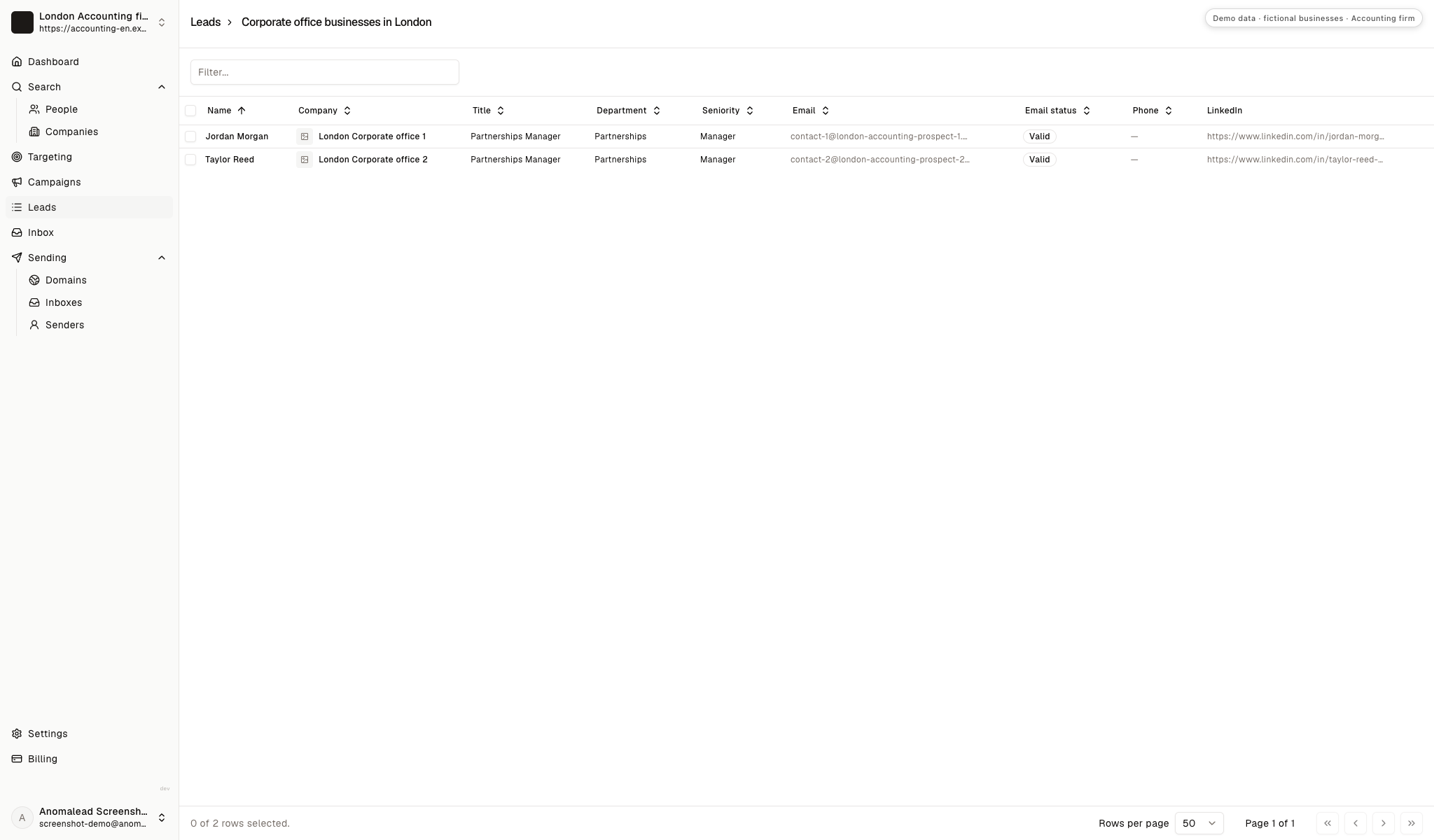
Check the people and records before outreach
Section titled: Check the people and records before outreachThe curated list contains two fictional contacts. Confirm the organization and role, remove anyone who is not relevant, and avoid adding financial or personal details that your team has no reason to retain.
Estimate the value of a recurring accounting relationship
Section titled: Estimate the value of a recurring accounting relationshipA recurring bookkeeping or reporting engagement can be valuable when its scope fits both the client’s cadence and your team’s review capacity. Estimate the work from the services you can deliver, onboarding effort, recurring review time and your own history with similar engagements. Do not treat a calculator output as a forecast of revenue or client retention.
Every value is an assumption you enter. The calculator does not contain accounting-fee benchmarks, expected client values or a prediction of engagements, savings or financial outcomes.
Do the math on one good deal
If one new customer is worth thousands, you don’t need magic. You need a few more meetings a month.
Projected monthly results
- Deals closed
- 2.0
- Projected revenue
- £10,000
- Growth plan (1 business)
- £79/mo
- ROI
- 12,558%
Conservative math on meetings you already believe you can book. One closed deal often pays for a year of Anomalead.
If the estimate only works when the client adds tax, audit or payroll work that your team is not qualified or staffed to provide, narrow the proposed scope before contacting them.
Open with a question about the close, not a full-service pitch
Section titled: Open with a question about the close, not a full-service pitchA credible first email names the type of work you handle and asks who reviews the company’s bookkeeping or reporting process. Keep the request small: do not ask the contact to forward a trial balance, payroll file or bank statement. The guide to writing a cold email covers message structure; your opening question should still sound like an accountant who understands recurring close work.
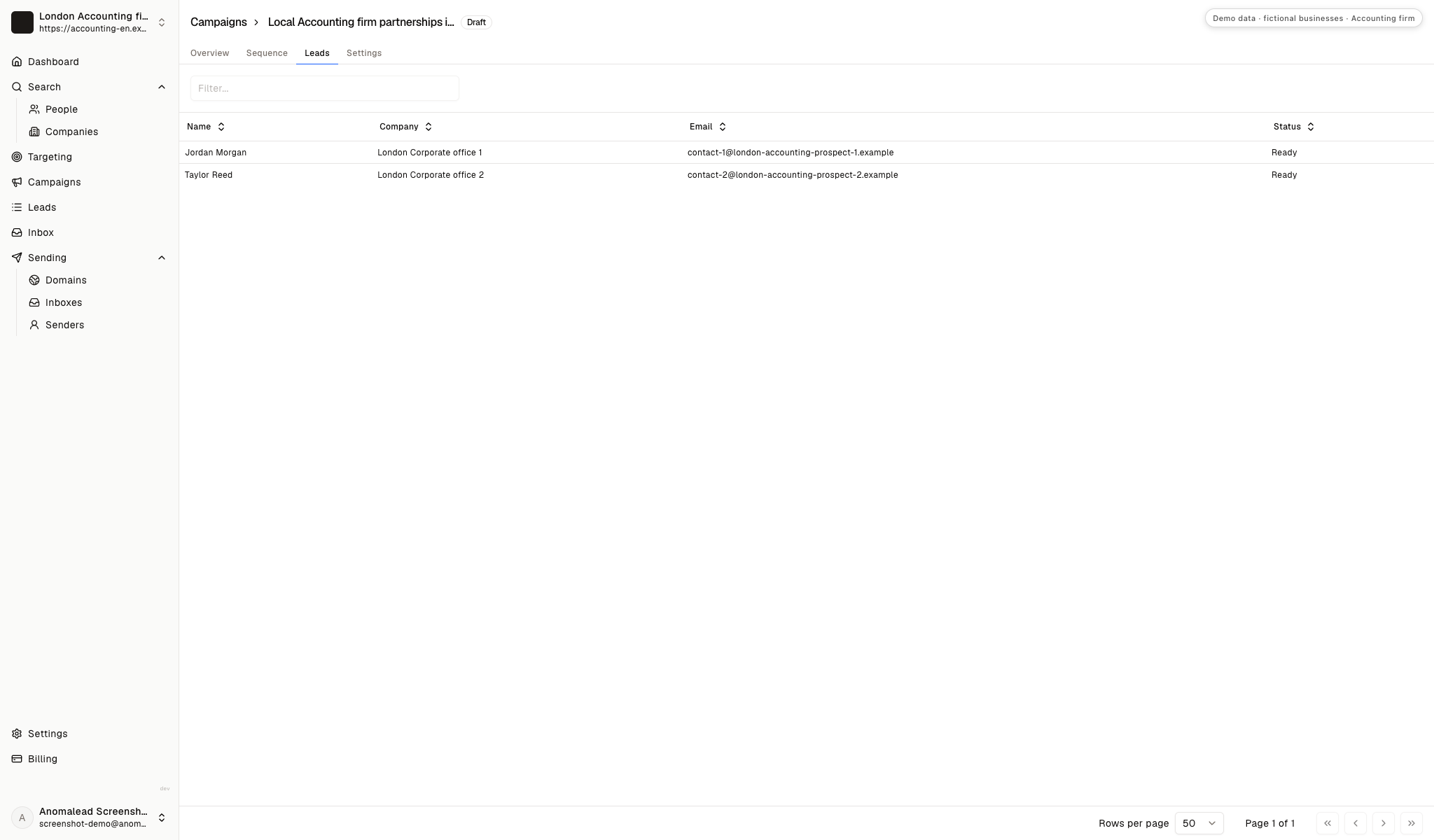
Choose contacts for a focused accounting conversation
Section titled: Choose contacts for a focused accounting conversationThe draft campaign has two recipients marked ready. Use one clear reason to contact each business, such as asking who reviews monthly bookkeeping support, rather than sending a generic offer for every accounting service.
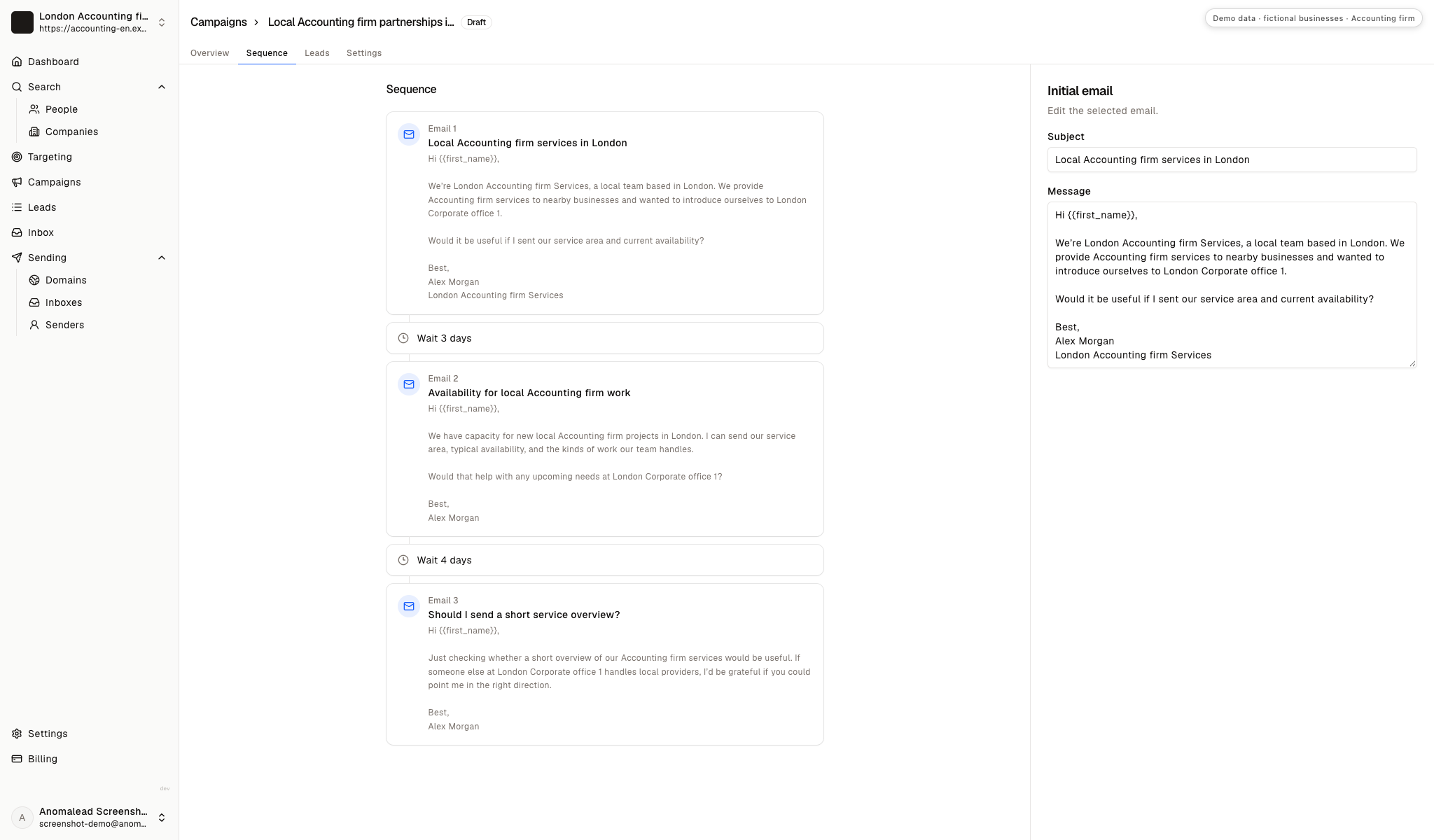
Read every follow-up as the recipient would
Section titled: Read every follow-up as the recipient wouldThe editor shows three emails separated by three-day and four-day waits. Review each message for a real accounting question, remove claims about results, and stop the sequence when the contact declines or points you to another owner.
A concise introduction to an owner-led business
Section titled: A concise introduction to an owner-led businessThis note opens a conversation about monthly books and reporting. It avoids quoting a fee before scope is known and asks one question the recipient can answer quickly.
First email to a possible finance contact
Subject: Who reviews your month-end bookkeeping?
Hi Jordan,
I’m Alex Morgan at London Accounting firm Services. We help owner-led businesses set up dependable bookkeeping and reporting routines as their operations grow.
When a company adds a location or sales channel, the month-end handoff can become harder to manage. We start by learning what the owner needs to see, which reconciliations the team handles and when reports are due. We do not need financial files to decide whether an initial conversation is relevant.
Are you the right person to ask who reviews outside accounting support at London Corporate office 1?
Best,
Alex Morgan, London Accounting firm Services
Adapt the service description to work your team can actually accept. These B2B cold email examples and subject line ideas can help with structure, but avoid promising tax or cash-flow outcomes.
Separate a buying question from access to financial records
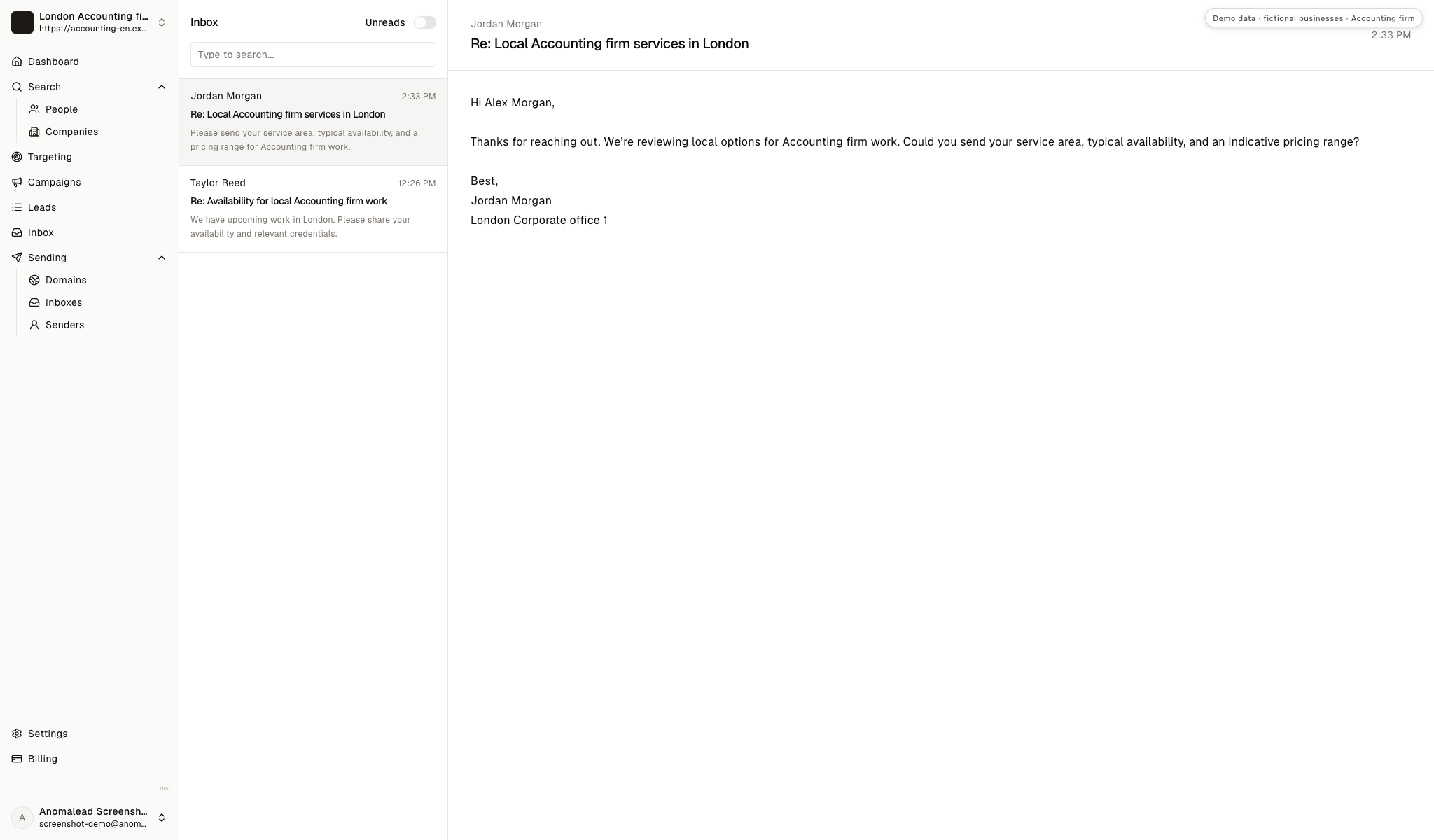
Section titled: Separate a buying question from access to financial recordsThe inbox shows one contact asking for service area, availability and a pricing range, and another asking about capacity and credentials. These are business questions, not permission to receive client records or a commitment to hire.
Answer accounting buyers with a clear scope and handoff
Section titled: Answer accounting buyers with a clear scope and handoffThe fixture replies ask about service area, availability, pricing and credentials. Answer with what your firm can verify, explain how you scope recurring work, and keep statements, payroll data and account credentials out of the outreach thread.
The contact asks for service area, availability and an indicative price range
Section titled: The contact asks for service area, availability and an indicative price rangePlease send your service area, typical availability, and a pricing range for accounting firm work.
State the locations or working arrangement you support and the current onboarding window you can stand behind. Explain that recurring bookkeeping fees depend on transaction volume, systems, cleanup and reporting scope; do not invent a quote from a company profile. Offer a scoping conversation before discussing an estimate.
Do not ask the contact to attach a ledger export or bank statement to email. If the conversation advances, explain how your firm securely gathers records and who will have access.
A reply that answers the question without guessing:
Thanks, Jordan. We support businesses in the areas listed in our service overview, and I can confirm current onboarding availability after we understand the reporting cadence and work in scope. Fees depend on the bookkeeping tasks, systems and review requirements, so I would first map those with the owner or finance lead.
We do not need statements or payroll files for an introductory discussion. Would a short conversation with the person who oversees the monthly close be useful?
The contact says a project may be coming up and asks for credentials
Section titled: The contact says a project may be coming up and asks for credentialsWe may have upcoming work. Please share your availability, the work your team covers, and relevant licenses or credentials.
Send a current service overview and the credentials that apply to the specific work. Distinguish bookkeeping and management reporting from tax preparation, audit or assurance services if your qualifications differ. Confirm who will review the handoff and when the business needs the work, rather than claiming broad capacity.
A response that gives the buyer a concrete next step:
Thanks, Taylor. I can send a current outline of our bookkeeping and reporting scope, the systems we support and the qualifications relevant to those services. Our team can confirm availability once we know the close dates and what needs to move in-house or remain with your staff.
If you share the reporting deadline and the person who approves the engagement, I can suggest a scoping call. Please do not send financial records by reply email.
The owner already has a bookkeeper
Section titled: The owner already has a bookkeeperWe have someone handling the books today. We are not looking to replace them.
Do not turn an existing provider into an objection to defeat. Ask whether the firm ever needs a bounded service such as cleanup, reconciliation coverage during leave or a second review, and accept that a stable in-house process may mean there is no fit.
A reply that leaves room for a limited need:
That makes sense. We are not asking you to replace a process that works. If you ever need a defined cleanup or temporary close support, I can send a short outline of that work so you can decide whether to keep it on file.
The contact will not send statements or payroll files over email
Section titled: The contact will not send statements or payroll files over emailWe do not share financial information through an introductory email thread.
Agree and keep the first conversation at the process level. Explain the approved secure transfer and access controls only when there is a real scope to assess; do not press for documents or imply that a prospect should disclose client information before an engagement.
A response that confirms the boundary:
Understood. We do not need records for an introductory conversation. If both sides decide to scope a project, our team can explain the secure document and access process before anything is transferred.
Build the next list around the client’s reporting cycle
Section titled: Build the next list around the client’s reporting cycleReview which business signals gave you a credible reason to ask about bookkeeping, who owned the decision and whether your team could meet the requested close dates. A company is not a prospect just because it has more staff or a new office; keep the rationale tied to observable operating changes and a service you can deliver.
For the next batch, choose one buyer type, research a small group of businesses, and write one opening question about their close or reporting handoff. Keep the secure intake path ready if a prospect asks to share records. Firms that serve professional practices can also compare buyer workflows in law firm lead generation; their service scope and confidentiality duties still need separate review.
Accounting lead generation questions
Section titled: Accounting lead generation questionsShould an accounting firm target every business that is hiring?
Section titled: Should an accounting firm target every business that is hiring?No. Hiring can help you understand how a company is changing, but it does not establish that its books need outside support. Check whether the change relates to a service your firm offers, then ask about the current workflow and decision owner.
What should I qualify before quoting monthly bookkeeping?
Section titled: What should I qualify before quoting monthly bookkeeping?Confirm which tasks are included, the accounting system, transaction and reconciliation workflow, reporting cadence, review responsibility and onboarding timing. A quote should follow a scoped conversation, not an assumption based on a public company profile.
Can I ask a prospect to email a trial balance or bank statement?
Section titled: Can I ask a prospect to email a trial balance or bank statement?Keep the first outreach focused on the workflow and do not request sensitive records in an unsecured email. If both sides decide to assess an engagement, use the firm’s approved secure intake and document-sharing process.
Are the companies and replies in the screenshots real?
Section titled: Are the companies and replies in the screenshots real?No. London Accounting firm Services, the London Corporate office listings, Jordan Morgan, Taylor Reed and their replies are fictional demo data. The screenshots do not show accounting records, Anomalead customers or actual campaign results.
Does the calculator predict client revenue or savings?
Section titled: Does the calculator predict client revenue or savings?No. It only combines the assumptions entered by the reader. It does not predict fees, client retention, tax savings, reporting quality or financial performance.